
Best Stocky Alternatives for Shopify in 2026: Full Comparison Guide
By Forstock Team · Last updated June 8, 2026
Compare five Stocky replacements for Shopify with pricing, setup time, and best use cases to plan your migration before Aug 31, 2026.

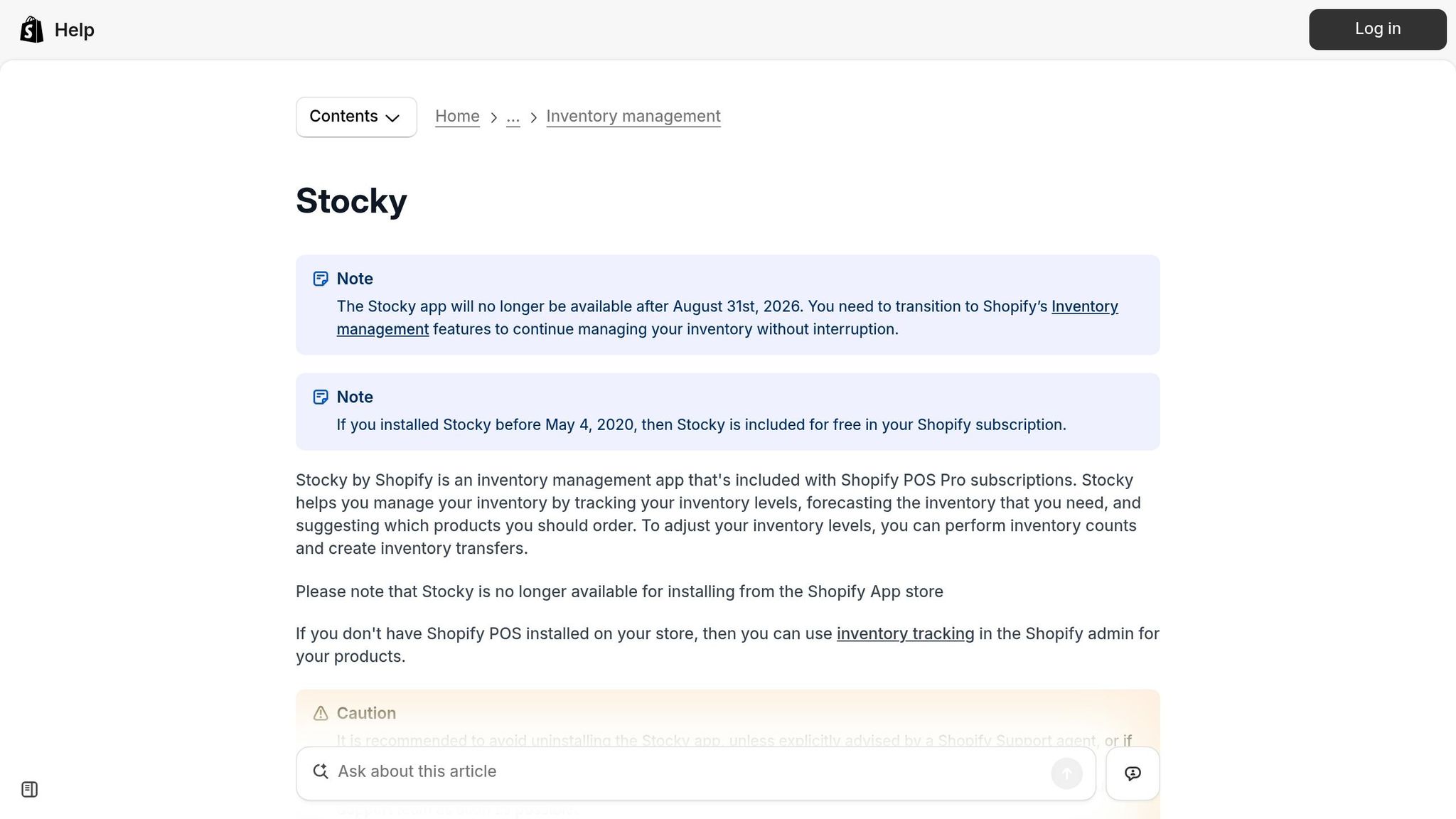
Shopify is discontinuing Stocky, with full functionality ending on August 31, 2026. If you rely on Stocky for inventory management, it's time to switch. This guide compares five alternatives to help you find the right replacement. Here's a quick breakdown:
- Forstock: Best for Shopify-only merchants with simple needs. $79/month pricing, AI-driven demand forecasting, and fast setup.
- Skubana (by Extensiv): Ideal for multi-channel sellers managing Shopify, Amazon, and more. Advanced automation but expensive and complex.
- Inventory Planner: Great for larger Shopify catalogs. Strong forecasting tools but pricing scales with SKUs.
- Cin7: Designed for businesses with manufacturing or wholesale needs. Feature-rich but has a steep learning curve.
- Brightpearl: Best for mid-market, multi-channel operations. Powerful but costly and time-intensive to implement.
Quick Comparison:
| Tool | Starting Price | Setup Time | Best For | Key Weakness |
|---|---|---|---|---|
| Forstock | $79/month | Minutes | Growing Shopify brands | Limited to Shopify |
| Skubana | $350/month | 1–2 weeks | Multi-channel sellers | High cost, complex setup |
| Inventory Planner | ~$99/month | 2–3 weeks | Large Shopify catalogs | Price scales with SKU count |
| Cin7 | $349/month | 4–8 weeks | Manufacturing & wholesale | Complexity, sync issues |
| Brightpearl | ~$18,000/year | 90–120 days | Mid-market multi-channel ERP | Expensive, lengthy setup |
Switch early to ensure a smooth transition. For smaller Shopify stores, Forstock offers simplicity and affordability. Multi-channel sellers or businesses with complex needs may prefer Skubana, Cin7, or Brightpearl. Start planning now to avoid disruptions when Stocky shuts down.
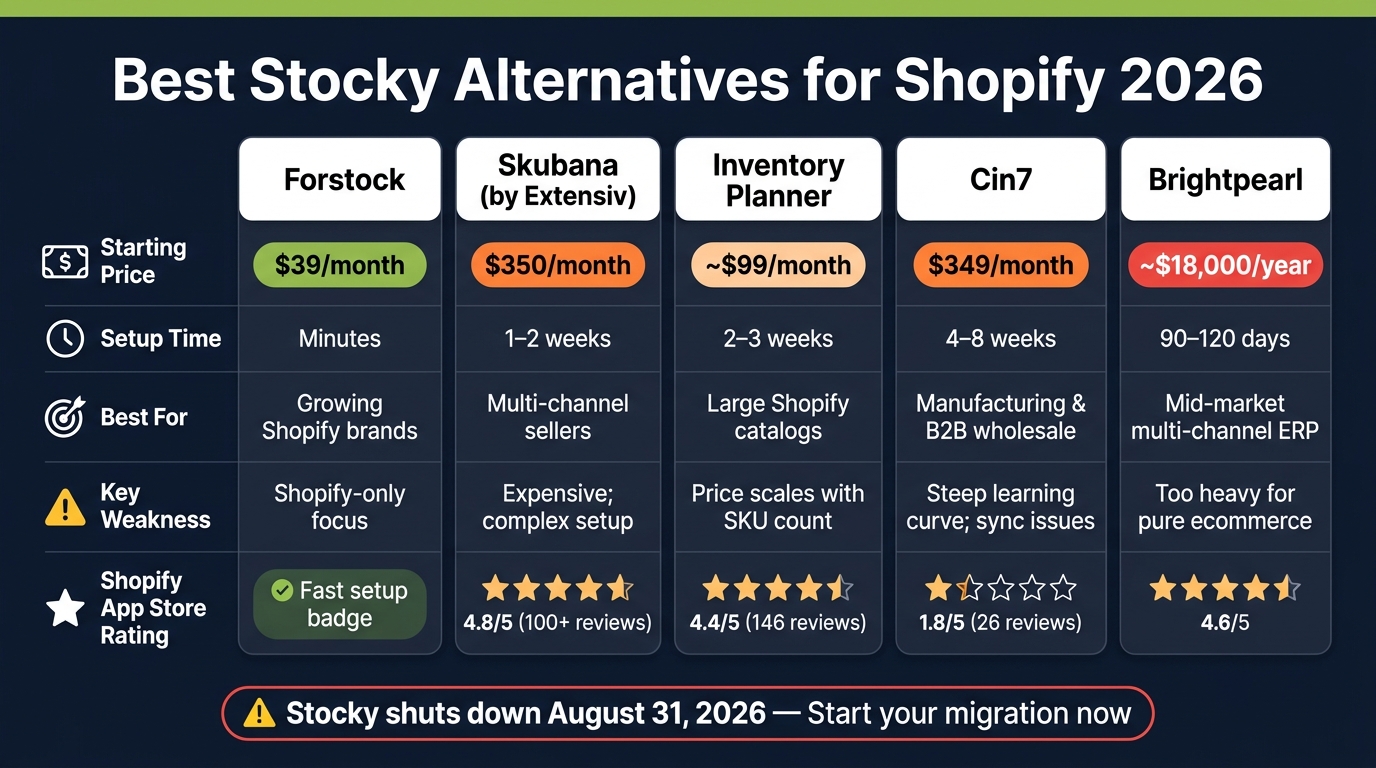
Best Stocky Alternatives for Shopify 2026: Side-by-Side Comparison
Stocky Alternatives for Shopify: What to Choose Next
sbb-itb-f0fc809
1. Forstock
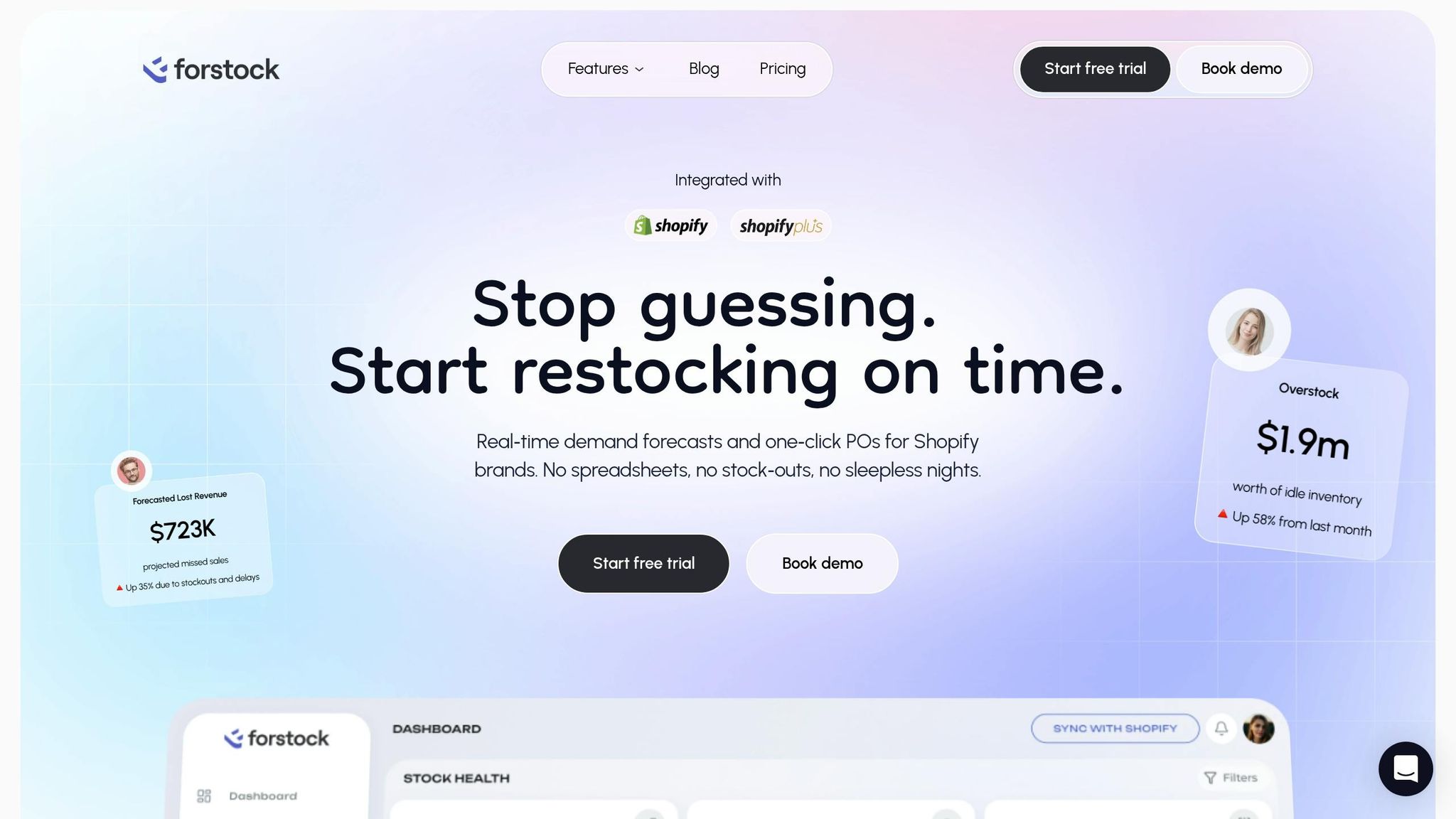
Forstock is a Shopify-native tool designed to handle inventory management with a focus on demand forecasting, purchase orders, and supplier coordination. Powered by machine learning, it connects directly with Shopify and can be set up in less than 10 minutes. Its standout functionality lies in its advanced forecasting capabilities.
Demand Forecasting
Forstock's AI analyzes your store's order history to identify patterns like seasonality, trends, and growth. It provides daily forecasts at both the SKU and variant levels, updates these forecasts daily, and offers a 12-month demand outlook. The platform also delivers reorder suggestions, explaining the reasoning behind each recommendation.
"The forecasting transparency is unmatched. I can see exactly why Forstock recommends reordering now vs. later. No more black-box guessing." - Founder & CEO, DTC Beauty Brand
Businesses using Forstock have reported a 28% improvement in forecast accuracy and a 75% drop in stockouts. Even for new product launches without historical sales data, the platform creates forecasts using insights from similar SKUs and category trends.
Purchase Order Management
Managing purchase orders is seamless with Forstock. It converts forecasts into supplier-ready purchase orders, accounting for factors like lead times, safety stock, and minimum order quantities (MOQs). The platform also simplifies the receiving process by using barcode scanning to match shipments with purchase orders, flagging any issues like short shipments.
Supplier Management
Forstock’s supplier module ensures that key details - such as lead times, MOQs, and consolidation rules - are incorporated into every reorder calculation. This integration helps eliminate errors and ensures smoother supplier coordination.
Multi-Location Inventory Support
If your business operates across multiple warehouses, retail locations, or Shopify markets, Forstock has you covered. It generates location-specific demand forecasts and replenishment schedules, enabling you to track and manage inventory across all locations efficiently. This feature complements its forecasting and order management tools, creating an all-in-one inventory workflow solution.
Pricing (USD)
Forstock keeps things simple with a flat monthly rate of $79 for businesses of all revenue tiers. This subscription includes features like AI-driven reorder suggestions, safety stock planning, purchase order tracking, and supplier management. Additionally, a 14-day free trial is available to test the platform.
| Plan | Monthly Price | Revenue Range |
|---|---|---|
| Starter | $79/month | Up to $250K ARR |
| Growth | $79/month | $250K–$5M ARR |
| Scale | $79/month | $5M–$40M+ ARR |
The revenue-based pricing ensures no extra fees based on order volume or the number of SKUs, making it a straightforward and budget-friendly option.
2. Skubana (by Extensiv)
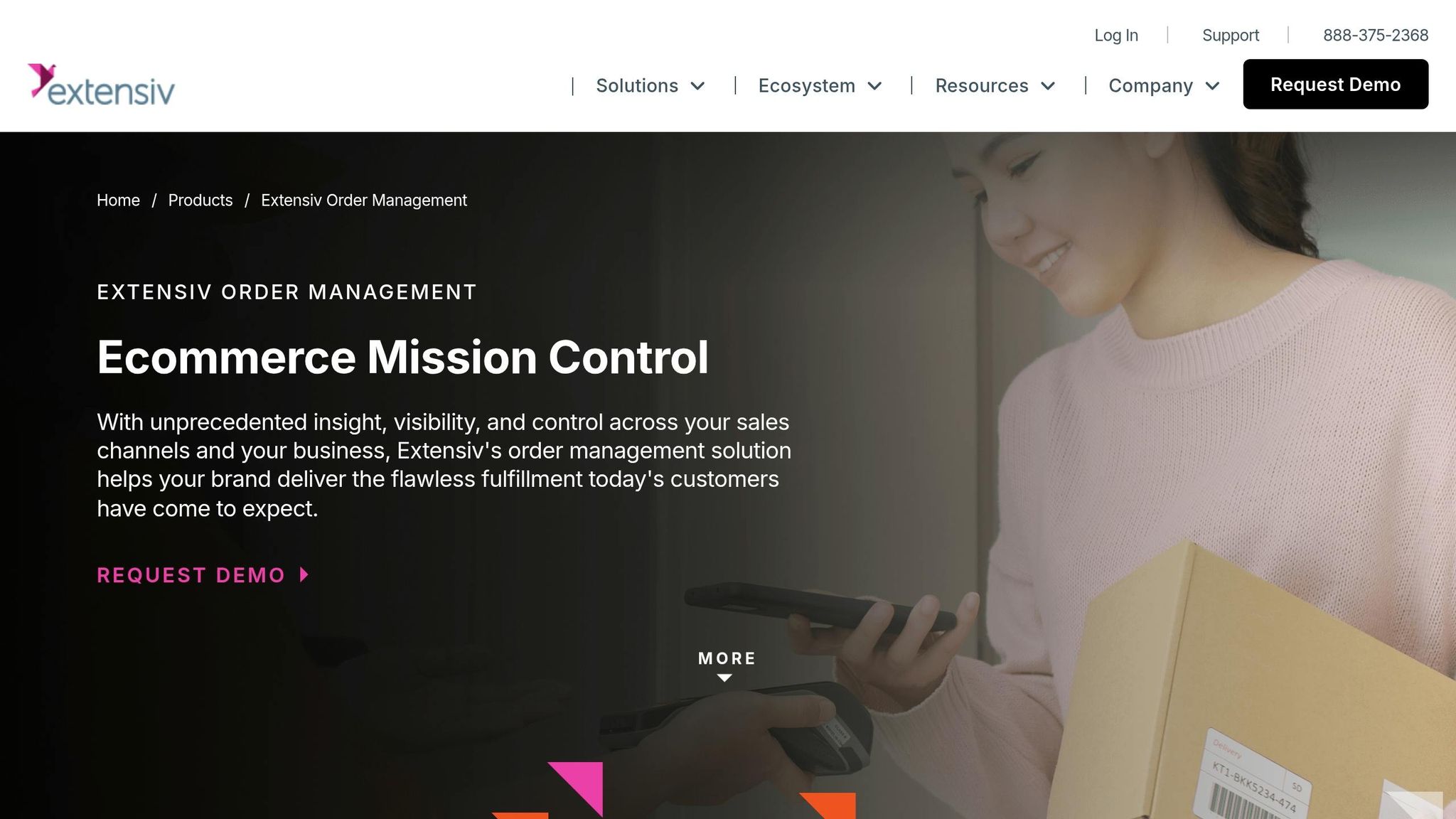
Skubana, now operating as Extensiv Order Manager, is tailored for high-volume, multi-channel merchants. It integrates smoothly with Shopify while managing operations across platforms like Amazon, Walmart, and eBay. With its advanced forecasting and order management tools, Skubana is built to handle the demands of larger, multi-channel businesses.
Demand Forecasting
Forget static spreadsheets - Skubana uses predictive analytics and real-time sales data to monitor demand and anticipate future needs. It calculates estimated runout dates for each SKU and sends alerts when stock hits minimum thresholds, factoring in sales velocity and lead times. Its Analytics Dashboard also identifies slow-moving, high-value inventory and suggests liquidation strategies to free up cash flow.
Purchase Order Management
Skubana simplifies procurement with Orderbots that automate purchase order creation. These bots consider real-time inventory levels, sales velocity, and reorder points, while also factoring in vendor lead times, seasonality, and projected growth. This automation cuts down the manual workload involved in managing orders.
Supplier Management
The platform tracks supplier lead times and minimum order quantities, ensuring that reorder recommendations align with operational requirements. This streamlined approach helps merchants maintain efficiency without manual intervention.
Multi-Location Inventory Support
Skubana provides instant visibility into inventory levels, showing "On Hand" and "In Transit" stock per SKU across warehouses or the entire fulfillment network. This feature allows merchants to balance stock levels across multiple locations without needing to sift through separate reports.
Pricing (USD)
While Skubana’s pricing isn’t openly listed, it reflects the enterprise-level service it provides. Merchants must request a demo or consultation to receive a custom quote, which can make upfront cost evaluations trickier compared to tools with clear pricing tiers. However, a free version of the Integration Manager is available for basic online order automation. The full Order Manager is offered as a paid SaaS product. Implementation typically takes four to six weeks, with most users fully set up within this timeframe.
"Skubana just made it easy to scale. We were at a point where we could not grow at all, and then when we got on Skubana, we went and doubled the company without any pain." - Patrick Barnhill, Founder, Specialist ID
Skubana boasts a 4.8/5 rating based on over 100 reviews. Users praise its automation and multi-channel capabilities, though its complexity and lack of transparent pricing may make it a better fit for established brands with dedicated operations teams rather than smaller Shopify merchants.
3. Inventory Planner
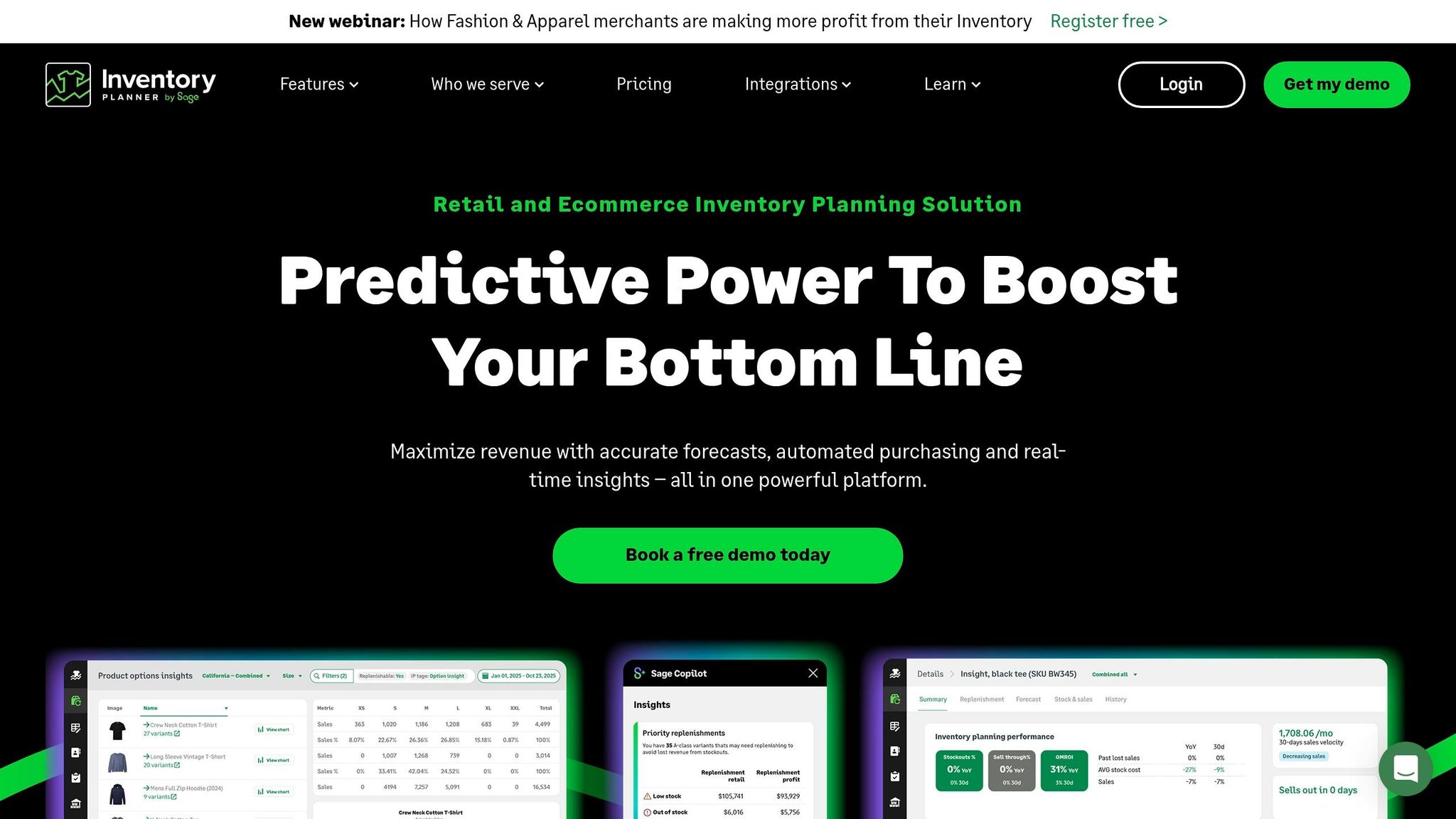
Inventory Planner is a forecasting tool tailored for Shopify merchants who require more than basic inventory tracking. With over 2,600 brands using the platform and a 4.4/5 rating from 146 verified reviews on the Shopify App Store, it’s a trusted solution for businesses looking to improve their inventory management processes.
Demand Forecasting
Inventory Planner provides SKU-level forecasts that simplify restocking decisions. By analyzing historical sales data and current trends, the platform determines the best times to reorder stock. It factors in seasonality, demand changes, and promotional spikes, saving merchants more than 50% of the time they’d typically spend on manual ordering tasks.
As Supplement Hub Global, a multi-channel merchant with over four years of experience using the app, shared:
"The platform gives us clear visibility into what to reorder, when to reorder, and how much to buy; all based on accurate forecasting and real-time sales data." - Supplement Hub Global
These detailed forecasts help streamline the entire ordering process, making it more efficient and accurate.
Purchase Order Management
Once forecasts are ready, Inventory Planner transforms them into purchase orders. Merchants can generate supplier-specific orders directly within the app, automatically updating stock levels. The platform uses ABC analysis to prioritize purchases, ensuring that budgets are allocated to the most critical items.
Supplier Management
The system incorporates supplier data - like lead times and minimum order quantities - into its replenishment calculations. This ensures that recommendations align with real-world operational needs. Additionally, the platform supports vendor notifications and task assignments, keeping procurement workflows on track.
Multi-Location Inventory Support
One of Inventory Planner’s standout features is its multi-location inventory management. It offers automated warehouse transfer recommendations, one-click Shopify transfer order creation, and location-specific reporting for channels like Amazon and wholesale. The platform also ensures that components required for assembly or shipping are available across locations.
"Multi-location support is best-in-class - few competitors handle warehouse transfers and multi-channel forecasting this well." - ATTN Agency
This interconnected approach ensures smooth inventory management across all stages and locations.
Pricing (USD)
Inventory Planner is free to install, but its pricing adjusts based on business needs. The base plan starts at approximately $249.99/month, covering one warehouse and an initial SKU allotment. Additional costs include $80/month for each extra warehouse and $15/month for every 1,000 SKU variants beyond the base allotment. Unlimited users are included at no extra charge. However, the platform typically requires a 12-month commitment, and onboarding fees may apply.
| Cost Item | Approximate Price (USD) |
|---|---|
| Base plan (1 warehouse) | $249.99/month |
| Each additional warehouse | $80/month |
| Every 1,000 additional SKUs | $15/month |
| Additional users | Included |
Some users mention that the interface can feel overwhelming due to the amount of data, and the mandatory annual contract is worth considering. Still, with 86% of Shopify App Store ratings being 5 stars, many customers highlight the platform's excellent support during onboarding.
4. Cin7
Cin7 is an inventory management platform tailored for multichannel sellers who need advanced tools to streamline their operations. Its direct integration with Shopify uses a two-way sync, automatically importing orders and updating stock levels in real-time. This feature alone can save merchants up to 16 hours of manual syncing each week.
Demand Forecasting
Cin7 takes inventory management a step further with its ForesightAI engine. This tool analyzes past sales data to predict future demand and recommend optimal reorder points. According to Cin7, merchants using ForesightAI have cut overstock by as much as 40% in just six months. However, ForesightAI is only available on the Advanced plan, which costs $999 per month.
Purchase Order Management
Cin7 simplifies purchase order processes with its Intelligent Document Recognition (IDR) feature. This tool extracts data from PDF purchase orders and converts it into draft orders, saving merchants 4–8 hours of data entry each week. The platform also supports Advanced Purchasing, allowing users to link multiple shipments and invoices to a single order. Customizable approval workflows provide added control over stock receipt and invoice processing.
Supplier Management
Cin7 streamlines vendor management by centralizing order history, payments, and deposits. For businesses working with international suppliers, it offers automatic multi-currency conversions. Marc Prospero from Earthmoving Warehouse highlighted its impact, saying:
"Compared to what we were doing before Cin7, it's light years ahead... We're a more efficient and effective business now, and Cin7 is at the heart of it."
Multi-Location Inventory Support
For businesses managing inventory across multiple locations, Cin7 offers a unified dashboard that covers warehouses, retail stores, and 3PLs. Features like bin-level tracking, cycle counting, and automated order routing help reduce carrying costs by 15–20%. These tools are particularly valuable for merchants navigating the complexities of multi-channel operations.
Pricing (USD)
Cin7's pricing structure is tiered to reflect its range of features. Keep in mind that access to ForesightAI and full ERP capabilities is limited to the highest-tier plan.
| Plan | Price | Key Features |
|---|---|---|
| Standard | $349/month | 5 users, multi-channel orders, standard warehouse management |
| Pro | $599/month | Advanced warehouse management, kitting/bundling, API access |
| Advanced | $999/month | ForesightAI forecasting, B2B portal, full ERP capabilities |
| Omni | $749/month | EDI integration, enterprise-level 3PL communications |
User Feedback
Cin7 holds a 1.8/5 rating on the Shopify App Store based on 26 reviews. Common complaints include its steep learning curve and challenges with handling exchanges through Shopify. To address these concerns, Cin7 provides resources like the Cin7 Academy for self-guided onboarding, 24/7 chat support, and a comprehensive knowledge base. While it’s a feature-rich platform, setting it up effectively requires time and technical know-how.
5. Brightpearl (by Sage)
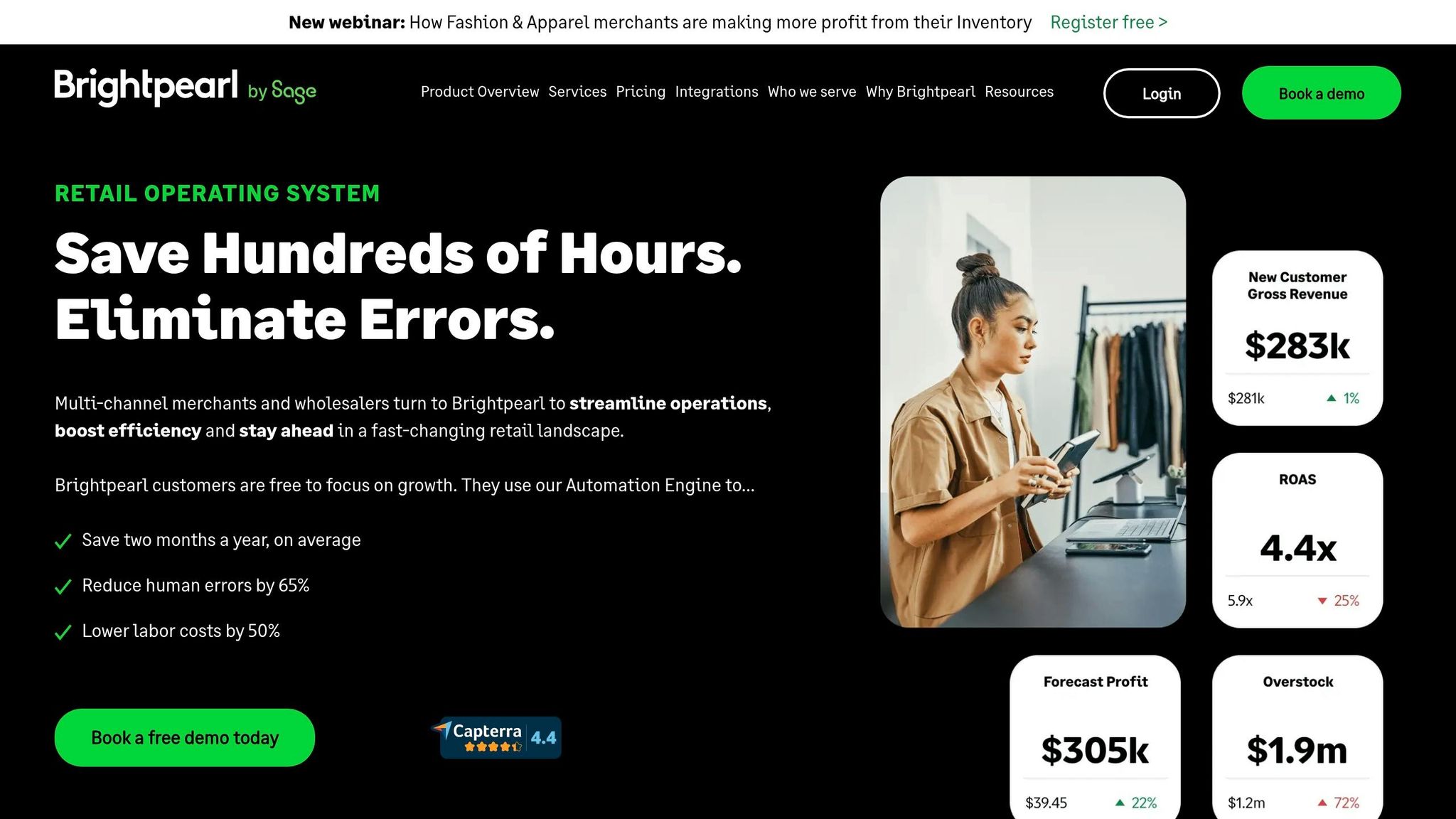
As Stocky's shutdown approaches, Brightpearl steps in as a strong alternative for merchants needing robust cloud inventory tools for Shopify. Designed for mid-market businesses, Brightpearl serves as a retail operating system that even supports Shopify's internal hardware distribution stores. It's one of just three platforms included in Shopify's Global ERP Program. If your business earns between $5M and $100M annually and operates across multiple channels, Brightpearl might be the right fit.
Demand Forecasting
Brightpearl's Inventory Planner uses sales data, lead times, seasonality, and promotions to provide accurate replenishment recommendations. Two standout reports include:
- Open-to-Buy Report: Helps plan purchasing budgets based on forecasted margins.
- Overstock Report: Identifies slow-moving inventory that could be tying up cash.
Trevor Martin, VP of Operations at Snow, shared how it transformed their approach:
"Brightpearl's inventory planning tool has been phenomenal for us. It factors in seasonality so that we can look at the data and instantly say 'ok, we need to order 100,000 of that item, not 10,000'".
Additionally, Brightpearl's automation features save businesses up to two months of manual work each year.
Purchase Order Management
Brightpearl simplifies purchase order creation by turning recommendations into orders with seasonal demand and lead times pre-calculated. For businesses sourcing internationally, it tracks landed costs - including freight, import duties, insurance, and taxes - at the SKU level to ensure accurate margins. The platform’s Automation Engine further streamlines workflows, handling backorder sequencing and multi-location routing with pre-built templates.
Supplier Management
The platform centralizes supplier interactions through a supplier portal, allowing vendors to update delivery dates directly. Automated invoicing and integrated purchasing workflows reduce the need for manual follow-ups, making supplier management more efficient.
Multi-Location Inventory Support
For merchants moving away from Stocky, Brightpearl offers seamless multi-location inventory management. It connects multiple Shopify stores to a single account, treating each store as a unique sales channel. Merchants can either share a global inventory pool or assign specific warehouses to each storefront. The Shopify Plus connector now syncs inventory in under 60 seconds, a huge improvement over the previous 15-minute intervals. Automated stock transfer recommendations help balance inventory across 3PLs, FBA warehouses, and retail locations. Jorge Henriques, COO of Bond Touch, highlighted that Brightpearl's tools saved them 320 hours per month - equivalent to two full-time employees.
Pricing (USD)
Brightpearl's pricing is tailored to mid-market merchants, with annual contracts ranging from $18,000 to $55,000. Costs depend on order volume, sales channels, and selected modules. A demo is required to receive a custom quote. Implementation typically takes 90 to 120 days, and Brightpearl boasts a 97% success rate for implementations. It also holds a 4.6/5 rating on the Shopify App Store.
Pros and Cons
Each tool fills a specific gap left by Stocky. Here's a closer look at their strengths and limitations, along with a summary table for easy comparison.
Forstock is a straightforward choice for Shopify brands looking to grow after Stocky. It offers a starting rate of $79/month for unlimited SKUs, making it cost-effective as your business expands. However, it's designed exclusively for Shopify, which means merchants with significant Amazon or wholesale operations might need additional tools.
Skubana (by Extensiv) stands out for multi-channel sellers, particularly those using Amazon FBA or AWD alongside Shopify. However, it comes with a hefty starting price of $350/month, requires 1–2 weeks to set up, and can climb to $1,997/month for the managed-service tier.
Inventory Planner excels in forecasting and has a solid track record among Shopify-native tools. Its main drawback is the pricing model, which scales with your SKU count - from around $99/month to over $1,000 as your catalog grows. It's a good fit for established stores with large catalogs and consistent sales.
Cin7 is tailored for complex needs like manufacturing BOMs, B2B wholesale, and EDI integrations. However, for Shopify-only merchants, the 4–8 week setup time and user-reported issues with sync bugs and support delays make it less appealing.
Brightpearl is the most robust platform on this list but also the most demanding. With annual contracts ranging from $18,000 to $55,000 and an implementation timeline of 90–120 days, it's aimed at mid-market businesses. For ecommerce-only brands, it may feel excessive.
Here's a quick comparison of the key metrics:
| Tool | Starting Price | Setup Time | Best For | Key Weakness |
|---|---|---|---|---|
| Forstock | $79/mo | Minutes | Growing Shopify brands | Shopify-only focus |
| Skubana (by Extensiv) | $350/mo | 1–2 weeks | Amazon/multi-channel sellers | Expensive; overkill for Shopify-only |
| Inventory Planner | ~$99/mo | 2–3 weeks | Large Shopify catalogs | Price scales fast with SKU count |
| Cin7 | $349/mo | 4–8 weeks | Manufacturing & B2B wholesale | Complex setup; buggy sync reports |
| Brightpearl | ~$18,000/yr | 90–120 days | Mid-market multi-channel ERP | Too heavy for pure ecommerce |
Conclusion
Stocky is shutting down on August 31, 2026 - so it’s time to act now to safeguard your data. Luckily, there are plenty of modern inventory management tools that can help you transition smoothly and support your business needs after the shutdown.
The best choice for your business depends on your specific operations. For smaller direct-to-consumer (DTC) brands using Shopify, Forstock offers straightforward pricing at $79/month, covering unlimited SKUs to fuel growth without additional costs. If you’re a multi-channel seller managing both Shopify and Amazon FBA, you may need a system designed to handle more intricate workflows. On the other hand, businesses involved in manufacturing - dealing with bills of materials or production schedules - might require tools tailored to those needs. Similarly, mid-market retailers with multiple locations and ERP requirements may find a more advanced platform worth the added setup time and cost. Choosing a tool that aligns with your operations now ensures a smoother transition when Stocky shuts down.
Start your migration process well before the August 31 deadline. Running your new system alongside Stocky for several weeks will help you verify reorder suggestions, identify any gaps, and adjust before the final switchover. Don’t forget to manually document supplier details like lead times, contacts, and minimum order quantities (MOQs), as these cannot be exported from Stocky automatically.
"The real risk isn't losing the Stocky app. It's losing the day-to-day process the app held together - and replacing it with something that has the same blind spots." - Upzone HQ
For Shopify-focused brands looking for a simple, fast setup without the complexity of enterprise solutions, Forstock is a solid option. By installing it and running it alongside Stocky for a few weeks, you can determine if it fits your workflow well before the shutdown date. Don’t wait - start planning now to keep your business running smoothly.
FAQs
How do I migrate from Stocky before August 31, 2026?
With Stocky set to shut down on August 31, 2026, it’s crucial to prioritize data preservation and ensure a smooth transition to your new system. Here's what you need to do:
- Export key data: Save CSV files containing your purchase order history, stocktake records, and product cost data.
- Manually document supplier details: Record important supplier information, such as lead times and minimum order quantities, to maintain accuracy during the migration.
- Test both systems: Run your current system and the new one side by side for 2–4 weeks. This overlap helps validate workflows and identify any discrepancies that need fixing before fully transitioning.
Taking these steps will help minimize disruptions and ensure your business continues to operate efficiently.
What should I document from Stocky that won’t export automatically?
To ensure a smooth transition, make sure to manually record supplier details such as vendor names, contact information, lead times, and minimum order quantities (MOQs), as these details won't be automatically exported. While you can download historical purchase orders and stocktake records as CSV files, they won’t carry over to a new system. Be sure to export these files and document all supplier data before uninstalling Stocky to maintain access to your important records.
How long should I run a new inventory tool alongside Stocky?
By July 1, 2026, make sure your new inventory tool is fully operational and running alongside Stocky. This overlap period allows you to confirm that the new system is functioning correctly while Stocky remains accessible. Transitioning early gives your team a chance to adjust workflows and address any issues before Stocky is officially discontinued on August 31, 2026. Don't forget to export your historical data from Stocky and tidy up supplier records to ensure the shift goes as smoothly as possible.
Keep reading
Try Forstock free for 14 days.
AI-powered demand forecasting and reorder automation for Shopify brands. No credit card required.