
Quick Summary
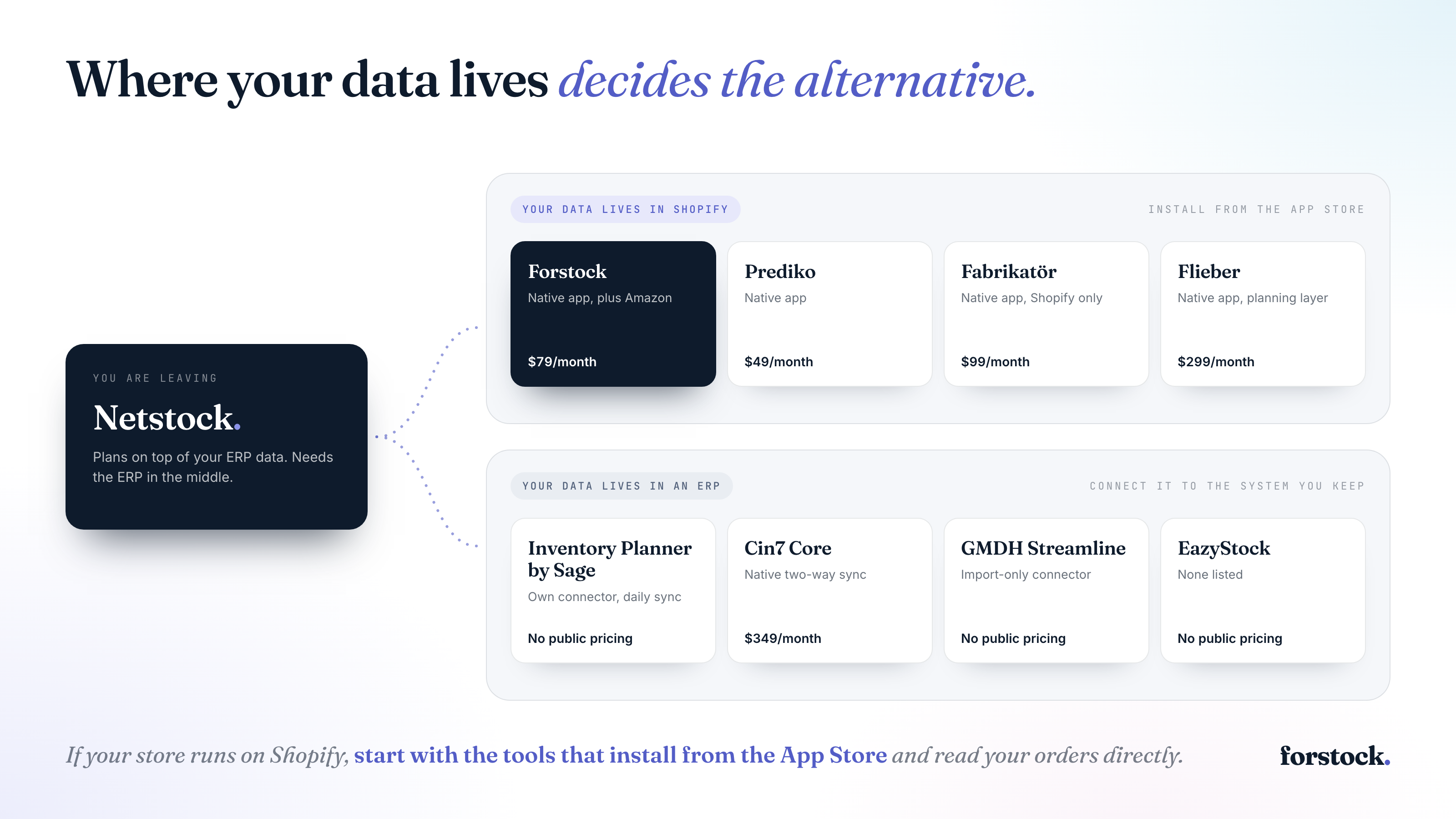
If your store runs on Shopify, start with Forstock, Prediko, or Fabrikatör. All three install from the Shopify App Store, forecast each SKU, and turn reorder suggestions into purchase orders. Forstock is our top pick for planning many variants across several locations. If you're running an ERP, GMDH Streamline, and EazyStock work more like Netstock.
| Tool | Best For | Starting Price |
|---|---|---|
| Forstock | Planning many variants across locations | $79/month |
| Prediko | Smaller brands watching costs | $49/month |
| Fabrikatör | Brands that sell on backorder | $99/month |
Where Your Data Lives Decides the Right Netstock Alternative
Netstock connects to more than 60 ERPs. The back-office systems run accounting, orders, and stock. That's where all its planning starts. So, before you compare alternatives, it's worth asking where your orders and stock live.
If they live in an ERP like NetSuite, a planner that plugs into it the same way will feel familiar. If they live in Shopify, though, you'll want one that reads your store directly. We'll cover both kinds below.
Why Listen to Us?
Ezz Studios, a fashion brand in Paris, reports about 40% fewer stockouts since switching to Forstock and about five hours saved every week compared with spreadsheets. The Afropolitan Shop, a Dallas brand, also calls Forstock a very easy to use stock and inventory tool. It's great for planning, the review says, with wonderful customer service, and it singles out the ABC analyses and the reorder feature.
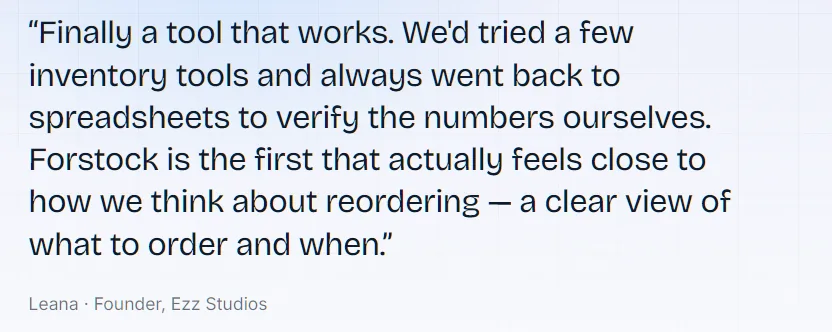
Both reviews point to what we weighed most heavily: forecasts you can check, reorders you can act on, and support you can reach.
What Is Netstock?
Netstock is a supply and demand planning software for manufacturers, wholesalers, distributors, and retailers. Founded in 2009, it has more than 2,400 customers in 67 countries.
It connects to an ERP like NetSuite, Sage, or Acumatica and pulls in your data daily. From there, Netstock forecasts every item at every location. It sets safety stock to hit a target fill rate (that’s the share of demand you can meet from stock). Its order recommendations then go back into your ERP where they're placed.
Why Seek Alternatives to Netstock?
Netstock is a capable planner, but it wasn't built around the way most Shopify brands work. Three things tend to send them looking elsewhere:
- It Needs an ERP: Netstock reads from an ERP or accounting system as its data source. It doesn't list a Shopify integration, and you won't find it on the Shopify App Store. If your orders and stock live in Shopify, you'd need an inventory system like Cin7 Core in the middle. That's one more tool to buy, set up, and keep in sync.
- Forecasts Refresh Monthly: Netstock's core forecasts regenerate at the start of each month using ERP data that refreshes daily. A new product with no sales history gets a zero forecast. That isn't great if your catalog changes fast. And because the data arrives in a daily batch, buyers can end up checking the ERP for live numbers anyway.
- Pricing and Setup Suit an ERP Project: Netstock's pricing starts at $900/month on an annual subscription. By its own estimate, implementation usually takes 6 to 10 weeks. For a growing brand with a small team. That's a lot of money and time before you see your first reorder plan.
8 Best Netstock Alternatives
The table below compares the eight alternatives on who each suits best, how it connects to Shopify, what it costs to start, and the standout feature that sets it apart.
| Tool | Best For | Shopify Fit | Starting Price | Standout Feature |
|---|---|---|---|---|
| Forstock | Planning many variants across locations | Native app, plus Amazon | $79/month | Reorder quantities that show their working for every SKU at every location |
| Prediko | Smaller brands watching costs | Native app | $49/month | One-click scaling of orders to supplier minimums |
| Fabrikatör | Brands that sell on backorder | Native app, Shopify only | $99/month | Backorders and preorders tied to incoming POs |
| Inventory Planner by Sage | Multichannel retailers | Own connector, daily sync | No public pricing | Container-aware purchase orders |
| Flieber | Brands selling on Amazon and Shopify | Native app, planning layer | $299/month | Bundles, backorders and shared components in one forecast |
| Cin7 Core | Replacing your inventory system | Native two-way sync | $349/month | Stock, orders, and purchasing in one system |
| GMDH Streamline | Mid-market brands with an ERP | Import-only connector | No public pricing | Order-date optimization across groups of items |
| EazyStock | ERP-run distributors | None listed | No public pricing | Stocking policies set from your service level |
1. Forstock
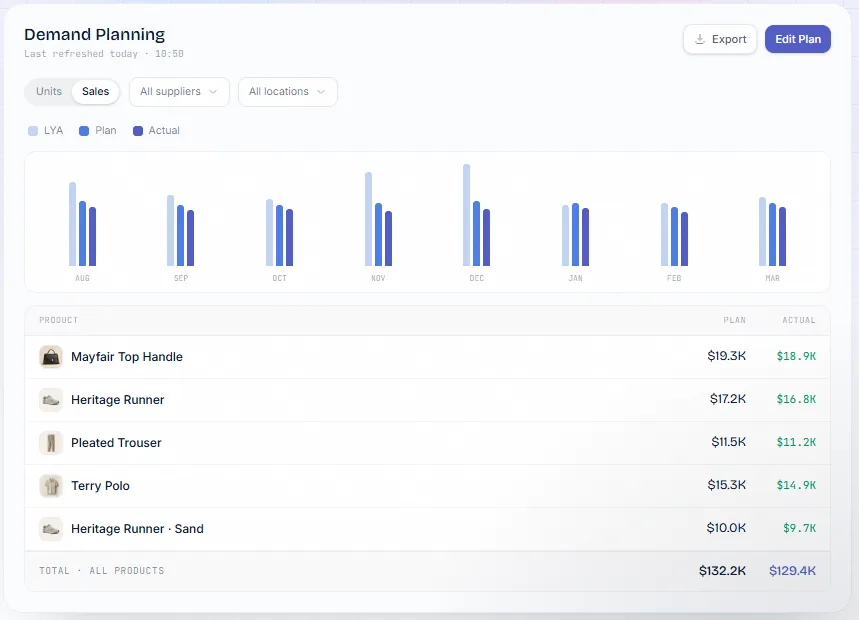
Forstock is an AI inventory planning platform for Shopify brands. It forecasts demand, flags stock risks, and recommends what to reorder and when. Then, it turns those recommendations into purchase orders across your suppliers, stores, warehouses, and sales channels.
Unlike Netstock, Forstock doesn’t need an ERP in the middle. You install it from the Shopify App Store and it reads your orders, stock, and discounts directly. It also pulls in Amazon orders, FBA stock, and counts from 150+ warehouse systems and 3PLs.
Forstock's forecast runs per variant, per location, and per channel. It knows which days a SKU sat out of stock and which spikes came from a sale so neither one skews next month's plan. Then, it simulates the day each SKU will run out and count back through your lead time to a should-order-by date.
Key Features
- Promotions and Launches: Declare an upcoming promotion by date, discount, and channel, or model a new product on one to five similar ones
- Reorder Rules: Set lead time, safety stock days, MOQ, and pack size per SKU and location
- Purchase orders: Turn the rows you pick into one draft PO per supplier and email it from Forstock
- Shopify Sync: Push received stock to Shopify order by order, only when you switch it on
- Alfred AI: Ask in plain language what's running low or what needs your attention, and get recommendations back from the same plan
- Inventory Table: See last year's sales by month, ABC-style grading, days of cover, and at-risk flags in units or in revenue
Pricing
One plan with every feature, priced by your annual revenue:
- Under $1M: $79/month
- $1M to $5M: $159/month
- $5M to $10M: $279/month
- $10M to $20M: $479/month
- $20M to $40M: $899/month
- $40M+: custom pricing
Every plan starts with a 14-day free trial, no credit card needed, and annual billing saves 15%.
Rating
5.0/5 ( Shopify App Store, 6 reviews)
Pros
- It installs from the Shopify App Store and bills through your Shopify invoice
- Every plan has every feature, with unlimited SKUs, suppliers, and locations so growing your catalog doesn't raise your bill
- Stocky users get free concierge migration, and App Store reviewers single out the team's responsiveness
- You can export the plan to CSV or Excel so buyers and finance can work from the same numbers
- The plan refreshes itself weekly so it stays current without anyone rebuilding it
Cons
- The AI forecast kicks in after six months of orders
- It's a planning tool, not an ERP: it needs a Shopify store and has no accounting or manufacturing planning
2. Prediko
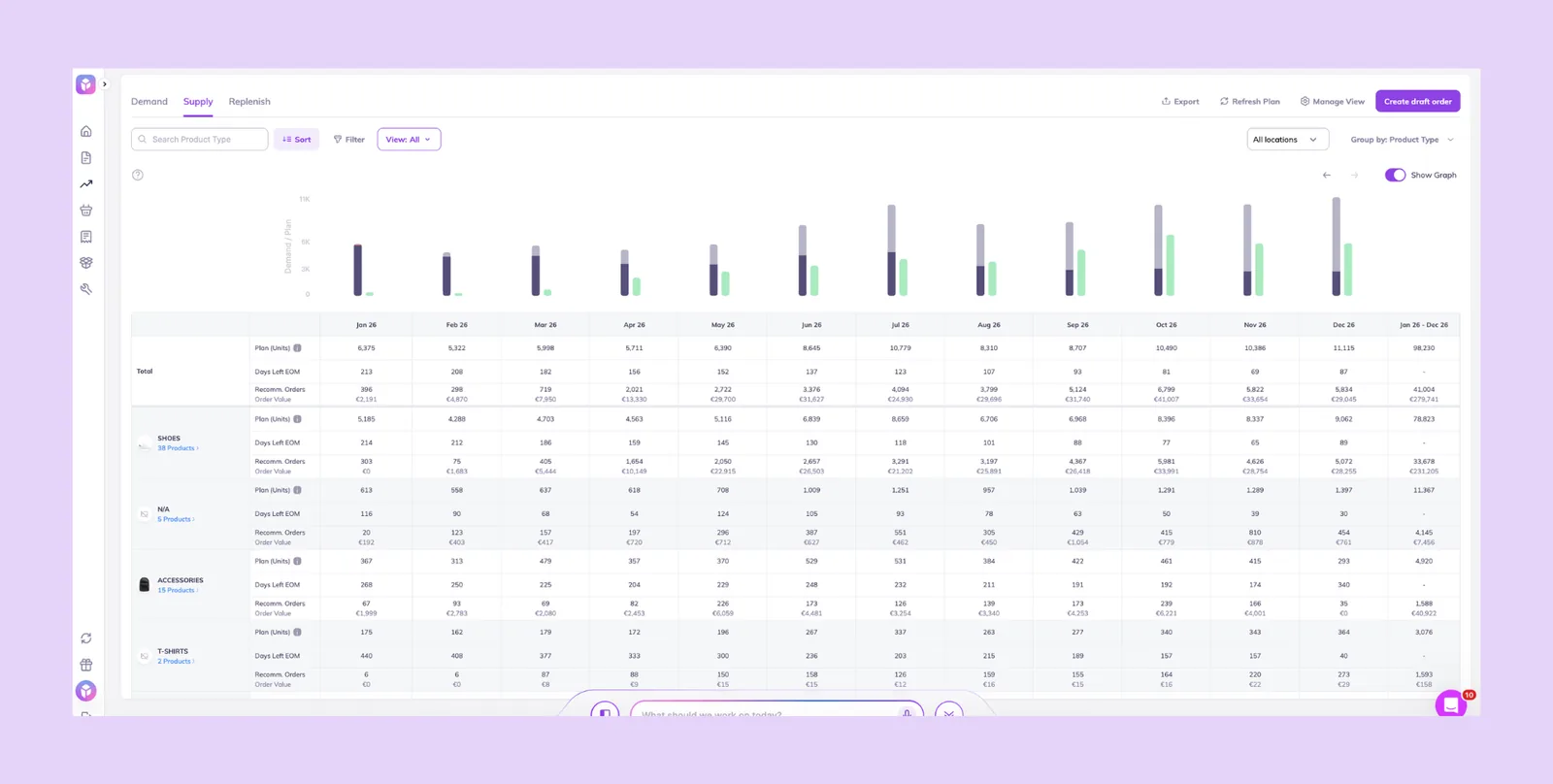
Like Forstock, it reads your store directly and syncs received stock back to Shopify. It builds an editable 12-month demand plan and picks up seasonality by location. You can also leave out stockout periods, so a sellout doesn't drag the forecast down.
Key Features
- The Buy Table shows each SKU's projected stock health and best order date, and lets you create a purchase order in one click
- Scale to MOQ is a bulk action that raises selected SKUs to a supplier’s minimum, set by quantity or by order value
- Split bundle scales down to component SKUs, with Shopify Bundles synced automatically
Pricing
Pricing rises with your annual revenue, from $49/month for stores under $100K. There's a 14-day free trial.
Rating
4.9/5 (Shopify App Store, 255 reviews)
Pros
- Every plan includes unlimited users, SKUs, and POs
- An onboarding session and a dedicated customer success manager are included on every plan
- It'll move your Stocky suppliers and POs across
Cons
- There's no weekly view of the demand plan
- The demand plan is top-down: you set a revenue target and Prediko spreads it across the year using your seasonality
- Promotions need manual edits
3. Fabrikatör
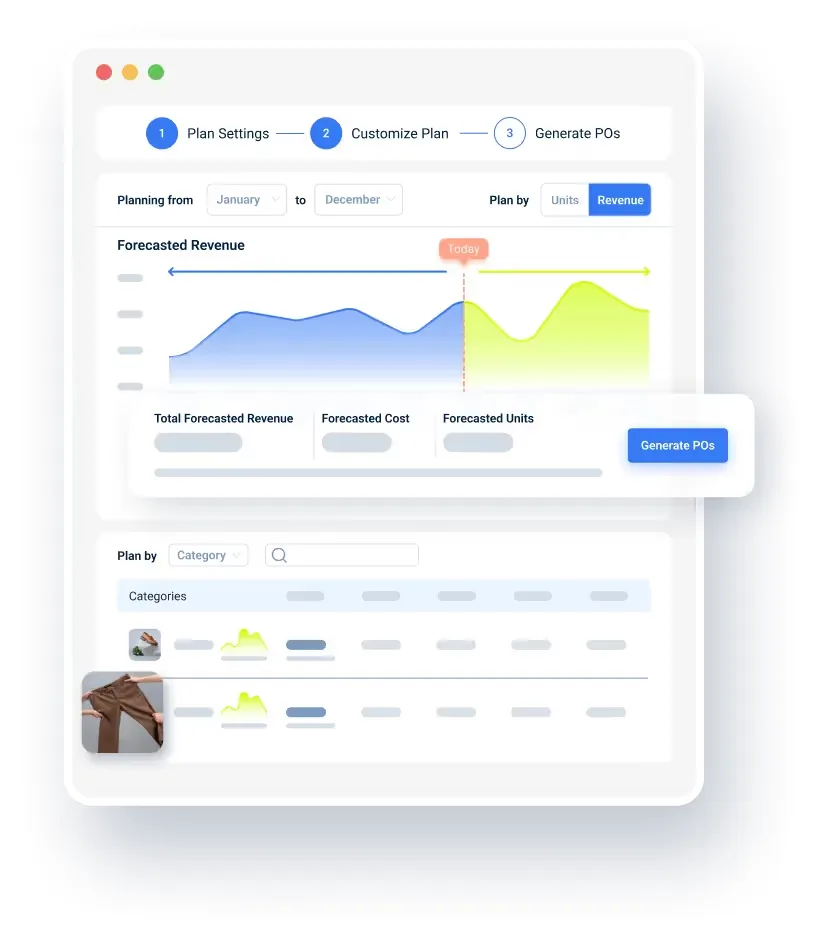
Fabrikatör is a natural fit if you sell on backorder or preorder. It can open backorders against incoming POs. Like Prediko, it forecasts each SKU from past sales and seasonality. Any restock suggestion becomes a PO in one click.
Key Features
- Marketing events let you add planned campaigns so the forecast accounts for them
- Split POs divide a purchase order across warehouses, delivery dates, or freight methods
- Barcode receiving allows you scan deliveries in and log accepted and rejected quantities
Pricing
Plans start at $99/month for brands up to $500K in yearly revenue, with a 14-day free trial. Backorders cost $0.75 each after the first 50.
Rating
4.8/5 (Shopify App Store, 111 reviews)
Pros
- You pay through Shopify, with a 30-day money-back guarantee
- Received stock counts push back to Shopify
- It forecasts both components and virtual bundles
Cons
- There's no dedicated safety stock setting, so you pad days of stock
- It's Shopify-only, so other channels have to run through Shopify
- It doesn't sync with Shopify's own purchase orders
4. Inventory Planner by Sage
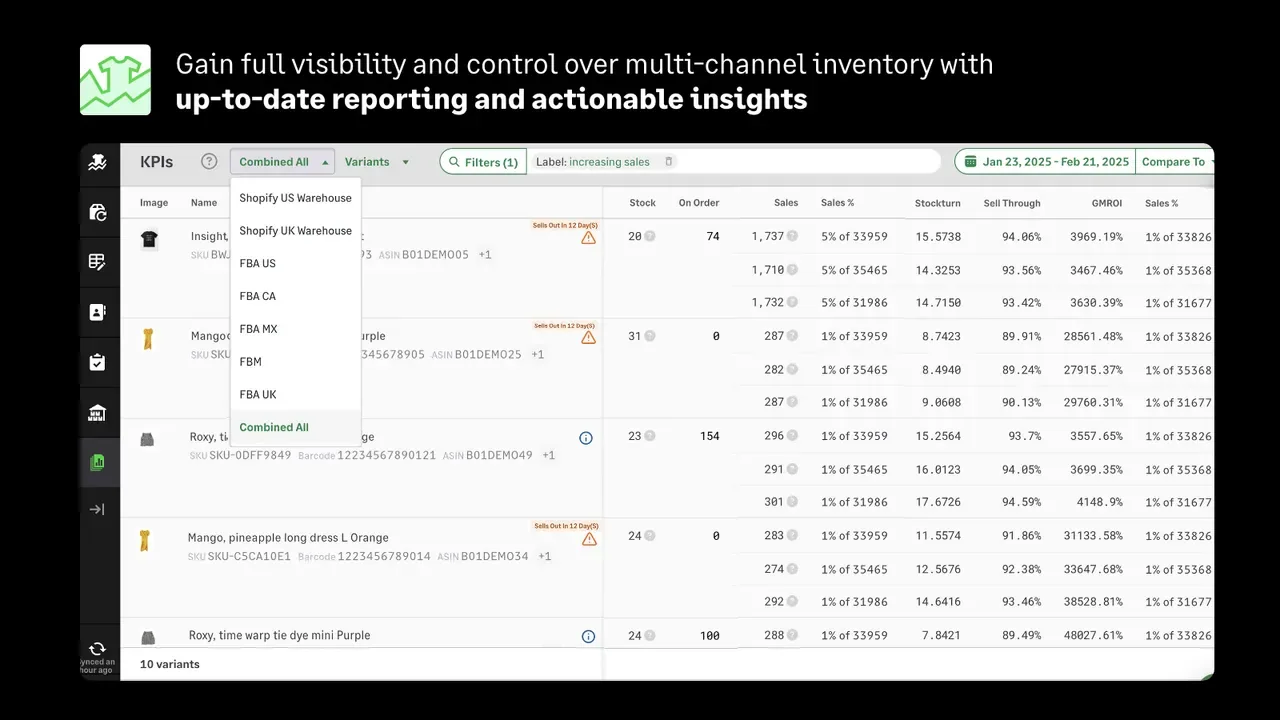
Inventory Planner by Sage is best for multichannel retailers. It plans across warehouses, stores, FBA, and 3PLs. You pick a forecasting model for each product. Unlike Netstock, it has its own Shopify connector. Its main Shopify App Store listing showed as unavailable when we checked in October 2026, though.
Key Features
- New-product forecasts borrow sales data from similar products to forecast new items
- Container-aware purchase orders scale an order by volume or weight to fill a shipment
- Open-to-buy planning lets you set buying budgets by month or retail week
Pricing
The full product is quoted based on the volume of inventory you manage. Its Shopify-only Essentials edition is $119.99/month, with a 14-day free trial.
Rating
4.6/5 (Capterra, 79 reviews)
Pros
- It plans across Shopify, Amazon, WooCommerce, eBay, and BigCommerce
- Unlimited users come at no extra cost
- Forecasts adjust as new sales trends appear
Cons
- Shopify data syncs once a day, so it isn't live
- You'll need vendor-led onboarding before you go live
- Sage Copilot, its AI assistant, needs the Premium plan
5. Flieber
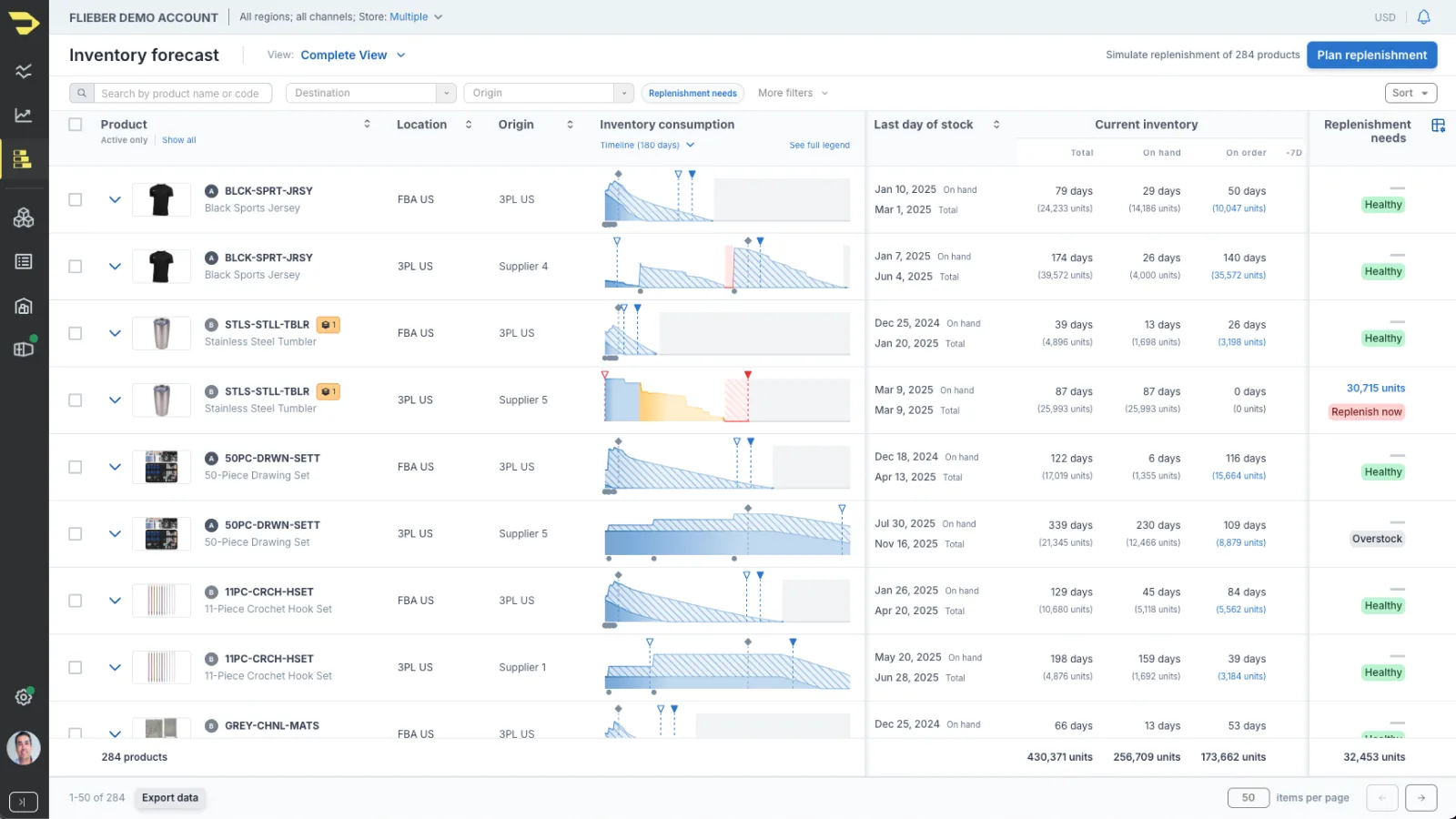
Flieber is suitable for brands that sell on Amazon, Shopify, Walmart, and wholesale. Like Forstock, it reads Amazon alongside Shopify. But, it's built as a planning layer on top of your ERP or inventory system. Before it forecasts, it cleans stockout zeros, price changes, and holidays out of your history.
Key Features
- Replenishment recommendations handle advanced cases like bundles and backorders
- Sales forecasts are AI-based and omni-channel, covering marketplaces, direct-to-consumer and wholesale
- Bundles and kits allow users to roll bundle demand down to components, including shared inventory pools
Pricing
Flieber doesn't publish a rate card. Its Shopify App Store listing starts at $299/month, with a 14-day free trial and no card needed.
Rating
5.0/5 (Shopify App Store, 5 reviews)
Pros
- It connects natively to Amazon, Walmart, eBay, Etsy, and BigCommerce
- Onboarding is free, with no implementation fees, and Flieber says setup takes under 20 minutes
- Backorders and wholesale channels are supported too
Cons
- AI forecasting models and the Google Sheets integration start at the $399 Pro plan
- Flieber says brands with two or more years of operations get better results
- API access needs the $599 Max plan
6. Cin7 Core
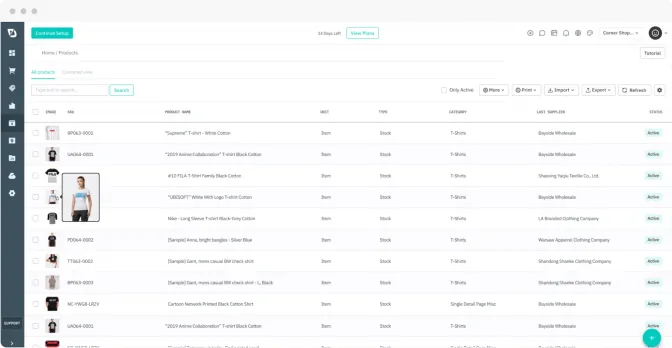
Cin7 Core is a full inventory management system. Choosing it means moving your stock, orders, and purchasing into Cin7. You get a native two-way Shopify sync in return. Unlike Netstock, Cin7 Core is where your records live, so POs get created inside it. AI forecasting by SKU and location comes from its ForesightAI add-on.
Key Features
- ForesightAI forecasts up to 24 months ahead per SKU and warehouse
- Multichannel selling covers several Shopify stores plus Amazon, wholesale, and point of sale
- Multi-location planning lets you manage stock across every warehouse in one place
Pricing
Standard is $349/month, Pro is $599/month, and Advanced is $1,199/month. ForesightAI is an add-on priced on your sales. There's a 14-day free trial with no credit card.
Rating
4.3/5 (Capterra, 739 reviews)
Pros
- Basic reorder suggestions come with every plan
- Every plan includes unlimited inventory locations
- Swings in supplier lead times feed straight into safety stock
Cons
- ForesightAI costs extra, and its price isn't published
- Each plan caps yearly sales orders and integrations
- Onboarding is also a separate paid package, and group onboarding takes 4 to 6 weeks
7. GMDH Streamline
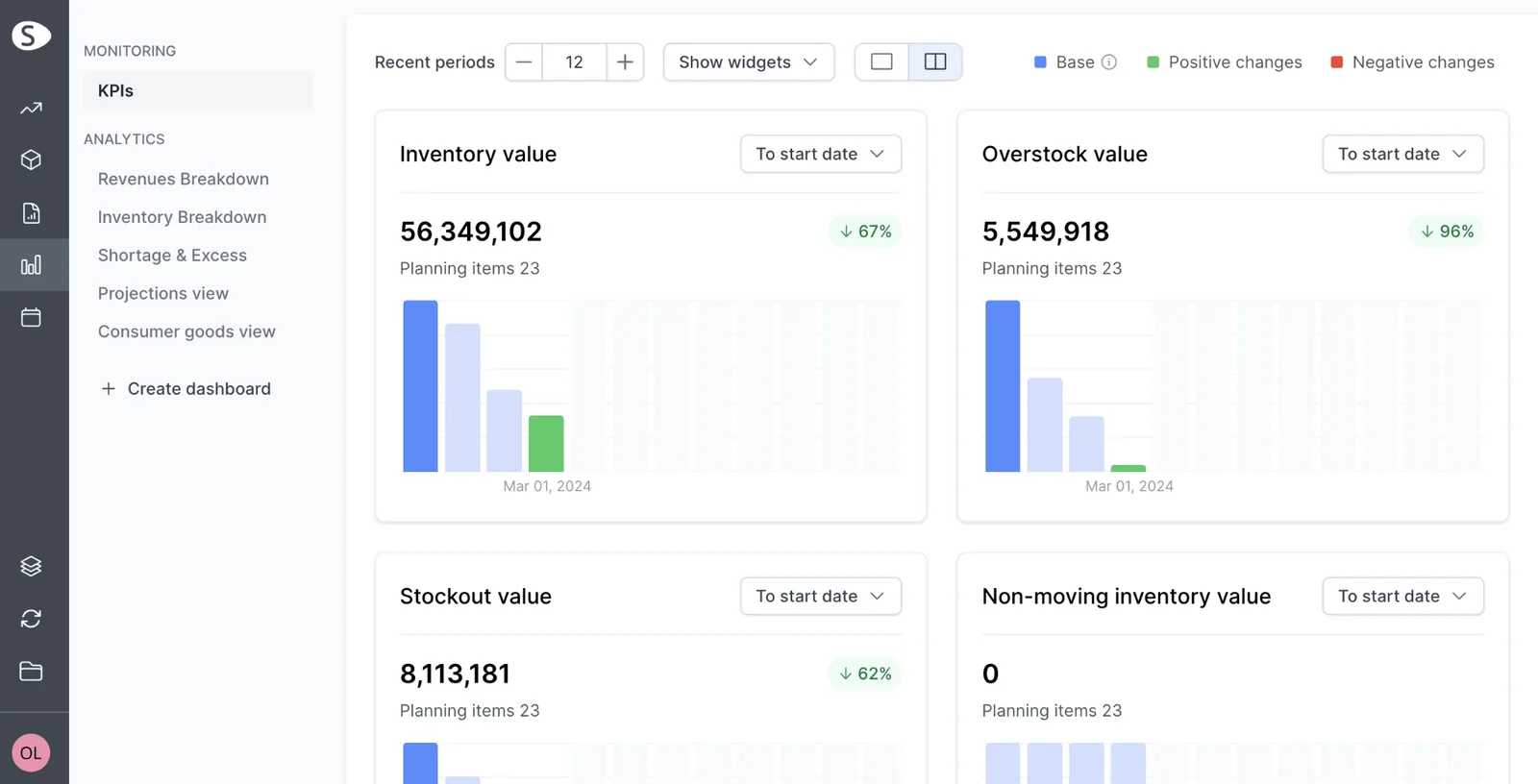
GMDH Streamline is a planning platform for mid-market and enterprise businesses. Much like Netstock, it runs on top of your ERP. It has a Shopify connector, but that only imports data. Approved POs still go out through your ERP or a spreadsheet export.
Key Features
- Group EOQ optimization syncs the order dates of a group of items to cut holding and ordering costs
- It forecasts demand, plans supply, and runs sales and operations
- Two-way links import your sales data and export forecasted orders back to your ERP
Pricing
No public pricing, so you'll need a custom quote.
Rating
4.8/5 (Capterra, 11 reviews)
Pros
- It connects to NetSuite, Acumatica, SAP Business One, Dynamics 365, and QuickBooks
- New items can borrow history from similar products
- It's SOC 2 Type II certified
Cons
- GMDH estimates 2 to 4 weeks to go live at mid-sized companies and 3 to 6 months for large ones
- It's aimed at enterprise supply chain teams, so a lean Shopify team may find it more than it needs
- Shopify appears among its listed data sources, but the platform is built around ERPs rather than Shopify stores
8. EazyStock
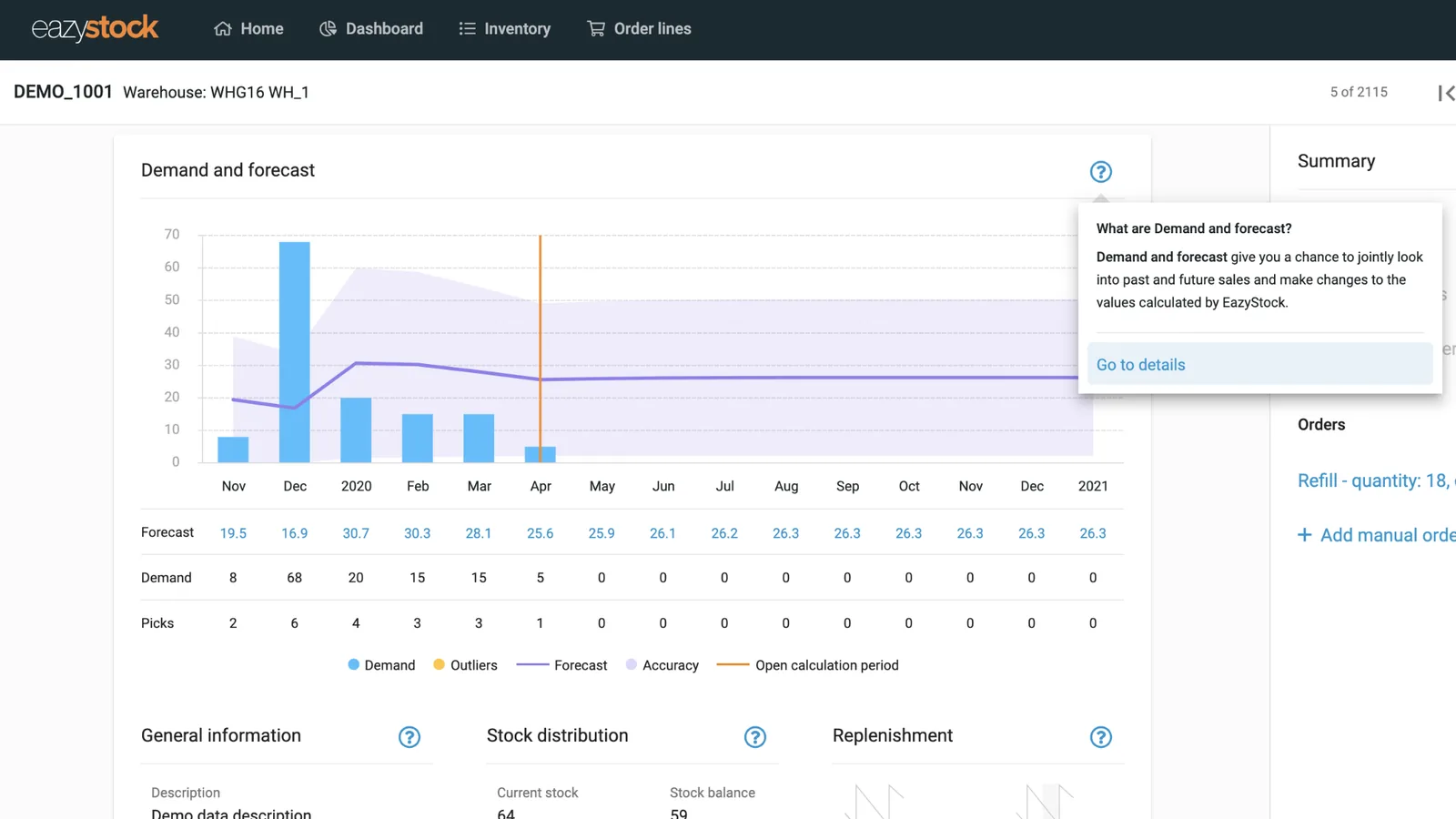
EazyStock is an AI inventory optimization tool for small and mid-sized wholesalers, distributors, and retailers. It works the way Netstock does, as a layer on top of your ERP, but it updates forecasts daily. It doesn't list a Shopify connector, so it only suits a Shopify brand with an ERP behind the store.
Key Features
- Stocking policies calculate reorder points, safety stock, and min/max levels from the service level you choose
- Its forecasts are tuned to each product's lifecycle stage and account for seasonality, trends, and promotions
- Multi-location planning covers a single warehouse or several
Pricing
No public pricing. EazyStock bills annually, and monthly billing costs 10% more.
Rating
4.7/5 (Capterra, 3 reviews)
Pros
- It spots seasonal items automatically, even slow movers
- Planned promotions feed into the forecast
- New items get forecasts from similar products
Cons
- Quote-only pricing makes costs hard to compare upfront
- If your ERP isn't on its pre-built list, connecting it may need extra development
- Capterra lists a starting price of $750/month, well above the entry prices of the Shopify-native apps
Selection Criteria
The tools above were judged the same way, and the steps below help you match them to how you run your business.
How We Evaluated
To see which tools could replace Netstock for a Shopify brand, we compared them on five factors:
- Forecasting: Per-variant, per-location forecasts that handle seasonality, promotions, and stockouts
- Replenishment: Reorder dates that respect lead times, safety stock, and MOQs
- Purchasing: Creating, sending, and receiving POs in the tool
- Shopify Fit: A direct connection and whether stock syncs back
- Pricing and Setup: Published prices, contract terms, and time to a first plan
How to Choose
There's no single best alternative, only the best fit for where your data lives and how you sell. Find the situation below that sounds most like yours.
- If Shopify holds your orders and stock, you’ll want a Shopify-native planner like Forstock, Prediko, or Fabrikatör. Pick Forstock if you plan many variants across several locations and want every reorder date explained.
- If Amazon is a big share of your sales, look at Forstock or Flieber. Both read Amazon alongside Shopify and forecast each channel separately.
- If an ERP like NetSuite already runs your business, GMDH Streamline and EazyStock plug into it the way Netstock does.
- If you sell on backorder or preorder, opt for Fabrikatör which opens backorders against incoming purchase orders.
- If you're replacing your inventory system anyway, consider Cin7 Core. It runs stock and purchasing in one place, with AI forecasting as an add-on.
Whichever tool you lean toward, weigh its price against the time it saves. If you spend four hours a week on reorder spreadsheets, that's more than 200 hours a year.
Start With Where Your Data Lives
Netstock makes sense when an ERP already runs your business. If your data lives in Shopify, start with a tool that reads it directly. Then, judge it on the reorder dates it gives you in week one.
You can do that with Forstock today. Start a 14-day free trial with no credit card, and get your first plan the same day. Prefer a walkthrough? Book a 20-minute demo, and we'll connect your store on the call.
Frequently Asked Questions
What Do I Need to Rebuild When I Switch From Netstock?
If your orders live in Shopify, a Shopify-native planner can read your sales history directly. What you'll rebuild are the settings that live in your old tool: supplier lead times, MOQs, pack sizes, and safety stock rules. Note them down before you leave, and run both tools side by side for a few weeks to compare reorder dates.
Can Netstock Work With Shopify Through Cin7 Core?
It's an indirect route. Netstock connects to Cin7 Core, which syncs both ways with Shopify. So, a brand already on Cin7 Core can feed its Shopify sales into Netstock. Netstock doesn't describe that setup itself, so confirm it before you sign.
How Do You Calculate a Reorder Point?
Multiply your average daily sales by your supplier's lead time in days, then add your safety stock. A product selling 20 units a day with a 30-day lead time needs 600 units to cover the wait. Add 200 units of safety stock, and you reorder at 800. Planning tools recalculate this for every SKU as your sales and lead times change.