
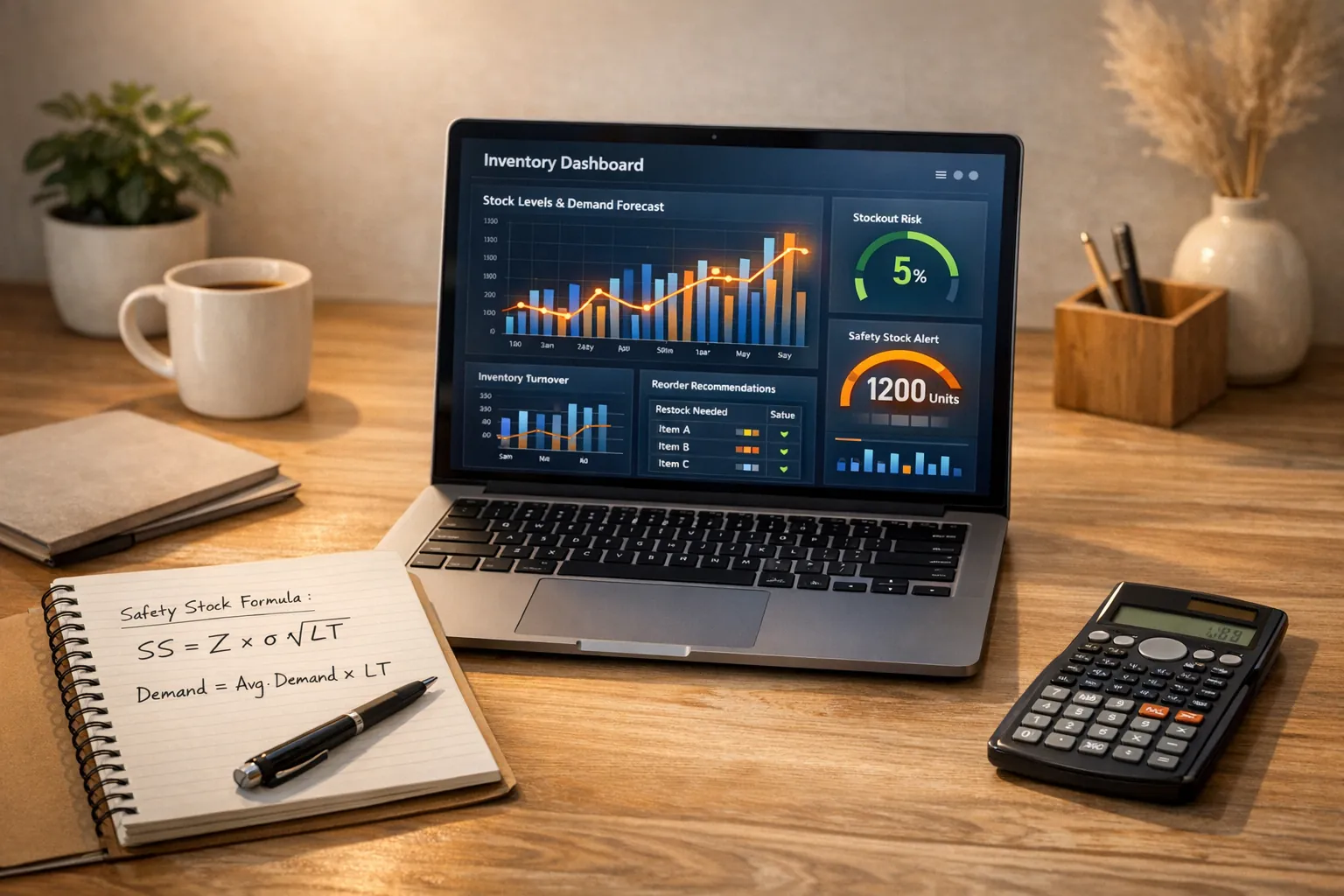
Safety stock is the buffer inventory that prevents stockouts and lost sales. Businesses traditionally use manual methods like spreadsheets and static formulas to calculate it. (See our guide on how to calculate safety stock for Shopify stores.) However, these approaches often fail to keep up with the unpredictable nature of modern supply chains. Enter AI: a data-driven solution that adjusts safety stock levels in real-time, factoring in demand trends, supplier reliability, and external conditions.
Here’s the bottom line:
- Manual methods rely on historical data and fixed assumptions, making them error-prone and labor-intensive.
- AI systems continuously analyze real-time data, improving forecast accuracy by up to 25%, cutting excess inventory by 10–30%, and reducing stockouts.
For Shopify brands juggling multiple SKUs or facing demand volatility, switching to AI can save time, lower costs, and improve inventory decisions.
AI Inventory Management: Predict Demand, Prevent Stockouts
What Are Manual Safety Stock Calculations?
Manual safety stock calculations rely on fixed formulas and historical data to determine how much extra inventory a business should keep on hand. These methods use past sales averages, lead times, and straightforward formulas to create a buffer against stockouts. Once calculated, the safety stock levels remain static until someone manually updates them.
Most manual methods assume demand follows a "Normal Distribution" (a bell curve), but real-world demand often doesn’t behave this way. Unexpected supply chain disruptions, viral social media trends, or even competitors leaving the market can cause demand spikes that these formulas don’t account for. This can lead to either running out of stock or tying up too much cash in excess inventory. Let’s take a closer look at the most common manual methods.
Common Manual Safety Stock Methods
Different manual formulas suit different business needs. Here’s a breakdown of some widely used methods:
-
Average-Max Method: This approach calculates safety stock with the formula:
(Maximum Daily Usage × Maximum Lead Time) – (Average Daily Usage × Average Lead Time).
It’s helpful for businesses dealing with large demand fluctuations. -
Standard Deviation Method: This method uses statistical probability and the formula:
Z-score × Standard Deviation of Demand × √Lead Time.
The Z-score reflects the desired service level (e.g., 1.65 for 95% stockout protection). Common Z-scores include 1.28 for 90%, 1.65 for 95%, and 2.33 for 99%. - Fixed Safety Stock: This method maintains a set inventory level, such as two weeks’ worth of supply, regardless of demand variability. While simple, it risks overstocking slow-moving products and understocking items with unpredictable demand.
-
Heizer and Render's Formula: This formula focuses on lead time variability and uses:
Z-score × Standard Deviation in Lead Time. -
Greasley's Method: A more comprehensive formula that factors in both demand and lead time variability:
Z-score × Standard Deviation in Lead Time × Average Demand.
| Method | Best Used For | Primary Formula |
|---|---|---|
| Average-Max | Large demand fluctuations | (Max Usage × Max LT) - (Avg Usage × Avg LT) |
| Standard Deviation | Service level targeting | Z × σd × √LT |
| Fixed Safety Stock | Simple, consistent demand scenarios | Avg Daily Usage × Desired Days |
| Heizer & Render | Supplier or lead time variability | Z × σLT |
| Greasley's | Demand and lead time variability | Z × σLT × Avg Demand |
Limitations of Manual Safety Stock Calculations
Manual safety stock calculations can quickly become overwhelming, especially for businesses managing hundreds or thousands of SKUs. Each product requires its own calculation, and these numbers need regular updates to reflect changes in sales trends, supplier performance, or market conditions. For growing Shopify brands, this workload can become unmanageable.
Human error is another challenge. Mistakes in data entry, incorrect Z-scores, or outdated inputs can lead to costly outcomes like excessive carrying costs or frequent stockouts. On average, holding additional inventory costs 15% to 30% of the item’s value annually.
"Optimizing Safety Stock levels by calculating the magical balance of minimal inventory while meeting variable customer demand is sometimes described as the Holy Grail of inventory management."
– Dave Piasecki, Owner/Operator, Inventory Operations Consulting LLC
Manual methods also struggle to keep up with sudden market shifts. Since they rely on historical data, they’re inherently reactive. By the time safety stock levels are recalculated, businesses may have already lost sales or unnecessarily tied up cash.
Seasonality adds another layer of complexity. While methods like the Average-Max formula work well in average conditions, they don’t automatically adjust for predictable spikes like holiday shopping or back-to-school seasons. Businesses need to manually update stock levels ahead of these periods, a step that’s easy to overlook when managing multiple products. Using AI for seasonal demand and lead time adjustments ensures these shifts are handled automatically.
"Supply problems tend to be related more to a vendor than an item, and the severity of the variations do not fall into the pattern of a normal distribution."
– Dave Piasecki, Owner, Inventory Operations Consulting LLC
Finally, manual processes often rely on scattered data. Sales figures might be in Shopify, supplier lead times in email threads, and historical calculations in Excel. Pulling all this information together for accurate calculations is labor-intensive. On the other hand, AI-driven solutions can integrate real-time data and adjust automatically, eliminating the need for constant recalculations.
These challenges highlight why many businesses are automating safety stock with AI to create more dynamic, responsive systems.
What Are AI Safety Stock Calculations?
AI uses real-time data to calculate optimal safety stock levels, moving beyond the static formulas of traditional methods that require manual updates. These systems continuously adjust to changes by analyzing factors like demand trends, supplier reliability, seasonality, and market conditions - all at the same time and often across thousands of variables.
Unlike traditional approaches that rely heavily on historical data, AI forecasts what’s likely to happen next and explains why.
"AI safety stock optimization involves machine learning algorithms to dynamically calculate and adjust buffer inventory levels based on real-time demand patterns, supplier variability, and market conditions."
– Netstock
AI also handles complexities that manual methods struggle with, such as identifying how products influence each other’s demand. It adjusts inventory levels accordingly, making it a game-changer for inventory management. By 2026, an estimated 90% of supply chain executives plan to integrate AI assistants and automation into their workflows.
How AI Models Calculate Safety Stock
AI models integrate a wide range of data sources with advanced algorithms to determine safety stock levels. These systems combine internal data - like historical sales, current inventory, and website traffic - with external signals, such as weather forecasts, social media trends, economic indicators, and geopolitical events.
Some of the key algorithms used include:
- Long Short-Term Memory (LSTM) networks for predicting demand fluctuations.
- Neural networks to capture complex demand drivers.
- Stochastic optimization to model uncertainties like supplier delays.
AI models rely on probabilistic distributions that adapt to real-world market behaviors, including sudden shifts and multi-modal patterns. One standout feature is streaming analytics, which continuously monitors demand signals and supplier performance. For example, if a supplier consistently misses delivery deadlines, AI automatically updates safety stock levels to account for this variability.
Real-world examples highlight the impact of AI-driven forecasting. In 2025, Novolex, a packaging manufacturer, reduced excess inventory by 16% and shortened planning cycles from weeks to days by combining historical sales data with external market insights. Similarly, Idaho Forest Group slashed its forecasting time from over 80 hours to under 15 hours using AI tools.
AI also enables multi-echelon optimization, calculating inventory needs across an entire supply chain rather than treating each warehouse or product line separately. This approach prevents situations where one location has surplus stock while another faces shortages.
Benefits of AI-Powered Safety Stock Methods
AI-powered safety stock methods bring better accuracy, cutting forecasting errors by up to 50%. This leads to fewer stockouts and reduced excess inventory. Companies using AI for inventory optimization often achieve a 10–20% improvement in service levels and "On-Time In-Full" (OTIF) performance.
Another advantage is scalability. While manual methods become unmanageable when dealing with thousands of SKUs, AI handles even millions of products with ease. Unlike traditional formulas that require periodic updates, AI continuously adapts as new data comes in. This makes it invaluable during unexpected events like supply chain disruptions or viral trends that cause sudden demand spikes.
From a financial perspective, AI helps reduce risks on both ends of the spectrum. Stockouts can cost businesses 3–5% of annual revenue due to lost sales and emergency shipping, while excess inventory carries annual costs of 20–30% for storage, insurance, and obsolescence. By maintaining precise buffer levels, AI minimizes these risks.
"This ability to 'predict the unpredictable' distinguishes AI from traditional forecasting methods, which usually falter without long data histories."
– IBM Think
AI also frees up time for more strategic tasks. Instead of spending hours updating spreadsheets, inventory managers can focus on building supplier relationships, refining product strategies, and driving growth. Top-performing supply chains use AI at more than twice the rate of their lower-performing counterparts, giving early adopters a clear competitive edge.
This dynamic capability of AI sets the stage for a deeper comparison with traditional methods in the next section.
Manual vs. AI: A Side-by-Side Comparison
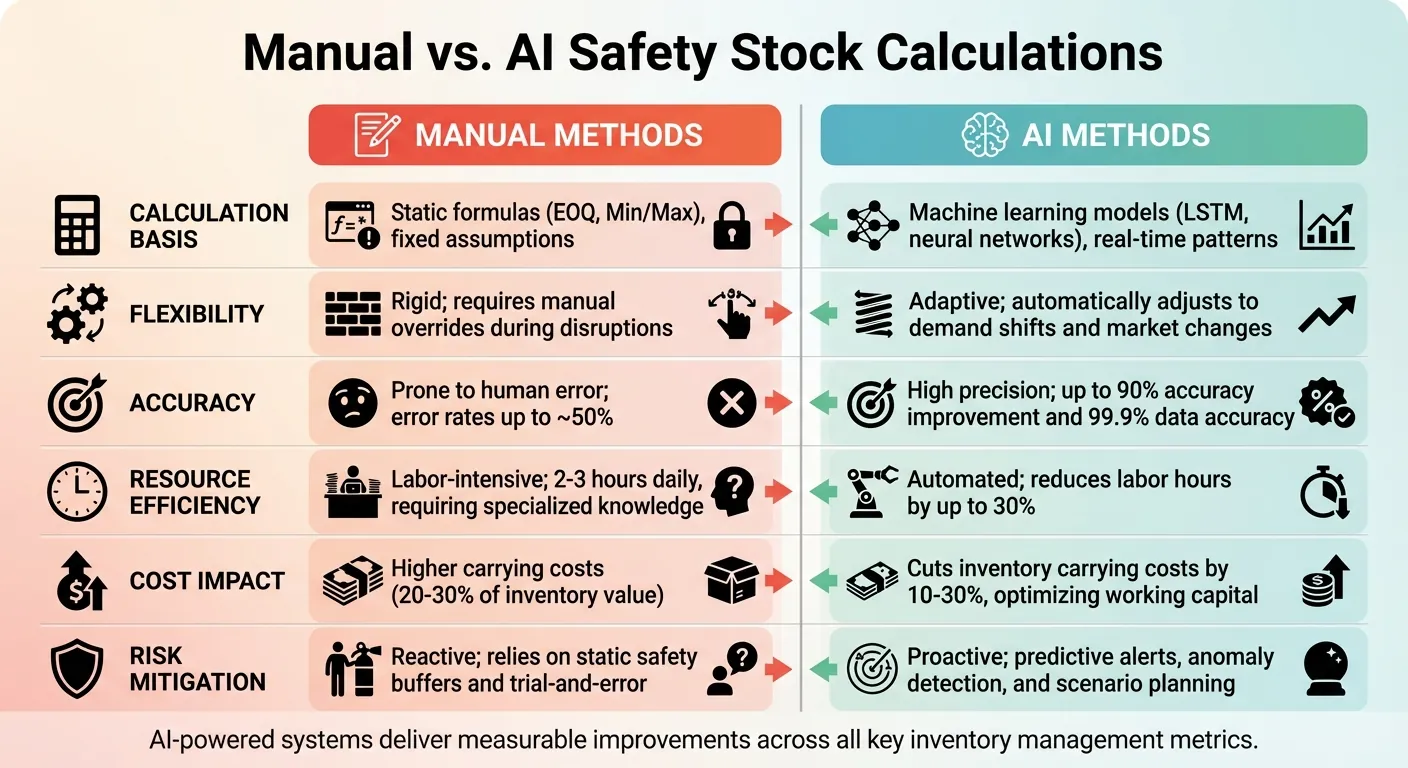
Manual vs AI Safety Stock Calculations: Key Differences and Benefits
Manual safety stock calculations depend on static formulas and historical averages that fail to adjust when market dynamics change. These methods require constant human intervention to accommodate shifts, making them labor-intensive and less responsive. On the other hand, AI uses machine learning to process real-time data and external factors - like weather patterns or social media trends - to automatically refine safety stock levels as conditions evolve. This difference highlights a key distinction in accuracy and adaptability.
When it comes to accuracy, the gap between manual and AI methods is striking. Traditional manual systems often suffer from human errors, leading to error rates as high as 50%. AI systems, however, automate data collection using IoT sensors and advanced algorithms, achieving up to 99.9% accuracy while reducing forecasting mistakes by 20–50%. In fact, AI-driven demand forecasting has been shown to improve accuracy by as much as 90%.
"Traditional rule-based solutions that were once a dependable way to maintain control are starting to show cracks."
– Netstock
Beyond accuracy, AI also outshines manual methods in cost and resource efficiency. Manual systems can drive up inventory holding costs to 20–30% of the inventory's value, while AI reduces these costs by 10–30%. Labor is another factor - manual tracking can take 2–3 hours each day, whereas AI automates these tasks, cutting labor hours by up to 30%. A real-world example of this is Walmart's 2024 adoption of real-time analytics, which led to a 15% decrease in stockouts by dynamically adjusting safety stock levels based on sales data and lead time variability.
In terms of risk management, manual approaches are typically reactive, relying on static safety buffers and trial-and-error adjustments. AI flips the script by being proactive, using predictive analytics and anomaly detection to foresee disruptions before they occur. This proactive approach has allowed AI-powered systems to reduce inventory shrinkage to less than 0.1%, compared to the industry average of 1.6%.
The table below captures these distinctions clearly:
Comparison Table
| Feature | Manual Methods | AI Methods |
|---|---|---|
| Calculation Basis | Static formulas (EOQ, Min/Max), fixed assumptions | Machine learning models (LSTM, neural networks), real-time patterns |
| Flexibility | Rigid; requires manual overrides during disruptions | Adaptive; automatically adjusts to demand shifts and market changes |
| Accuracy | Prone to human error; error rates up to ~50% | High precision; up to 90% accuracy improvement and 99.9% data accuracy |
| Resource Efficiency | Labor-intensive; 2–3 hours daily, requiring specialized knowledge | Automated; reduces labor hours by up to 30% |
| Cost Impact | Higher carrying costs (20–30% of inventory value) | Cuts inventory carrying costs by 10–30%, optimizing working capital |
| Risk Mitigation | Reactive; relies on static safety buffers and trial-and-error | Proactive; predictive alerts, anomaly detection, and scenario planning |
This comparison underscores how AI not only streamlines processes but also delivers measurable improvements in accuracy, efficiency, and risk management.
sbb-itb-f0fc809
How Forstock Improves AI Safety Stock Calculations

Forstock takes the guesswork out of inventory management by replacing static spreadsheet formulas with real-time inventory adjustments. Instead of sticking to rigid "min-max" thresholds, the platform continuously recalculates safety stock levels using up-to-the-minute demand and lead time data from your Shopify store. This ensures that your inventory buffers stay aligned with current trends and conditions.
What sets Forstock apart is its ability to analyze multiple variables at once, such as seasonality, price elasticity, and marketing campaigns. For instance, if you're running a flash sale or introducing a new product variant, Forstock’s AI detects the demand surge and adjusts safety stock levels for the affected SKUs. This level of precision ensures that each product variant - whether it’s a specific size, color, or bundle - gets its own tailored calculation instead of being grouped into broad averages.
"AI safety stock optimization involves machine learning algorithms to dynamically calculate and adjust buffer inventory levels based on real-time demand patterns, supplier variability, and market conditions." – Netstock
When inventory reaches the AI-calculated reorder point, Forstock goes a step further by automatically generating purchase orders with accurate quantities and timing. This automation significantly reduces the manual workload, allowing inventory managers to focus on higher-value tasks. The system also tracks supplier performance - monitoring factors like lead times and fill rates - and feeds this data back into its calculations to account for unreliable vendors. Shopify merchants using AI forecasting have seen an 80% reduction in time spent on planning and a 15–25% drop in stockouts.
To get the most out of Forstock's dynamic system, it's recommended to have 6–12 months of clean sales data and a synced marketing calendar. This enables more accurate demand forecasting. The platform’s unified dashboard offers a 12-month demand overview across all locations, further boosting the real-time accuracy and operational efficiency of AI-driven inventory management.
When Shopify Brands Should Switch to AI

For Shopify brands, the moment to consider AI often comes when manual processes start falling short. When inventory planners are stuck putting out fires instead of focusing on growth, it’s a clear sign that traditional methods just aren’t cutting it anymore.
Another tipping point is when your product catalog grows more complex. Managing hundreds - or even thousands - of SKUs across multiple locations with spreadsheets can lead to outdated data and costly errors. AI, on the other hand, reduces these risks. In fact, 75% of companies using AI-driven planning tools have uncovered inventory opportunities exceeding $50,000.
Expanding into multichannel sales adds another layer of difficulty. Selling on Shopify, Amazon FBA, and in physical stores often creates inventory silos and drives up costs like markdowns and Amazon fees. AI can help cut these expenses by up to 40%.
"Before switching to automated inventory software, tracking purchase orders by hand was a 'nightmare' - the transition enabled her team to know exactly when to place orders for each brand and accurately track back‐ordered products." – Stephanie Parks, CEO, DermWarehouse
Unpredictable factors like supplier issues, fluctuating lead times, tariff changes (which impact 63% of small and medium-sized businesses), and viral demand surges also call for a more flexible approach. Static formulas often fall short in these situations. AI has proven its value here, too. For example, Bargreen Ellingson reduced excess inventory by $2 million, boosted their fill rate for high-turn items by 5%, and cut stockouts to one-third of previous levels after adopting AI-driven optimization.
To make the switch, brands should take a strategic approach. Start with a data readiness audit: gather 6–12 months of clean sales history, ensure product information is accurate, and confirm reliable lead times. Then, test AI solutions on a subset of SKUs to measure ROI before scaling up.
Conclusion
The way safety stock is calculated - manually or with AI - can make or break a business's competitive advantage. Manual methods rely on rigid formulas that struggle to adapt to sudden changes in demand or unexpected supplier delays. On the other hand, AI dynamically adjusts by analyzing a wide range of factors, creating buffers that help avoid both stock shortages and surplus inventory.
AI-driven inventory planning delivers measurable benefits: it can cut excess inventory by $2 million, reduce forecasting errors by 50%, and reveal opportunities valued between $50,000 and $160,000. In contrast, manual systems often leave teams scrambling to manage crises. These numbers highlight why scalable, intelligent solutions are critical in today’s complex inventory environment.
For Shopify brands juggling intricate catalogs across multiple sales channels, scalability is a constant challenge. Forstock addresses this by embedding AI directly into your Shopify processes, automating replenishment and alerting you to inventory risks before they escalate.
"AI is no longer a luxury – it's becoming essential for scalable success." – Netstock
Shifting from reactive to proactive inventory management is no longer optional - it’s becoming a necessity. Brands that continue to rely on manual approaches risk falling behind with slower, less efficient operations. AI doesn’t replace human decision-making; it amplifies it, providing the speed and insights required to navigate today’s unpredictable markets.
FAQs
How does AI make safety stock calculations more accurate than manual methods?
AI takes safety stock calculations to a new level by leveraging machine learning models that analyze real-time demand patterns. Unlike traditional methods that rely on static formulas or historical averages, AI adapts to the ever-changing factors that influence inventory needs. Manual approaches often fall short because they depend on fixed inputs like past sales or lead times, leaving businesses vulnerable to unexpected events like sudden sales spikes, promotional campaigns, or supplier delays.
AI-powered systems, on the other hand, process a wide range of data continuously. They factor in sales trends, seasonal fluctuations, supplier reliability, and even external events to dynamically adjust safety stock levels. This ensures inventory aligns more closely with actual demand, reducing the risks of overstock or stockouts. For Shopify brands, tools like Forstock integrate AI to simplify inventory management, freeing up merchants to focus on growing their business instead of wrestling with manual calculations.
What are the key advantages of using AI for managing safety stock in Shopify stores?
AI-powered safety stock management brings a host of benefits to Shopify merchants.
First, it improves forecast accuracy by analyzing real-time data like sales trends, lead times, and seasonal patterns. By doing so, it helps brands avoid stockouts and overstocking, ensuring inventory levels stay balanced and cash flow remains steady.
Second, AI takes over repetitive tasks such as generating reorder recommendations, creating purchase orders, and updating demand plans. This not only cuts down on manual work but also reduces the chances of human error, giving merchants more time to focus on strategic priorities.
Lastly, AI is highly adaptable for businesses with extensive or complex product catalogs. It dynamically adjusts safety stock as market conditions shift, allowing brands to respond quickly to changes in demand. These advantages help Shopify merchants cut costs, prevent missed sales opportunities, and channel their energy into growing their business with confidence.
How can businesses switch from manual to AI-driven safety stock calculations effectively?
Switching to AI-driven safety stock calculations begins with getting your data in order. Make sure your historical sales, lead times, promotions, and supplier performance data are clean, complete, and consistently formatted. For example, use MM/DD/YYYY for dates and U.S. dollars for monetary values. This level of organization is crucial for the AI to deliver accurate forecasts.
Next, select an AI platform that works seamlessly with your current systems to automate data collection and forecasting. Start small - test the AI on a few high-volume products. Compare its recommendations to your existing manual calculations to see where it improves stock levels and reduces issues like stockouts or overstocking.
Once you’re confident in the results, expand the system to cover your entire inventory. Use the AI to automate routine tasks like creating purchase orders and coordinating with suppliers. To keep the system accurate, regularly review the AI’s suggestions and adjust for factors like market shifts or supplier changes. Over time, this approach can help you cut down on excess inventory, boost cash flow, and avoid costly errors.