
7 Multi-Location Inventory Metrics to Track
Seven location-level inventory KPIs to prevent stockouts, cut carrying costs, and improve reorder accuracy across multiple warehouses and stores.

7 Multi-Location Inventory Metrics to Track
Managing inventory across multiple locations can be challenging without the right data. Tracking these seven metrics can help you avoid stockouts, reduce overstock, and improve overall efficiency:
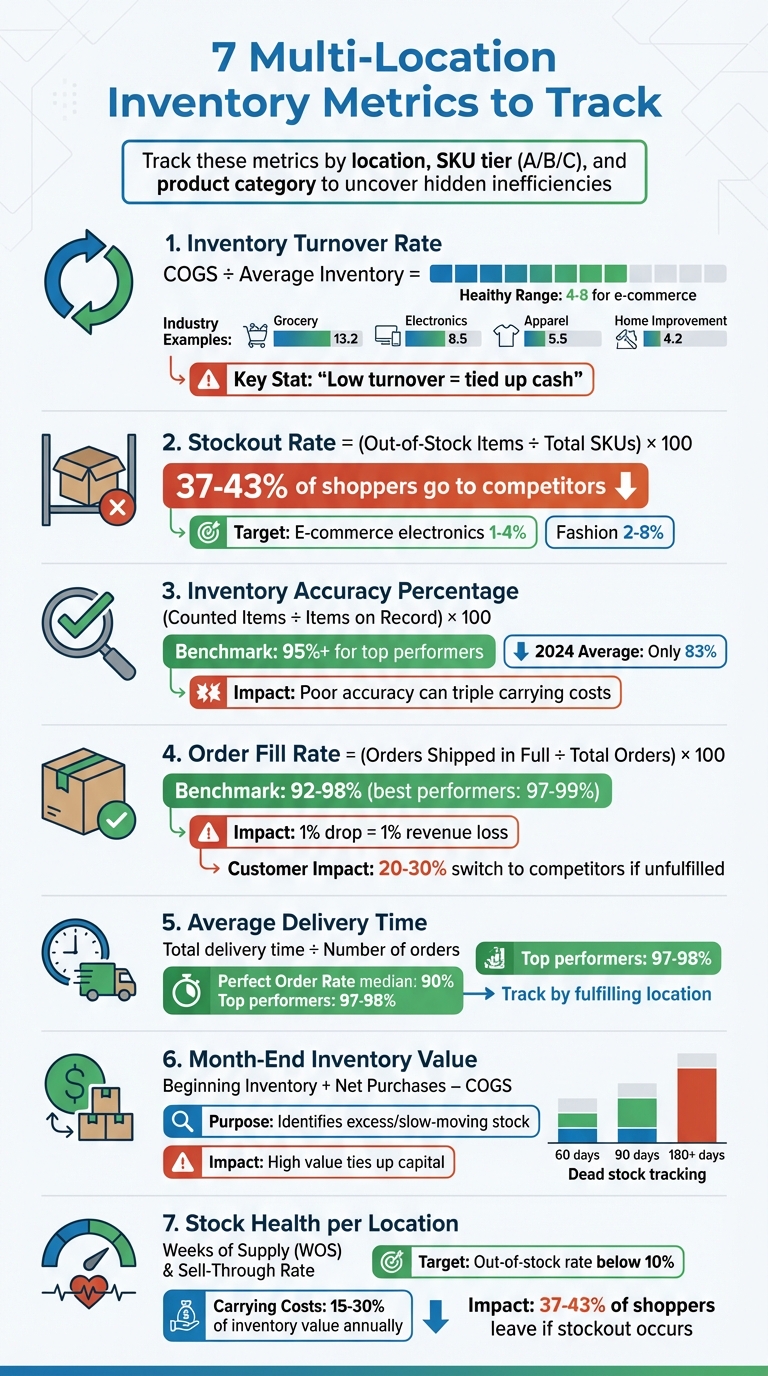
- Inventory Turnover Rate: Measures how often stock is replenished annually. Low turnover signals inefficiency; high turnover may indicate stockouts.
- Stockout Rate: Tracks how often items are unavailable. High rates drive customers to competitors.
- Inventory Accuracy Percentage: Compares recorded stock to actual stock. Errors inflate costs and disrupt operations.
- Order Fill Rate: Shows the percentage of orders fulfilled immediately. Falling rates mean lost sales.
- Average Delivery Time: Monitors how long orders take to reach customers. Long times reduce satisfaction.
- Month-End Inventory Value: Calculates the total value of unsold stock. High values tie up cash flow.
- Stock Health per Location: Evaluates how well inventory meets demand, identifying overstock or shortages.
These metrics provide location-specific insights, helping businesses optimize inventory, cut costs, and maintain customer satisfaction. Tools like Forstock can simplify tracking by offering real-time visibility and AI-driven forecasting.
7 Essential Multi-Location Inventory Metrics to Track for Business Success
Guide to Multi-Location Inventory Management in Warehouses
sbb-itb-f0fc809
1. Inventory Turnover Rate
The inventory turnover rate tells you how efficiently each location manages its stock - a key metric in multi-location inventory analytics. It reflects how often a business replenishes its inventory over the course of a year. The formula is straightforward: divide your Cost of Goods Sold (COGS) by your average inventory (calculated as the average of beginning and ending inventory).
In multi-location operations, a solid overall turnover rate can sometimes hide inefficiencies at individual locations. For example, one location might turn its inventory 12 times a year, while another only manages 1.5 turns. This disparity can create serious issues, such as tying up cash in slow-moving inventory, increasing storage costs, and limiting the ability to reinvest in other areas.
"A 5.0 inventory turnover across your whole catalogue sounds respectable. But dig one level deeper and you might find... the aggregate hides the problem." – VNDLY
For e-commerce, a healthy turnover ratio typically falls between 4 and 8, meaning inventory is refreshed every 1.5 to 3 months. However, benchmarks differ by industry. In 2025, grocery businesses averaged 13.2 turns per year, consumer electronics 8.5, apparel 5.5, and home improvement 4.2. It's crucial to calculate turnover using COGS, not sales revenue, to avoid inflated ratios that misrepresent performance.
If a location's turnover is low, consider reducing replenishment levels or offering targeted discounts to move inventory faster. On the other hand, if turnover is unusually high, increasing safety stock for fast-moving items can help avoid stockouts. A great example comes from the UK-based craft brand Babymaxi. In 2025, the company switched from a single warehouse to multiple 3PL providers. By implementing real-time visibility across locations, Babymaxi successfully tracked stock movement for hundreds of SKUs and maintained balanced turnover across its distributed network.
Analyzing turnover rates by location provides valuable insights into stock efficiency. It also sets the stage for addressing other inventory metrics, helping businesses make smarter, data-driven decisions.
2. Stockout Rate
Tracking stockout rates is essential for understanding whether your locations are consistently meeting customer demand. This metric measures how often products are unavailable, using the formula: (Count of Out-of-Stock Items ÷ Total SKUs) × 100. It provides a clear picture of whether you're satisfying your customers or inadvertently sending them to competitors.
And the impact? It's significant. Studies indicate that 37–43% of shoppers encountering a stockout will head straight to a competitor, leading to lost revenue and eroding customer loyalty. For businesses with multiple locations, relying solely on an aggregate stockout rate can be misleading. A seemingly low overall rate might hide the fact that certain locations frequently run out of best-selling items.
To stay competitive, different industries set specific benchmarks. For example, top-performing e-commerce electronics brands aim for stockout rates between 1–4%, while fashion retailers typically target 2–8%. However, inaccurate inventory counts can inflate stockout rates unnecessarily. Maintaining inventory accuracy above 95% through regular cycle counts is critical to avoiding such issues.
Reducing stockouts starts with prioritizing your most important products. Using ABC analysis helps identify high-value SKUs, allowing you to increase safety stock levels for these key items. For instance, set up alerts for A-class items that remain at zero for more than 24 hours. If stockouts seem to occur at the same time each month, it might point to a flaw in your reorder points rather than just a supply issue. Predictive metrics can also enhance your replenishment strategy by identifying patterns before they lead to shortages.
More businesses are now adopting a proactive approach by tracking "Days of Inventory Remaining." This predictive metric, calculated as Current Stock ÷ Average Daily Sales, estimates how many days remain before a stockout occurs. It allows you to reorder in advance, keeping inventory levels steady. A practical guideline is to set reorder points at "Lead Time + 7 days" for urgent items and "Lead Time + 14 days" for standard ones. This buffer helps mitigate supply chain variability and ensures products are consistently available.
3. Inventory Accuracy Percentage
Inventory Accuracy Percentage measures how closely your recorded stock matches the actual stock on hand. The formula is simple: (Counted Items ÷ Items on Record) × 100. Alternatively, you can use [1 – (Total Absolute Variance ÷ Total Recorded Inventory)] × 100 to account for both overages and shortages.
In 2024, the average inventory accuracy rate was only 83%, while top-performing organizations consistently reached 95% or more. That difference is critical - poor accuracy can triple carrying costs. When managing multiple warehouses or retail locations, even minor errors can escalate quickly. For instance, a facility operating at 95% accuracy might spend 10–15 hours each week searching for misplaced items. This inefficiency could cost between $10,400 and $15,600 annually in labor alone.
One major problem is "ghost inventory", where items appear available in your system but don't physically exist at that location. This often leads to expensive overnight stock transfers, with rush shipping fees that are 3–5 times higher than normal rates.
Brad Bearden, Product Manager at Acctivate Inventory Software, highlights, "Inventory accuracy isn't just about knowing what you have in stock - it's about ensuring every item is correctly accounted for and ready when needed."
To improve accuracy, consider adopting regular cycle counts instead of relying solely on annual full counts. Use ABC analysis to focus on the most critical items: count high-value "A" items weekly, "B" items monthly, and "C" items quarterly. Implementing barcode scanning at every step can improve accuracy by 3–7 percentage points. Standardize procedures across all locations to ensure consistent inventory practices. When discrepancies arise, investigate the root causes - whether it's data-entry errors, theft, or spoilage - rather than just adjusting the numbers. A consistent process is essential to maintaining high accuracy.
For businesses with multiple locations, Inventory Location Accuracy is another key metric. This is calculated as (Items in Correct Spot ÷ Total Items Checked) × 100. It ensures that items are stored where your system says they should be. To improve this, use clear signage, logical warehouse layouts, and a "one-touch" putaway rule - where incoming stock is immediately scanned and stored correctly. This prevents items from being left undocumented in receiving areas.
4. Order Fill Rate
Order Fill Rate tracks how effectively you can fulfill orders immediately from your current stock. It’s a straightforward yet crucial metric for balancing customer satisfaction and financial health across various locations. The formula is simple: (Total Orders Shipped in Full ÷ Total Orders Placed) × 100. For instance, if you receive 500 orders and fully ship 470 of them, your fill rate would be 94%.
"Basically, a fill rate is your ability to say 'yes, we have it!' when an order comes in", says Faisel Azeez, Co-Founder & CTO at Carriyo.
Ecommerce benchmarks for fill rates typically range between 92% and 98%, with the best-performing operations hitting 97–99%. But aiming for a perfect 100% fill rate might not be ideal - it could mean you're overstocking vs. stockouts, which drives up holding costs. The stakes are high: a 1% drop in your fill rate can cut annual revenue by up to 1%, and about 20–30% of customers might turn to competitors if their orders aren’t fulfilled.
For businesses managing multiple locations, this metric can highlight issues in inventory distribution. If one facility consistently outperforms another, it could signal that inventory isn’t matching local demand. Problems like these often stem from inaccurate demand forecasting or inefficient distribution systems. By focusing on location-specific fill rates, you can identify and fix gaps. For example, setting reorder points based on local demand patterns or analyzing fill rates for individual SKUs can reveal which high-demand products are causing stockouts.
Another approach to maintaining strong fill rates is adopting ship-from-store strategies. This involves using retail store inventory to fulfill online orders when your main distribution center is out of stock. It’s a practical way to keep fill rates high without overstocking any single location. Regularly monitoring fill rates - whether weekly or monthly - can also help you spot regional stockout trends before they escalate. Distributing inventory across multiple regional hubs has been shown to improve fill rates by 5–10%.
Parisa Sadrzadeh, Senior Vice President of Omnichannel Fulfillment at Flexport, highlights: "Operations is critical to building brand trust and loyalty with consumers. If your products are constantly out of stock, you'll lose sales and customers".
Keeping fill rates optimized across all locations is essential for maintaining consistent inventory performance and customer trust.
5. Average Delivery Time
Average Delivery Time measures how long it takes from when an order is placed to when it’s delivered. It’s calculated by dividing the total delivery time by the number of orders. For businesses with multiple locations, it’s important to break this metric down by the fulfilling location. This helps pinpoint which warehouses or stores might be slowing things down. Identifying these bottlenecks is crucial since they can directly impact customer satisfaction.
This metric plays a big role in both customer happiness and revenue. For instance, the industry median for the Perfect Order Rate - which includes on-time delivery - hovers around 90%, while top-performing consumer electronics brands reach an impressive 97–98%. On the flip side, 37–43% of shoppers are likely to jump ship to a competitor if delivery expectations aren’t met.
"Inventory visibility becomes less about counting units and more about knowing what's actually available, where, and right now", says Bhoomi Singh at Sumtracker.
One of the biggest factors in delivery speed is how close the fulfillment location is to the customer. Shipping from a faraway warehouse when there’s stock available locally only adds unnecessary delays. This is where real-time inventory syncing comes in - it ensures orders are routed to the nearest location with stock. To make this work, switch to event-based inventory updates that refresh instantly instead of relying on slower batch processes.
It’s also a mistake to look at Average Delivery Time as a single, overall number. A good average might mask underperformance at a specific warehouse. Stay on top of your A-class SKUs by monitoring them daily and keeping high-demand items stocked near your busiest customer regions. Regular physical stock audits are another must - they help prevent delays caused by "phantom inventory", where the system shows an item as available, but it’s actually out of stock on the shelves.
6. Month-End Inventory Value
Month-end inventory value represents the total worth of unsold stock at the end of a given period. It’s calculated using this formula: Beginning Inventory + Net Purchases – COGS. For businesses operating across multiple locations, it’s important to calculate this value for each site. Doing so allows you to compare performance and identify locations burdened with excess or slow-moving inventory. This insight can be a game-changer for managing cash flow effectively.
When inventory value is high, it ties up capital in unsold products. This impacts your operating costs and profit margins since inventory is a major asset on your balance sheet. It also plays a role in evaluating gross profit and financing options.
Tracking these values can also help you spot dead stock and its impact on cash flow - items that remain unsold for 60, 90, or even 180 days. If your ending inventory consistently surpasses your net income for the same period, it might indicate overstocking. Using AI analytics to reduce dead stock can help mitigate these risks. For example, during the pandemic, Hasbro faced challenges with excess inventory and delayed write-downs. This not only distorted their financial performance but also led to legal action from investors.
"Completing a full physical inventory count is the best way to calculate your ending inventory and start the new year on the right foot."
- Jara Moser, Digital Marketing Manager at Shopventory
To get an accurate picture of your inventory value, remember to include landed costs - expenses like shipping, duties, and freight - along with the base purchase price. This ensures your profit margins reflect the true cost of goods. Additionally, stick with one inventory valuation method (such as FIFO, LIFO, or Weighted Average) throughout the year. Switching methods mid-period can lead to inconsistent reporting and might even require formal IRS approval. Regular physical audits at each location are also essential. Research shows that inventory valuation errors account for 60% of inaccuracies in financial reporting.
7. Stock Health per Location
Stock health evaluates how well inventory at each location turns into profit. It’s a balancing act - keeping enough stock to meet customer demand while avoiding tying up money in slow-moving or inactive items.
Looking at overall metrics can hide location-specific problems. For instance, a solid company-wide turnover rate might obscure the fact that one warehouse is overloaded with inventory, while another deals with constant stockouts. Key metrics like Weeks of Supply (WOS) and Sell-Through Rate are critical for pinpointing these issues. WOS is calculated by dividing the inventory on hand by the average weekly sales forecast, showing how long it will take a location to sell out. On the other hand, a low sell-through rate often signals overstocking relative to local demand.
"The aggregate hides the problem. Always track KPIs by SKU tier (A/B/C), by product category, and by location if you operate multiple warehouses."
- VNDLY
Tracking WOS and sell-through rates helps uncover these hidden issues. Retailers should aim for an out-of-stock rate below 10% to maintain customer loyalty and minimize lost sales. Studies show that 37% to 43% of shoppers encountering a stockout will turn to a competitor rather than wait for a restock. Additionally, inventory carrying costs - typically 15% to 30% of the total inventory value annually - can spiral if Days on Hand (DOH) is too high or turnover is sluggish. Spotting inactive stock early allows businesses to reallocate it to locations with higher demand, avoiding costly markdowns.
Take Baik Brands, for example. This retail group ditched manual spreadsheet tracking and adopted a centralized inventory system to manage thousands of SKUs across eCommerce, wholesale, and physical stores. With full visibility across all inventory locations and automated forecasting tools, they eliminated guesswork in purchasing and saved over 150 hours of administrative work each month. This centralized approach highlights how better visibility improves stock health. By understanding location-specific demand, businesses can prevent situations where one warehouse has excess stock while another loses sales due to shortages.
How Forstock Simplifies Multi-Location Inventory Tracking
Managing inventory across multiple locations can feel overwhelming, especially if you're relying on spreadsheets. Forstock takes that chaos and organizes it into a single, streamlined dashboard. It syncs real-time Shopify data to give you a clear picture of stock levels, risks, bestsellers, and deadstock across all your locations - all in one place.
Once your data is unified, Forstock's advanced filtering tools help you dig deeper. You can sort inventory by warehouse, category, or even date range to identify specific issues. For instance, one user discovered $70,000 worth of slow-moving stock at a single facility thanks to these filters.
"I open the dashboard in the morning and instantly know what needs reordering, what is overstocked, and what to focus on."
- Emily, Inventory Manager
Forstock also leverages AI-powered demand forecasting to transform how you make inventory decisions. Instead of reacting to stockouts or overstocking, you can predict demand with precision. The Reorder Table highlights which products need replenishing and even auto-generates customized purchase orders, factoring in demand trends, lead times, and seasonality.
"Forstock has been great. We're preventing stockouts that were costing us $50K monthly. The AI predictions are incredibly accurate."
- Matt, Operations Lead at TechGear
"The automated PO creation saves us 10+ hours weekly."
- Alexander, Supply Chain Manager at FashionCo
The results speak for themselves.
"We reduced excess inventory by 45% and freed up $150K in working capital."
- Jason, Co-founder at HomeGoods
Forstock's customizable views ensure that every team member gets the exact data they need, whether it’s inventory levels, stock health, or financial metrics. This shared access to accurate, location-specific data eliminates miscommunication and keeps everyone aligned. It’s a proactive way to manage inventory with a focus on key performance indicators, making multi-location management far more efficient.
Conclusion
Keeping track of these seven metrics - inventory turnover rate, stockout rate, inventory accuracy percentage, order fill rate, average delivery time, month-end inventory value, and stock health per location - brings clarity to multi-location inventory management. These insights help cut carrying costs (which often account for 15% to 30% of total inventory value annually), avoid lost sales (since 37% to 43% of shoppers turn to competitors when faced with stockouts), and improve cash flow by enabling smarter purchasing decisions.
The problem is that traditional spreadsheets can’t handle the complexity of managing multiple locations. To identify issues like overstock at one warehouse while another struggles with stockouts, you need to analyze data by SKU tier, product category, and individual warehouse.
This is where Forstock comes in. The platform automates the entire process, giving you real-time visibility across all locations through a single dashboard. With AI-driven forecasting and automated reorder suggestions, Forstock helps you make proactive decisions based on accurate data. Plus, its customizable views and proactive alerts free your team from spending time interpreting reports, allowing them to focus on taking action.
FAQs
Which inventory metrics should I track by location vs. company-wide?
To stay on top of your inventory game, keep an eye on location-specific metrics like stock levels, sales performance, demand trends, Days on Hand (DOH), inventory turnover, and reorder points. These insights help fine-tune operations at the local level.
At the same time, don't lose sight of the bigger picture. Track company-wide metrics such as aggregate inventory turnover, sell-through rate, and total stock-to-sales ratio. These numbers give you a clear snapshot of overall inventory health and efficiency.
By balancing these two perspectives, you can manage inventory effectively both on the ground and across the organization.
What’s the best way to set reorder points for each location?
When setting reorder points for different locations, focus on three key factors: sales velocity, lead time, and safety stock. These elements ensure you maintain the right inventory levels and avoid stockouts.
Here’s how to calculate it:
- Average daily sales: Determine how much of each product sells daily at each location.
- Lead time: Measure the time it takes for suppliers to deliver new stock.
- Safety stock: Account for unexpected demand spikes or delivery delays.
The formula to calculate reorder points is straightforward:
Reorder point = (Average daily sales × Lead time) + Safety stock
Make it a habit to review and update these numbers regularly to keep up with changing demand patterns at each location. This way, your inventory stays aligned with real-world needs.
How can I improve inventory accuracy across multiple locations fast?
To boost inventory accuracy across multiple locations, implement real-time tracking systems to instantly reflect updates like transfers and orders. A centralized dashboard can bring all your data together, making it easier to spot and correct errors. Automating tasks such as stock transfers and purchase orders adds another layer of precision. Regular physical counts help reconcile any discrepancies, while AI-powered tools can provide forecasting and alerts to prevent issues like stockouts or overstocking. These steps can help keep your inventory organized and dependable.
Keep reading
Try Forstock free for 14 days.
AI-powered demand forecasting and reorder automation for Shopify brands. No credit card required.