
Quick Summary
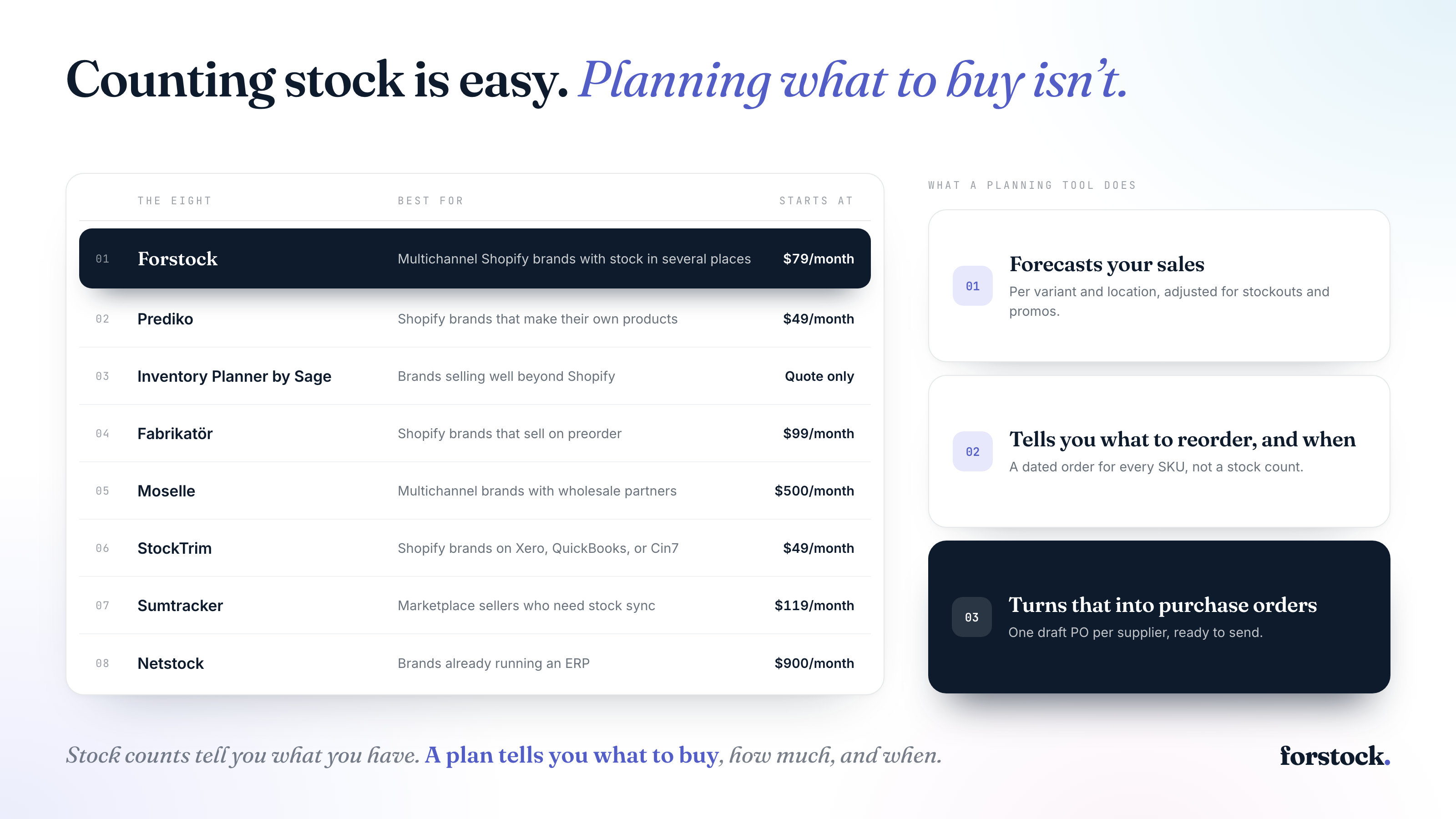
The best inventory planning tools forecast your sales, tell you what to reorder and when, and turn that into purchase orders. For growing ecommerce brands, our top picks are Forstock, Prediko, and Inventory Planner by Sage.
| Tool | Best for | Starting price |
|---|---|---|
| Forstock | Multichannel Shopify brands with stock in several places | $79/month |
| Prediko | Shopify brands that make their own products | $49/month |
| Inventory Planner by Sage | Brands selling well beyond Shopify | Quote only |
Knowing What's in Stock Is the Easy Part
Shopify already shows how many units of each variant you hold at each location. But, the hard question every operator eventually asks is: what do I need to order, how much, and when? Get it wrong one way and you run out of a bestseller. Get it wrong the other way and cash sits on a shelf.
According to IHL Group, stockouts and overstock cost retailers $1.7 trillion in 2026. Stockouts made up 65.6% of that. So, running out is the bigger problem. If you rely on Shopify's Stocky app to suggest what to order, you need a replacement. Stocky shut down on August 31, 2026, so you’re likely working around that gap right now.
Shopify says read-only access to your Stocky data lasts at least 90 days from that shutdown. This puts the earliest cutoff at around November 29, just after Black Friday. Export your purchase orders, stocktakes and costs before then. Suppliers can't be exported at all, so you'll need to rebuild them in whatever you move to.
Why Listen to Us?
We spend our days on the question you're asking: what do I need to order, how much, and when? With Forstock, brands like cesarARCHIVES now see about 40% fewer stockouts and save about four hours a week on spreadsheets. Gentlehomme has about 20% less cash tied up in overstock.This list judges each tool on whether it tells you what to order and when, not just what happened.
What Are Inventory Planning Tools?
Inventory planning tools are software that forecast how many units of each product you'll sell. Then they work out what to reorder, how much, and when.
That's different from inventory management software, which tracks the stock you already have. It's also different from a dashboard, which shows you the data and leaves the decision to you. If inventory management is your bank balance, inventory planning is your budget for the next six months
A good tool also knows your lead times (how long suppliers take to deliver) and safety stock (your buffer for surprises). It rounds each order up to your minimum order quantity (MOQ) so it's ready to place.
8 Best Inventory Planning Tools
The table compares the eight tools side by side:
| Tool | Best For | How It Plans | Sales Data From | Starting Price | Standout Feature |
|---|---|---|---|---|---|
| Forstock | Multichannel Shopify brands with stock in several places | Per variant and location, adjusted for stockouts and promos | Shopify, Amazon | $79/month | A dated, MOQ-ready order for every SKU at every location, plus Alfred AI to ask what needs attention |
| Prediko | Shopify brands that make their own products | 12-month plan from a revenue target | Shopify, Amazon | $49/month | Unlimited users, SKUs, stores and warehouses on every plan |
| Inventory Planner by Sage | Brands selling well beyond Shopify | A forecast method per variant | Shopify, Amazon, eBay, Walmart, more | Quote only | Open-to-buy planning against your buying budgets |
| Fabrikatör | Shopify brands that sell on preorder | 30-day sales average by default, plus a seasonal plan | Shopify, Amazon on request | $99/month | Backorders and preorders tied to incoming purchase orders |
| Moselle | Multichannel brands with wholesale partners | Forecast per SKU and per channel | Shopify, Amazon, Walmart, TikTok | $500/month | Mo, an AI planner that answers questions and can generate purchase orders |
| StockTrim | Shopify brands on Xero, QuickBooks, or Cin7 | A model picked for each product | Shopify, BigCommerce, WooCommerce, more | $49/month, billed annually | Raw materials and multi-level bill of materials forecasting (add-on) |
| Sumtracker | Marketplace sellers who need stock sync | 12-month forecast on its Replenish plan | Shopify, Amazon, Etsy, eBay, Walmart | $119/month for forecasting | Stock sync across your marketplaces |
| Netstock | Brands already running an ERP | Daily risk scores per SKU and location | Your ERP | $900/month | Supply and capacity planning on top of your ERP data |
1. Forstock
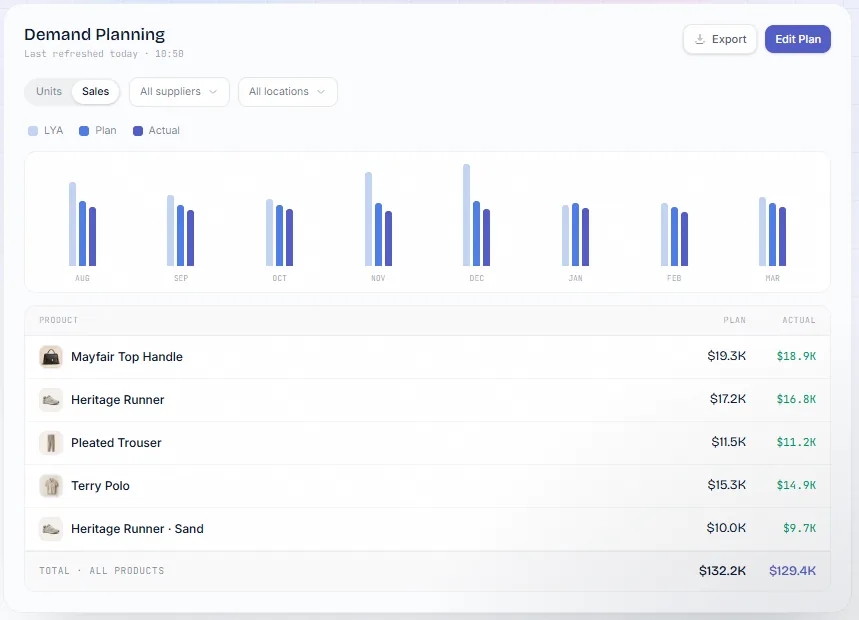
Forstock is an AI inventory planning platform for Shopify brands. It forecasts demand, identifies stock risks, and recommends what and when to reorder. Then, it turns those recommendations into purchase orders across suppliers, stores, warehouses, and sales channels.
Frostock builds your forecast from every Shopify and Amazon order. It does so for each variant at each location, up to 12 months out. It also knows when a product was out of stock and which spikes came from promotions, so that neither skews your plan. If you have six months of orders, it uses the AI forecast. If not, then it uses a simple average over a window you choose.
Stock planning and replenishment come next. The platform works back from the day each SKU will run out, through your supplier’s lead time, to a should-order-by date. It rounds each order up to your MOQ and pack size. That's how Authentic Stadium, a sneaker shop in Dakar, gets weeks of warning before a stockout.
Multichannel brands using Forstock get one plan that combines sales from Shopify and Amazon with stock from 150+ warehouse systems and 3PLs. You can view it by location when you're buying and by channel when you're selling. Pick the rows you want, and Frostock'll turn them into one purchase order per supplier.
Key Features
- Promotion and Launch Planning: Declare a sale by date, discount, and channel, or plan a launch from one to five comparable products
- Purchase Order Tracking: Create, send, split, and receive orders, including split deliveries
- Landed Cost: Add freight, duty, and insurance to see each unit's full cost
- Alfred AI: Ask what's running low, then approve any change it suggests
- Bundle Planning: Pull bundle demand down to the component SKUs
- Optional Shopify Sync: Send received stock to Shopify per order, so your 3PL stays the source of truth
Pricing
Every plan comes with all the features, unlimited SKUs, suppliers, and locations. Your Forstock plan is also priced based on the size of your operation:
- Under $1M: $79/month
- $1M to $5M: $159/month
- $5M to $10M: $279/month
- $10M to $20M: $479/month
- $20M to $40M: $899/month
- $40M and up: custom pricing
Paying annually saves about 15%, and every plan starts with a 14-day free trial with no credit card.
Pros
- Pricing grows with your revenue; there are no per-seat or per-SKU charges, and every plan has all the features
- Your first plan and reorder list arrive the same day you connect your store, not after weeks of implementation
- Hands-on support is part of the plan and many users report that the team is responsive
- The system refreshes itself weekly, so it stays current without anyone rebuilding it
- Plans export to CSV or Excel so that buyers and finance can work from the same numbers
Cons
- There's no raw material, bill of materials, or expiry planning
- The AI forecast needs six months of orders, so newer stores start on a simple average
2. Prediko
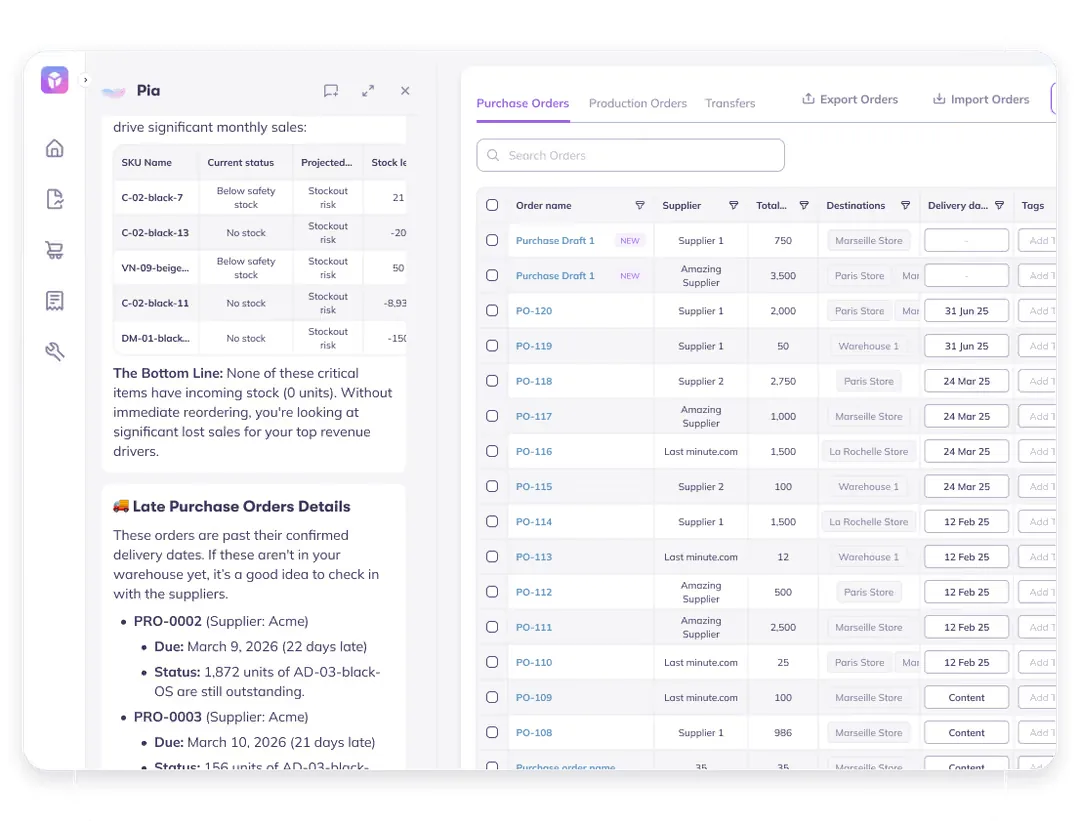
Prediko is a Shopify app for direct-to-consumer brands. It turns your Shopify and Amazon orders into a 12-month demand plan. Once you set a revenue target, Prediko spreads it across the year using your seasonality. The Buying Table suggests reorders based on lead time, safety stock, and days of cover.
Key Features
- Prediko's supply planning calendar turns the demand plan into a 12-month purchase order calendar
- Pia is its inventory-specific AI agent and it's included in every plan
- Location transfers let you set min and max stock per location and get suggested transfers
Pricing
Pricing rises with your revenue and it starts at $49/month for stores under $100K. Raw materials cost extra, and there's a 14-day free trial.
Pros
- Unlimited users, SKUs, stores, and warehouses in every plan
- Onboarding and a dedicated customer success manager are included in every plan
- It lists 100+ WMS and 3PL integrations, which helps if your stock sits in a warehouse system
Cons
- It spreads your growth target, but it won't predict how fast you'll grow
- Demand plans are monthly only, and promotions need manual edits
3. Inventory Planner by Sage
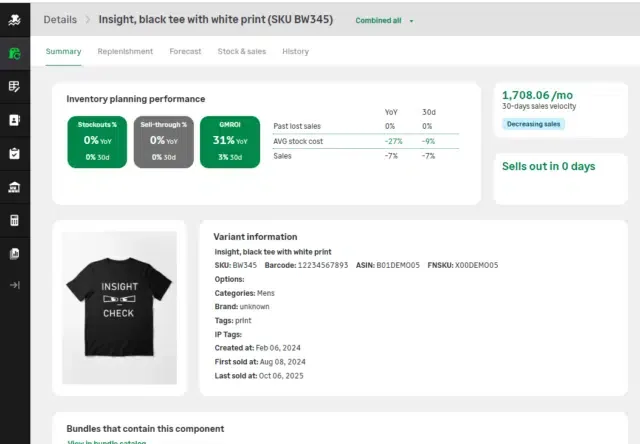
Inventory Planner by Sage is a forecasting and replenishment platform for ecommerce brands and wholesalers. With 30+ native connections, it suits brands that sell well beyond Shopify. You pick a forecast method for each variant, and it can estimate demand you missed during a stockout. Each variant gets a replenish date (the last day to order without running out).
Key Features
- Open-to-buy planning lets you set buying budgets and plan purchases against them
- You can create supplier purchase orders scaled to vendor MOQs, and it also handles transfers and assembly orders
- Reporting is configurable, with more than 200 metrics and full ABC analysis
Pricing
There's no public pricing. You'll get a custom quote based on the volume of inventory you manage, and paid onboarding is required.
Pros
- The full product includes chat and 1:1 technical support calls
- Lost-sales estimates show what a stockout would cost you
- Purchase orders can be scaled to fill a shipping container
Cons
- Open-to-buy and the NetSuite connector need the Premium tier
- Stockouts are tracked automatically only from the day you connect, so you have to import older history yourself
4. Fabrikatör
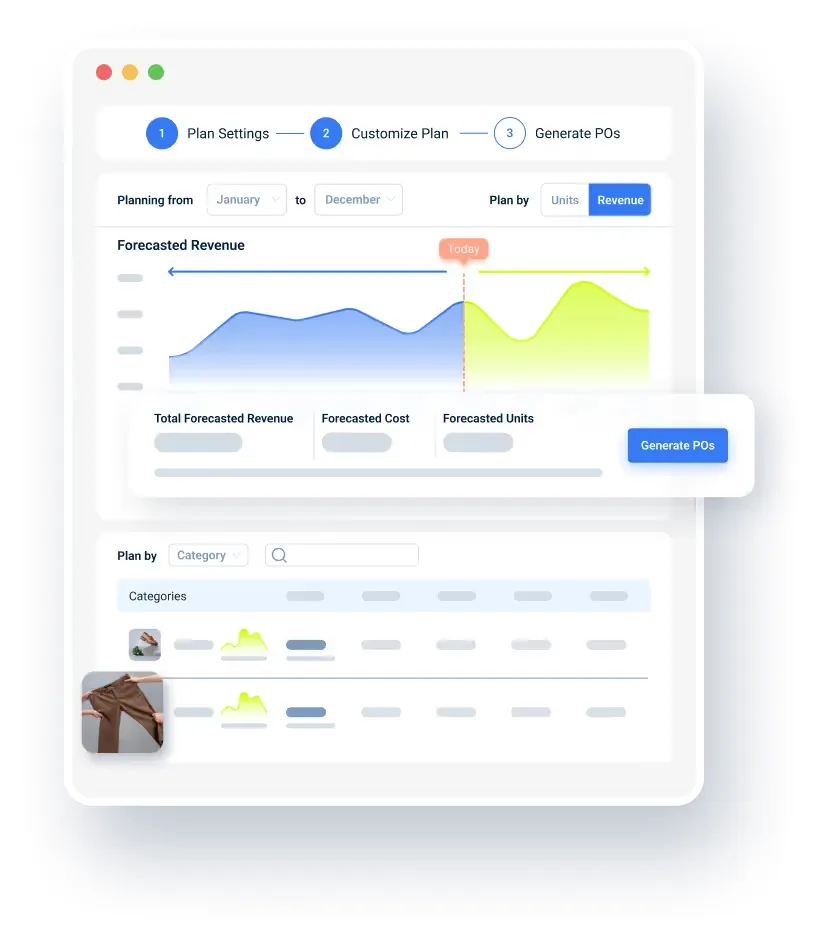
Fabrikatör is an inventory planning app for growing Shopify and Shopify Plus brands with lean teams. Its Replenish page suggests reorders using your average daily sales. It does so over a forecasting window you set, your days of stock, and your lead time. Its help center gives the formula: daily sales average times days of stock, minus current stock, minus incoming stock.
Key Features
- Backorders and preorders allow you to sell stock that's still on a purchase order
- Freight planner is a built-in tool for freight decisions against the cost of running out
- A Klaviyo integration lets you tell customers about backorders and preorders
Pricing
Pricing is per store and set by revenue. It starts from $99/month for business under $500K. Backorders cost $0.75 each after the first 50, and there's a 14-day free trial.
Pros
- Unlimited SKUs and users, billed on your Shopify invoice
- Bundle planning is included in every plan
- Setup takes minutes, with a 30-minute onboarding call
Cons
- It's best suited to stores with 50+ SKUs and at least six months of order history
- Order data comes only from Shopify unless you request the Amazon connection
5. Moselle
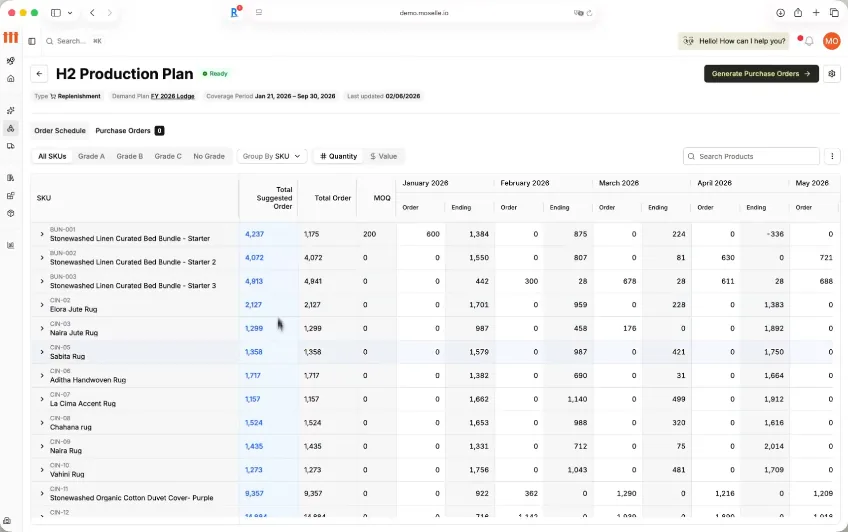
Moselle is an inventory forecasting, purchasing, and planning platform for fast-growing multichannel brands. Since it forecasts each channel separately, it's useful if you sell on Shopify, Amazon, Walmart, and TikTok, plus wholesale. Moselle's machine-learning models forecast each SKU 12 months out and adjust for stockouts.
Key Features
- Allocation plans generate orders either for replenishment or to allocate stock you already own across locations, channels, or stores
- Supply planning covers purchases, production runs, and transfers across every warehouse
- Mo, the AI planning companion, answers questions in plain English and can generate purchase orders in one click
Pricing
Starter is $500/month and Growth is $750/month, with custom Enterprise pricing. AI features run on monthly Mo Credits.
Pros
- There are no limits on channels or warehouses
- You can go live in under a month with dedicated support
- Every plan has unlimited users, so there are no seat fees
Cons
- Its entry price is more than four times that of most tools in this list
- A plan doesn't update when your forecast changes, and rebuilding it resets your edits
6. StockTrim
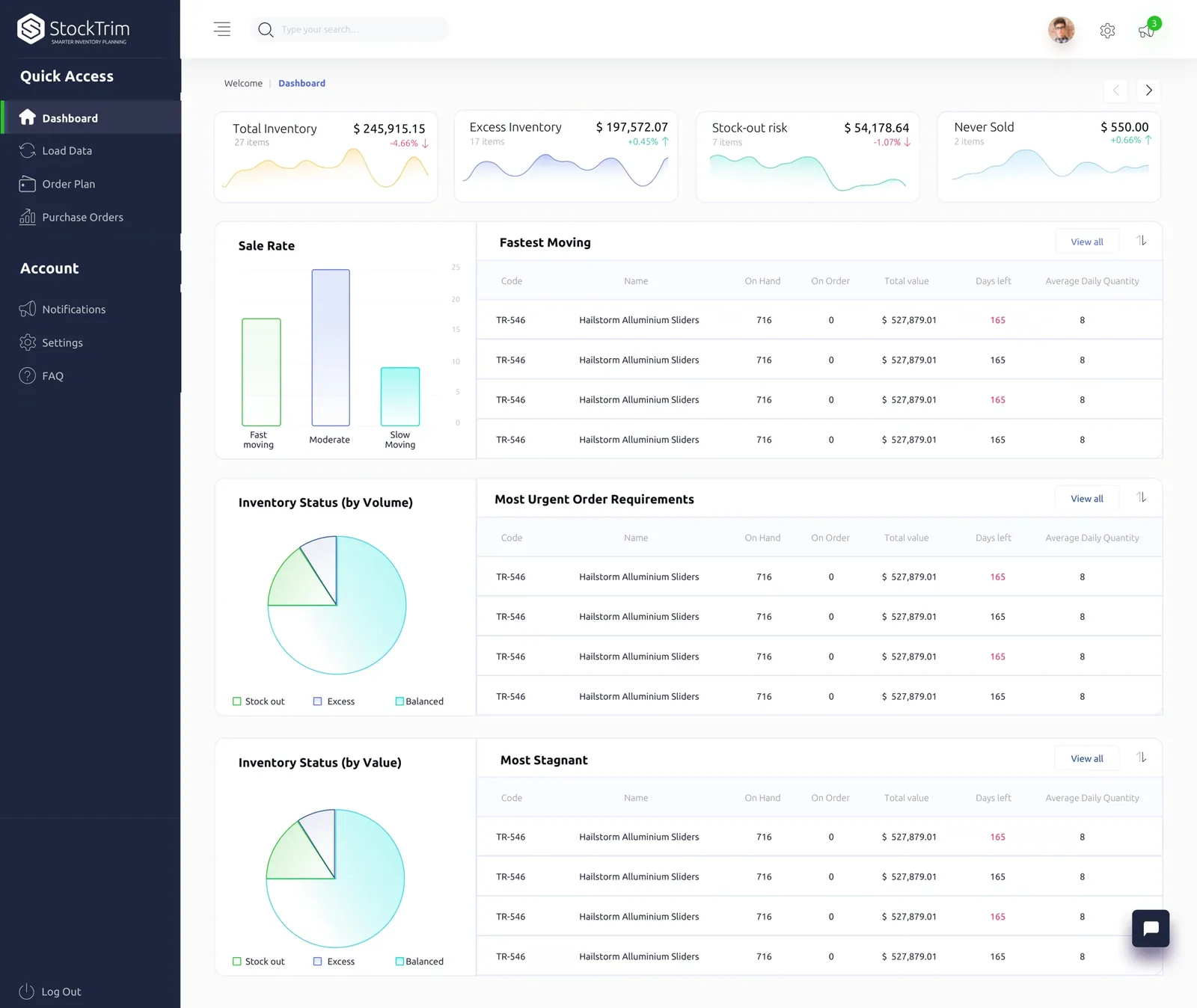
StockTrim is inventory planning software that connects to the tools you already use. If you run Shopify alongside Xero, QuickBooks, or Cin7, it combines their data into one forecast. For each product, StockTrim builds forecasting models and picks the one that's predicted your sales best. Out-of-stock days are left out, and by default, orders include safety stock for a 95% service level.
Key Features
- StockTrim generates purchase orders automatically, with container sizes and MOQs applied
- It can simulate sales volumes and purchasing needs for new products and it plans stock by location
- A raw materials add-on forecasts components and multi-level bills of materials, from $50/month at the lowest revenue band
Pricing
Pricing is set by revenue. It costs from $49/month, billed annually under $100K. Though, its Shopify App Store plans start at $39/month. There's a 14-day free trial.
Pros
- It connects to more than 20 ecommerce, accounting, and inventory platforms
- StockTrim says received purchase orders push updated stock back into Shopify
- It forecast at both variant and parent-product level
Cons
- StockTrim can produce duplicate listings or distorted forecasts if your historical data is messy or if you use inconsistent SKU codes
- Its forecasting for brand-new products or one-off items may require manual overrides
7. Sumtracker
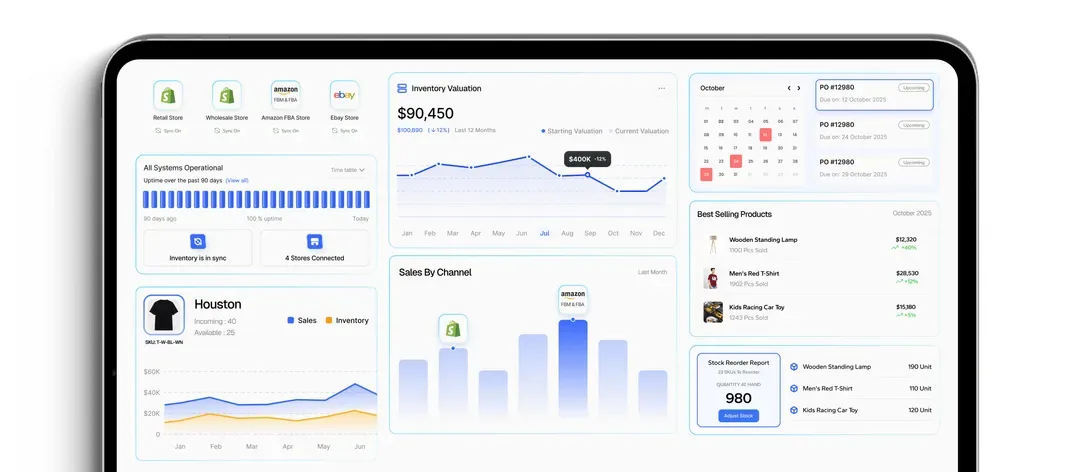
Sumtracker is inventory management and replenishment software for Shopify and Amazon brands. It's built around keeping stock in sync. That's important if you sell the same products on several marketplaces. On the Replenish plan, forecasting reads your last 12 months of sales and skips out-of-stock days. It then suggests what to buy using your lead times and days of cover.
Key Features
- Its multichannel sync keeps stock counts matched across your store and marketplaces
- Bundle inventory updates automatically from the in-stock component products
- You can email purchase orders to suppliers, track incoming stock, receive partial shipments, and track landed costs
Pricing
Pricing follows annual order volume. The Replenish plan starts at $119/month for up to 2,500 orders a year. Manage, which covers sync and bundles but not forecasting, starts at $59/month.
Pros
- You can start on sync alone and move up to forecasting later
- Receiving a purchase order pushes the new stock to your store
- It has a migration path from Stocky and similar apps
Cons
- It's built around sync first, so planning is lighter than in dedicated planning tools
- Entry prices cover up to 2,500 orders a year, so busier stores pay more
8. Netstock
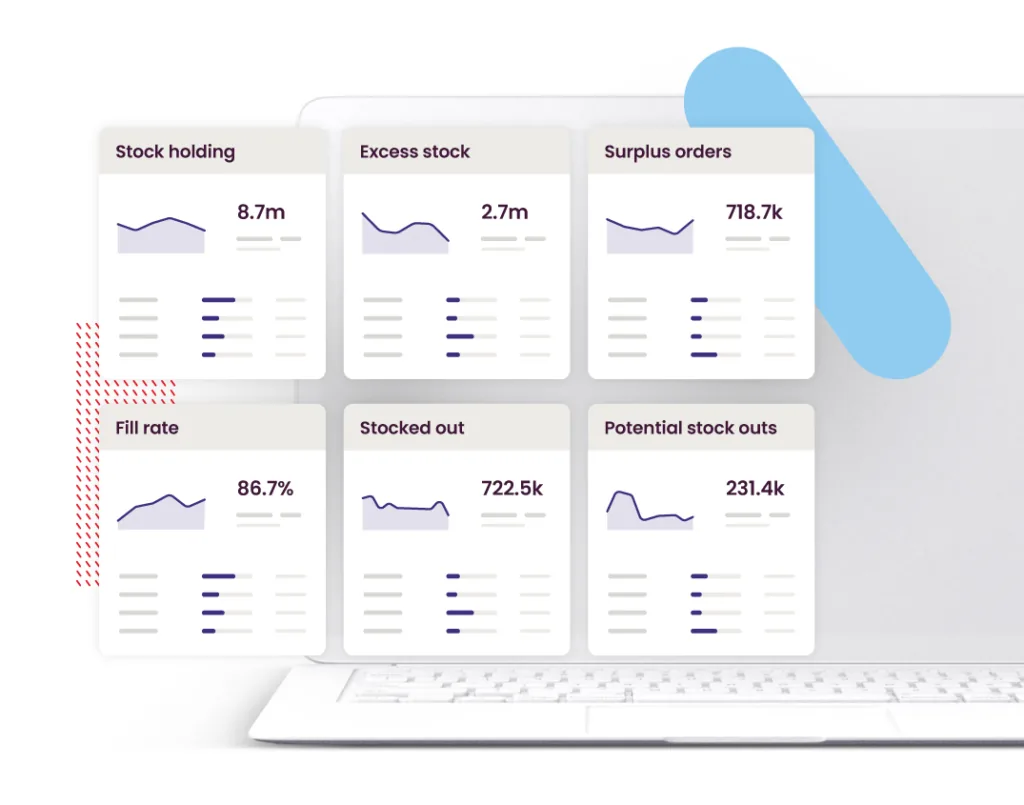
Netstock is a supply and demand planning software that pulls its data from an ERP. So, it makes sense once you've grown into NetSuite or Business Central. Every day, it scores supply and forecast risk for each SKU at each location. Then it ranks your next steps by financial impact. Suppliers with less reliable lead times get more safety stock.
Key Features
- Demand planning add-on forecasts by product, channel, customer, or region
- Container Builder turns recommended orders into container-ready shipments
- It flags AI opportunities to prevent stockouts and cut excess stock
Pricing
Pricing starts at $900/month on an annual subscription, and each bundle is priced by custom quote.
Pros
- It connects to 60+ ERP systems and turns that data into forecasts and orders
- It's ISO 27001 certified
- It's sold in Essentials, Advanced and Commercial bundles, so you can start with the core and add capability as you grow
Cons
- A Shopify-only brand would need an ERP or accounting system first
- Implementation typically takes 6 to 10 weeks
How We Evaluated
We reviewed each tool using the vendor's own website, pricing information, and its Shopify App Store listing where it has one. We then judged on the same five questions:
- Does the forecast handle seasonality, promotions, and stockouts?
- Does it turn the forecast into a dated order that respects lead times and MOQs?
- Can you create, send, and receive purchase orders in the tool?
- Does it plan across your channels and locations?
- Is the price published?
How to Choose
What you sell, where your stock sits, and which systems you already use will narrow the field quickly. Find the situation below that sounds most like yours.
- If you're running out of bestsellers while slow sellers pile up, you'll want a forecast that corrects for stockouts and promotions and turns into dated orders per location. That's what we built Forstock around.
- If you make some of what you sell, opt for a tool that plans components. Prediko and StockTrim offer raw materials planning as paid add-ons. Netstock and Moselle plan production runs and Inventory Planner supports assembly orders.
- If you worry about overselling, start with Sumtracker's sync. For planning across Amazon, Walmart, and wholesale, look at Inventory Planner or Moselle.
- Do you sell on preorder? Fabrikatör ties every backorder to an incoming purchase order.
- Do you already run an ERP or accounting system? Netstock plans from your ERP's data, and StockTrim suits smaller brands on Xero or QuickBooks.
Find the Tool That Plans the Way You Buy
What do I need to order and when? That's the question Forstock is built to answer, for every SKU at every location, with the assumptions in view and the final call yours.
Start a 14-day free trial with no credit card. Or book a demo, and we'll connect your store and walk through your first reorder list together.
Frequently Asked Questions
What Replaced Shopify Stocky?
Shopify replaced Stocky with tools in its own admin. You can create purchase orders there and ask the Sidekick assistant what to reorder. But Shopify keeps lead times and MOQs as reference fields its ordering doesn't use. So if you need reorder dates, you'll want a planning app that replaces Stocky.
How Do I Calculate a Reorder Point?
Multiply your average daily sales by your supplier's lead time in days, then add your safety stock. A product selling 20 units a day with a 30-day lead time needs 600 units to cover the wait. Add 200 units of safety stock, and you'll reorder at 800.
What Happens to My Inventory Visibility When I Move to a 3PL?
Your Shopify counts can drift from the warehouse, because the 3PL now holds the real stock. Treat the 3PL's system as the source of truth for on-hand stock, and make sure your planning tool reads from it. Forstock connects to 150+ warehouse systems and 3PLs, and Prediko lists 100+ WMS and 3PL integrations.