
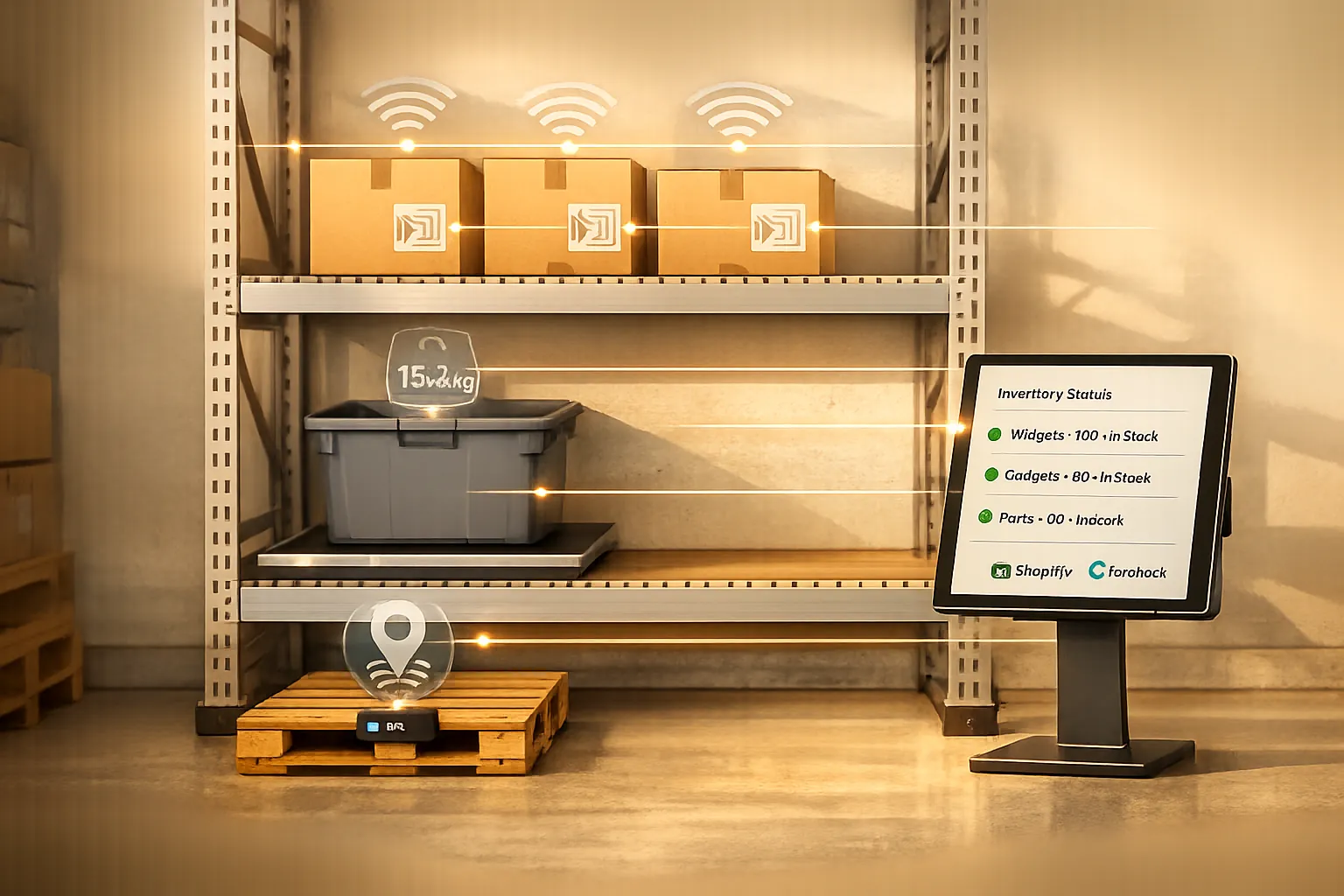
IoT sensors revolutionize inventory management by providing real-time data on stock levels, locations, and conditions. They automate processes, reduce errors, and improve efficiency across warehouses and stores. Key benefits include:
- Accuracy Over 95%: IoT systems outperform manual methods (60–65% accuracy) and can reach up to 99.5% when integrated with platforms like Shopify.
- Cost Savings: Companies adopting IoT reduce inventory costs by at least 20% and cut overstock and stockouts by 50%.
- Sensor Types: RFID tags (track items without manual scanning), weight sensors (monitor stock levels), and GPS sensors (track shipments in transit).
- Integration Tools: Platforms like Forstock use IoT data for automated updates, demand forecasting, and purchase planning.
Real-time tracking eliminates guesswork, speeds up order fulfillment, and ensures stock visibility across locations. Whether managing warehouses or retail shelves, IoT sensors are a practical solution for smarter inventory decisions.
IoT in Inventory Management
sbb-itb-f0fc809
Types of IoT Sensors for Inventory Management
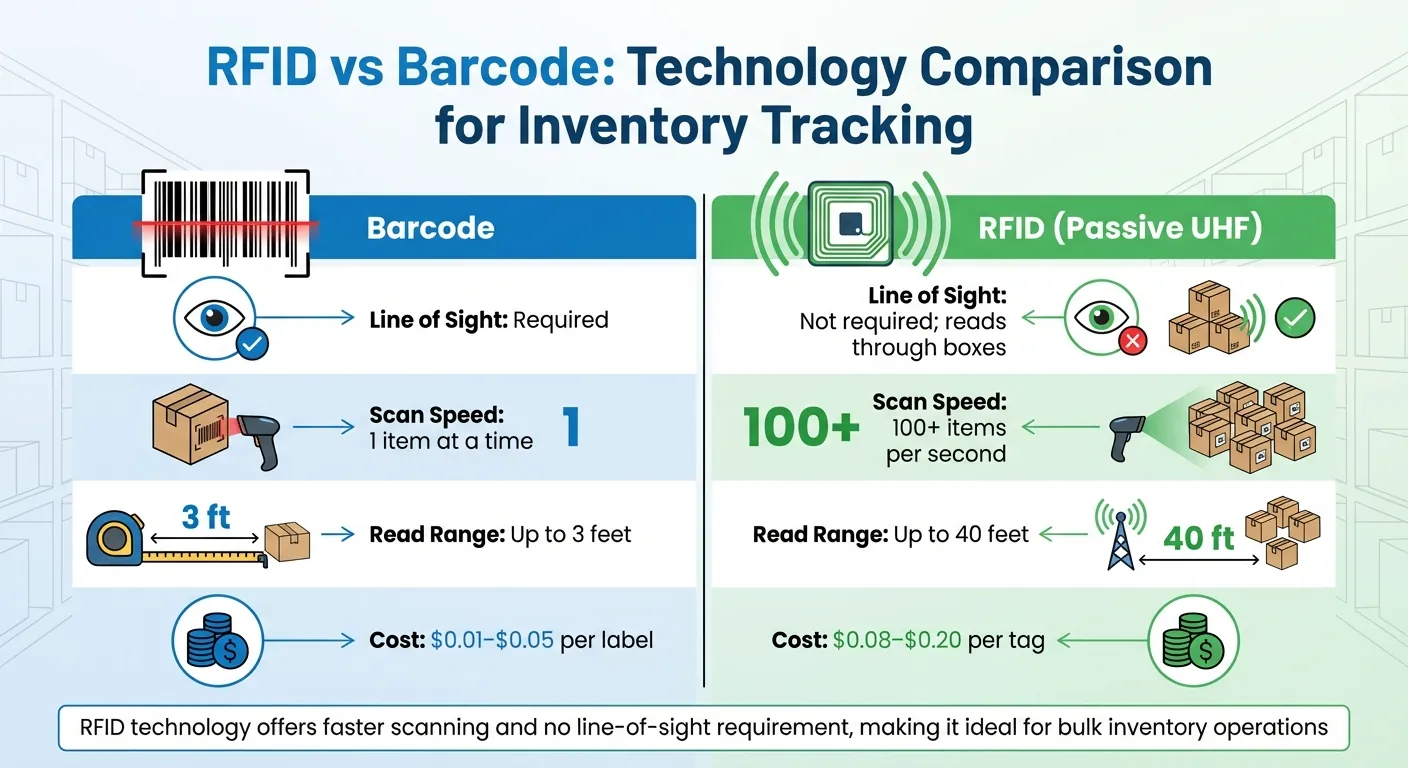
RFID vs Barcode Technology Comparison for Inventory Tracking
IoT sensors are specifically designed to tackle various tracking challenges in warehouses and retail settings. Among the most common are RFID tags, weight sensors, and GPS sensors. Each of these tools serves a distinct purpose, from tracking individual items to monitoring shipments in transit. Let’s dive into how each type of sensor contributes to inventory management.
RFID Tags for Item Tracking
RFID (Radio Frequency Identification) tags use radio waves to identify and track items, eliminating the need for a direct line of sight. Unlike barcodes, which require manual scanning, RFID systems allow for faster processes like bulk receiving and cycle counting.
- Passive RFID tags: Powered by the reader's radio field and cost between $0.08 and $0.20 each.
- Active RFID tags: Equipped with internal batteries for extended transmission ranges (approximately 100–330 feet), with costs ranging from $10 to $50 per tag.
RFID’s accuracy and efficiency have been demonstrated in real-world applications. For instance, in March 2024, Spanish lingerie brand Selmark implemented UHF RFID tagging at the manufacturing stage. This upgrade enabled seamless tracking from production to distribution, boosting picking and dispatch capacity by 30%. Similarly, Decathlon introduced 458 RFID-enabled point-of-sale stations across 50 stores in Brazil, cutting self-checkout times by 50% and ensuring 100% automatic item registration.
| Feature | Barcode | RFID (Passive UHF) |
|---|---|---|
| Line of Sight | Required | Not required; reads through boxes |
| Scan Speed | 1 item at a time | 100+ items per second |
| Read Range | Up to 3 feet | Up to 40 feet |
| Cost | $0.01–$0.05 per label | $0.08–$0.20 per tag |
Weight Sensors for Stock Level Monitoring
Weight sensors are often installed on racks or floor scales to detect changes in weight, providing automated updates to stock levels. For instance, if a rack shows a 50-pound decrease, it might indicate that 10 units have been removed. These sensors are particularly effective for high-turnover inventory like bins or pallets. They can even trigger automatic replenishment orders when stock falls below a predefined threshold. This constant tracking feeds into the larger IoT inventory system, keeping stock levels accurate and up to date.
GPS Sensors for Shipment Tracking
GPS sensors provide real-time location updates, making them essential for tracking inventory during transit. They refine delivery predictions, monitor fleet movements, and send alerts for route deviations using geofencing technology. Unlike RFID and weight sensors that focus on in-facility tracking, GPS sensors ensure visibility over long distances. This data integrates seamlessly with IoT systems to update estimated arrival times and optimize warehouse receiving schedules, offering greater control over the supply chain.
How to Set Up IoT Sensors for Inventory Tracking
Getting real-time inventory tracking right starts with setting up IoT sensors in a way that fits your hardware and operational needs. A smart way to begin is by testing in a pilot area, like the receiving dock. This approach not only helps fine-tune the system but also speeds up full-scale deployment by up to 30%. Many small to medium-sized businesses take this route before rolling out sensors across their entire facility.
Selecting Hardware and Installation Requirements
Choosing the right sensors depends on factors like item value, environment, and system compatibility. For high-value inventory, RFID tags with built-in security features are a solid choice. On the other hand, for large volumes of lower-value goods, standard barcode scanning might be more efficient.
Consider connectivity needs based on your space. For larger areas, long-range options like LoRaWAN or cellular are ideal, while smaller spaces can rely on Bluetooth or Zigbee. Power availability also plays a role - fixed readers often use mains power, while remote sensors with long-life batteries (lasting 2–10 years) are better for areas without easy access to power.
Another critical factor is ensuring that the sensors come with APIs or SDKs for seamless integration with your ERP or warehouse management system. Once you’ve selected your hardware, the next step is figuring out the best spots to place the sensors for maximum efficiency.
Where to Place Sensors in Warehouses and Stores
Even with the right hardware, placement is key to avoiding connectivity problems and getting the best performance. Poor placement accounts for 70% of connectivity issues. Start by conducting a site survey to identify potential RF interference from things like metal racks, machinery, or thick walls. Map out high-traffic areas, such as dock doors and main aisles, where inventory movement is frequent.
For receiving and shipping zones, fixed RFID portals at dock doors can automate bulk verification [8, 13]. On racks and shelves, weight sensors or AI-powered cameras can track stock levels in real time [8, 14]. If you’re managing perishable or temperature-sensitive goods, environmental sensors in cold storage areas can monitor temperature and humidity [8, 16]. For proper WiFi 6 coverage, aim for one access point per 2,500 square feet of warehouse space.
Using ABC analysis can guide sensor placement by prioritizing "A" items, which typically make up 20% of SKUs but drive 80% of revenue. Keep in mind that materials like metal and liquids can interfere with RFID signals. To address this, use specialized "on-metal" tags or adjust placement angles for more accurate reads. To prevent network overload, edge computing devices can filter out duplicate RFID pings locally before sending the data to the cloud [8, 14].
Connecting IoT Sensors with Shopify and Forstock

After you've set up and placed your sensors, the next step is integrating them with platforms like Shopify and Forstock. This integration ensures real-time updates and a unified view of your inventory, keeping operations smooth and efficient.
Linking Sensors to Shopify Using APIs
Shopify doesn’t directly support IoT hardware, so you’ll need third-party APIs to connect your sensors to Shopify’s inventory system. These APIs act as a bridge, enabling your store to receive updates whenever your sensors detect stock changes. Webhooks are particularly useful here because they send instant notifications to your store. As Technosoftwares explains:
"Webhooks allow your store to receive real-time updates and notifications from the external service, while custom apps provide a more tailored and customizable solution for integrating complex APIs."
For businesses with multiple sensor types or locations, custom app development can offer a more precise integration. However, before rolling out your setup, it’s critical to test for potential issues like network disruptions or data mismatches to avoid inventory errors. Also, make sure to secure API keys and limit access to trusted users to safeguard your system.
Once your sensors are linked to Shopify, you can take things further by centralizing this data with Forstock.
Using Forstock to Centralize IoT Data
While APIs handle the connection between sensors and Shopify, Forstock consolidates all this IoT data into one dashboard. This gives you a clear, real-time view of inventory across multiple locations - whether in warehouses, retail outlets, or even during transit.
Forstock’s advanced forecasting tools turn sensor data into actionable strategies. For example, if weight sensors detect low stock or RFID tags track movement trends, Forstock can automatically generate purchase orders based on reorder points and lead times. This eliminates manual tracking and helps avoid both overstocking and stockouts. For instance, if a fast-selling SKU drops below its safety stock threshold, Forstock’s automation steps in to reorder it, saving time and reducing errors - a game-changer for managing complex inventories with multiple variants.
Benefits of Real-Time Inventory Tracking with IoT
When IoT sensors are integrated with platforms like Shopify and Forstock, the operational improvements are hard to miss. These systems bring a new level of precision and efficiency to inventory management, directly impacting profitability. Here's how real-time IoT tracking can transform your operations:
Higher Accuracy and Fewer Errors
Manual inventory processes are prone to mistakes - items get skipped, miscounted, or entered incorrectly. IoT sensors eliminate these issues by automating data collection throughout the supply chain. Tools like RFID tags, weight sensors, and GPS trackers provide constant updates, ensuring an accurate, real-time view of your inventory.
For example, RFID systems can cut inventory discrepancies by up to 30%, and inventories managed with RFID are 20 times faster to count compared to manual methods. Satya Karteek Gudipati, Principal Software Engineer, highlights the value of automation:
"Using data-driven automation, we can eliminate the need for manual tasks and improve operational efficiency for tasks like inventory audits, order fulfillment, and even staffing needs."
This level of precision helps reduce the need for excessive "just in case" stock, freeing up both cash and warehouse space. It also supports better demand forecasting and tighter stock control, leading to smarter inventory decisions.
Better Demand Forecasting and Stock Control
Accurate, real-time data is the backbone of effective decision-making. With IoT tracking, you gain instant insights into inventory levels, which feed directly into predictive analytics. This allows businesses to forecast demand more precisely and adjust stock levels proactively.
For instance, companies using IoT data for predictive analytics have reduced safety stock by about 30%. In industries handling perishable goods, IoT sensors tracking expiration dates and environmental conditions have cut loss rates by 25%. Additionally, 52% of businesses applying machine learning to IoT data report significant improvements in demand forecasting accuracy.
Real-time tracking also prevents overstocking. Companies leveraging these technologies have reduced inventory carrying costs by up to 30%, while tightly monitoring finished goods has led to a 20% reduction in excess stock.
| Inventory Area | Benefit of IoT Tracking | Impact Metric |
|---|---|---|
| Raw Materials | Minimizes production delays | 30% reduction in lead times |
| Work-in-Progress | Identifies bottlenecks | 15% reduction in WIP boosts throughput by 50% |
| Finished Goods | Balances stock levels | 20% decrease in excess stock |
| Safety Stock | Optimizes buffer levels | 30% reduction in safety stock |
| Perishables | Monitors spoilage/wastage | 25% to 30% improvement in loss rates |
These benefits highlight how IoT-driven inventory tracking not only enhances operational accuracy but also equips businesses with the tools to make smarter, data-backed decisions. Whether it's reducing waste, cutting costs, or improving forecasting, the impact is substantial.
Best Practices for IoT Inventory Systems
Setting up IoT sensors is just the start. To keep your system running smoothly and efficiently, it’s essential to monitor hardware, network stability, and how well the data integrates into your operations.
Expanding IoT Systems Across Multiple Locations
Rolling out IoT inventory tracking across multiple warehouses or stores requires a step-by-step approach. Start small, such as in a specific area like the receiving dock, to test its accuracy and measure ROI. This method can cut implementation time by about 30%.
Before expanding, conduct RF site surveys to pinpoint potential interference. Since 70% of connectivity problems are due to poor sensor placement, these surveys ensure you avoid dead zones and optimize sensor positioning right from the start.
As your system grows, a reliable network infrastructure becomes a must. For large facilities, consider private 5G or LoRaWAN for wide coverage, and use WiFi 6 for areas with dense sensor networks.
Edge computing plays a key role in managing the data flow from thousands of sensors. For example, in a warehouse generating over 10,000 data points per minute, edge computing can filter out redundant RFID reads - up to 50 per second - preventing data overload. The ECOSIRE Research and Development Team highlights this:
"Data architecture matters more than sensor selection - a warehouse generating 10,000+ data points per minute needs edge computing and data filtering to prevent system overload."
Don’t overlook maintenance. Regular firmware updates and battery replacements are critical, as 70% of devices are at risk of hacking without proper security measures. Battery-powered sensors can last anywhere from 2 to 10 years, so schedule periodic checks and have power backups ready to avoid disruptions. Sensors tracking environmental factors like temperature or humidity also need regular calibration. Additionally, plan for RFID tag replacements annually.
Training your staff is equally important. Proper training can increase system usage by 30% and reduce operational mistakes by 40%.
| Maintenance Component | Frequency | Purpose |
|---|---|---|
| Firmware Updates | Periodic/As released | Security and vulnerability mitigation |
| Full Inventory Comparison | Every 4 hours | Detect and correct data drift |
| High-Velocity SKU Check | Every 30 minutes | Prevent overselling of popular items |
| Physical Stock Take | Monthly/Annually | Verify digital records against physical stock |
| Network Assessment | Periodic | Identify bottlenecks and optimize throughput |
By combining well-maintained systems with scalable infrastructure, you’ll be ready to use AI to fine-tune inventory decisions.
Integrating IoT Data with Forstock's AI Forecasting
Once your IoT network is fully operational, you can turn raw data into actionable insights. Forstock’s platform connects directly to IoT devices like RFID tags, weight sensors, and GPS trackers, converting real-time inventory updates into smarter purchasing decisions.
By integrating IoT data with Forstock, you gain real-time visibility into inventory trends. This allows AI models to account for factors like seasonality and lead times, cutting inventory costs by 20% and reducing stockouts by 60%.
Forstock’s centralized dashboard brings together IoT data, supplier details, purchase orders, and 12-month demand forecasts, ensuring every decision is backed by data. For instance, if weight sensors detect a drop in stock for your fastest-moving products, Forstock can automatically create purchase orders based on demand forecasts, lead times, and safety stock levels.
To keep this integration running smoothly, separate your data feeds. Use one feed for adding products (ADD feeds) and another for syncing inventory updates (SYNC feeds). This prevents API rate limits from being exceeded and avoids accidental overwrites. Set up automated alerts with thresholds so Forstock notifies you before stock levels become critically low .
Even with automation, regular physical checks are essential. Perform full inventory comparisons every 4 hours and check high-velocity SKUs every 30 minutes to catch any mismatches between sensor data and actual stock. This ensures Forstock’s AI has the most accurate data, helping you save time, improve cash flow, and meet customer demands without errors.
Conclusion
IoT sensors are changing the game for inventory management by replacing outdated manual checks with continuous, real-time data. This approach bridges the gap between traditional checkpoints, where inventory often becomes "invisible" during transitions, and provides businesses with a clear, uninterrupted view of their stock. With this shift, operations transition from reactive problem-solving to proactive management, freeing up teams to focus on strategic decisions instead of tedious data entry.
The numbers speak for themselves. Companies using IoT-enabled warehouse systems report a 25–35% drop in inventory carrying costs. Accuracy rates jump from 85–93% to over 99% when these systems are properly implemented. Physical inventory counts take 30–50% less time, and receiving speeds improve by as much as 70%. For businesses leveraging cloud-based IoT data, accuracy rates exceed 95%, while predictive analytics help reduce stockouts by 60%.
Starting small is often the best approach. A pilot program - such as deploying IoT sensors at your receiving dock - can showcase the benefits while cutting implementation time by around 30%. Medium-sized businesses typically see a return on investment within 12 to 18 months, with 94% of IoT adopters reporting positive ROI. Beyond these immediate gains, integrating IoT with advanced platforms can further enhance operational efficiency.
For example, combining IoT sensor data with Forstock's AI-powered forecasting tools transforms raw tracking data into actionable insights. Through a centralized dashboard, Forstock consolidates IoT data, supplier details, purchase orders, and 12-month demand forecasts. This setup ensures decisions are based on real-time information. Imagine weight sensors detecting low stock levels and automatically triggering purchase orders based on demand forecasts, lead times, and safety stock thresholds - no manual effort required.
The technology is ready, and the tools are available. Whether you're overseeing a 10,000-sq-ft warehouse or a massive 200,000+ sq-ft distribution center, IoT sensors and Forstock provide the visibility, accuracy, and control you need to meet customer demands while keeping cash flow optimized.
FAQs
What’s the best sensor type for my inventory (RFID, weight, or GPS)?
The best sensor type really comes down to what your inventory requires. If you're managing retail or warehouse stock and need real-time tracking, RFID sensors are a solid choice. They provide automated updates and high accuracy, making them perfect for environments where quick and precise tracking is key. For bulk goods, weight sensors work well by monitoring stock levels through weight changes. On the other hand, if you're dealing with mobile assets like vehicles that move across large areas, GPS sensors are ideal for keeping tabs on their location. Your decision should align with your specific environment and the items you're managing.
How do I connect IoT sensor data to Shopify inventory updates?
To link IoT sensor data with Shopify, start by integrating devices such as RFID readers, weight sensors, or smart shelves with an IoT platform like Azure IoT Hub. This platform helps manage the flow of data from your devices. Next, use APIs or automation tools to connect this data to Shopify, ensuring seamless synchronization. Tools like Forstock can simplify the process by enabling real-time inventory updates, cutting down on manual tasks, and reducing the chances of stock errors.
How do I prevent bad sensor reads from causing wrong stock counts?
To keep stock counts accurate and avoid mistakes from faulty sensor readings, it's essential to use reliable IoT sensors, such as RFID tags, and perform routine calibrations. Pair these sensors with cloud platforms to automatically spot anomalies and send alerts for manual checks when needed. These practices improve data reliability and reduce inventory tracking errors.