

Manual inventory tracking is costing businesses time, money, and growth. Here's why:
- Human Errors: Up to 78% of inventory mistakes come from manual processes, leading to stockouts, overselling, and lost customers.
- Time-Consuming: Employees spend 40% of their time on manual inventory tasks, slowing operations and driving up labor costs.
- Outdated Data: Without real-time updates, businesses face phantom inventory, delayed decisions, and missed sales opportunities.
- Scaling Issues: Manual systems can't handle growth, creating chaos when managing more SKUs, locations, or sales channels.
- Poor Reporting: Disconnected spreadsheets make it hard to generate accurate, actionable reports, costing businesses $1.1 trillion annually.
Switching to automated tools like Forstock can solve these issues with real-time updates, AI-driven forecasting, and streamlined processes - all for $79/month. Stop relying on outdated methods and start improving your inventory management today.
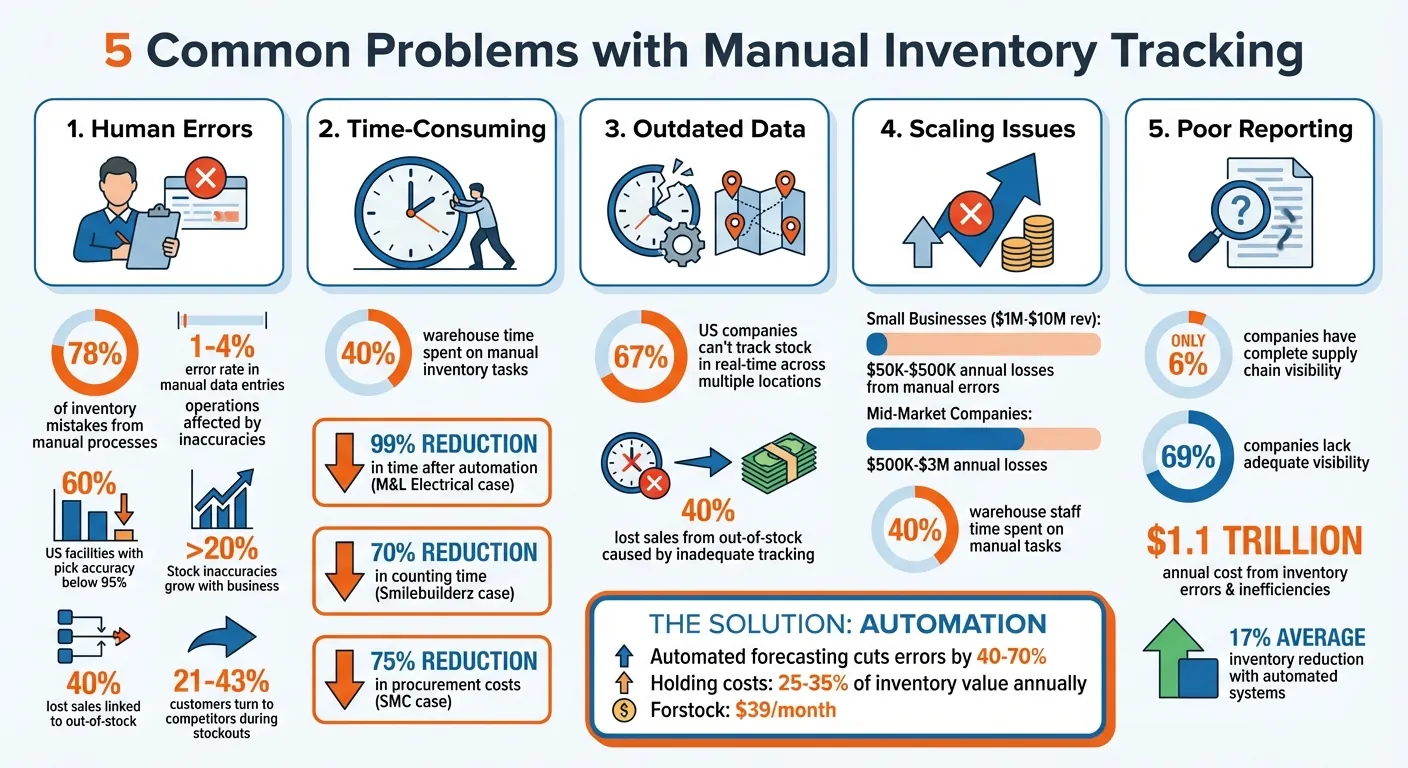
5 Costly Problems of Manual Inventory Tracking: Key Statistics
1. High Risk of Human Error
Error Frequency and Impact
When it comes to manual data entry, mistakes are almost inevitable. In fact, errors occur in 1% to 4% of entries, and as much as 27% of operations can be affected by these inaccuracies. These aren't just harmless typos - they can trigger a ripple effect of problems that disrupt your entire business.
Some of the most frequent mistakes include mixing up numbers, misreading pick-slips, entering the wrong shipping addresses, or misplacing SKUs. These errors can lead to "phantom inventory", where records show stock that doesn't actually exist. The result? Overselling, canceled orders, shipping delays, and unhappy customers. Once these errors enter your system, they often go undetected, as highlighted by Extensiv:
"If the initial information is entered wrong at the beginning, it will go through the entire system without ever being caught." - Extensiv
The financial impact is just as concerning. Incorrect inventory data can tie up your capital in overstock that goes unsold or leave you dealing with stockouts during key sales periods, leading to missed revenue opportunities. Consider this: 60% of US facilities have pick accuracy rates below 95%. That means one out of every 20 orders could be wrong. And as order volumes grow, businesses relying on manual processes often see stock inaccuracies exceed 20%.
The cost of these errors extends beyond immediate sales. 40% of lost sales are linked to out-of-stock situations. Even worse, when customers encounter a stockout, 21–43% will turn to a competitor rather than wait. So, a single mistake doesn't just risk a sale - it could mean losing a customer permanently.
2. Slow and Labor-Intensive Data Entry
Time Efficiency and Labor Costs
Manual inventory tracking can be a massive drain on time and resources. Did you know that 40% of warehouse time is spent on manual inventory tasks? Workers often dedicate up to half of their hours to counting items, updating spreadsheets, and cross-checking records. These repetitive tasks not only consume valuable time but also hold back opportunities to focus on growing the business. And as operations expand, this inefficiency only gets worse.
When inventories grow, tasks like counting, receiving, and transferring stock between locations become even more overwhelming. But the impact of switching to automation is clear. For instance, M&L Electrical reported a 99% reduction in time spent managing inventory after moving away from manual processes. Similarly, Smilebuilderz cut their counting and replenishing time by 70%, while SMC, an electrical distributor, slashed procurement costs by 75%. These changes save thousands of hours and bring significant cost savings every year.
Beyond the time and money, manual data entry ties up staff who could be focusing on more valuable tasks, like improving customer service or driving marketing efforts. The labor-intensive nature of manual processes not only leads to delays but also increases the risk of errors, as highlighted earlier.
"Managing inventory with paperwork and manual processes is tedious and not secure. And it doesn't easily scale across multiple warehouses with lots of stock", says Abby Jenkins, Product Marketing Manager at NetSuite.
These challenges make a strong case for exploring automated solutions that free up time, reduce errors, and simplify operations.
3. No Real-Time Updates
Real-Time Visibility
Relying on manual tracking methods means your inventory data is often outdated. These systems typically update on a weekly, monthly, or yearly basis, leaving a significant gap in visibility. A striking 67% of US companies can't track their stock in real time across multiple locations. This lack of up-to-date information can lead to overselling, backorders, and canceled orders - frustrating customers and damaging trust. On top of that, outdated data exacerbates issues like phantom inventory and poor reordering practices.
The problem lies in the delay between actual stock changes and when they are manually recorded. These lags create discrepancies, such as "phantom stock", where inventory appears available on paper but is nowhere to be found in reality.
For decision-makers, the consequences are significant. Without access to real-time data, it's nearly impossible to monitor current trends or determine accurate stock levels. This makes setting optimal reorder points a guessing game. The result? Costly stockouts that drive away sales or over-ordering that ties up valuable resources. Shockingly, 40% of lost sales stem from out-of-stock situations caused by inadequate tracking. When inventory data is inaccurate or delayed, it undermines timely decisions and creates a ripple effect of operational headaches.
"Before, we were overselling and the way we were operating was too slow to grow the business. Now we're exploring new countries and new channels all of the time. And we do that with confidence knowing we can cope with the orders coming in." - Richard Goss, Commercial Director and Co-Founder, Rinkit
4. Hard to Scale as Your Business Grows
Scalability for Growing Businesses
Manual inventory tracking might suffice when you're managing a small operation with just a few products in one location. But as your business grows - introducing more SKUs, adding warehouses, or branching out across multiple sales channels - those trusty spreadsheets and paper logs quickly become unworkable. The problem is simple: manual systems don’t scale effectively. While keeping tabs on 50 SKUs in one spot might be tedious but doable, juggling 500 SKUs across three warehouses and several sales platforms turns into a logistical nightmare. It’s not just challenging - it’s chaotic and riddled with errors. The more your business expands, the more your team finds themselves buried in disconnected spreadsheets, struggling to reconcile stock levels and resolve discrepancies. This lack of scalability doesn’t just complicate operations; it also inflates labor costs and leads to financial losses.
Time Efficiency and Labor Costs
Expanding your business amplifies the time sink of manual inventory management. Did you know that nearly 40% of warehouse staff time is spent on manual inventory tasks? That’s valuable time that could be redirected toward activities that actually drive growth. The financial toll is staggering, too. For small businesses generating $1 million to $10 million in revenue, manual errors and stockouts can result in annual losses ranging from $50,000 to $500,000. For mid-market companies, those losses can climb to a jaw-dropping $500,000 to $3 million every year.
These inefficiencies create serious operational roadblocks. Every hour spent updating spreadsheets is an hour not spent scaling your business. As your company grows, these challenges only compound, adding to the errors and inefficiencies outlined earlier. It becomes clear that manual methods simply can’t keep up with the demands of a growing operation, making automated solutions not just an option, but a necessity.
sbb-itb-f0fc809
5. Difficult Reporting and Limited Insights
Challenges in Generating Useful Reports
Tracking inventory manually makes creating meaningful reports a struggle. This often leads to outdated and incomplete data, leaving businesses with an unclear picture of their inventory.
Manual systems lack the ability to generate reports using real-time data. Instead, information ends up scattered across disconnected spreadsheets from various locations. This fragmented approach limits the ability to make timely and informed decisions.
Here’s a staggering fact: only 6% of companies report having complete visibility into their supply chain, while 69% admit they fall short in this area. This lack of transparency comes with a hefty price tag - inventory errors and inefficiencies cost businesses around $1.1 trillion every year.
These gaps in reporting directly impact a company’s ability to plan strategically.
"When management cannot visualize inventory stock or trends, making informed decisions on purchase and inventory becomes tough. This directly affects the bottom line of the company." - Tally Solutions
Errors in manual data entry only make things worse, distorting reports and complicating demand forecasting. Extracting data manually also eats up time that could be better spent elsewhere.
Switching to automated inventory management systems can make a big difference. Businesses that adopt these systems report an average inventory reduction of 17% thanks to improved data quality. That’s not just a number - it’s money saved by cutting down on excess stock.
What Are The Challenges Of Manual Inventory Tracking?
Why Switch to Automated Inventory Management with Forstock

Forstock takes the hassle out of inventory tracking by syncing data directly from your Shopify store, eliminating the common errors that come with manual processes. With real-time updates, you can trust that your inventory information is always accurate and up-to-date.
But it’s not just about reducing errors. Forstock’s automated forecasting goes a step further, using AI to analyze your sales trends, lead times, and seasonal patterns. This advanced forecasting technology can cut forecast errors by 40–70%, offering data-driven recommendations for purchase orders. The result? You avoid stockouts and overstocking - two costly pitfalls of manual inventory management. Speaking of costs, carrying inventory manually can add up fast, with holding costs eating up 25–35% of your total inventory value annually. Forstock’s system simplifies this by providing real-time insights and streamlining processes like data entry, ordering, and inventory tracking.
Here’s a quick comparison to highlight the difference:
| Factor | Manual Inventory Tracking | Forstock Automated Management |
|---|---|---|
| Data Entry | Manual and prone to errors | Automatically synced with Shopify for real-time accuracy |
| Ordering | Requires manual calculations | Automated triggers based on stock thresholds |
| Visibility | Often outdated and delayed | Real-time updates across all sales channels |
Beyond these core features, Forstock offers a centralized dashboard that keeps everything in one place. You can track stock levels across multiple locations, manage supplier communications, and even access 12-month demand plans. Routine tasks like generating reorder suggestions and creating purchase orders are fully automated, saving you time and effort. And all of this comes at an affordable $79/month, making it scalable for businesses of all sizes - from startups to those generating over $40M in annual sales.
Switching to Forstock means fewer hours spent on operations, better cash flow management, and smarter purchasing decisions - all powered by real-time data instead of outdated spreadsheets. It’s a game-changer for businesses looking to streamline their inventory strategy and focus on growth.
Conclusion
Relying on manual tracking might work for a small startup, but as your business grows, it quickly becomes a liability. Human errors account for 78% of inventory mistakes in manual processes, and 75% of businesses lose sales because of poor inventory control. These aren't just numbers - they represent lost revenue and tied-up cash that could be better utilized elsewhere.
The issues we’ve discussed - like data entry mistakes, time-consuming inventory counts, outdated information, and scalability problems - highlight one clear takeaway: manual tracking can hold your business back. On the other hand, businesses that embrace automation experience significant improvements in both efficiency and savings.
This is where Forstock comes in. With features like real-time syncing, AI-driven forecasting that cuts errors by 40–70%, and automated purchase orders, Forstock addresses these challenges head-on. And at just $79/month, it’s a cost-effective solution that scales with your business - whether you’re generating $250,000 or $40M+ in annual sales. Plus, it offers the benefits of an advanced system without the complexity or price tag of enterprise solutions.
By shifting to proactive inventory management, you can free up working capital, save countless hours, and make smarter, data-driven decisions. As more businesses move toward AI-powered tools, now is the perfect time to automate.
Your inventory management shouldn’t be a source of frustration or lost revenue. Automating your system today can help you eliminate those challenges and set the foundation for long-term growth.
FAQs
How does automating inventory tracking help prevent errors?
Automating inventory tracking takes the guesswork out of managing stock by replacing outdated manual methods - like hand-written logs or spreadsheet entries - with real-time tools. Technologies such as barcode scanners and automated software make it possible to capture data instantly and accurately, cutting out errors caused by transcription mistakes or miscalculations.
With these systems in place, businesses gain access to up-to-the-minute inventory data, reducing the chances of stock discrepancies, overstocking, or running out of key items. Beyond saving time, this approach boosts operational efficiency and supports smarter decision-making.
How can automated inventory management save costs for my business?
Automating inventory management can cut costs by taking over tedious tasks like updating spreadsheets and performing frequent physical counts. This not only lowers labor expenses, including overtime, but also lets employees dedicate their time to higher-value, strategic work.
Real-time stock tracking helps businesses avoid overstocking, which means less cash tied up in unused inventory. Plus, accurate demand forecasting reduces the risk of expensive stockouts and waste, ensuring you’re buying only what you need.
For Shopify brands, Forstock provides an AI-powered platform that handles real-time tracking, demand forecasting, and even purchase order creation. This helps businesses simplify operations, improve cash flow, and boost profitability.
How does using real-time data make inventory management more efficient?
Real-time data offers businesses the ability to stay on top of stock levels and demand trends as they happen. This means decisions about restocking and order fulfillment can be made quickly and accurately, helping to reduce mistakes, prevent delays, and ensure inventory aligns perfectly with what customers need.
Using this up-to-the-minute information, companies can trim down unnecessary labor and expenses, avoid the pitfalls of overstocking or running out of stock, and keep operations running smoothly. It’s an effective way to streamline inventory management and reduce headaches.