
RFID in Shopify Inventory Management
RFID boosts Shopify inventory accuracy to >95%, speeds counts and fulfillment, reduces shrinkage, and integrates with POS and forecasting across channels.
RFID in Shopify Inventory Management
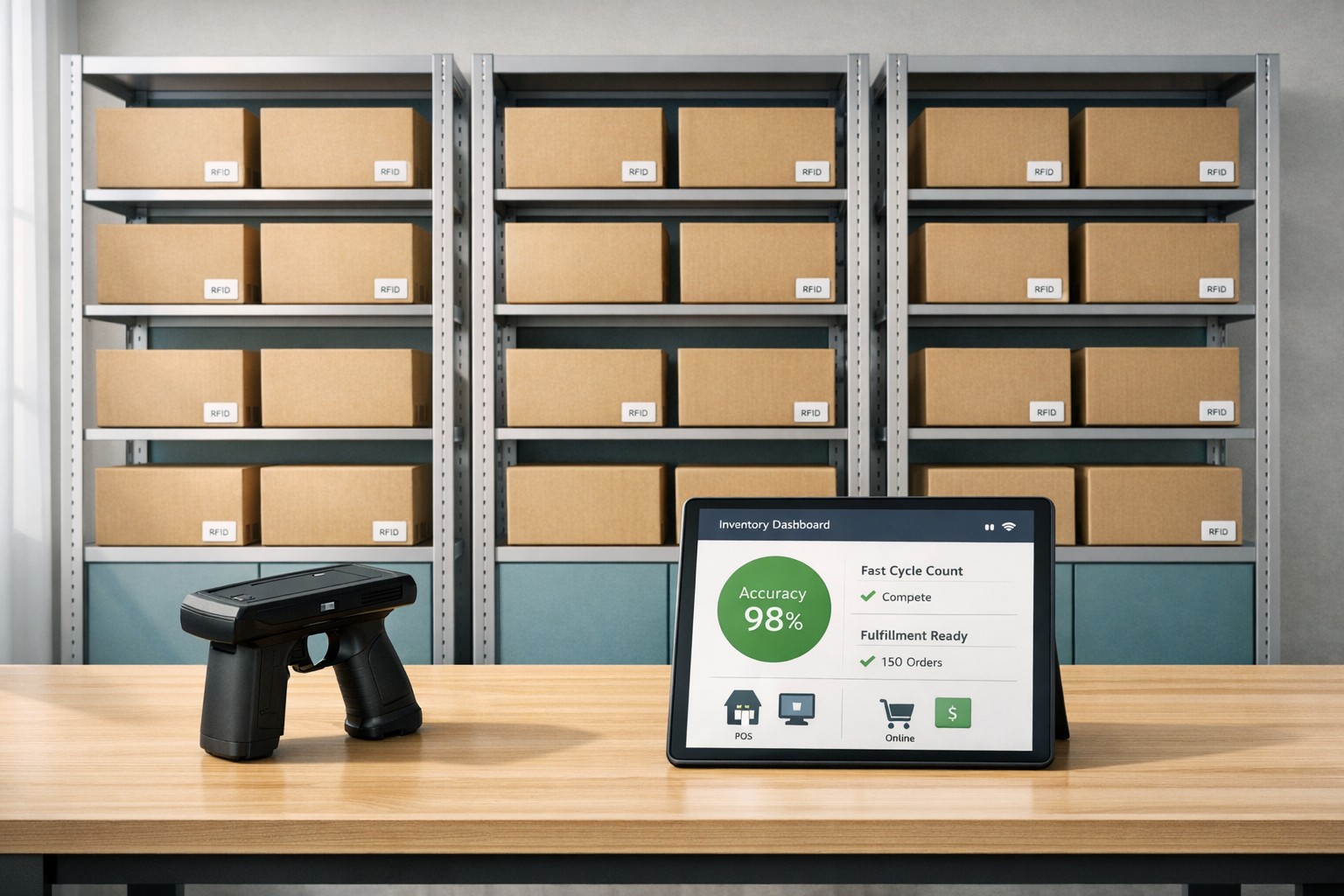
RFID technology is transforming how Shopify merchants manage inventory. While many follow a standard inventory guide, RFID offers a high-tech alternative. Unlike traditional barcode systems, RFID uses radio waves to track products automatically, scanning hundreds of items in seconds - even through packaging. This boosts inventory accuracy from around 60% to over 98%, reduces errors, and saves time. For Shopify brands, RFID ensures real-time stock updates, faster order fulfillment, and better customer satisfaction.
Key Insights:
- Efficiency: RFID scans multiple items at once, cutting manual inventory time significantly.
- Accuracy: Real-time updates prevent stockouts and overselling, and "phantom stock."
- Cost: Passive RFID tags now cost as low as $0.05 per unit, making the technology accessible for smaller businesses.
- Shrinkage Reduction: RFID helps reduce losses from theft and errors, which cost retailers $112.1 billion annually.
- Integration: RFID pairs with Shopify POS for synchronized inventory management across all channels.
Quick Comparison: RFID vs. Barcodes
| Feature | Barcodes | RFID |
|---|---|---|
| Line of Sight | Required | Not required |
| Read Speed | One item at a time | Hundreds in seconds |
| Durability | Easily damaged | Weather-resistant |
| Data Capacity | Limited | High (e.g., history, origin) |
| Security | No encryption | Data can be encrypted |
RFID simplifies inventory management for Shopify merchants, ensuring accurate stock levels across online and physical stores. With growing adoption and decreasing costs, now is the time to explore RFID for your business.
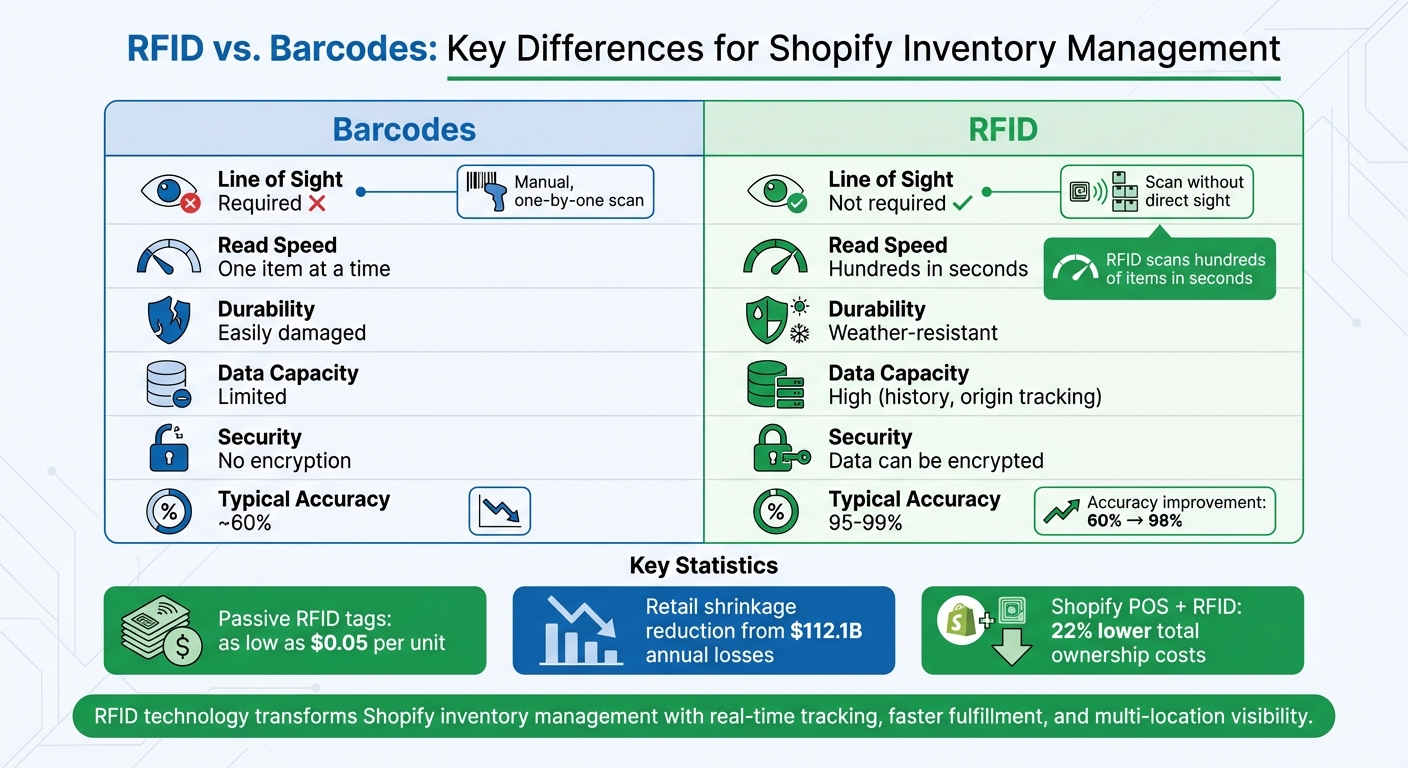
RFID vs Barcode Inventory Systems Comparison Chart
Shopify Store with TagMatiks RFID Connect!

Benefits of RFID in Inventory Management
RFID technology offers a powerful way to improve inventory management by increasing accuracy, speeding up processes, and enhancing customer experiences. Retailers using RFID have seen measurable improvements that positively affect their profitability.
Better Inventory Accuracy and Visibility
RFID takes the guesswork out of stock management by automating inventory counts, increasing accuracy rates from 60% to an impressive 95–99%. This level of precision helps prevent costly errors like "phantom stock", which can lead to missed sales opportunities. For example, inaccuracies among the top 100 SKUs alone can result in up to 4% of weekly sales being lost.
Each RFID tag carries detailed information such as SKU numbers, colors, sizes, and even supply chain details. This item-level tracking means you can monitor individual products as they move through multi-warehouse Shopify stores, retail locations, or distribution centers. For Shopify merchants juggling multiple sales channels, this unified visibility ensures accurate stock levels across all platforms.
Faster Operations and Lower Costs
One of RFID's standout features is its ability to significantly speed up operations. Unlike traditional barcode systems, RFID readers can scan hundreds of items in seconds without needing a direct line of sight. This can reduce inventory counts from hours to mere minutes, allowing employees to spend more time assisting customers instead of managing stock.
RFID also tackles the issue of retail shrinkage - a global problem that costs businesses $112.1 billion annually due to theft, fraud, and errors. By enabling real-time tracking and verifying supply chain history, RFID helps minimize these losses. Additionally, Shopify POS systems integrated with RFID have been shown to lower total ownership costs by 22%, thanks to the elimination of manual processes and seamless synchronization of sales and inventory data.
These efficiencies also translate into faster order processing and fulfillment. Integrating RFID data with AI inventory forecasting further ensures that high-demand items are always available.
Faster Fulfillment and Customer Satisfaction
With RFID, locating items becomes much quicker, cutting down picking times and improving order accuracy. Entire shipments can be scanned in seconds, reducing errors during packaging and shipment confirmations.
For BOPIS (Buy Online, Pick Up In-Store) orders, RFID ensures that items marked as available for pickup are genuinely in stock. This real-time accuracy boosts customer trust and encourages repeat purchases. Fixed RFID portals at dock doors further streamline operations by automatically updating inventory levels as shipments arrive, eliminating the need for manual data entry and reducing errors.
Case Studies: RFID Applications in Retail
Uniqlo's RFID Implementation

Uniqlo has revolutionized its inventory system by embedding RFID labels on every product. This move automates stock replenishment and drastically reduces the chances of running out-of-stock items. The retailer’s strategy is centered on achieving exceptional inventory accuracy while enhancing the shopping experience with faster and more efficient store operations.
With this level of precision, staff can quickly locate products in busy stockrooms, turning retail stores into highly efficient mini-distribution centers. These stores can handle online order fulfillment as effectively as traditional warehouses. For Shopify brands managing omnichannel operations, this kind of accuracy is critical for making BOPIS (Buy Online, Pick Up In-Store) a dependable service rather than a risky one. Walmart’s RFID program provides another example of how this technology scales to even larger operations.
Walmart's RFID Supply Chain Program
Walmart has expanded its RFID program significantly, moving beyond apparel to include categories like home goods and fresh food. In November 2025, the company partnered with Avery Dennison to introduce RFID in its fresh departments. By incorporating digital use-by dates, Walmart helps associates track product freshness and rotate stock efficiently, aligning with its mission to cut global food waste in half by 2030.
"By cutting down on manual work, we're giving our associates more time to focus on what really matters - helping our customers."
- Christyn Keef, VP of Front End Transformation, Walmart U.S.
Walmart aims to achieve near-real-time visibility for 90 million pallets across 4,600 locations by the end of 2026. The company has also started using millions of battery-free IoT sensors from Wiliot, advancing beyond traditional RFID to enable continuous sensing capabilities.
The benefits of RFID adoption are clear. Retailers have reported sales increases of 10–15% due to improved product availability. Additionally, RFID-enabled systems can boost revenue by 1.5% and raise regular price sales by 1% to 3.5%. Inventory audits that once took 8–12 hours per store with barcodes can now be completed in just minutes. For Shopify brands, these large-scale successes highlight how RFID can streamline multi-channel operations.
How Shopify Brands Use RFID
Shopify brands are adopting RFID technology and cloud inventory tools to enhance and automate their inventory management. For example, fashion retailer Baroque Japan implemented an RFID-based tool called P3 Finder in 150 of its 700 stores. Integrated with Sensormatic's TrueVUE Cloud, this system uses 3D radar to help staff locate items for restocking and BOPIS orders, ensuring accurate inventory counts.
RFID offers Shopify brands serial-level tracking, allowing them to monitor individual item costs, expiration dates, and lot numbers rather than just bulk quantities. When paired with Forstock, RFID data is centralized, syncing online and in-store inventory without the need for manual reconciliation. This is especially useful for ship-from-store workflows, where knowing the precise location and availability of each item prevents overselling and customer dissatisfaction.
Shopify merchants use handheld RFID readers with audio and visual cues to locate items quickly for order fulfillment. Fixed RFID portals at dock doors automate the receiving process as goods arrive, while RFID scanners at shipping stations ensure that items in boxes match their packing slips before leaving the warehouse. This comprehensive visibility transforms inventory management for Shopify brands, optimizing operations across the board.
sbb-itb-f0fc809
Integrating RFID with Shopify
RFID Workflows for Shopify Stores
To successfully integrate RFID with Shopify, start by defining your primary objectives. Whether it's reducing phantom stock, improving BOPIS (Buy Online, Pick Up In-Store) accuracy, or speeding up fulfillment processes, clear goals will guide your setup. Shopify merchants have two main RFID tag options: passive UHF tags (no battery, priced between $0.05 and $1.50 each, suitable for item-level tracking) and active tags (battery-powered, starting at $25, ideal for pallets or high-value items).
A typical RFID hardware setup includes fixed readers at dock doors to automatically scan incoming shipments and handheld scanners for tasks like cycle counting. Shopify POS acts as the central system, syncing inventory data in real time across warehouses and retail locations. At shipping stations, RFID scanners ensure that the contents of each box match the packing slips before orders are dispatched.
The adoption of RFID is rapidly growing. In 2024, global shipments of UHF tag chips reached 52.8 billion - a 17% increase from the previous year. By 2028, 42% of retailers are expected to implement RFID technology. This growing adoption highlights its role in streamlining operations and preparing businesses for advanced inventory forecasting tools.
Using Forstock with RFID Data
RFID readers collect detailed item data, including SKUs, prices, and supplier history, which can then be synced with Shopify. When combined with Forstock, this accurate RFID data becomes a powerful tool for AI-driven demand forecasting and automated purchase order creation. This ensures reorder points are based on real-time stock levels rather than estimates.
Forstock takes advantage of RFID's near-perfect inventory visibility to generate precise 12-month demand plans and automate reordering processes. Staff can complete cycle counts in a matter of minutes instead of hours, with every scan instantly updating Forstock's unified dashboard. This level of accuracy helps prevent overselling across online and in-store channels, making inventory management more efficient. By transforming RFID data into actionable insights, this integration enhances Shopify's inventory capabilities.
Common Integration Challenges
While RFID offers substantial benefits, implementing it with Shopify comes with its own set of challenges. For example, Shopify POS does not natively support RFID hardware, so merchants often need third-party apps or middleware to enable integration. Additionally, upfront costs - such as tags, readers, network upgrades, and ongoing software maintenance - can strain budgets.
Other technical challenges include tag collisions, which can result in data errors, necessitating the use of anti-collision algorithms. Radio signals can also be disrupted by metals and liquids, so careful placement of RFID readers is essential. Privacy concerns should be addressed by deactivating or encrypting Electronic Product Codes (EPC) at checkout.
To mitigate risks and manage costs, consider starting with a pilot program to refine your processes. Calculating your Total Cost of Ownership (TCO), including hardware, software, and training expenses, can help prevent unexpected financial surprises down the line. By addressing these challenges upfront, merchants can ensure a smoother integration process.
Future Trends in RFID for Shopify
Unmanned Stores and IoT Connections
Retail is moving toward a seamless shopping experience where customers can simply walk in, pick up what they need, and leave - no checkout lines required. RFID technology is at the heart of this transformation. Frictionless checkout systems, powered by fixed RFID readers at store exits, automatically detect items and charge customers through their linked payment methods. Experts predict that the global RFID market will grow from around $17 billion in 2025 to $38 billion by 2032, fueled by these cutting-edge retail innovations.
Another exciting development is the rise of smart shelves equipped with RFID readers connected via IoT. These shelves can automatically track when products are removed or restocked, updating inventory in real time and triggering restock alerts. For Shopify merchants, this means inventory changes on physical shelves are immediately reflected across all sales channels. This ensures accurate stock counts for both in-store and online customers, minimizing overselling and improving overall inventory management. These advancements pave the way for centralized tracking across multiple locations, simplifying operations.
RFID for Multi-Location Stores
While RFID offers game-changing benefits for single-location stores, its impact is even greater for businesses with multiple locations. For Shopify brands expanding their footprint, RFID delivers real-time, unified inventory visibility that’s nearly impossible to achieve with manual counts or barcode systems. The technology allows merchants to track items as they move between warehouses, retail stores, and pop-up locations, thanks to each tag's unique identifier. This precision is especially critical for Buy Online, Pick Up In-Store (BOPIS) services, ensuring customers can only reserve items that are physically available at their chosen location.
Andrew Pevzner, CEO of Laced Up, highlights the importance of accuracy:
"Having hyper-precise inventory is crucial… inaccuracy means cancellation fees, penalties, and it can hurt our seller rating. We find that being able to audit our entire inventory daily means our shrinkage has gone down to basically nothing!"
When paired with tools like Forstock, RFID data becomes even more effective for managing multi-location operations. The near-perfect inventory accuracy provided by RFID integrates seamlessly with Forstock’s AI-powered demand forecasting. This combination enables Shopify purchase order apps with automation and detailed 12-month demand plans based on actual stock levels, not estimates. Merchants can avoid stockouts at certain locations while preventing overstock at others, improving cash flow and ensuring every store is prepared to meet customer demand efficiently.
Conclusion
Key Benefits Summary
RFID technology can boost inventory accuracy from around 60% to over 98% while scanning hundreds of items in just seconds. This leap in precision leads to faster stock counts, speedier order fulfillment, and more dependable Buy Online, Pick Up In-Store (BOPIS) services.
In addition to improving accuracy, RFID helps cut labor costs and addresses retail shrinkage, a global issue that costs businesses approximately $112.1 billion annually. For merchants managing multiple locations, RFID provides a real-time, unified inventory view, ensuring stock levels in warehouses and stores stay consistent and reliable.
These advantages open the door to meaningful operational improvements.
Next Steps for Shopify Merchants
To fully take advantage of RFID in your Shopify store, consider taking these steps.
Start by modernizing your inventory management. Identify pain points like phantom stock, slow cycle counting, or inaccurate BOPIS orders. Then, run a pilot program with high-value items to test RFID hardware and fine-tune your workflows. Opt for UHF (Ultra-High Frequency) tags, which allow for quick, multi-item scans from distances of 3–50 feet.
Integrate RFID readers with Forstock to provide accurate inventory data for AI-driven forecasting and automated purchasing. This can help eliminate guesswork and avoid stockouts. With 76% of retailers planning to adopt RFID within the next two years, now is the perfect time to revamp your Shopify inventory management system.
FAQs
How does RFID technology enhance inventory accuracy compared to barcodes?
RFID technology takes inventory accuracy to the next level by allowing automatic, real-time tracking of items - no manual scanning required. Unlike barcodes, which need a direct line of sight to be scanned, RFID tags can be read remotely and even in bulk. This makes the entire process faster and significantly reduces the chance of human error.
With this level of precision, businesses can maintain accurate stock counts, minimize discrepancies, and simplify inventory management. By cutting down on manual tasks, RFID ensures inventory data stays reliable and up-to-date. This is especially helpful for Shopify brands dealing with large inventories or managing multiple locations.
What costs should I consider when implementing RFID for my Shopify store?
Implementing RFID technology in your Shopify store comes with several costs to keep in mind. Hardware expenses are a primary consideration, including RFID tags, readers, and antennas. These costs can vary based on the size of your business and the level of precision you require. On top of that, you’ll need to factor in integration costs for connecting RFID systems to your existing inventory management software. This might also involve subscription fees for platforms that enhance RFID capabilities.
You should also plan for employee training to ensure your team knows how to use the RFID tools effectively. Additionally, there may be infrastructure upgrades needed, such as enhancing your Wi-Fi or network systems to handle the increased data flow from RFID technology. While the initial investment might feel steep, many businesses report that RFID helps cut down on manual labor, boosts inventory accuracy, and reduces stockouts. These benefits often lead to a return on investment within 12–18 months, making it a worthwhile consideration for improving efficiency and customer satisfaction.
How does RFID improve customer satisfaction for Shopify merchants?
RFID technology makes shopping more convenient by offering real-time inventory tracking and better product availability. For Shopify merchants, this means they can keep a close eye on stock levels, ensuring popular items are always on hand. This minimizes the chances of running out of stock or overstocking, making it easier for customers to find exactly what they’re looking for when they need it.
RFID also simplifies tasks like inventory checks and checkout processes. In physical stores, for instance, RFID enables faster self-checkout by allowing customers to scan multiple items at once. This reduces wait times and makes shopping quicker and more convenient. By using RFID, Shopify merchants can create a smoother shopping journey, helping to build trust and keep customers coming back.
Keep reading
Try Forstock free for 14 days.
AI-powered demand forecasting and reorder automation for Shopify brands. No credit card required.