
RFID Inventory Tracking: Basics for Shopify Brands
Learn how RFID improves inventory accuracy, speeds counts, and syncs stock with Shopify, plus costs and setup tips.
RFID Inventory Tracking: Basics for Shopify Brands
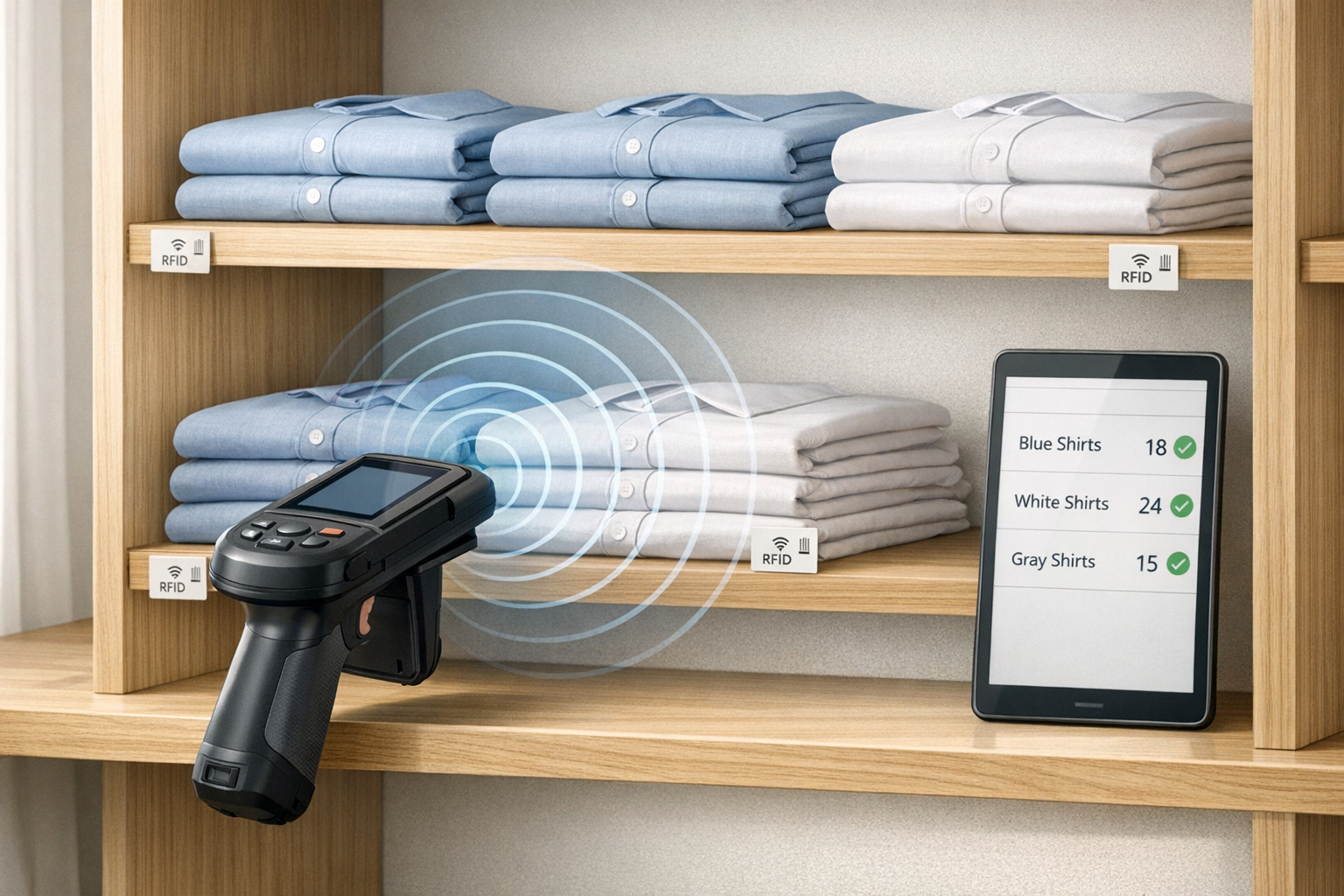
RFID technology simplifies Shopify inventory management for Shopify merchants by using radio waves to identify and manage products in real-time. Unlike barcodes, RFID can scan hundreds of items simultaneously, even through packaging, with accuracy rates up to 99%. This eliminates manual counts, reduces errors, and ensures stock data is always up-to-date across locations.
Key Benefits for Shopify Stores:
- Improved Accuracy: Achieves 95%-99% accuracy compared to traditional methods (~65%).
- Time Savings: Scans multiple items at once, cutting inventory management time.
- Real-Time Updates: Syncs stock levels across online and physical stores.
- Cost Efficiency: With RFID tags now costing as little as $0.05, it's more affordable than ever.
- Streamlined Operations: Automates stock updates at key points like store exits and warehouses.
RFID is especially useful for stores with 5,000+ SKUs or those offering services like Buy Online, Pickup In-Store (BOPIS). Initial setup costs range from $10,000 to $100,000, but many businesses recover their investment within 12-24 months due to reduced labor costs and increased sales.
What is RFID Technology?
RFID Definition and Purpose
Radio Frequency Identification (RFID) is a wireless technology that uses radio waves to track items without needing a direct line of sight. Unlike barcodes, which require a scanner to physically see the label, RFID can read tags through packaging or shelving.
For Shopify merchants, RFID's primary goal is to improve inventory accuracy while reducing the impact of manual inventory on operations. This system tracks products from manufacturing all the way to the point of sale, offering real-time updates on stock levels and locations.
This is especially helpful for retailers managing inventory across multiple locations. A great example is the western wear brand Tecovas, which implemented RFID in over 30 retail stores. By integrating RFID data with Shopify POS, they achieved over 99.5% inventory accuracy across all locations.
The system's effectiveness comes from its key components, which work together seamlessly.
RFID System Components
RFID technology relies on four main components to track inventory efficiently:
- Tags: These are small devices, often as thin as a sticker or embedded in labels, that store unique identifiers like serial numbers or SKUs. Each tag has a microchip for data storage and an antenna to communicate via radio waves.
- Antennas: Antennas emit radio frequency energy to power passive tags and collect their data. When a tagged item comes into an antenna's range, the tag activates and sends its stored information.
- Readers: Readers capture data from the antennas and send it to your inventory management system. They come in two types: handheld readers ($500–$2,000) for manual counts and fixed readers ($1,000–$5,000) mounted at exits or checkpoints.
- Software: Acting as the system's brain, the software processes tag data, updates inventory in real time, and generates reports. For Shopify merchants, this ensures stock levels are automatically synced across online stores, physical locations, and warehouses.
In March 2024, Spanish lingerie brand Selmark introduced a UHF RFID source-tagging system at the manufacturing stage. Under the leadership of Director of Innovation Diego Piñeiro, the project assigned unique IDs to SKUs, enabling precise tracking throughout the supply chain. This effort boosted picking and dispatch capacity by 30% and earned Selmark recognition as a finalist for Best Retail RFID Implementation at the RFID Journal Awards 2025.
sbb-itb-f0fc809
How to do an inventory with RFID and Barcode
How RFID Improves Inventory Tracking
RFID vs Barcode Inventory Tracking Comparison for Retailers
RFID vs. Barcode Scanning
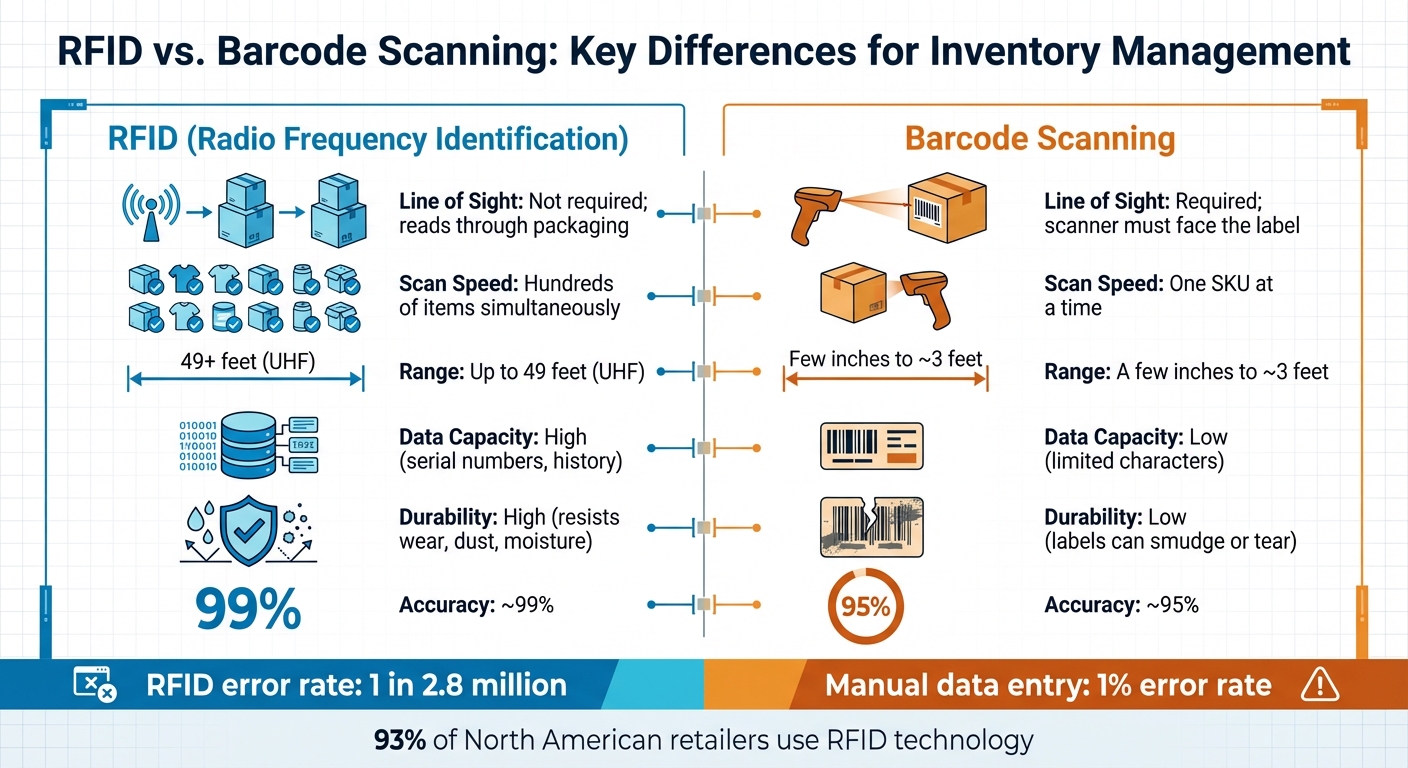
RFID technology eliminates the hassle of scanning items one by one. Unlike barcode systems, which require staff to align and scan each label manually, RFID readers can process data from hundreds of items at once - even if those items are hidden inside packaging.
For example, a handheld RFID reader can count an entire inventory section in seconds, a task that could take hours with a barcode scanner. Passive UHF RFID tags can be read from distances of up to 49 feet, compared to the limited range of a few inches to about 3 feet for standard barcode scanners.
| Feature | RFID | Barcode |
|---|---|---|
| Line of Sight | Not required; reads through packaging | Required; scanner must face the label |
| Scan Speed | Hundreds of items simultaneously | One SKU at a time |
| Range | Up to 49 feet (UHF) | A few inches to ~3 feet |
| Data Capacity | High (serial numbers, history) | Low (limited characters) |
| Durability | High (resists wear, dust, moisture) | Low (labels can smudge or tear) |
| Accuracy | ~99% | ~95% |
Manual data entry often has a 1% error rate, but RFID systems reduce errors dramatically, achieving a rate as low as 1 in 2.8 million. With 93% of North American retailers already leveraging RFID in some way, it’s clear this technology has become a standard tool in modern inventory management.
These technical strengths translate into meaningful advantages for Shopify merchants juggling multi-channel inventories.
Benefits for Shopify Merchants

For Shopify merchants managing inventory across online and physical locations, RFID delivers several game-changing benefits that simplify and improve inventory management.
Real-time Stock Synchronization
Take Lululemon’s example: in 2025, they rolled out the Nedap iD Cloud platform across 600+ stores worldwide, creating a seamless omni-channel experience by providing accurate, real-time inventory data at every location. Carl Barker, Lululemon’s VP of Global Omni Programs, highlighted the impact:
"Stores are a significant point of connection and community for guests, and real-time inventory data is the foundation for keeping the right product assortment on the floor".
Integrating RFID with tools like Forstock allows Shopify merchants to synchronize inventory data across both online and offline channels with ease.
Reduced Labor Costs
RFID minimizes the need for time-consuming manual inventory counts, freeing up staff to focus on customer interactions. For instance, Decathlon installed 458 RFID-enabled self-checkout stations across 50 stores in Brazil. This upgrade cut checkout times in half and ensured 100% automatic item registration at the point of sale.
Higher Accuracy Rates
RFID achieves inventory accuracy levels of 95% to 99%. This precision is especially critical for Buy Online, Pickup In-Store (BOPIS) orders, where accurate stock data ensures a smooth customer experience.
Streamlined Operations
Fixed RFID readers installed at key points like warehouse entrances and store exits automatically update inventory systems as products move. With inventory distortions - such as stockouts and overstocks - costing businesses an estimated $1.7 trillion globally in 2024, RFID’s ability to improve accuracy can lead to substantial cost savings.
The retail RFID market was valued at $13.46 billion in 2024 and is expected to grow to $29 billion by 2033. Retailers who fully embrace RFID report a return on investment exceeding 10%, making it a smart move for Shopify merchants aiming to scale efficiently.
How to Implement RFID for Your Shopify Store
Evaluate Your Business Needs
The first step is to figure out whether RFID makes sense for your Shopify store. RFID works best if you're managing a large number of SKUs - usually 5,000 or more - or handling high-value inventory where the cost of each tag is worth it.
Start by checking your current inventory accuracy. If your accuracy is hovering around the industry average of 60%–65%, RFID can boost it to an impressive 95%–99%. Additionally, think about your fulfillment needs. For example, if you offer Buy Online, Pickup In-Store (BOPIS), RFID can help avoid overselling items that aren’t actually in stock.
Your store’s physical setup also matters. Environments with a lot of metal or liquids can interfere with UHF tags. To decide if RFID is worth it, compare the upfront costs of readers and software with the potential savings. These savings could come from reduced labor costs, fewer stockouts, and better customer satisfaction. Stores that use RFID for five or more omnichannel features tend to see up to 20% higher ROI than those using fewer applications. Start by improving inventory accuracy, and then you can explore other benefits like loss prevention or faster checkout processes.
When your business needs are clear, you’ll have an easier time choosing the right RFID solution.
Select the Right RFID Tags
Finding the right tag depends on your products, store environment, and budget. For most Shopify stores, passive RFID tags are the go-to option. These tags, which are powered by the reader's signal, cost between $0.10 and $1.00 each when bought in bulk and can last over 20 years. They’re great for tracking individual items and have a read range of up to 82 feet (25 meters) with UHF technology.
On the other hand, active RFID tags come with an internal battery, allowing them to broadcast signals on their own. They can cover distances of over 328 feet (100 meters) but cost $25 or more per tag. These are better suited for tracking high-value assets in large warehouses or logistics operations, making them less practical for typical Shopify retailers.
| Feature | Passive RFID | Active RFID |
|---|---|---|
| Power Source | Reader's signal | Internal battery |
| Read Range | Up to 82 feet (25 meters) | 328+ feet (100+ meters) |
| Cost per Tag | $0.10–$1.00 | $25+ |
| Lifespan | 20+ years | Limited by battery life |
| Best Use Case | Retail inventory tracking | High-value asset tracking |
If your products contain liquids or metals, low-frequency (LF) tags might be a better option since they’re less affected by interference. To maximize efficiency, you can use an ABC analysis to focus RFID efforts on "A items" - the top-selling, high-value products that drive about 80% of your revenue.
Once you’ve chosen the right tags, the next step is integrating RFID with your Shopify system.
Connect RFID with Shopify and Inventory Tools
After selecting your tags, it’s time to link RFID data to Shopify’s inventory system. While Shopify doesn’t directly support RFID scanning at the point of sale, you can use specialized apps from the Shopify App Store to bridge the gap. The best systems sync RFID scan data directly with Shopify’s inventory, giving you a centralized view for online orders, BOPIS fulfillment, and in-store stock management.
Apps like TagMatiks RFID Connect work with RAIN RFID labels, assigning unique identifiers to individual items. Another option is Keonn RFID, which provides an integrated hardware solution for scanning.
For merchants using Forstock, integrating RFID with its AI-powered tools can be a game-changer. RFID ensures real-time, accurate stock counts, while Forstock uses that data to predict demand, automate purchase orders, and eliminate overstock and stockouts. Together, they create a seamless inventory management system that keeps your business running smoothly.
Start with the basics - getting inventory counts right. As Greg Buzek, Founder and Principal Analyst at IHL Group, explains:
"The primary thing is to have your inventory accurate. How much time do you waste when an associate is running around the store trying to find stuff?"
RFID Implementation Costs and Challenges
Upfront Investment Requirements
Setting up RFID technology involves a hefty initial investment. For a retail business, the total cost of an RFID system typically falls between $10,000 and $100,000, depending on factors like store size and system complexity. The hardware alone accounts for a large portion of this expense - fixed readers range from $1,000 to $8,000 each, handheld scanners cost between $500 and $4,500, and RFID printers for encoding labels are priced at $1,500 to $5,000.
On the software side, cloud-based solutions usually cost $1,000–$5,000 annually, while on-premise systems can start at $5,000 for basic setups and climb to $100,000 for more advanced configurations. Installation is another cost to consider, with professional services running from $2,000 to $15,000. Additionally, upgrading network infrastructure, such as Power over Ethernet (PoE) switches, can add $1,000 to $5,000 to your budget.
Before diving into installation, many businesses opt for a professional site survey to ensure proper placement of readers and antennas, avoiding signal "dead zones." These surveys typically cost $5,000 to $20,000.
Despite the high initial costs, most mid-to-large retailers recover their investment within 12–24 months. Many report a return on investment (ROI) of over 10%, which can climb to 20% when the technology is used across at least five omnichannel features.
Common Implementation Obstacles
While RFID technology offers many advantages, it also comes with its share of challenges. Signal interference is a major issue - metals and liquids can block or reflect radio waves, leading to inaccurate readings. For stores with metal shelving or liquid-based products, careful calibration of reader positions and selecting the appropriate tag types are essential to mitigate these problems.
Another common hurdle is tag collision. This occurs when multiple readers simultaneously pick up the same tag signal, causing errors. Implementing anti-collision algorithms can help manage these overlapping signals effectively.
Staff training is equally important. Employees need to feel comfortable using handheld readers and syncing data with platforms like Shopify. Training sessions are key to ensuring smooth adoption and effective use of the technology.
Lastly, data security cannot be overlooked. Encrypting transmissions and establishing clear protocols for deactivating tracking at the point of sale are critical steps to safeguard customer privacy and sensitive information. Addressing these challenges head-on will help Shopify brands unlock the full potential of RFID technology.
Conclusion
RFID technology offers Shopify merchants a game-changing level of inventory accuracy - up to 99%. Compare that to the industry average of just 60%–65%, and it’s easy to see how this eliminates the guesswork that often comes with traditional tracking methods. By reducing the need for manual counts, your team can focus more on serving customers and less on hunting down misplaced items.
But while RFID delivers precise inventory counts, the real value lies in turning that raw data into actionable insights. Think of RFID as the "eyes" of your operation, constantly monitoring what’s moving, what’s stagnant, and what’s missing. However, to make that data work for you, you need the "brain" - a smart inventory management system that can analyze the information and guide decisions like when to reorder and how much stock to maintain.
That’s where Forstock comes in. RFID ensures your inventory data is accurate to the last unit, and Forstock takes it a step further by using that data for AI-driven demand forecasting, automated purchase orders, and long-term inventory planning with a 12-month outlook. Together, they create a perpetual inventory system that updates in real-time with every transaction. This integration supports seamless omnichannel experiences, such as Buy Online, Pickup In-Store (BOPIS).
Retailers who implement five or more omnichannel features alongside RFID see a 20% higher ROI compared to those who use it for fewer applications. Combining RFID's tracking accuracy with Forstock's advanced purchasing tools means you’re not just managing inventory - you’re optimizing it. This approach helps prevent stockouts, improves cash flow, and eliminates time wasted on manual processes, all while setting the stage for scalable growth.
FAQs
Do I need RFID if I have under 5,000 SKUs?
RFID's usefulness for inventories under 5,000 SKUs really boils down to your specific needs and budget. While RFID can speed up stock counts and enhance item tracking, smaller inventories might find manual or barcode systems more practical and affordable. If improving accuracy and streamlining operations are high on your priority list, RFID could still be worth considering. However, it's important to weigh the potential efficiency improvements against the upfront costs to decide if it’s the right fit for your business.
What RFID setup works best for a Shopify store?
For a Shopify store, an effective RFID setup involves tagging each item with RFID tags and installing RFID readers in key locations like entry points, storage areas, and checkout counters. These readers gather data and sync it with Shopify, ensuring your inventory updates automatically. When combined with inventory management software, such as Forstock, you gain tools for better demand forecasting, automated purchase orders, and analytics to help avoid stockouts or excess inventory.
How do I sync RFID scans to Shopify inventory?
To connect RFID scans with Shopify, you'll need an RFID inventory system that works directly with Shopify. When RFID readers scan items, the data is transmitted to your inventory system. From there, Shopify can be updated either automatically or through a manual syncing process. This setup keeps your Shopify stock levels aligned with the most recent RFID updates.
Keep reading
Try Forstock free for 14 days.
AI-powered demand forecasting and reorder automation for Shopify brands. No credit card required.