
Raw Materials vs Finished Goods: Inventory Planning for Brands That Manufacture
By Forstock Team · Last updated July 19, 2026
Plan finished goods and raw materials separately using BOMs, lead times, scrap rates, capacity checks, and layer-specific reorder rules.

If you make your own products, one reorder rule is not enough. I need to plan finished goods from sales demand, and I need to plan raw materials from the BOM, build timing, supplier lead times, scrap, and capacity.
Here’s the short version:
- Finished goods answer: How much should I have ready to sell?
- Raw materials answer: What do I need to buy, and by when?
- WIP sits in the middle and follows the build schedule.
- A simple BOM math error can throw off every downstream material order.
- Material dates should be set from the build start date, not the ship date.
- Capacity can change what I need to buy. If the line can only make 7,000 units but the plan says 8,000, I need to fix the build plan before I place POs.
- Scrap matters. If I need 4,500 lb of input and scrap is 3%, I should buy about 4,639 lb, not 4,500 lb.
- Reorder points should be split by layer. Finished goods protect in-stock rates. Raw materials protect production uptime.
A simple example shows why this matters. If I use 10 units per day, supplier lead time is 14 days, and I keep a **5-day** buffer, my raw-material reorder point is 190 units. That is very different from how I would set a reorder point for a finished SKU based on sales swings and channel demand.
Quick Comparison
| Item | Finished Goods | Raw Materials |
|---|---|---|
| Demand type | Independent | Dependent on BOM and build plan |
| Main input | Sales forecast | Component usage |
| Main timing rule | Plan to meet customer demand | Plan to arrive before production starts |
| Main risk | Sales spikes | Supplier delay, scrap, MOQ |
| Main goal | Keep products in stock | Keep the line running |
| Reorder logic | Sales + service level | Usage + lead time + buffer |
In other words: I should not run components and sellable SKUs with the same planning rules. The clean workflow is sales data → finished-goods forecast → BOM explosion → component demand → purchase order.
sbb-itb-f0fc809
Raw materials vs. finished goods: planning differences that change decisions
Finished-goods planning answers one question: how much product should you keep ready to sell? Raw-material planning answers a different one: what should you buy, and when should you buy it?
That difference matters more than it seems. If you run both layers with the same reorder logic, purchasing gets messy and production can drift off schedule. The reason is simple: each layer reacts to different signals, faces different risks, and needs different safety buffers. In practice, finished-goods plans protect service levels, while raw-material plans protect production.
| Factor | Finished Goods | Raw Materials |
|---|---|---|
| Lead-Time Risk | Last-mile delivery and fulfillment speed | Supplier delays, long procurement windows, freight disruptions |
| Service Goals | Protect customer in-stock rates | Protect production uptime |
| Carrying Cost | Higher - includes materials, labor, and overhead | Lower - base cost of materials only |
| Common KPIs | Sell-through rate, Available to Promise (ATP) | Reorder points, supplier lead time variance |
| Main Stockout Cause | Unexpected sales spikes or marketing success | Supplier failure, material scrap/waste, or poor BOM accuracy |
| Main Excess Cause | Poor sales forecasting | High minimum order quantities (MOQs) |
Finished goods planning starts with sales, channels, and service levels
Finished-goods planning starts with Shopify sales history, seasonality, promotions, and wholesale commitments. Then you set an in-stock target: the share of days a SKU should be available to ship. From there, you work backward to decide how much inventory to keep on hand.
Channel data matters here. If a brand sells through Shopify, Amazon, and wholesale at the same time, it needs demand from all three channels before setting finished-goods targets. Leave one out, and you’ll likely underbuild. That forecast then becomes the starting point for component demand.
Raw material planning starts with BOMs, lead times, and supplier constraints
Raw material planning works the other way around. Instead of asking, "what will customers buy?" you’re asking, "what do we need to build what customers will buy?" The answer comes from your Bill of Materials.
Each component in the BOM has its own usage rate, scrap assumption, supplier lead time, and minimum order quantity. Those limits shape buying decisions weeks, sometimes months, before production begins. Supplier lead times and freight delays can throw off the build schedule, so material plans need buffer time before production starts. And if your process creates waste, that scrap needs to be built into the BOM. If it isn’t, production will come up short. Those limits should drive purchase timing before production is put on the calendar.
How to convert finished-goods forecasts into raw-material purchase plans
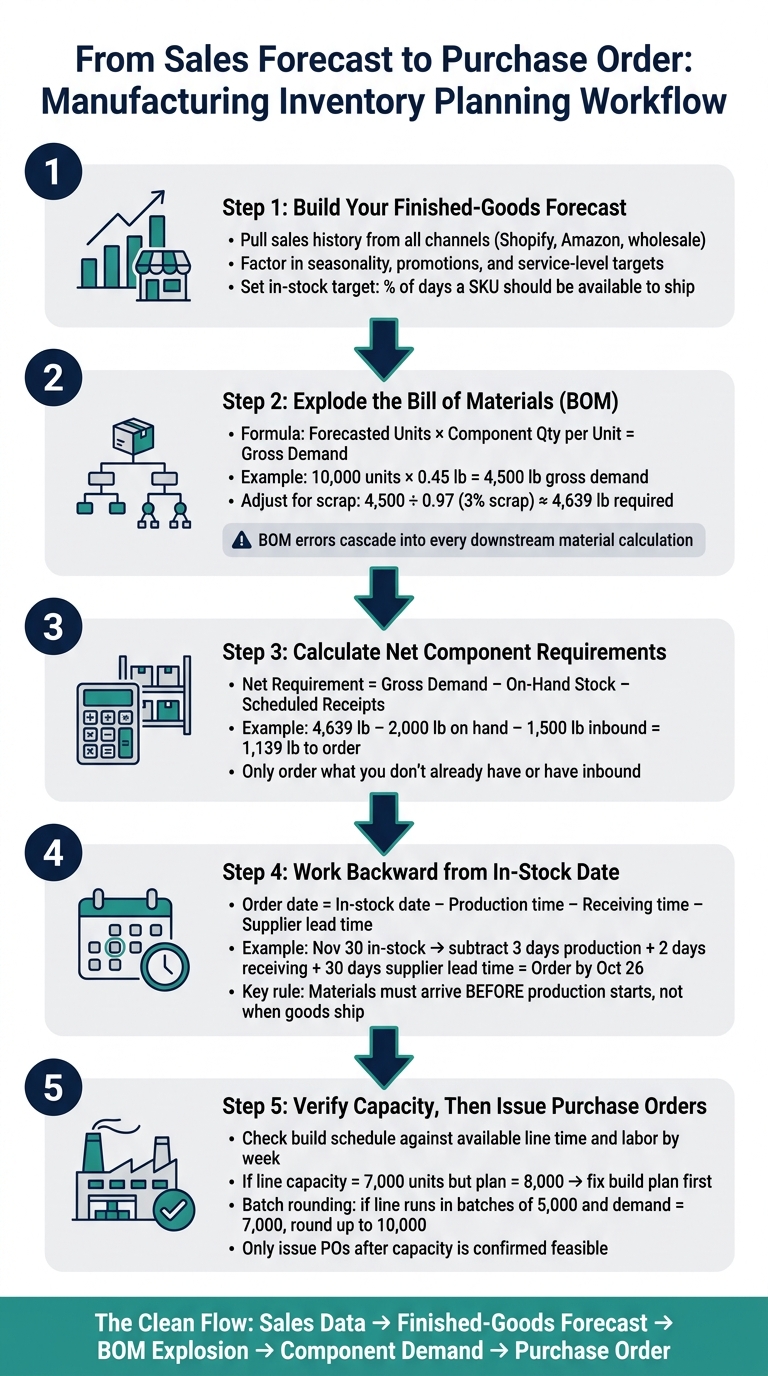
From Sales Forecast to Purchase Order: Manufacturing Inventory Planning Workflow
Once you have a finished-goods forecast - whether you make products in-house or through production partners - the next step is turning that forecast into a purchase plan for the materials required to make it. In plain English: your finished-goods forecast becomes the starting point for raw-material purchasing.
Use BOMs to calculate component demand from finished-goods sales forecasts
The core formula is simple: forecasted finished units × component quantity per unit = gross component demand. After that, adjust for yield loss or scrap.
Here’s what that looks like in practice. If your BOM shows 0.45 lb of a key ingredient per unit and you plan to build 10,000 units, gross demand is 4,500 lb. But if your scrap rate is 3%, your procurement requirement is 4,500 ÷ 0.97 ≈ 4,639 lb - not 4,500.
Next, convert gross requirements into net requirements. Subtract projected available inventory, including on-hand stock and scheduled receipts, and factor in any allocations or reservations. So if you have 2,000 lb on hand and a PO for 1,500 lb arriving this month, your net requirement drops to 1,139 lb. That’s the number you use for purchasing - not the gross figure. It keeps you from ordering material you already have or already know is inbound.
And here’s the part that can trip teams up fast: BOM errors cascade into every downstream material calculation.
Time-phase material demand around build dates, not ship dates
Materials need to arrive before production begins, not when finished goods ship. That means you work backward from the in-stock date and subtract production time, receiving and inspection time, and supplier lead time.
For example, if finished goods need to be available by November 30, and you need 3 days to produce, 2 days to receive materials, and your printed carton supplier has a 30-day lead time, the latest order date for those cartons is October 26. Miss that date, and production stops cold - even if every other component is sitting there ready to go.
Account for production limits before placing purchase orders
Before you commit to any purchase order, make sure the production plan can actually happen. Take the build schedule, translate it into resource hours, and compare that against available line time and labor by week. If your line can only fill 7,000 cases in November but the plan calls for 8,000, something has to change before you buy materials.
Batch sizes matter too. If your filling line runs in batches of 5,000 units and demand calls for 7,000, the production plan rounds up to 10,000. That pushes material needs above what the forecast alone suggests. The usual flow is:
- Run the unconstrained material plan
- Check it against capacity
- Adjust the build schedule to a feasible level
- recalculate material requirements before issuing purchase orders
Set reorder points and safety stock at both inventory layers
Once your forecast and build plan are in place, you need separate reorder points for finished goods and raw materials. That split matters. If you treat both layers the same way, customer orders and production runs can bump into each other fast.
Finished goods and raw materials need different buffers because they solve different problems. Finished goods help protect in-stock levels and customer service. Raw material buffers help keep production from stopping in the middle of a run.
Finished goods buffers should protect customer service levels
A finished goods reorder point should be based on forecasted sales and channel demand. Its main job is to protect in-stock rates and conversion.
Set this buffer using forecast error and your target service levels. Safety stock at this layer helps absorb swings in demand, including sales spikes and changes in channel velocity.
Raw material buffers should protect production running
Raw material reorder points should be based on material usage rates and build schedules. A practical formula is (Daily Usage × Lead Time) + Safety Stock Buffer.
Here’s a simple example. If you use 10 units per day, have a 14-day lead time, and keep a 5-day safety buffer, your reorder point is 190 units.
Reorder point = (10 × 14) + (10 × 5) = 190 units
This buffer helps protect production from supplier delays and lead-time variance. In plain English, it gives you room to handle schedule slippage before the line stalls.
| Planning Input | Finished Goods Layer | Raw Materials Layer |
|---|---|---|
| Reorder point driver | Forecasted sales and channel demand | Material usage rates, BOM requirements, and build schedules |
| Safety stock driver | Demand variability and sales spikes | Supplier reliability and lead-time variance |
| Review frequency | Daily, linked to sales velocity | Weekly or monthly, linked to production runs |
| Key monitoring metrics | Stockout rate, sell-through, days on hand | Shortage alerts, supplier lead-time accuracy, production downtime |
| Primary goal | Protect customer service levels | Keep production running |
Use one planning system to keep finished-goods and component signals aligned.
Put the full workflow into one planning system
Once reorder points are set, the next move is simple: connect forecasting, BOM planning, and purchasing in one place.
How Forstock links forecasts, components, and purchasing

Forstock connects finished goods, WIP, and component demand inside a single system. A BOM ties each finished product to the parts and materials it needs. From there, Forstock rolls finished-goods demand down into component requirements, so if demand shifts, the purchasing plan shifts with it too.
It also uses historical PO lead times to generate purchase recommendations and factors in supplier MOQs and pack sizes. That link matters. Without it, demand changes can slip through the cracks between planning and buying.
For teams working across multiple warehouses, Forstock shows inventory in one view and lets users split a single PO across different warehouses.
What good planning looks like in practice
The flow should look like this:
- Sales data
- Finished-goods forecast
- BOM explosion
- Component demand
- Purchase order
When those steps stay connected, teams can cut stockouts, excess raw material, and production delays.
FAQs
How do I forecast raw material demand from a finished-goods plan?
Use your Bill of Materials (BOM) to tie each finished product to the parts it needs. Start with your finished-goods sales forecast, turn that into a production schedule, and then multiply planned unit output by the quantities listed in the BOM.
You’ll also want to account for each component’s lead time, current raw material inventory, and reorder point:
(Average Daily Usage × Lead Time in Days) + Safety Stock
That keeps material purchases in line with expected sales and production demand.
When should I order materials if supplier lead times vary?
When supplier lead times change, static averages can throw you off. A better move is to use dynamic reorder points:
(Average Daily Sales × Average Lead Time) + Safety Stock
Then tighten up your Safety Stock so it covers swings in both demand and lead time.
For better accuracy, base lead time on your actual past data, not the supplier’s estimate. In plain English, measure the full window from purchase order placement until the item is sellable.
How do I set separate reorder points for finished goods and components?
Treat them as separate inventory layers, then connect them through production needs.
For finished goods, base reorder points on customer demand:
(Average Daily Sales × Lead Time) + Safety Stock
For raw materials, base them on production use:
(Daily Component Usage × Component Lead Time) + Safety Stock
The key is to track component usage against your finished-goods forecast. That way, materials are on hand when production starts, not after the line is ready to run.
Keep reading
Try Forstock free for 14 days.
AI-powered demand forecasting and reorder automation for Shopify brands. No credit card required.