
How to Plan Reorders Around Your Co-Packer's MOQs and Production Slots
By Forstock Team · Last updated July 16, 2026
Plan co‑packer reorders by matching lead‑time demand, safety stock, MOQs, cash and slot timing to avoid stockouts and excess inventory.

If you wait until stock looks low, you're often already late. I plan co-packer reorders by lining up 4 inputs first: forecast demand, current and inbound inventory, total lead time, and supplier run rules.
Here’s the short version:
- Set the reorder trigger with: lead-time demand + safety stock
- Subtract on-hand and inbound units to find what I still need
- Round the order up to fit the binding MOQ or batch rule
- Check cash and storage before I approve the run
- Book the slot backward from the in-stock date, not from the day I want to place the PO
That matters because the amount I need and the amount I’m allowed to make are often different. A 6,000-unit bottle MOQ can force a bigger run than a 4,000-unit co-packer minimum. And a lower unit cost can still be the wrong choice if it ties up an extra $16,000 and doubles pallet use from ~10 to ~20 pallets.
A simple example from the article:
- Monthly demand: 2,000 units
- Run option A: 5,000 units at $4.00/unit = $20,000
- Run option B: 10,000 units at $3.60/unit = $36,000
- Unit savings: $0.40
- Extra cash required: $16,000
So I don’t just ask, "What should I reorder?" I ask:
- When will I run out?
- What is the last date I can book production?
- Which MOQ sets the floor?
- How many months of cover am I buying?
- Can I pay for it and store it?
One timing example makes the point fast: if I need inventory in stock by 11/01/2026, the latest booking deadline may land as early as 08/15/2026 once I count production, freight, receiving, and buffer time.
Below, I’d use this flow each cycle: forecast demand, calculate net need, fit the run to MOQ and budget, then work backward to lock the slot.
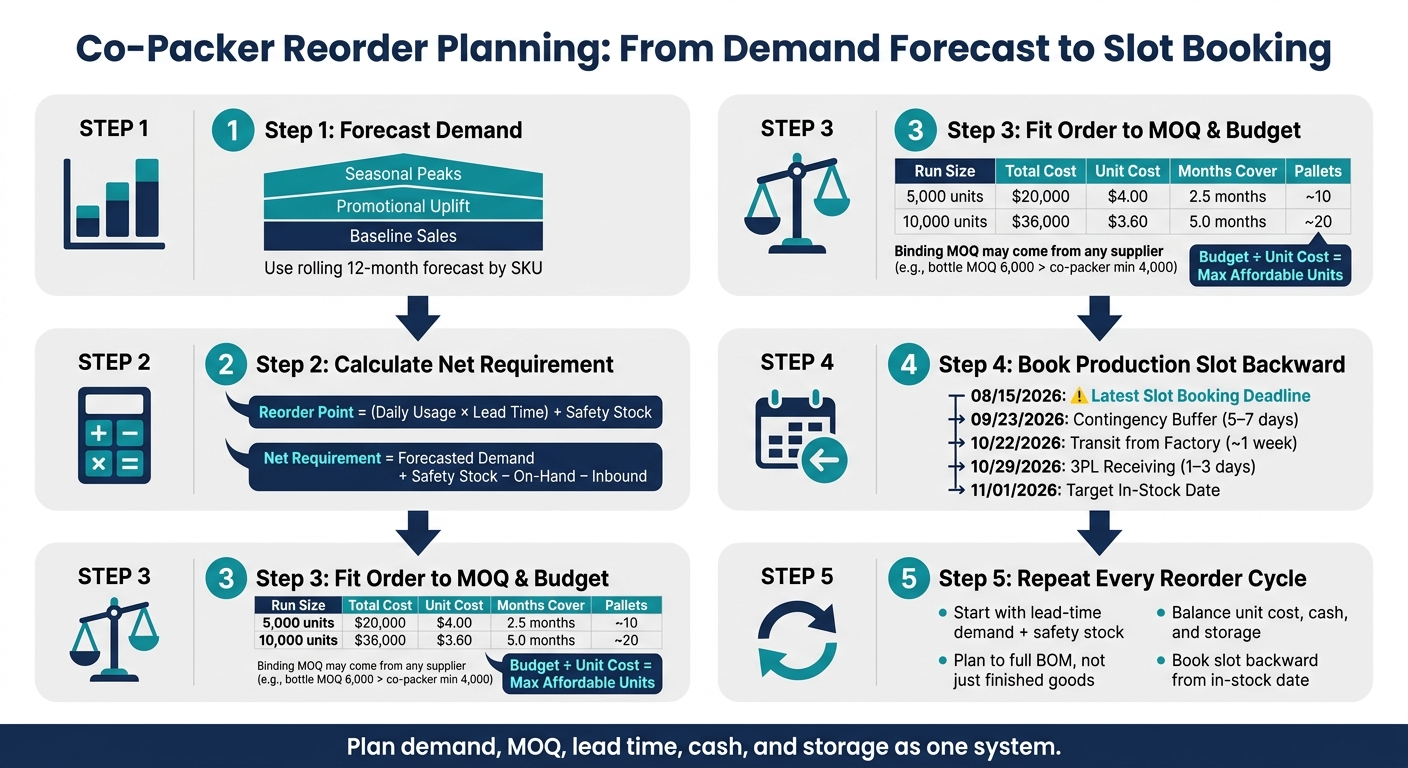
Co-Packer Reorder Planning: From Demand Forecast to Slot Booking
Step 1: Calculate net production requirements from demand and inventory data
Start with the net production requirement: the units you still need after you subtract forecast demand, on-hand stock, and inbound stock.
Forecast demand by month, promo period, and peak season
Start with a rolling 12-month forecast that splits demand into three layers: baseline sales, promotional uplift, and seasonal peaks. If you blend all three together, peak demand gets buried and booking often happens too late.
A simple way to handle this is to build your forecast with three columns for each month: baseline, promo/event uplift, and total. Then mark every month where total demand sits well above baseline. That helps pull those periods into slot planning early. Month-by-month visibility also shows which SKUs need production attention first.
Calculate reorder points from lead-time demand and safety stock
Once your demand forecast is in place, the reorder point math is simple:
Reorder Point = (Daily Usage × Lead Time) + Safety Stock Buffer
Set safety stock using actual lead-time swings from your PO history, not gut feel.
From there, your net production requirement becomes:
Net Requirement = Forecasted Demand During Lead Time + Safety Stock − On-Hand Inventory − Inbound Stock
Define safety stock in days of cover so it moves with seasonal demand. After you set the net requirement, you can check order quantities against MOQ limits and storage capacity.
Use Forstock to turn Shopify and channel data into time-phased requirements
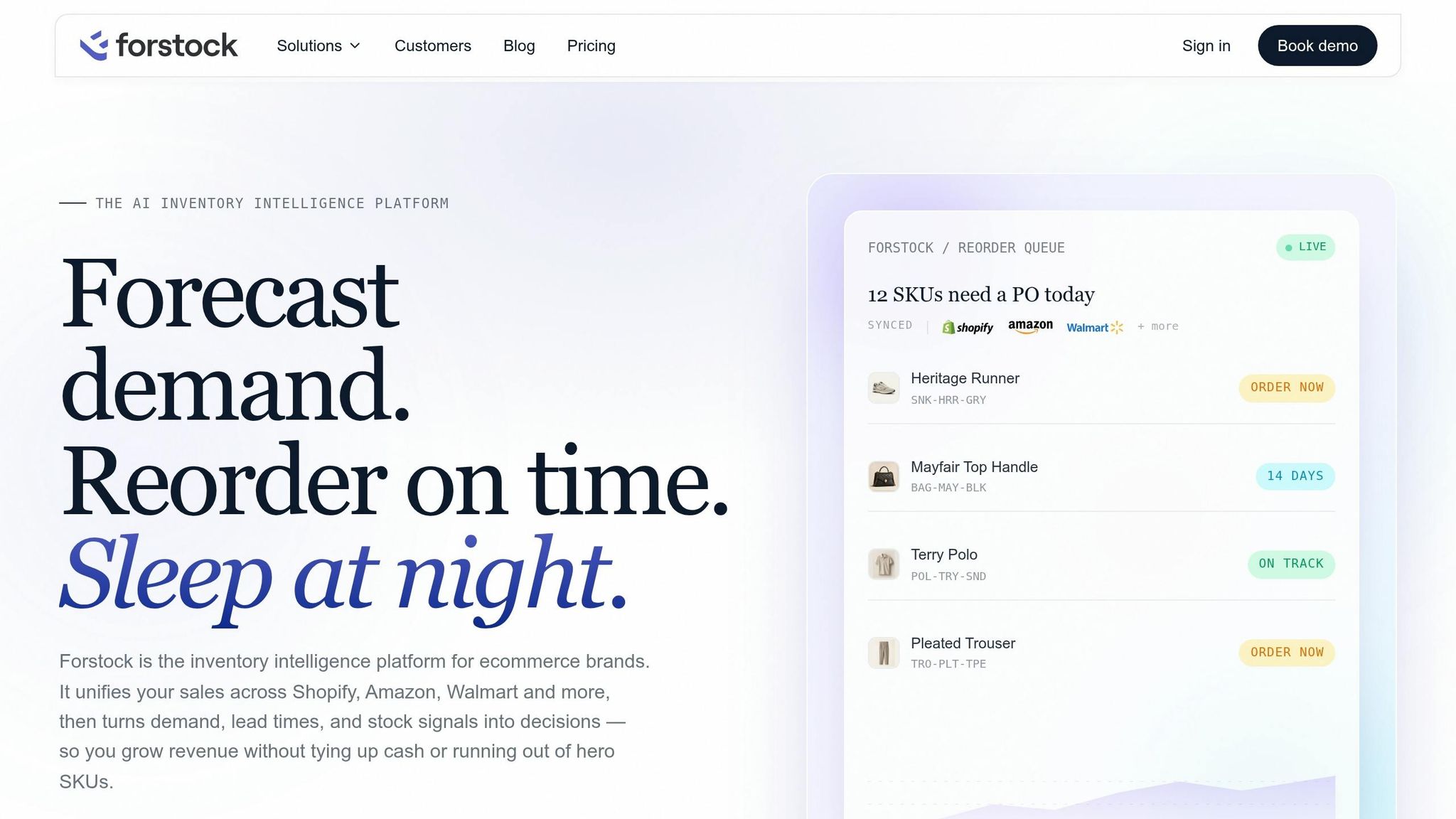
Use Forstock to pull together Shopify, other sales channels, open POs, and demand history into SKU-level time-phased requirements. Instead of a static low-stock alert, you get a forward-looking view: the exact day a SKU is expected to run out, and the last day you can place a production order based on your supplier’s actual lead time.
"Forstock projects each SKU's demand forward to the exact day it runs out - and the last day you can order, given the supplier's real lead time." - Forstock
Once net requirements are time-phased by SKU, the next move is to fit them to MOQ and batch-size rules.
sbb-itb-f0fc809
Step 2: Adjust order quantities to fit MOQs, batch sizes, and cash limits
Net requirement shows what you need. MOQ rules show what you can actually make. The job here is simple: take the net requirement and test the smallest workable batch against MOQ rules, cash on hand, and storage space.
Map every MOQ before approving a run
The minimum that controls your batch size may come from any supplier, not just the co-packer. So before you approve a run, put together a simple constraint table for each SKU. Include every upstream MOQ you need to follow, plus monthly demand, months of cover, and cash required.
For a SKU selling 2,000 units per month:
| Item | MOQ | Monthly Demand | Months of Cover | Cash Required |
|---|---|---|---|---|
| Bottles | 6,000 units | 2,000 units | 3.0 months | $2,400 ($0.40/unit) |
| Co-packer run size | 4,000 units | 2,000 units | 2.0 months | $10,000 ($2.50/unit) |
You'd add the same fields for labels, cartons, ingredients, and any other limit in the system. In this case, bottles are the binding constraint because the 6,000-unit MOQ is higher than the co-packer's 4,000-unit minimum.
Choose a batch size by comparing months of cover, unit cost, and storage impact
Once you know the binding constraint, you still need to pick a run size. Do you stay at the minimum, or go bigger?
Larger runs often cut unit cost. But there's no free lunch. They also lock up more cash and take more pallet space.
Take an SKU with monthly demand of 2,000 units and an all-in unit cost of $4.00 at 5,000 units, dropping to $3.60 at 10,000 units:
| Run Size | Total Cost | Unit Cost | Months of Cover | Pallets Used |
|---|---|---|---|---|
| 5,000 units | $20,000 | $4.00 | 2.5 months | ~10 pallets |
| 10,000 units | $36,000 | $3.60 | 5.0 months | ~20 pallets |
That larger run saves $0.40 per unit. Sounds good at first. But it also adds $16,000 to your cash outlay and doubles your pallet count.
For a stable, year-round SKU with a long shelf life, that trade may be worth it. For a seasonal SKU or a new launch, five months of cover can leave you sitting on product you may struggle to move.
A quick cash check helps rule things out fast:
- Inventory budget ÷ all-in unit cost = maximum affordable units
If your budget is $22,000 and your unit cost is $4.00, your ceiling is 5,500 units. That alone knocks out the 10,000-unit run, even though the unit cost is lower.
Use Forstock to model MOQ-constrained replenishment scenarios
Use Forstock to test workable batch sizes against run minimums, component MOQs, lead times, and coverage targets at the SKU level. You can set up multiple scenarios - for example, 5,000 units every 8 weeks versus 10,000 units every 16 weeks - and compare the projected effect on on-hand inventory, stockout risk, months of cover, cash committed, and pallet count side by side. Once a batch size is approved, Forstock turns that choice into aligned purchase-order recommendations for each component, checks whether the required quantities meet supplier MOQs, and flags any gaps for review before the run is booked.
Once the run size is set, the next limit is slot timing.
Step 3: Book production slots backward from must-hit dates
Once your run size is set, the last big limit is the co-packer's schedule. The move here is simple: start with the date you need inventory in stock, then work backward through production, freight, receiving, and a small buffer.
Build a slot calendar by working backward from your target in-stock date
Begin with the target in-stock date, then back into each step before it. That includes production, transit, 3PL receiving, and buffer time. From there, use the approved batch size to figure out the latest slot you can still book.
Here’s what that looks like for a November promotion with a target in-stock date of 11/01/2026:
| Planning Stage | Duration | Example Date |
|---|---|---|
| Target in-stock date | - | 11/01/2026 |
| 3PL receiving | 1–3 days | 10/29/2026 |
| Transit from factory to 3PL | ~1 week | 10/22/2026 |
| Production completion | - | 10/21/2026 |
| Production lead time | ~21 days | 09/30/2026 |
| Contingency buffer | 5–7 days | 09/23/2026 |
| Latest slot booking deadline | - | 08/15/2026 |
A 5–7 day buffer gives you some breathing room for freight delays, late materials, or production slipping a bit. When you set the booking deadline, count everything: raw-material delivery, production time, transit, and receiving.
Schedule recurring runs when demand exceeds one MOQ every few weeks
If you have a steady, high-volume SKU, don't wait around for open capacity each time. Book recurring slots on a fixed cadence.
Say a product sells 50 units per day and lead time is 30 days. You need 1,500 units just to cover that lead time. Add a 10-day safety buffer, and the reorder point lands at 2,000 units.
At that rate, a fixed schedule helps you stay ahead instead of scrambling to catch up. If the product is likely to sell out before the next batch arrives, switch it to pre-order until the next run lands. You can also track in-transit inventory separately from finished goods, so your available-to-sell number shows what's already on the way.
The key is to book the next run before the current one is fully sold through.
Track slot timing and stock impact in one planning view
Keep slot dates, planned quantities, expected receipts, and projected on-hand inventory in a single planning view. That makes it much easier to spot coverage gaps before they turn into stockouts.
Conclusion: A repeatable playbook for reorder timing and run sizing
Co-packer reorders only work when you plan demand, MOQ, lead time, cash, and storage as one system.
Once you’ve set demand, order quantity, and slot timing, the last step is keeping that plan up to date. Follow the same sequence each cycle: forecast demand, calculate net requirements, size the order to fit MOQ and budget, then book the slot backward from the target in-stock date.
Key points to carry into the next reorder cycle
- Start with lead-time demand plus safety stock. That’s your reorder trigger before MOQ or slot timing enters the picture.
- Plan to the full BOM, not just finished goods. One missing component can cap sales, even when everything else is ready.
- Use batch size to balance unit cost, cash, and storage. The lowest unit cost isn’t always the right run size.
- Book the slot backward from the required in-stock date. The booking deadline matters more than the production start date.
That sequence gives you a repeatable process for co-packer reorders.
FAQs
How do I set safety stock for co-packer reorders?
Set safety stock to act as a buffer against two things that can throw inventory off fast: demand spikes and lead-time delays.
A common formula is:
(Maximum Daily Sales × Maximum Lead Time) – (Average Daily Sales × Average Lead Time)
If you want a risk-based method, use the service-level formula tied to your target service level. That gives you a more precise way to decide how much backup stock to hold.
It also helps to prioritize SKUs with ABC analysis so you focus the most attention on the items that matter most. And when you run the numbers, use actual lead times, not rough guesses. That means including:
- production
- transit
- receiving
A lot of stock issues happen because teams only count supplier lead time and skip what happens before or after the shipment moves.
What if supplier MOQs are higher than my actual demand?
When a supplier’s minimum order quantity is higher than what you can actually sell, cash gets stuck in inventory that may sit on the shelf for too long.
A better move is to work the terms. You might negotiate staggered deliveries, lock in a longer-term contract, or accept a small premium for smaller batch sizes. Another smart approach is to place bigger orders only on high-margin, fast-moving products, which helps turnover and cuts down on excess stock.
How far ahead should I book a production slot?
Book based on your full actual lead time: the total calendar days from the moment you place an order to the point when inventory is received, processed, and ready to sell. Don’t rely only on your supplier’s estimate.
A simple rule of thumb:
- Share rolling forecasts with your co-packer 8–12 weeks in advance.
- For complex or high-volume items, plan 4–6 months ahead.
Keep reading
Try Forstock free for 14 days.
AI-powered demand forecasting and reorder automation for Shopify brands. No credit card required.