
Co-Packer vs Co-Manufacturer: What Is the Difference and Who Needs Which?
By Forstock Team · Last updated July 17, 2026
Clarifies whether to use a co-packer or co-manufacturer, how each affects BOM, inventory, lead times, and partner evaluation.
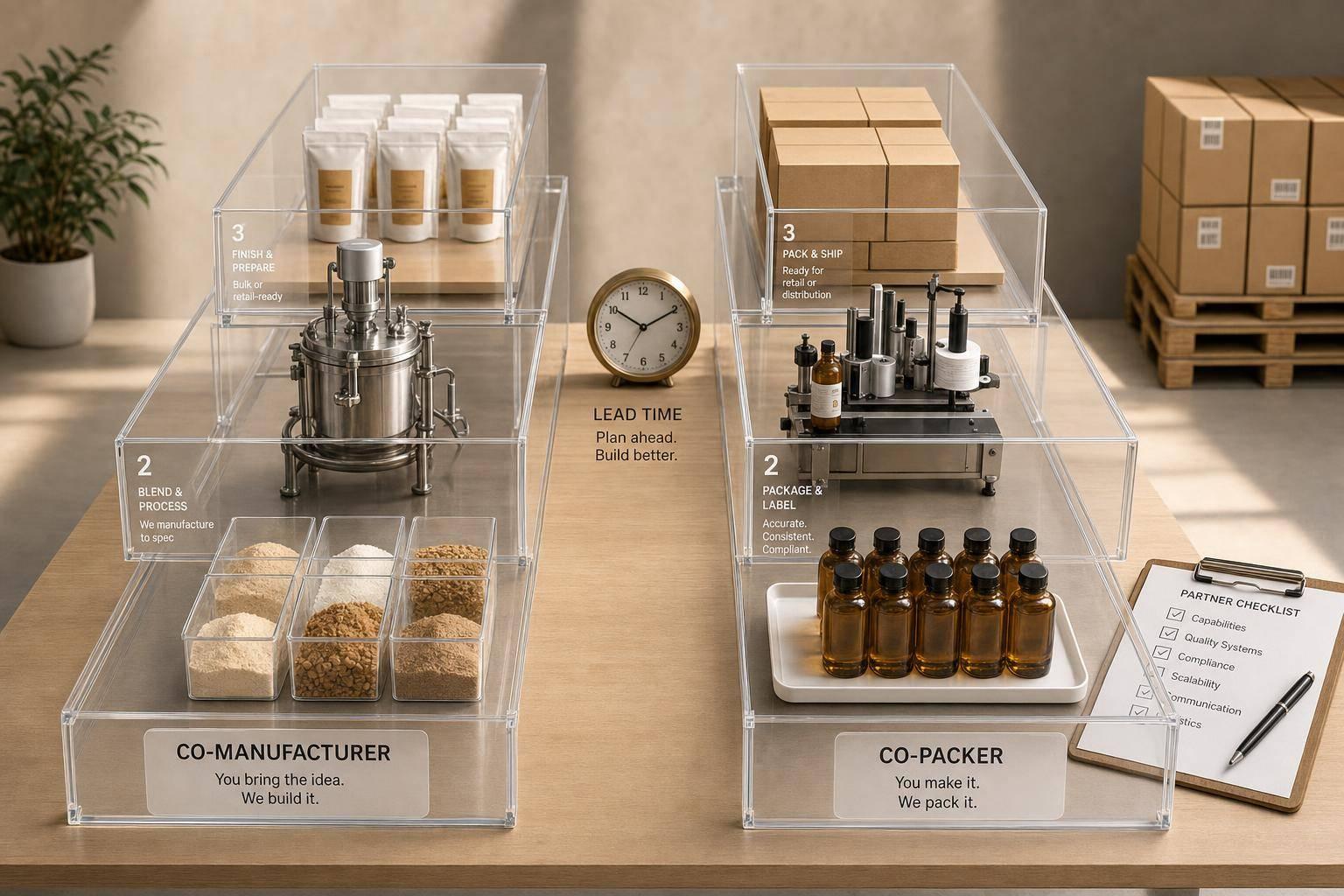
The short answer: if you already have the product made, you likely need a co-packer. If you need a partner to make the product and pack it, you likely need a co-manufacturer.
I’d make the choice based on where the work starts, what inventory I need to track, and who carries production risk. Get that wrong, and the usual problems show up fast: stockouts, extra inventory, delayed launches, and cash tied up in parts or ingredients that can’t move.
Here’s the whole article in plain English:
- A co-packer handles the last steps: filling, sealing, labeling, kitting, and getting units ready for sale.
- A co-manufacturer works earlier: sourcing ingredients or inputs, making the product, then often packaging it too.
- With a co-packer, I mostly need to track bulk product, bottles, labels, cartons, and finished goods.
- With a co-manufacturer, I also need visibility into raw materials, work-in-progress (WIP), production schedules, and finished goods.
- The decision usually comes down to one question: Do I already have finished product, or do I only have a formula/recipe?
- Before signing, I’d check lead times, BOM ownership, lot tracking, ATP data, system syncs, and shop-floor updates.
One missed input can stop a production run. That’s why this choice affects more than packaging. It changes purchasing, planning, and what my inventory numbers mean day to day.
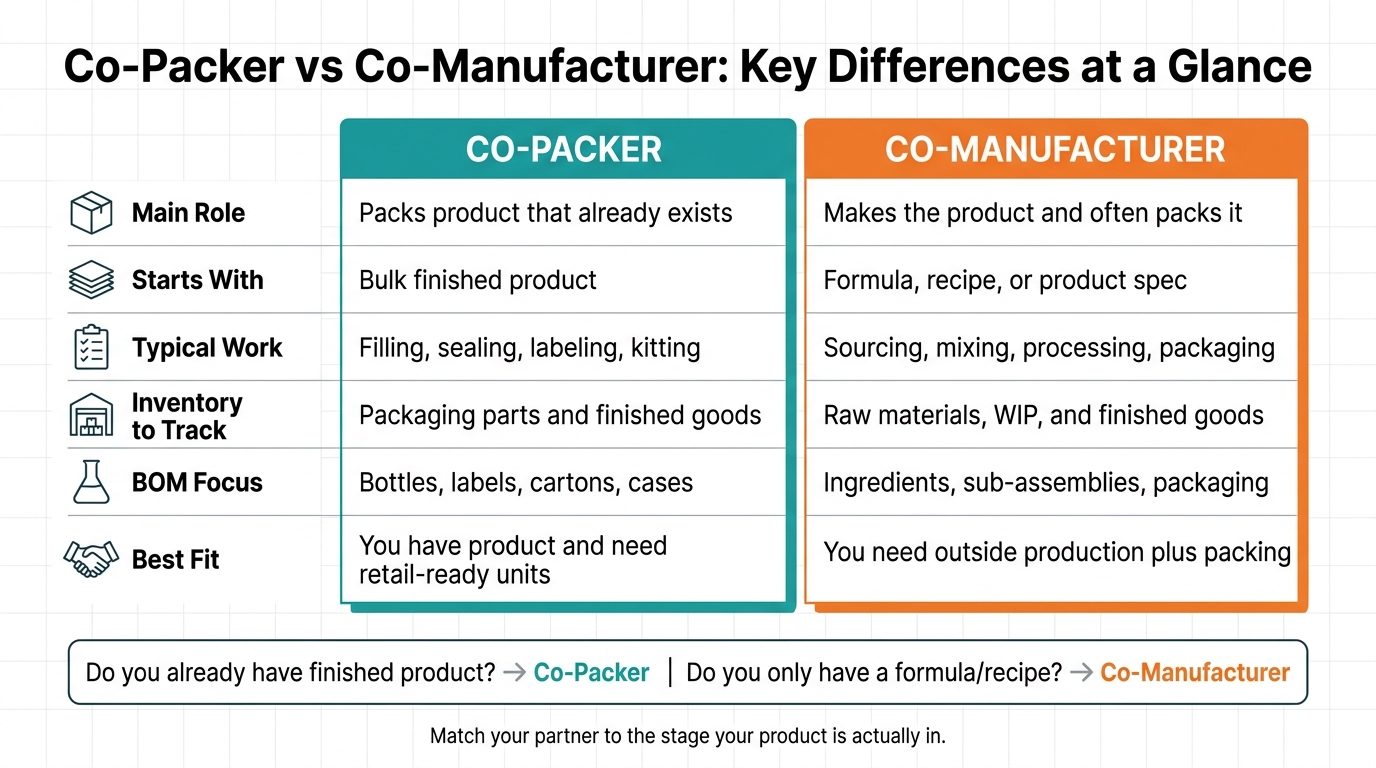
Co-Packer vs Co-Manufacturer: Key Differences at a Glance
TNL0010 Teaser - The Difference Between Co-Packing and Co-Manufacturing
sbb-itb-f0fc809
Quick Comparison
| Criteria | Co-Packer | Co-Manufacturer |
|---|---|---|
| Main role | Packs product that already exists | Makes the product and often packs it |
| Starts with | Bulk finished product | Formula, recipe, or product spec |
| Typical work | Filling, sealing, labeling, kitting | Sourcing, mixing, processing, packaging |
| Inventory I watch | Packaging parts and finished goods | Raw materials, WIP, and finished goods |
| BOM focus | Bottles, labels, cartons, cases | Ingredients, sub-assemblies, packaging |
| Lead time risk | Packaging component delays | Ingredient delays and production schedules |
| Best fit | I have product and need retail-ready units | I need outside production plus packing |
If I want fewer supply-chain surprises, I’d match the partner to the actual stage my product is in - not the label they use.
Co-packer vs co-manufacturer: how scope, control, and inventory impact differ
The split comes down to where the work begins.
A co-packer takes bulk product that already exists and turns it into sellable units. A co-manufacturer makes the product first and often packages it too. That changes what you're buying, what you're tracking, and how closely you need to watch inventory.
| Co-Packer | Co-Manufacturer | |
|---|---|---|
| Scope of work | Filling, sealing, labeling, and kitting | Making the formula, sourcing ingredients, and processing |
| Inventory focus | Brand manages bulk product and packaging materials | Brand needs visibility into raw materials, WIP, and finished goods; partner controls production-stage inventory |
| BOM / planning focus | Packaging components like bottles, labels, and cartons | Raw ingredients, sub-assemblies, and packaging components |
| Lead time impact | Primarily affected by packaging supplier timelines | Affected by raw ingredient sourcing and production schedules |
The day-to-day difference shows up most clearly in inventory ownership. Packing is mostly about packaging inputs. Manufacturing reaches further upstream into raw materials, WIP, and production timing.
What a co-packer is responsible for
A co-packer starts with bulk product that's already been made. From there, they handle filling, sealing, labeling, and kitting.
That also means there are clear limits to their role. They do not source inputs or make the product. If your item still needs formulation or processing, that work sits outside a co-packer's scope.
What a co-manufacturer is responsible for
A co-manufacturer takes over earlier in the process. They make the formula, source raw ingredients, and run the processing steps. So the shift isn't just about who does the packaging. It changes procurement timing too.
In this setup, you need visibility into raw materials, WIP, and finished goods, not just sellable units. That's why safety stock and reorder points matter more when you're outsourcing production instead of only packing finished product.
How each model changes purchasing and stock planning
With a co-packer, your BOM is centered on packaging components like bottles, labels, and cartons. Your main job is pretty simple: make sure the bulk product and packaging materials get to the co-packer on time and in the right amounts.
With a co-manufacturer, the BOM gets broader. Now you're dealing with raw ingredients, sub-assemblies, and packaging components. And because production depends on ingredient lead times and run schedules, one delayed input can stall the next production run and push back product availability.
These inventory differences feed straight into the decision framework in the next section.
Which model fits your brand: a simple decision framework
Start with one question: who owns production? That’s the fork in the road.
If you already have finished product and just need it packed for retail, go with a co-packer. If you need one partner to handle sourcing, production, and packaging, go with a co-manufacturer. That decision shapes the inventory you’ll need to track next.
Choose a co-packer if you already have product and need it packed for sale
If your brand already has finished product in bulk, a co-packer takes care of the last packaging steps. That usually means bottling, labeling, and case packing. Your role is to make sure product and packaging arrive on time.
In this setup, your inventory focus stays fairly narrow. You’re mainly tracking finished goods and packaging parts like bottles, labels, and cartons.
If your product still needs sourcing or production, this model doesn’t go far enough.
Choose a co-manufacturer if you want to outsource production plus final packaging
If you own the formula but don’t have factory infrastructure, a co-manufacturer is usually the better fit. This setup works well for more complex products because the partner handles inputs, production, and packaging.
That also changes what you need to watch. Instead of tracking only finished goods, you need sight into raw materials, WIP, and finished goods.
| Co-Packer | Co-Manufacturer | |
|---|---|---|
| You already have | Finished product in bulk | A formula or recipe |
| Partner does | Bottling, labeling, and case packing | Sourcing, production, and packaging |
| Track | Finished goods and packaging components | Raw materials, WIP, and finished goods |
| Use when | You have product and need packing scale | You own a formula but lack factory infrastructure |
Once you pick the model, the next step is simple: check whether the partner can support your lead times, lot tracking, and real-time stock visibility.
How to evaluate the right partner without creating supply-chain problems
Once you choose a model, the next risk is execution. A co-packer or co-manufacturer may look solid on paper and still cause headaches if its systems, capacity, or communication don't line up with how you run inventory.
Questions to ask before signing
Before you commit, get clear answers on the day-to-day details that affect stock levels and order flow.
- Who owns the BOM, and how are component and labor costs tracked? Make sure they can keep a complete BOM for every component. One missing input can stop a production run cold. Also confirm they can track accurate COGS, including both component and labor costs.
- What lead times can they actually commit to, and how do they handle disruption? Use their actual lead times to set a reorder point: (Daily Usage × Lead Time) + Safety Stock Buffer.
- Can they provide available-to-promise (ATP) data? ATP shows what you can sell today based on raw materials on hand, open purchase orders, and scheduled production runs, minus what has already been promised to customers.
- How do they track production completion on the shop floor? Look for digital, real-time updates so inventory records refresh as soon as goods are finished.
- Can their system sync inventory across sales channels? If they use an MRP system as the master record, they can help keep inventory aligned across Shopify, Amazon, wholesale, and other channels without over-selling.
What to track in your inventory system after you choose
After contract terms are set, shift your attention to what your system needs to track.
The aim is simple: keep component stock, BOMs, open purchase orders, and sales-channel availability in one master record. An MRP system can fill that role and send accurate quantities to your sales channels.
When inventory data lives in one place, connect it to your sales channels so low-stock SKUs stop selling before you oversell.
Conclusion: the right choice depends on who makes the product and who manages complexity
A co-packer handles packaging. A co-manufacturer handles production.
So the choice comes down to two things: where your operation starts and how much of the supply chain you want to hand off.
Look at who owns the formula, sourcing, and production. Then look at how much inventory complexity your BOM adds. That part matters more than people think. If the scope is off, even a good inventory system won't save it.
The final check is pretty simple: match the partner's scope to your current supply chain. If you don't, you can end up with inventory gaps, missed lead times, and cash tied up where it shouldn't be. Get the model right, and you can shorten lead times, improve inventory visibility, and cut tied-up cash.
FAQs
Can one partner handle both packing and manufacturing?
Yes. One partner can handle both manufacturing and packing.
Many companies offer end-to-end services, from raw material sourcing and formulation to final packaging and shipment prep. That setup can simplify your supply chain because production and packaging happen in one facility, depending on how much control, product complexity, and oversight your product calls for.
How do I know when to switch from a co-packer to a co-manufacturer?
Consider switching when your brand has moved past basic packaging and needs a partner that can handle formulation, ingredient sourcing, and full-scale production.
This shift often makes sense when you need more control over day-to-day execution, steadier quality and output, or you’re tired of juggling fragmented procurement and want to spend more time on brand growth and marketing.
What inventory mistakes happen if I choose the wrong model?
Choosing the wrong partnership model can throw inventory out of sync. When lead times don’t line up and visibility is weak, problems show up fast. If your partner can’t deal with the level of production complexity you run, you can end up with stockouts that stall sales or excess inventory that locks up cash.
Some of the most common issues are:
- Inaccurate inventory levels
- Higher carrying costs from excess stock
- Operational problems, such as incorrect SKUs or incomplete shipments
- Weak forecasting caused by limited visibility into manufacturing cycles
These aren’t small hiccups. They can ripple through purchasing, fulfillment, and cash flow at the same time.
Keep reading
Try Forstock free for 14 days.
AI-powered demand forecasting and reorder automation for Shopify brands. No credit card required.