
IoT vs. Traditional Inventory Tracking: Cost Breakdown
By Forstock Team · Last updated April 23, 2026
Compare upfront and long-term costs of IoT (RFID/sensors) vs barcode/manual tracking to choose the right inventory system.
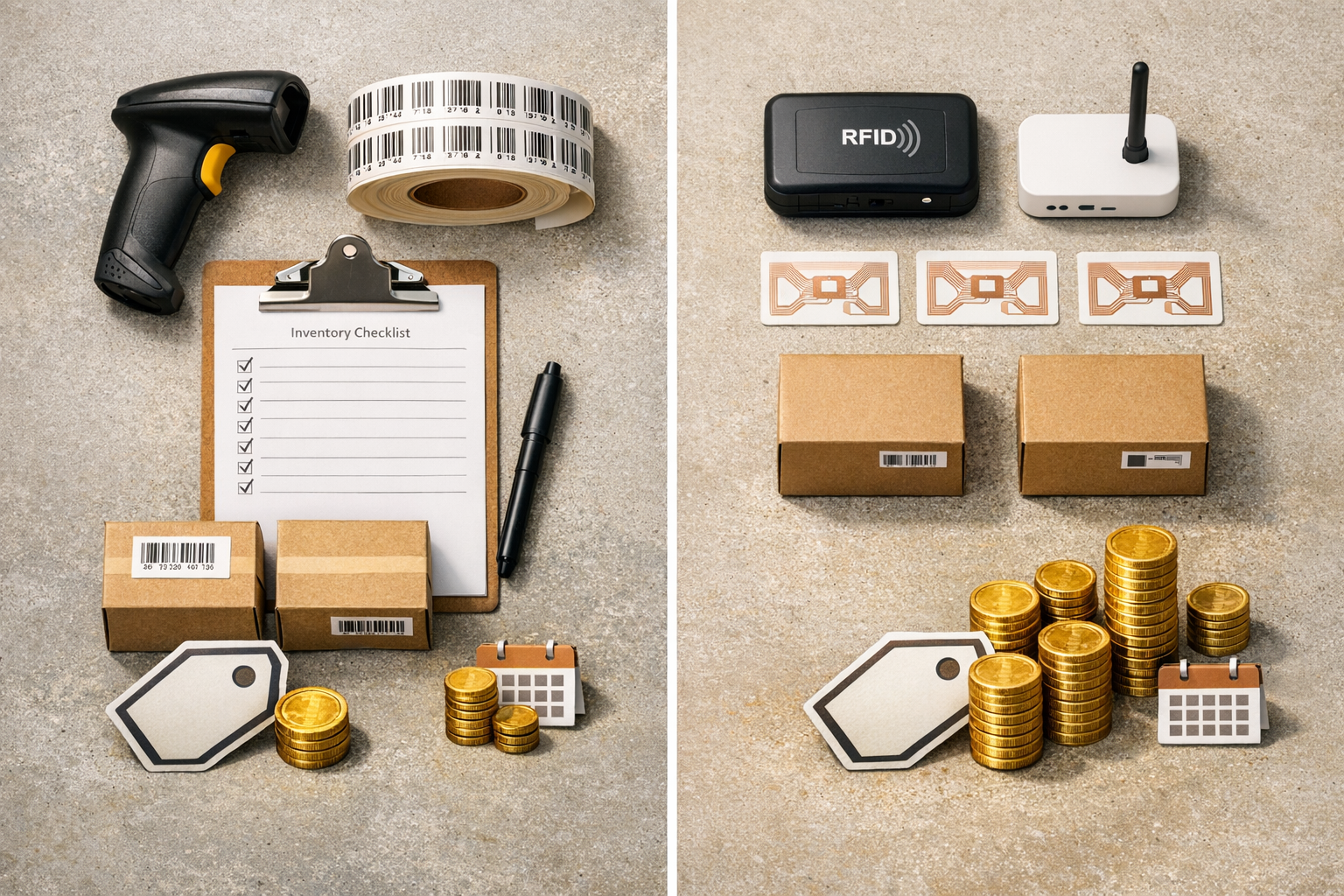
Which inventory tracking system is better for your business? It depends on your goals, scale, and budget. Here's a quick summary:
- Manual systems (spreadsheets, barcodes): Lower upfront costs ($5,000–$25,000) but time-consuming, error-prone, and expensive in the long run. Hidden costs like labor, overstock vs. stockouts, and errors can total $46,400/year for a mid-sized business.
- IoT systems (RFID, sensors): Higher initial investment ($68,000–$435,000) but reduce labor by 60–95%, improve accuracy to 99.5%, and save money over time. ROI is typically achieved in 12–24 months for businesses managing 10,000+ items daily.
Key Points:
- Manual systems: Affordable upfront but inefficient for growing businesses. Accuracy ranges from 85–93%, with high labor costs and frequent errors.
- IoT systems: Costly to set up but efficient, accurate, and scalable. They cut labor costs, shrinkage, and stockouts significantly.
Quick Comparison:
| Metric | Manual Systems | IoT Systems (RFID) |
|---|---|---|
| Initial Cost | $5,000–$25,000 | $68,000–$435,000 |
| Accuracy | 85–93% | 99.5–99.9% |
| Labor Reduction | Baseline | 60–95% |
| ROI Timeline | N/A | 12–24 months |
If you're managing fewer than 50 SKUs, manual systems might work. For larger operations, IoT systems are a smarter long-term choice. Keep reading for a detailed breakdown of costs and benefits.
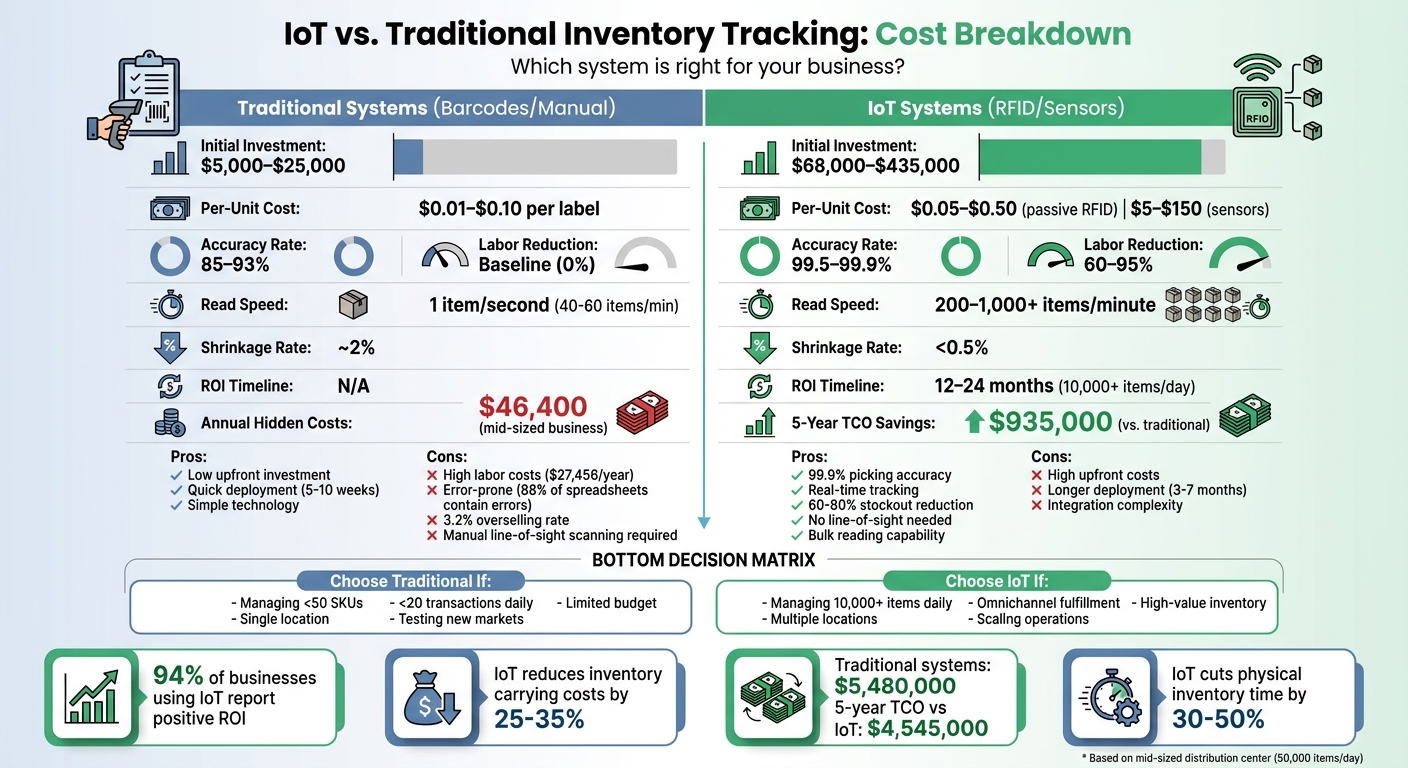
Traditional vs IoT Inventory Tracking Cost Comparison
Retail IoT Explained: Smart Stores, RFID, Beacons & Sensors for Inventory Management
sbb-itb-f0fc809
Traditional Inventory Tracking: Costs and Limitations
On the surface, traditional inventory tracking methods like spreadsheets, manual counts, and barcode scanners appear budget-friendly. But the hidden costs - time spent updating data, fixing mistakes, and dealing with stockouts - quickly add up. For example, a mid-sized e-commerce business earning around $500,000 annually might spend close to 24 hours every week just managing inventory manually. That’s essentially the workload of a full-time employee dedicated to spreadsheet upkeep.
Labor and Time Expenses
Manual tracking is labor-intensive and demands constant attention. Employees typically spend about 14 hours a week on tasks like data entry and reconciling inventory across sales channels. This translates to an annual labor expense of approximately $27,456. On top of that, business owners often dedicate 5 to 8 hours weekly to troubleshooting errors or making decisions based on outdated information - time valued at $50 per hour or more.
Even barcode scanning, which is supposed to streamline processes, has its limits. It can handle only 40–60 items per minute, meaning a 1,000-item inventory count would take over 16 minutes - assuming no errors occur. For small manufacturers, manual updates alone can eat up 2 to 4 hours every week.
Training new hires adds another layer of hidden costs. Traditional systems often rely on "tribal knowledge", where processes are informally passed down rather than documented. When staff turnover happens, onboarding can take 1 to 2 weeks as new employees learn to navigate spreadsheet quirks and inventory locations. On top of this, interruptions for inventory questions or updates cost employees about 1 hour of productivity each day.
These time demands not only drain resources but also increase the likelihood of errors and financial losses.
Error Rates and Financial Losses
Manual data entry is inherently risky - studies show that 88% of spreadsheets contain errors. Mistakes like entering "500" instead of "50" can lead to massive over-ordering, while broken formulas may corrupt data over time. Typical error rates hover between 1% and 5% per field.
The financial impact of these errors is enormous. For instance, manual inventory tracking leads to a 3.2% overselling rate for multichannel sellers. Each oversold order costs around $63.15 when factoring in lost revenue, additional customer service time, and reduced customer lifetime value. A single stockout event can cost a mid-market business about $1,050, and 34% of customers will shop elsewhere after encountering a stockout - 9% of whom never return.
"The weighted average cost of a spreadsheet error in e-commerce operations is roughly $15–$75 depending on where the error occurs." - Sarah Jenkins, Nventory US
Worker fatigue also contributes to errors. Employees tasked with scanning 300 to 600 items daily can see their accuracy drop by 5% to 10% during long shifts or late-night counts. Overall, manual tracking systems achieve only 70% accuracy, compared to 95%–98% with advanced barcode systems. This accuracy gap results in shrinkage rates of 2%–3%, whereas automated systems keep shrinkage under 0.5%.
The holiday season, particularly in Q4, exposes even more flaws. During peak periods, barcode-only systems require 20%–30% more time for cycle counts. Additionally, holding excess inventory comes at a steep cost, with storage and obsolescence eating up 20%–25% of an item’s value annually.
These inefficiencies become even more pronounced as businesses grow.
Scaling Challenges
As businesses expand, the complexities of manual tracking multiply. Managing inventory for more than 100–200 SKUs or adding a new sales channel can overwhelm traditional systems. Spreadsheets lack the ability to handle tasks like multi-location inventory allocation or intelligent order routing, forcing businesses to choose between growth and operational chaos.
High-pressure events, like flash sales, highlight critical weaknesses. When multiple employees edit the same spreadsheet, version conflicts arise. Manual systems also struggle to keep up with real-time transactions, leading to situations where the same item sells on multiple channels simultaneously. Returns often go unrecorded promptly, creating "phantom stockouts" where items are physically available but not listed as such.
The numbers paint a clear picture: 43% of small businesses still rely on manual inventory tracking or skip tracking altogether. These businesses experience error rates two to three times higher than those using dedicated software. For a company generating $50,000 in monthly revenue, the hidden costs of spreadsheet-based tracking can reach $46,400 annually - a figure that dwarfs the cost of modern inventory solutions.
These challenges underscore the need for smarter, more efficient systems, which we’ll explore next.
IoT-Enabled Inventory Tracking: Cost Structure and Benefits
IoT systems bring a different approach to managing costs. While they require a higher upfront investment, the savings they generate in labor and error reduction often make them worthwhile in the long run.
Initial Technology Costs
The initial costs for IoT hardware can be steep. For instance, a four-port fixed RFID reader costs between $1,500 and $3,500, while handheld units range from $1,200 to $3,000 each. More advanced setups, like portal systems installed at dock doors that automatically scan items, can cost anywhere from $8,000 to $25,000. In comparison, traditional barcode scanners are much cheaper, with RFID equipment costing 5–10 times more at the outset.
Beyond hardware, implementation costs add up quickly. Conducting site surveys to address interference from metal or liquids can cost $5,000 to $20,000. Integrating the system with existing ERP or warehouse management software adds another $20,000 to $150,000, while staff training costs range from $5,000 to $25,000. In total, implementing an IoT system can cost between $68,000 and $435,000, compared to $12,000 to $74,000 for barcode systems.
Even the tags themselves come at a premium. Passive UHF RFID tags cost $0.05 to $0.35 each, far more than barcode labels, which are priced at $0.01 to $0.05 each. Active tags with built-in batteries and sensors, used for high-value items requiring real-time tracking, are even pricier at $8.00 to $50.00 each.
| Category | RFID (IoT) | Barcode (Traditional) |
|---|---|---|
| Site Survey & Assessment | $5,000–$20,000 | $500–$2,000 |
| Software/Middleware | $15,000–$100,000 | $2,000–$20,000 |
| ERP/WMS Integration | $20,000–$150,000 | $5,000–$30,000 |
| Training | $5,000–$25,000 | $1,000–$5,000 |
| Total Implementation | $68,000–$435,000 | $12,000–$74,000 |
Another consideration is the timeline. Deploying IoT systems takes about 3 to 7 months, including RF engineering and integration work, while barcode systems can be up and running in just 5 to 10 weeks.
Despite these higher initial costs, IoT systems offer substantial savings in labor and accuracy, which can quickly offset the investment.
Lower Labor Costs and Fewer Errors
Although IoT systems demand a significant upfront investment, their operational efficiency reshapes cost dynamics. RFID technology can read between 100 and over 1,000 items per second without requiring a direct line of sight. This is a massive improvement over barcodes, which must be scanned one item at a time. Tasks like cycle counts become as simple as walking through aisles with a handheld reader, and automated portal readers at dock doors eliminate manual scanning altogether. These advancements reduce physical inventory time by 30% to 50% and cut receiving times from 30–45 minutes to just 5 minutes. In terms of labor, businesses often report a 60% to 80% reduction in inventory management costs.
Accuracy is another area where IoT systems excel. Inventory accuracy rates climb to 99.5%–99.9%, compared to 85%–93% for traditional methods. Real-time location systems speed up asset searches by as much as 90%, and picking accuracy surpasses 99.9%, reducing costly returns and reshipping.
This improved accuracy also allows businesses to cut safety stock levels by 15% to 25%, freeing up working capital. Shrinkage from theft or loss drops by 30% to 50% due to continuous real-time tracking.
Real-Time Data and Demand Response
IoT systems offer continuous monitoring, which helps reduce stockouts by 60% to 80% using stockout alert tools and boosts order fulfillment rates to over 99.5%. They also shorten order cycle times by 30% to 50% and lower carrying costs by 25% to 35%. For operations handling more than 10,000 items daily, these efficiencies typically lead to a positive ROI within 12 to 24 months.
"Organizations processing 10,000+ items daily typically see RFID deliver positive ROI within 12-24 months despite higher upfront costs." - CPCON
Over a five-year period, a mid-sized distribution center handling 50,000 items daily might spend about $4,545,000 on an RFID system, compared to $5,480,000 for traditional barcodes. This nearly $1 million in savings is largely driven by reduced labor costs and lower shrinkage.
For Shopify merchants, these benefits mean smoother operations and a clearer path to long-term cost savings.
Cost Comparison: Traditional vs. IoT Inventory Tracking
Cost Category Breakdown
This section dives into the cost differences between traditional inventory systems and IoT-enabled solutions. For Shopify merchants, understanding these distinctions is key to making an informed decision that aligns with long-term business goals.
When comparing the two systems, the contrasts are stark. Traditional barcode systems come with lower upfront costs, requiring an initial investment starting around $5,000, whereas IoT systems demand a much higher starting cost. Per-unit expenses also differ: barcode labels cost between $0.01 and $0.10 each, passive RFID tags range from $0.05 to $0.50, and advanced IoT sensors can cost anywhere from $5 to $150 per unit.
Operational costs, however, shift the narrative. IoT systems significantly reduce labor expenses - by as much as 60–95% - thanks to automated bulk reading that eliminates the need for manual, line-of-sight scanning. Accuracy is another game-changer. While traditional systems achieve 95–98% accuracy, IoT solutions boast an impressive 99.5–99.9%. For a warehouse managing $10 million in inventory, this difference could mean avoiding $700,000 to $1.5 million in misplaced or phantom stock.
| Metric | Barcode (Traditional) | RFID (IoT) | IoT Sensors (Advanced) |
|---|---|---|---|
| Initial Investment | $5,000–$25,000 | $50,000–$500,000+ | $20,000–$300,000 |
| Per-Unit Cost | $0.01–$0.10 | $0.05–$0.50 | $5–$150 |
| Labor Reduction | Baseline | 60–80% | 80–95% |
| Accuracy | 95–98% | 99.5–99.9% | 99%+ |
| Read Speed | 1 item/sec | 200–1,000+ items/min | Real-time |
| Shrinkage Rate | ~2% | <0.5% | <0.5% |
Looking at a five-year total cost of ownership for a mid-sized distribution center handling 50,000 items daily, the numbers favor IoT. RFID systems cost about $4,545,000, compared to $5,480,000 for barcodes - a savings of $935,000, largely driven by reduced labor costs. With RFID, labor costs drop to $1,800,000 for 8 full-time employees, compared to $4,500,000 for 20 employees using barcodes. Additionally, IoT systems cut shrinkage losses, further boosting savings.
These figures highlight how IoT systems can deliver meaningful cost reductions while improving operational efficiency.
ROI and Long-Term Savings
The return on investment (ROI) for IoT systems depends heavily on the scale of operations. For businesses handling 10,000+ items daily, ROI is typically achieved within 12–24 months. Smaller operations processing 5,000–10,000 items may see ROI in 18–30 months, while large enterprises moving 200,000+ items daily can break even in just 6–12 months.
"Organizations processing 10,000+ items daily typically see RFID deliver positive ROI within 12-24 months." - CPCON
For Shopify merchants expanding across multiple channels, IoT's real-time inventory monitoring capabilities are becoming indispensable. Real-world examples underscore the benefits: Decathlon's global RFID rollout across 50,000 readers and Selmark's 30% boost in picking and dispatch efficiency demonstrate the tangible improvements IoT can bring.
The savings go beyond labor. IoT systems often reduce inventory carrying costs by 25–35% and enable businesses to lower safety stock levels by 15–25%, freeing up valuable working capital. With 94% of businesses using IoT reporting positive ROI, the financial advantages become even clearer as operations grow and inventory management becomes more complex.
Implementation Guide for Shopify Merchants

After breaking down the cost differences, here's how Shopify merchants can effectively implement the right inventory tracking system for their business.
When to Use Traditional Methods
Traditional barcode systems work best for smaller, single-location businesses. If you’re managing fewer than 50 SKUs, operating from one location, and handling under 20 transactions daily, manual or barcode tracking is the most practical and affordable option. Initial costs typically range from $5,000 to $25,000, with per-label expenses between $0.01 and $0.10.
For merchants selling lower-value consumables or running seasonal pop-ups, Shopify's built-in inventory tools paired with modern 2D barcodes can handle batch, lot, and expiration data effectively. This is particularly useful when testing new products or markets before committing to more advanced technology.
That said, traditional methods come with limitations. Accuracy rates hover between 85% and 93%, and manual scanning can slow down operations . Once your business grows beyond these thresholds, it’s time to consider IoT-based solutions.
Moving to IoT: What to Consider
Switching to IoT tracking involves evaluating three key factors: the number of SKUs, the scale of your operations, and the value of your inventory. If you’re managing over 10,000 items daily, running multiple locations, or offering omnichannel fulfillment options like "buy online, pick up in store", IoT systems become a necessity.
Before diving in, calculate the total cost of ownership. This includes infrastructure, software subscriptions, training, and a short-term productivity dip (typically 1–2 weeks). Real-world examples show the benefits. In January 2025, LisolaStore, an Italian homeware company, adopted Shopify POS to sync inventory, which led to a 15% boost in average order value and the lowest inventory shrinkage rate in their history.
Integration is another critical factor. The system you choose should seamlessly connect with Shopify POS, Shopify Flow for automation, and your existing ERP systems like NetSuite or Microsoft Dynamics 365. For high-value or temperature-sensitive products - such as pharmaceuticals or luxury goods - IoT sensors, costing $5 to $150 per unit, provide real-time tracking and environmental monitoring.
If a full-scale IoT rollout feels overwhelming, a hybrid approach offers a more manageable path forward.
Hybrid Approaches for Gradual Transition
A hybrid system combines traditional and IoT methods, allowing for a smoother transition without disrupting daily operations. Many businesses use a mix of technologies tailored to their inventory's value. For example:
- Advanced tracking for high-revenue items
- Barcodes for mid-tier products
- Basic tracking for lower-priority items
Start small by piloting IoT in a specific area, like the receiving dock, to prove its ROI. For instance, in August 2025, apparel brand Oak + Fort unified their retail and inventory systems, cutting operating costs by 47% and saving 50 labor hours per week. This phased approach helps refine processes, clean up data, and build team confidence without disrupting operations.
Forstock can also play a key role in bridging the gap. Its AI-driven demand forecasting and automated purchase orders adapt to your current setup while preparing you for future upgrades. This ensures you’re not stuck with outdated systems or forced into premature investments as your business scales.
Conclusion
Choosing between traditional and IoT inventory tracking systems isn’t about finding a one-size-fits-all solution - it’s about matching the technology to your current operations and long-term goals. Traditional barcode systems, with initial costs ranging from $5,000 to $25,000, may seem appealing due to their affordability. However, their 85–93% accuracy can leave a warehouse managing $10 million in inventory with $700,000 to $1.5 million in phantom stock . This trade-off highlights the limitations of relying solely on low-cost options.
On the other hand, IoT systems flip this equation. While their upfront costs range from $50,000 to over $500,000, they deliver significant advantages: 60–95% reductions in labor costs, accuracy rates of 99.5–99.9%, and an ROI payback period of just 12–18 months . These systems also reduce carrying costs by 25–35% and help prevent stockouts, which can drain 5–8% of potential revenue . For businesses aiming to streamline operations and improve profitability, these benefits can outweigh the initial investment.
For Shopify merchants, the choice boils down to scalability. Smaller operations with fewer than 50 SKUs might prioritize software with flexible APIs to avoid being locked into a system that limits future growth. Larger businesses managing thousands of SKUs could explore a phased IoT implementation, such as focusing on high-value items or specific zones like receiving, to validate ROI without disrupting day-to-day operations.
Forstock offers a practical bridge between these options. Its AI-driven demand forecasting and automated purchase order features integrate seamlessly with both barcode and RFID systems. Whether you’re scanning barcodes today or planning an RFID upgrade next quarter, Forstock ensures your inventory management remains efficient and data-driven.
Ultimately, traditional systems keep upfront costs low but carry higher ongoing labor and error expenses. IoT systems demand a larger initial investment but deliver lower operational costs and superior accuracy over time. The best choice depends on your current scale, growth trajectory, and how much revenue you’re losing to inefficiencies like stockouts and phantom inventory.
FAQs
What’s the cheapest way to pilot RFID before a full rollout?
The smartest way to test RFID without breaking the bank is by starting small. A limited-scale implementation keeps initial costs low while letting you see how well it works. For instance, you can use a smaller number of passive UHF tags, which are affordable at just $0.01 to $0.05 each, along with basic hardware. This step-by-step method allows you to pinpoint any challenges and evaluate the return on investment (ROI) before diving into a larger rollout. It’s a practical way to minimize financial risk while gauging effectiveness.
How do I estimate ROI for IoT inventory tracking in my warehouse?
To calculate the ROI of IoT-based inventory tracking, start by weighing the initial investment against the potential long-term savings. Here are some key benefits to consider:
- Reduced inventory costs: IoT systems can cut these costs by as much as 20%.
- Minimized stockouts and overstocking: Businesses may see reductions of up to 50%.
- Enhanced accuracy: Inventory tracking accuracy often exceeds 95%.
- Lower labor costs: Automation can slash labor expenses by 60-80%.
Platforms like Forstock take things a step further by automating repetitive tasks and fine-tuning inventory management, which can significantly boost your ROI. By comparing these savings to the upfront and operational costs of implementation, you’ll have a clearer picture of the financial benefits IoT can bring to your inventory management.
Will RFID work around metal shelves, liquids, or dense packaging?
RFID technology is capable of scanning through most types of packaging. However, its performance can drop when it's near certain materials like metal shelves, liquids, or dense substances. These elements can weaken the signal and impact reading accuracy. To ensure dependable results, it's a good idea to test the system in your specific environment.
Keep reading
Try Forstock free for 14 days.
AI-powered demand forecasting and reorder automation for Shopify brands. No credit card required.