
API Integration vs Manual Inventory Management
API automation beats spreadsheets — it delivers real-time accuracy, reduces labor, and scales inventory without costly errors.
API Integration vs Manual Inventory Management
When it comes to inventory management for Shopify brands, the choice between manual methods and API integration can significantly impact your efficiency, accuracy, and growth potential. Here's the bottom line:
- Manual systems rely on spreadsheets and physical counts, which are prone to errors (8-12%) and delays. They work for small businesses with fewer than 50 SKUs but become a bottleneck as operations scale.
- API integration automates tasks, providing real-time updates, reducing errors to under 0.1%, and saving hours of work each week. It’s ideal for businesses managing hundreds or thousands of SKUs across multiple channels.
Key Takeaways:
- Manual systems cost more in labor and errors as your business grows.
- API integration supports real-time visibility, scalability, and accuracy.
- Shopify brands using API tools report fewer stockouts and inventory issues, faster order fulfillment, and better inventory control.
Quick Comparison:
| Feature | API Integration | Manual Inventory Management |
|---|---|---|
| Time Efficiency | Saves up to 13 hours/week | Labor-intensive |
| Accuracy | Under 0.1% error rate | 8-12% error rate |
| Real-Time Updates | Instant synchronization | Delayed updates |
| Scalability | Handles 200+ SKUs easily | Limited by labor capacity |
| Cost | $29-$99/month software | $500-$1,000/month labor |
API integration is the smarter choice for Shopify brands looking to streamline operations and minimize costly mistakes. Read on to learn how each method works and why automation is the future of inventory management.
API Integration vs Manual Inventory Management Comparison
Master Shopify's API for Automation: A Complete Developer's Guide

sbb-itb-f0fc809
What is Manual Inventory Management?
Manual inventory management is an old-school way of keeping track of stock, orders, and sales without relying on specialized software. Businesses using this method often depend on tools like spreadsheets (think Excel or Google Sheets), handwritten records, and physical stock counts. The process is entirely reliant on human effort - employees count items, verify shipments against purchase orders, and manually record movements.
Here’s how it typically works: When a shipment arrives, someone physically counts the items, checks them against the order, and logs the numbers. As sales happen, staff update the records by subtracting sold quantities. Periodically, businesses reconcile these records with the actual inventory to spot errors or discrepancies.
While this approach might work for very small businesses - those with fewer than 50 to 100 SKUs and a single sales channel - it comes with its fair share of risks. Manual data entry alone has an error rate of 1% to 3%, and broader manual processes can see error rates climb as high as 8% to 12%. A simple mistake, like a typo in a spreadsheet formula, can disrupt inventory tracking, and shared files add another layer of risk with potential overwrites.
One of the biggest downsides is the lack of real-time visibility. Manual systems only provide a snapshot of inventory at the time of the last count. Between counts, data quickly becomes outdated, leading to surprise stockouts or overstocking. In fact, research shows retailers only have accurate visibility of their inventory about 70% of the time.
Common Processes in Manual Inventory Management
Manual inventory tracking involves a lot of repetitive, time-consuming tasks. For example:
- Staff check incoming shipments against purchase orders, inspecting for damage and verifying quantities.
- Numbers are manually logged into paper records, stock cards, or spreadsheets, updating totals for incoming and outgoing items.
- Regular reconciliation is necessary to identify discrepancies caused by theft, damage, or miscounts. This typically happens weekly or monthly.
- Reorder decisions are made by manually summarizing data.
For a business managing over 200 SKUs, this process can cost anywhere from $5,850 to $11,700 annually in labor alone.
Problems with Manual Inventory Management
As businesses grow, manual inventory systems often become more of a burden than a solution. The reliance on human input leads to frequent errors - miscounts, illegible handwriting, incorrect units, or spreadsheet formula mishaps. Over time, these errors can pile up and cause significant financial headaches.
Another major issue is the delay in updates. Inventory data is rarely current, so by the time a sale is recorded or stock is counted, the numbers may already be off. This can lead to "phantom inventory", where records show stock that no longer exists, resulting in unfulfilled orders and frustrated customers. Similarly, overselling becomes a risk when sales on one platform aren’t immediately reflected across the system.
Manual systems also struggle to scale. As SKU counts exceed 200 to 500 or businesses expand to multiple locations, requiring multi-warehouse optimization, the workload grows exponentially. More time and staff are needed to keep records accurate, which isn’t always feasible. There’s also a heavy reliance on specific employees who hold key knowledge of the system. If they leave, that knowledge goes with them. Additionally, manual tracking makes it tough to monitor details like expiration dates or damaged goods, often leading to unnoticed losses and write-offs.
These challenges are why many Shopify brands are turning to API-driven inventory management solutions, which offer real-time accuracy and scalability.
What is API Integration for Inventory Management?
API integration connects your Shopify store with various software systems - like warehouse management tools, supplier databases, and ERPs - allowing data to flow automatically without manual intervention. Think of it as a bridge that enables smooth communication between different platforms. Instead of manually updating spreadsheets after every sale, APIs instantly share updates across all connected systems.
Every inventory event - whether it's a sale, return, or adjustment - is treated as a trigger. This information is sent to a central hub and distributed across all channels in just 2 to 5 seconds. Compare this to older polling methods, which checked for updates every 5 to 15 minutes and often left you working with outdated data.
The real magic of API integration lies in automation. For instance, when a customer buys a product on your Shopify store, the API immediately reduces stock levels across all channels, updates your warehouse system, and even flags when it's time to reorder. Industry reports show that 58% of retailers see at least a 20% boost in operational efficiency through automation and API integration.
How API Integration Works
Here’s a closer look at how API integration powers real-time automation.
APIs use webhooks to send instant notifications and a delta sync to update only the SKUs that have changed. This ensures updates happen quickly and efficiently, making it ideal for managing large inventories and high sales volumes on Shopify.
APIs also handle complex inventory scenarios. For example, when a bundled product’s stock changes due to a component being sold, the API recalculates availability automatically. To prevent overselling - which can cost businesses between $25 and $150 per incident - high-performance integrations process orders sequentially. This ensures that if two customers try to buy the last unit at the same time, one order is processed while the other is declined.
Benefits of API-Driven Inventory Management
API integration eliminates manual data entry errors, which are a common cause of inventory mistakes. Poor inventory management can lead to an average revenue loss of 10%, and globally, retailers lose about $1.77 trillion annually due to overstock and stockouts.
With real-time visibility across all sales channels and warehouse locations, you can make data-driven decisions 24/7. This is especially important for Shopify brands since 40% of customers who experience order cancellations due to overselling may never shop with you again.
API integration also grows with your business. Whether you’re managing 200 SKUs or 20,000, the system handles the workload without requiring extra staff or manual processes. This not only saves time but also supports smarter decisions, like using AI-powered tools for demand forecasting to reduce stockouts.
"If your inventory data is more than 60 seconds stale, you are operating with dangerous blind spots." - Sarah Jenkins, Nventory US
These advantages highlight why API integration is a game-changer compared to manual inventory methods.
API Integration vs Manual Inventory Management: Main Differences
Comparison Criteria
Looking at the challenges and advantages of both methods, it's clear that manual inventory management and API integration differ significantly across four critical areas: time efficiency, accuracy, scalability, and real-time visibility.
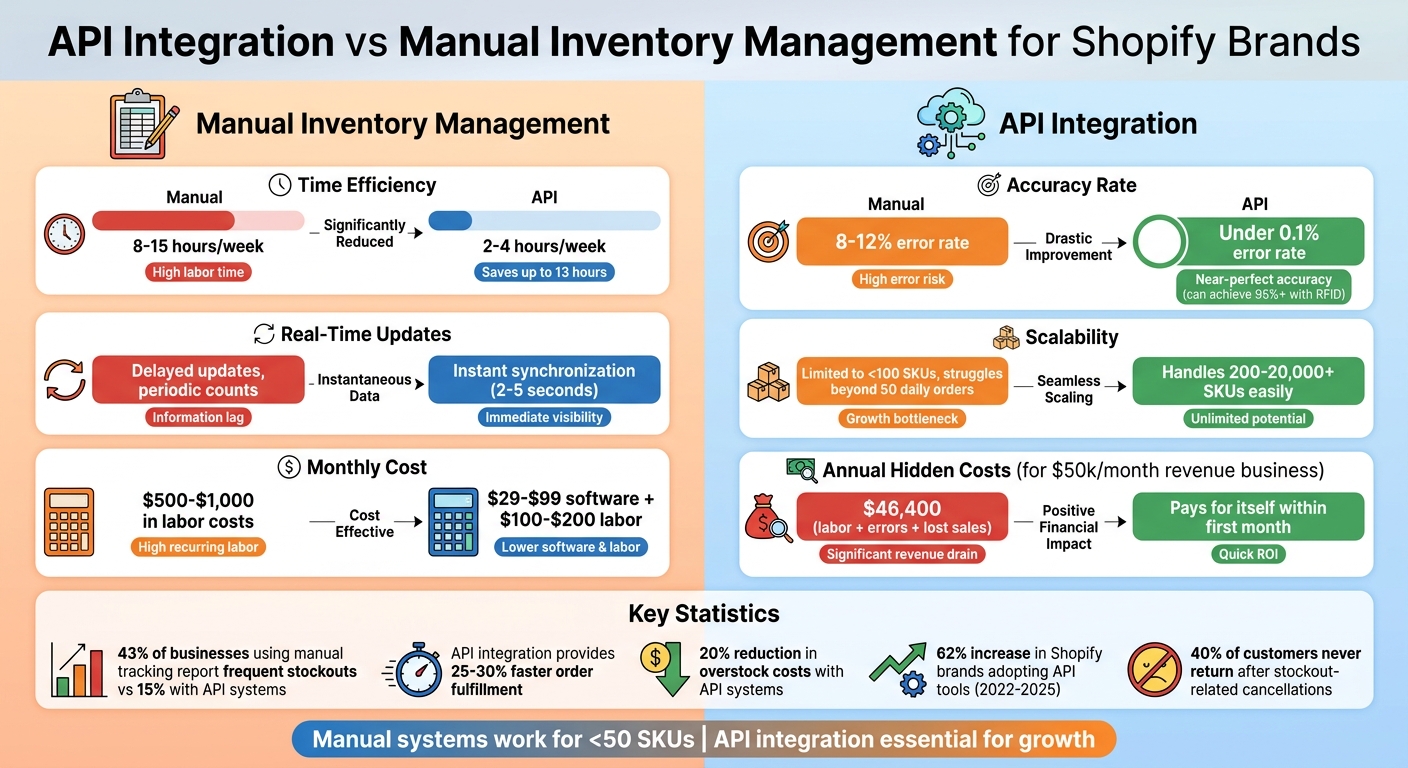
Time Efficiency: Manual inventory management can consume 8–15 hours per week for mid-sized brands. In contrast, API-driven systems slash that down to just 2–4 hours weekly - saving up to 13 hours.
Accuracy: Error rates in manual systems range from 1–3% per field, sometimes reaching as high as 8–12%. Meanwhile, API integration boasts an impressively low error rate of under 0.1%.
Scalability: Manual systems hit a wall when managing over 100 SKUs or two sales channels. Handling 50+ daily orders with spreadsheets often demands full-time effort. API systems, however, can seamlessly handle growth, managing anywhere from 200 SKUs to over 10,000 without increasing operational strain.
Real-Time Visibility: With manual systems, businesses rely on delayed updates through spreadsheets and periodic physical counts. On the other hand, API integration provides instant synchronization across all channels, ensuring real-time stock visibility as soon as an order is placed.
Sarah Jenkins from Nventory highlights the hidden costs of manual systems perfectly:
"Your spreadsheet is not free. It is the most expensive tool in your tech stack." – Sarah Jenkins, Nventory
For a business generating $50,000 in monthly revenue, manual spreadsheet management can lead to hidden costs of around $46,400 annually. This includes labor, errors, and lost sales opportunities. While spreadsheets might seem cost-effective, labor costs alone can exceed $15,000 per year - not to mention the financial hit from stockouts or overstocks.
These differences lay the groundwork for a deeper dive into the pros and cons of each approach.
Pros and Cons Comparison
Looking at the two methods side by side highlights their main trade-offs. Manual inventory management comes with low upfront costs and gives businesses direct control over every entry. This makes it a reasonable choice for companies managing fewer than 50 SKUs or operating a single sales channel. However, as noted earlier, these methods often include hidden costs and are more prone to errors.
On the other hand, API integration involves upfront expenses, such as software subscriptions ranging from $29 to $99 per month for small to mid-sized businesses, along with time spent on setup and training. Its success hinges on maintaining clean historical data - otherwise, you risk the classic "garbage in, garbage out" issue. Configuring alerts wisely is also critical; poorly managed alerts can overwhelm your team, leading to alert fatigue.
That said, the benefits of API integration are hard to ignore. Advanced tools like RFID technology can push inventory accuracy to 95% or higher. Additionally, stockouts - a common issue with delayed manual updates - can cost small and mid-sized businesses between 4% and 8% of their annual revenue. As the StockPilot Editorial Team aptly explains:
"The 'free' tool [Excel] costs 3-6x more than the paid one. The software pays for itself within the first month".
When labor costs are considered, the differences become even clearer. Managing inventory manually for a business with over 200 SKUs can cost $500 to $1,000 per month (assuming a $25 hourly rate). In contrast, automation reduces that to just $100 to $200 per month. For Shopify merchants, these distinctions are crucial when deciding on the cloud inventory tools for Shopify.
Comparison Table: Pros and Cons
| Category | API Integration | Manual Inventory Management |
|---|---|---|
| Efficiency | Automates tasks, saving time | Labor-intensive and time-consuming |
| Accuracy | Reduces errors; can achieve 95%+ accuracy | Prone to human error; error rates of 8–12% |
| Real-Time Updates | Provides instant stock visibility | Updates are often delayed |
| Scalability | Scales easily with business growth | Becomes challenging as operations expand |
| Error Reduction | Limits reliance on manual entries | High risk of cumulative errors |
| Integration | Connects seamlessly with platforms | Lacks automation and integration options |
| Cost Implications | Requires upfront investment but lowers hidden costs | Low software fees, but higher labor costs |
Why API Integration is Better for Shopify Brands
For Shopify brands aiming for growth and scalability, API integration isn't just helpful - it's essential. While manual methods might suffice for tiny inventories, they quickly become a bottleneck as operations grow. Consider this: 43% of small businesses using manual inventory tracking report frequent stockouts, compared to only 15% of businesses using automated, API-driven systems.
As businesses expand, API integration offers tangible benefits, including 25–30% faster order fulfillment and a 20% reduction in overstock costs. These improvements stem from the ability of API-driven systems to provide instant stock visibility across all sales channels. Plus, with AI-powered demand forecasting, businesses can predict inventory needs with 35% greater accuracy during peak seasons. Manual spreadsheets simply can’t handle the complexity of managing multi-location inventory, extensive product catalogs, or seasonal surges. These advantages make API integration a game-changer.
Additionally, API automation achieves 99% inventory accuracy and speeds up reorder cycles by 40%, further underscoring its efficiency. Between 2022 and 2025, Shopify brands adopting API-based inventory tools increased by 62%, driven by the need to thrive in multi-channel retail without ballooning operational costs. These stats clearly highlight how API integration transforms inventory management in practical, measurable ways.
Forstock: How API Integration Works in Practice
Forstock is a prime example of how API integration outperforms manual methods for Shopify merchants. By connecting directly to your Shopify store via its native API, Forstock pulls live sales data, product details, and stock levels to fuel its AI-driven forecasting models. These models analyze sales patterns, seasonal trends, and supplier lead times to create 12-month demand plans, helping businesses avoid both stockouts and overstock situations.
The platform also automates purchase order creation. When inventory drops below threshold levels, Forstock generates precise purchase orders, eliminating the 15–20% error rate common with spreadsheet-based ordering. Its unified dashboard provides real-time visibility across multiple locations and can handle thousands of SKUs, whether you sell simple items or complex multi-variant products.
At just $79 per month, regardless of revenue, Forstock offers features like supplier management, reorder suggestions, and safety stock calculations. These tools have helped Shopify brands cut inventory management time from 20 hours a week to just 2 hours, all while reducing costly mistakes.
Conclusion
Deciding between manual inventory management and API integration is more than a matter of convenience - it’s a crucial choice that can determine a retailer's ability to compete. Relying on manual methods exposes businesses to financial risks, such as stockouts and overstocking, making automation a key solution for tackling these expensive challenges. API-driven systems step in here, offering unmatched precision and efficiency.
With real-time updates and predictive analytics, API systems allow brands to make smarter, faster decisions. These tools handle routine tasks automatically, reducing errors while freeing up time for more strategic work. However, the success of these systems hinges on having clean, organized data to work with.
Before transitioning to an API-based system, take the time to clean your data. Conduct a full physical inventory count and standardize your SKUs to prevent issues caused by inaccurate input. Once your data is in order, set up strategic alerts tailored to your business needs - like aggressive reorder points for top-selling items or velocity alerts to monitor the performance of new products.
Forstock offers a user-friendly solution at just $79 per month. It includes real-time AI forecasting, automated purchase orders, and unified dashboards. Plus, you can try it out for 14 days without needing a credit card. With tools like these, managing inventory becomes simpler and more effective, without the complexity of enterprise systems.
For Shopify brands aiming to grow, API integration is no longer optional. It’s a must-have for scaling efficiently, keeping customers happy, and safeguarding your bottom line from the risks of outdated, manual processes.
FAQs
When should I switch from spreadsheets to an API?
Switching to an API-based inventory system is a smart move when manual tracking starts to fall short. Key indicators include error rates in order picking exceeding 1%, struggling to manage inventory across multiple sales channels, or juggling more than 500 SKUs across different locations. Manual methods often lead to mistakes, take up too much time, and lack the real-time updates and automation needed for smooth operations.
Platforms like Forstock can simplify inventory management by offering real-time stock updates, automated purchase orders, and seamless multi-channel synchronization. These features help businesses scale more efficiently while reducing errors and saving time.
How hard is Shopify API inventory setup?
Setting up Shopify's API for inventory management might feel a bit challenging, particularly if you're new to API integrations. Shopify provides tools such as the Admin REST API and GraphQL API, which help automate workflows and keep stock data synchronized. However, using these tools effectively requires a good understanding of authentication, rate limits, and data structures.
While it does take some planning and technical expertise, the effort pays off. Once set up, these APIs can streamline operations and make scaling your inventory management much easier.
What data should I clean before automating?
Before diving into automating inventory management, it's critical to start with clean, reliable data. Double-check for common problems such as typos, incorrect stock quantities, or outdated records. Fix mismatched stock counts, standardize product identifiers like SKUs, and confirm supplier information is up-to-date. When your data is accurate and consistent, it reduces errors and ensures automation runs smoothly, allowing for real-time tracking and precise demand forecasting.
Keep reading
Try Forstock free for 14 days.
AI-powered demand forecasting and reorder automation for Shopify brands. No credit card required.