
Checklist for Coordinating Inventory Replenishment with Suppliers
A practical checklist to audit suppliers, set reorder points, forecast demand, sync systems, and automate purchase orders to avoid stockouts and overstock.
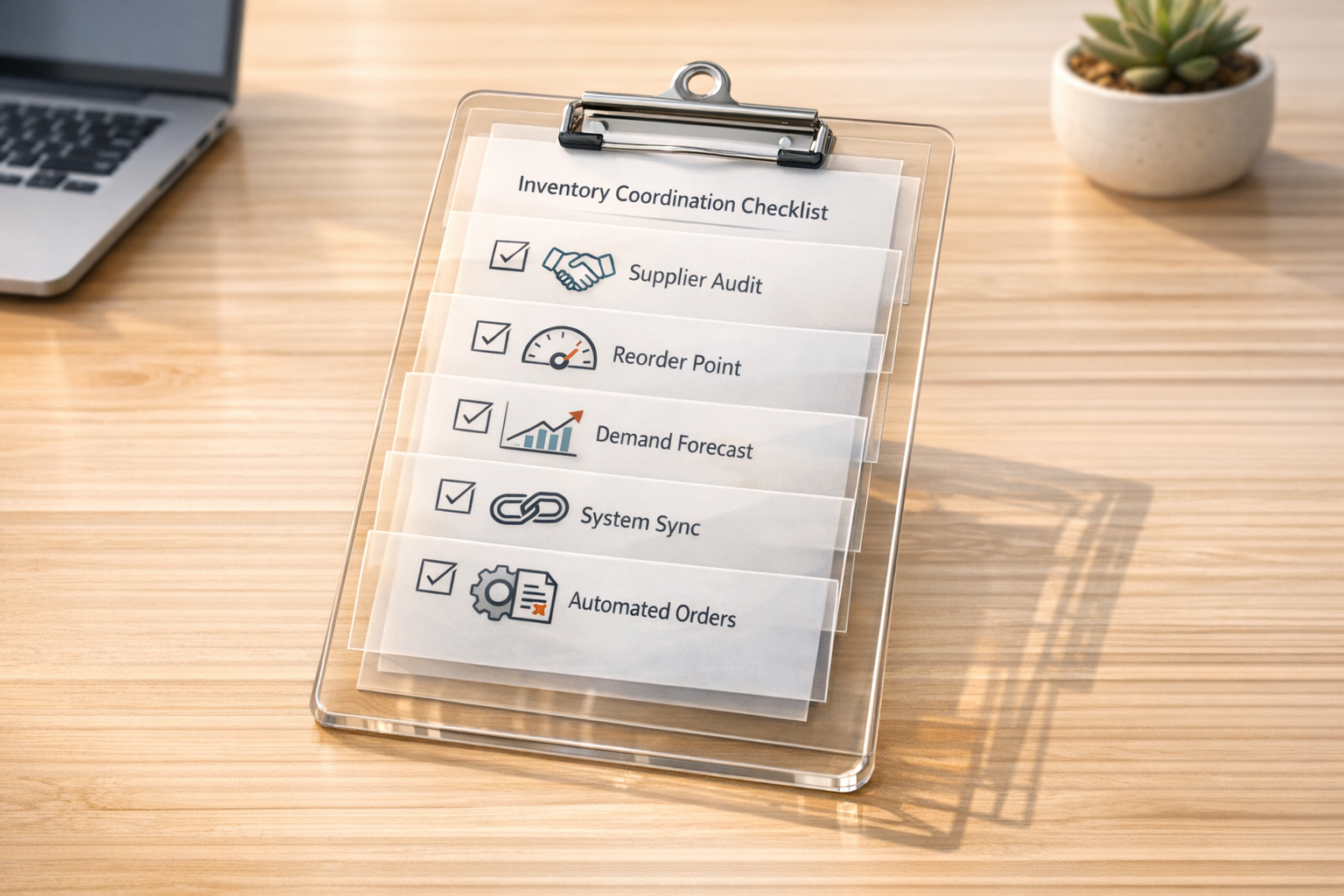
Checklist for Coordinating Inventory Replenishment with Suppliers
Running a Shopify store means balancing two key challenges: avoiding stockouts that cost sales and steering clear of overstock that ties up cash. Mismanaging inventory can lead to lost customers, high storage costs, and wasted resources. For example, Adidas faced €500M in unsold inventory in 2023, highlighting the risks of poor planning.
Here’s what you’ll learn to avoid these pitfalls:
- Audit your supply chain: Track metrics like inventory turnover, stockout rates, and supplier lead times.
- Set reorder points: Calculate when to restock based on demand and lead times.
- Forecast demand: Use historical data and adjust for trends, promotions, and seasonality.
- Communicate with suppliers: Confirm availability, negotiate terms, and create service-level agreements (SLAs).
- Sync inventory systems: Automate updates, set alerts, and use tools like Shopify Collective for real-time accuracy.
- Monitor and improve: Track supplier performance, update inventory strategies, and use alerts to prevent disruptions.
Shopify Inventory Management Made Simple - Tips That Actually Work in 2025

sbb-itb-f0fc809
Planning Before You Order
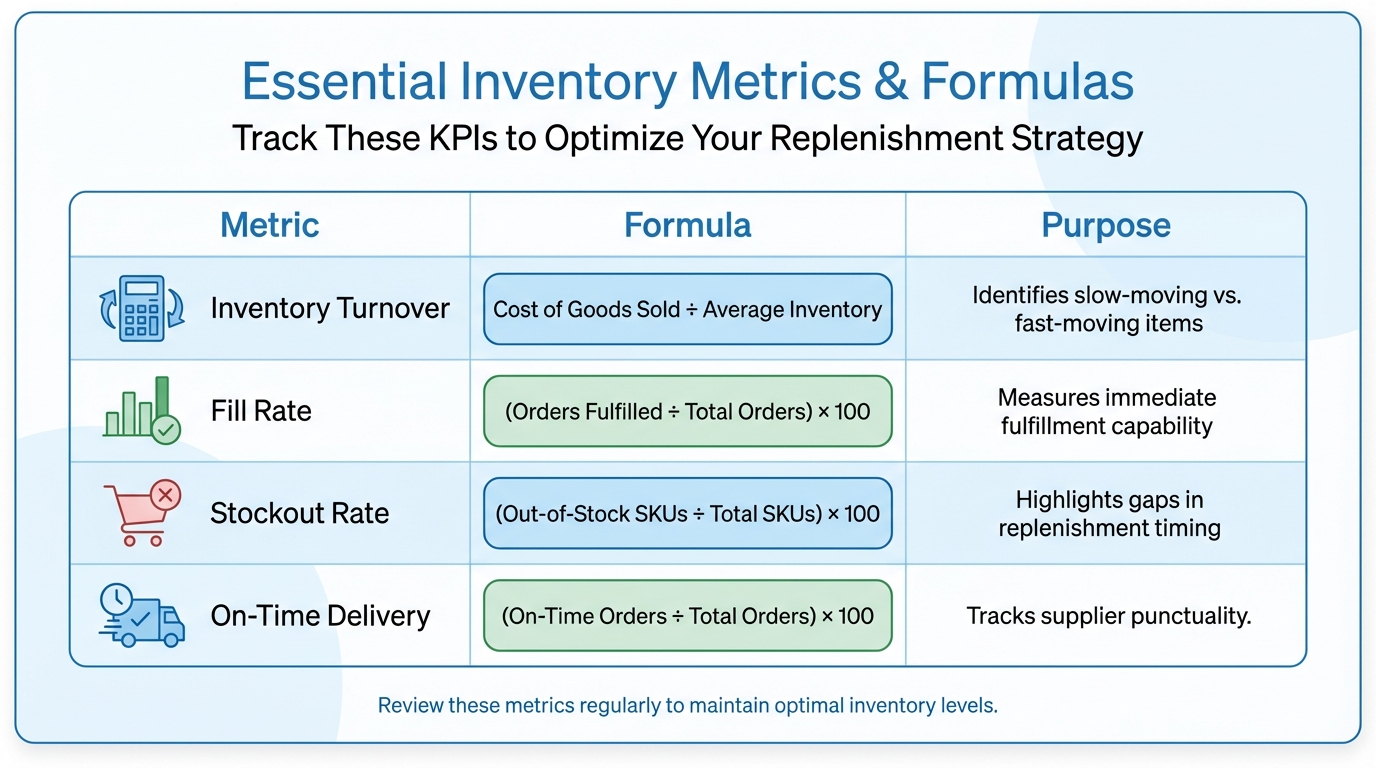
Key Inventory Metrics and Formulas for Shopify Store Owners
Before placing an order, it’s crucial to have a clear understanding of your current warehouse situation. Skipping this step is like flying blind - it’s a surefire way to end up with either empty shelves or piles of unsold inventory that tie up your cash flow.
Review Your Supply Chain Performance
Start by auditing key metrics that reflect how well your replenishment process is working. Focus on these:
- Inventory turnover: This shows how quickly you sell and replace products. Low turnover could mean you’re holding onto slow-moving stock that’s draining your resources.
- Stockout rate: This highlights how often items are out of stock, signaling potential gaps in your replenishment strategy.
- Fill rate: This measures the percentage of orders you can fulfill immediately using your current inventory.
You should also track actual lead times by comparing when orders arrive versus when they were promised. Don’t forget to factor in additional steps like unloading, quality checks, and warehouse processing beyond just transit time. To ensure accuracy, perform three-way matches - compare purchase orders, invoices, and receipt notes before paying suppliers. This step ensures you’re only paying for what was delivered correctly.
Here’s a quick look at how these metrics work:
| Metric | Formula | Purpose |
|---|---|---|
| Inventory Turnover | Cost of Goods Sold ÷ Average Inventory | Identifies slow-moving vs. fast-moving items |
| Fill Rate | (Orders Fulfilled ÷ Total Orders) × 100 | Measures immediate fulfillment capability |
| Stockout Rate | (Out-of-Stock SKUs ÷ Total SKUs) × 100 | Highlights gaps in replenishment timing |
| On-Time Delivery | (On-Time Orders ÷ Total Orders) × 100 | Tracks supplier punctuality |
Once you’ve reviewed these metrics, you’ll be in a better position to set accurate reorder points and safety stock levels.
Set Reorder Points and Safety Stock Levels
To avoid running out of stock - or overordering - you’ll need to calculate safety stock and reorder points. Safety stock acts as a buffer for unexpected demand or supplier delays. Use this formula to calculate it:
(Maximum Daily Sales × Maximum Lead Time) – (Average Daily Sales × Average Lead Time).
Next, determine your reorder point. This is the inventory level that triggers a new purchase order:
(Average Sales Rate × Lead Time) + Safety Stock.
Regularly update these numbers based on current sales trends and supplier lead times. For example, if you sell seasonal products like surfboards, you’ll need higher reorder points in summer and lower ones in winter to avoid unnecessary carrying costs.
To prioritize effectively, use ABC analysis. High-value "A" items may need more safety stock compared to less critical "C" items.
Create a Demand Forecast
Accurate demand forecasting is key to aligning your inventory with market needs. Use at least two years of historical data, point-of-sale (POS) records, and marketing results to identify trends. Start by calculating your average daily sales:
Total sales ÷ 365 days.
Look for patterns like seasonal dips or upward trends. When forecasting for a specific quarter, compare it to the same quarter from the previous year to account for seasonal changes.
For more precise planning, calculate lead time demand - the amount of stock you’ll need while waiting for a shipment:
Average lead time in days × average daily sales.
Don’t forget to adjust your forecasts for special events like promotions, product launches, or sudden market shifts that historical data might not account for.
Take the example of Aerflo, a Brooklyn-based water bottle company. In 2025, they adopted a Sales, Inventory, and Operations Planning (SIOP) process to manage production across multiple locations. Co-CEO John Thorp emphasized:
"Rule number one for this company is never run out of capsules... We try to be really strict about that."
By aligning their sales forecasts with operational capacity, Aerflo relied on ocean freight for most shipments but kept air freight as a backup for unexpected spikes in demand.
If manual calculations feel overwhelming, tools like Forstock can simplify the process. Their AI-powered forecasting models adapt to trends, lead times, and seasonality, offering real-time demand forecasts with 95% accuracy. This can save hours of manual work while giving you a clear view of your inventory needs for the next 12 months.
Communicating and Coordinating with Suppliers
Good communication with suppliers is the backbone of keeping your inventory plans on track. Clear coordination minimizes delays, reduces mistakes, and ensures your cash flow stays healthy. On the flip side, poor communication can lead to late deliveries - and considering that 21% of shoppers will abandon their cart if delivery times seem too slow, this isn’t something you can afford to overlook.
Confirm Product Availability and Delivery Times
Before placing an order, it’s crucial to confirm your supplier can deliver exactly what you need. Double-check SKUs, product codes, and descriptions to avoid surprises. Also, ensure raw materials are available to sidestep any production hiccups.
Get a clear lead time from your supplier. This should outline how many days are needed for processing, production, and shipping. Discuss shipping methods - whether it’s freight, air, or local delivery - and agree on delivery dates and Incoterms. To keep things moving smoothly, ask suppliers to confirm or reject purchase orders within 24 hours. Helen Armstrong, Founder of Apsley and Company, emphasizes the importance of trust in supplier relationships:
"Trust is essential in any relationship, but it can be tough to build trust with a supplier. Just like any relationship, supplier relationships need to be nurtured through timely communication."
Sharing your sales data and demand forecasts with suppliers can also be a game-changer. It helps them prepare materials in advance and reduce lead times. Yedra Lopez Gragera from OpenStore adds:
"Suppliers appreciate it when we show interest in their process, lead times, and where and how they source raw materials."
Once you’ve confirmed product availability, you’re ready to negotiate terms that align with both your budget and supplier relationships.
Discuss Pricing and Payment Terms
Negotiating pricing is all about finding a balance that works for both parties. Start by confirming Minimum Order Quantities (MOQs). If the MOQ feels too high, it could tie up your cash in inventory that doesn’t move fast. Building strong relationships can help you negotiate more flexible MOQs during slower times.
When you receive a quote, add a time limit - like 10 days - to lock in the price and avoid renegotiations. Use the Economic Order Quantity (EOQ) formula to figure out the best order size that balances ordering costs with holding costs. Keep in mind, inventory holding costs typically range from 16% to 20% of your total inventory value.
Payment terms are another key area to negotiate. A common term is Net 30, giving you 30 days from the invoice date to pay in full. Paying on time can build what some call “relationship currency,” which can lead to perks like exclusive discounts or priority treatment when supplies run low. Nicholas Fiorentino, Owner of The Meatery, sums it up well:
"It is OK to not get the lowest price in exchange for having the best mutually beneficial relationship."
These practices not only streamline supplier coordination but also set the stage for formal agreements that define expectations clearly.
Create Service-Level Agreements (SLAs)
For your most critical suppliers, it’s worth drafting a formal Service-Level Agreement (SLA). One key metric to include is On-Time-In-Full (OTIF), which tracks the percentage of orders delivered on schedule and in the correct quantities. A good OTIF target is 98%.
Your SLA should also outline acceptable defect and return rates to ensure product quality remains high. Include lead times, shipping schedules, and what happens if commitments aren’t met. For strategic suppliers, consider creating a one-page Joint Business Plan (JBP) that includes volume forecasts and shared KPIs.
Set up a regular cadence for performance reviews and operational calls. Clearly document who is responsible for each metric on both sides. This structure helps catch small issues before they grow into bigger problems. Nick Huber, Founder of The Sweaty Startup, warns:
"Miscommunications lead to misunderstandings, which lead to lost money and conflict. As a business owner, your job is to be understood."
To simplify tracking, use supplier relationship management software instead of manual spreadsheets. This provides real-time visibility into performance scorecards and keeps communication tight as you work toward syncing inventory systems.
Syncing Inventory Systems
After establishing strong supplier communication, the next step is syncing your inventory systems to ensure accurate stock data. Inventory inaccuracies are a common challenge - 58% of brands report that their accuracy is below 80%. This gap can lead to overselling, missed sales opportunities, and unhappy customers.
Connect Product Data Between Systems
How you sync inventory depends on your supplier's capabilities and the speed at which products move. If both you and your supplier use Shopify, Shopify Collective provides a seamless way to sync inventory, costs, and pricing in real time. For near-instant updates, APIs and webhooks are excellent options.
In cases where inventory changes are more predictable, scheduled CSV/XML feeds can update stock levels at regular intervals. For larger wholesalers and third-party logistics providers (3PLs), EDI (Electronic Data Interchange) remains a reliable and scalable solution. However, Bhoomi Singh from Sumtracker highlights a key limitation:
"Shopify isn't built for multi-supplier inventory management. It gives you only one vendor field and one cost price, leaving you to handle everything else manually."
To streamline syncing, ensure supplier labels like "QTY" match Shopify's fields, and coordinate updates to align with supplier time zones and shipping cut-off times.
Set Up Automated Alerts and Backup Plans
Automated alerts can help you avoid stockouts before they occur. Start by enabling inventory tracking in Shopify - go to the Products page and activate "Track quantity" for each variant. Then, set reorder points to trigger notifications when stock drops to a specific level, giving you the time needed to restock.
To further reduce risks, maintain safety stock buffers by listing fewer units than you actually have (e.g., display 8 available when you have 10). Daniel Hedegaard, Head of Press at Cool Parcel, stresses the importance of real-time inventory tracking:
"Getting the correct tools and integrations to track inventory in real time is one of the best things you can do for your tracking inventory."
Rank your suppliers so automation can switch to a backup when your primary supplier runs out of stock. Use failover logic to pause listings if all suppliers fall below minimum thresholds.
Automate Purchase Order Management
Manually managing purchase orders (POs) can lead to costly errors. Tools like Forstock automate PO creation using real-time inventory data and demand forecasts, instantly updating stock levels.
For instance, in 2025, AstraZeneca adopted the Coupa P2P system across 11 markets, cutting the purchase-order-to-approval time from 3 days to 1.5 days and reducing invoice approval time from 60 days to just 4.5 days. Similarly, health and wellness brand Kimai saved 20 hours a week by switching from spreadsheets to automated POs.
To minimize errors, implement three-way matching by comparing POs, receipts, and invoices. Top-performing businesses often complete POs within five hours.
Monitoring and Improving Over Time
Setting up inventory systems is just step one - keeping an eye on them ensures they stay effective. Continuous monitoring helps catch potential problems early, avoiding the costly pitfalls of stockouts or overstocking. In fact, in 2024, global retailers lost an estimated $1.7 trillion due to inventory distortions like these.
Once your inventory systems are automated and synced, regular monitoring keeps everything running smoothly.
Enable Low Stock Notifications
Real-time alerts are a lifesaver when it comes to avoiding stock shortages. Start by defining reorder points for each SKU, factoring in supplier lead times and historical demand data. These reorder points serve as thresholds that, when crossed, trigger notifications so you can restock in time.
For instance, if a supplier takes 10 days to deliver, set your alert to go off when you have 12-14 days of inventory left. This buffer allows for unexpected demand spikes or shipping delays.
Platforms like Forstock make this process easier by tracking stock levels across multiple warehouses and sales channels in real time. As the IZIMINI team shared:
"I can also set up alerts to know when I'm low on inventory for certain products to make replenishment easier".
For items with high turnover, you might need to adjust these notification thresholds based on how fast they sell daily.
Measure Supplier Performance
Using data to track supplier performance helps you make informed decisions, rather than relying on gut instincts. Lara from Move Supply Chain puts it plainly:
"Feelings aren't data. And in DTC, where margins are tight and cash is king, you can't afford to manage suppliers by gut feeling".
Here are some key metrics to monitor:
| Metric | Formula | Target |
|---|---|---|
| On-Time Delivery (OTDR) | (Orders On Time ÷ Total Orders) × 100 | 95% - 98% |
| Quality Acceptance (QAR) | (Units Accepted ÷ Units Received) × 100 | 98% - 99.5% |
| Order Accuracy | (Correct Orders ÷ Total Orders) × 100 | 98%+ |
| Price Variance | ((Actual Price - Quoted Price) ÷ Quoted Price) × 100 | 0% |
To evaluate suppliers, use a red/yellow/green framework:
- Green (95%+ OTDR): Maintain and reward these suppliers.
- Yellow (85-94% OTDR): Work on a 90-day improvement plan.
- Red (below 85% OTDR): Escalate issues or consider replacing them.
Critical suppliers should be reviewed monthly, while non-critical ones can be assessed quarterly.
A great example is fitness brand Bala. In June 2025, they used Shopify Collective to launch "The Movement Store", treating eight partner brands as on-demand suppliers. By syncing select SKUs in under 24 hours, they avoided upfront inventory costs and saw 45% of sales come from new customers.
Tracking these metrics not only strengthens supplier relationships but also ensures smooth operations.
Regularly Update Your Inventory Approach
Inventory strategies need to evolve. The frequency of updates depends on your product turnover - daily for fast-moving items, weekly for standard products, and monthly for slower-moving or seasonal goods. Supplier lead times can change due to market shifts or seasonal demand, so reorder points and safety stock levels should be adjusted accordingly.
Check integration dashboards daily to catch technical issues or data mismatches between systems. Combine these checks with automated alerts and supplier metrics to refine your approach. For high-demand products, conduct weekly physical audits to ensure your records match reality. Use historical sales data, seasonal trends, and market research to guide your updates.
Inventory carrying costs usually account for around 3% of your total inventory value. Frequent reviews can help you identify ways to cut these costs without compromising service quality. Additionally, diversifying suppliers for key products can minimize risks from long lead times or underperforming vendors.
Wrapping It Up
This checklist equips you to sync supplier coordination with your inventory needs effortlessly. The secret lies in proactive planning - adjusting reorder points based on real-time usage and lead times ensures your stock arrives just when you need it. Businesses that adopt well-structured replenishment workflows can cut inventory carrying costs by as much as 20%.
Strong communication shifts supplier relationships from mere transactions to true partnerships. Service Level Agreements (SLAs) help maintain accountability, avoiding costly misunderstandings and keeping everyone on the same page.
Tools like Forstock simplify supplier coordination by linking your Shopify store with supplier data feeds. It automates purchase orders, sends low-stock alerts, and eliminates the hassle of managing spreadsheets. This means more time to focus on growing your business.
Consistent monitoring is key to refining your inventory process. Assessing supplier performance and sharing rolling forecasts help uncover bottlenecks and improve lead times. By combining smart automation with regular performance reviews, you create a system where every inventory decision strengthens your supplier coordination. The payoff? Improved cash flow, fewer stockouts, and the assurance that you can meet customer demand without overloading on inventory.
FAQs
How do I pick the right safety stock level?
To determine the appropriate safety stock level, you’ll need to account for both demand variability and lead times. A widely used formula is:
Safety Stock = (Max Daily Sales × Max Lead Time) − (Average Daily Sales × Average Lead Time)
This helps ensure you’re ready for unexpected demand surges or delays from suppliers. To simplify this process, tools like Forstock can automate the calculations, keeping your safety stock aligned with real-time sales data and supply chain dynamics.
What should I ask suppliers before sending a PO?
Before you send a purchase order (PO), make sure to clarify a few key details with your suppliers. Ask about their minimum order requirements, pricing and total costs, payment terms, lead times, product quality assurance, and inventory availability. Getting this information upfront helps set clear expectations and ensures smoother collaboration with the supplier.
How can I automate reordering in Shopify?
To make reordering easier in Shopify, consider using tools like Forstock. These tools use real-time data and AI-based forecasting to handle tasks like creating precise purchase orders and setting up automatic reorder points based on inventory levels. By organizing your product information and setting up inventory rules, you can cut down on manual work, avoid running out of stock, and simplify inventory management with less hands-on involvement.
Keep reading
Try Forstock free for 14 days.
AI-powered demand forecasting and reorder automation for Shopify brands. No credit card required.