
How Backorders Impact Customer Satisfaction
By Forstock Team · Last updated February 22, 2026
How backorders erode customer trust and future sales, plus practical steps—forecasting, real-time inventory, supplier coordination, and clear customer communication to prevent them.

How Backorders Impact Customer Satisfaction
Backorders can frustrate customers, harm your brand's reputation, and reduce future sales. When products aren't available but orders are still accepted, customers face delays that often lead to abandoned carts, lost trust, and long-term revenue losses. In fact, delays longer than 20 days can decrease customer orders by 8.4% the following year.
To prevent backorders:
- Use accurate demand forecasting with tools like AI to predict trends and avoid overstock and stockouts.
- Implement real-time inventory tracking to monitor stock levels and automate reordering.
- Strengthen supplier communication to reduce delays and ensure steady stock flow.
- Communicate transparently with customers about delays, offering clear timelines and alternatives.
For Shopify brands, platforms like Forstock simplify inventory management with AI-driven forecasting and real-time updates, helping businesses avoid backorders and maintain customer trust.
What Backorders Are and Why They Occur
What Are Backorders?
A backorder happens when a customer orders a product that's temporarily out of stock, with the promise that it will be delivered once inventory is replenished. As Investopedia explains:
A backorder occurs when an item cannot be filled immediately due to insufficient supply, though it might still be in production.
This is different from stockouts or pre-orders because backorders indicate the product will soon be available again. ShipStation offers a simple analogy:
One way to look at backorders is as backups: 'We're out right now, but we've got more on the way'.
Take Apple, for instance. During new iPhone launches, demand often outpaces supply. Instead of marking products as unavailable, Apple keeps accepting orders, informing customers of extended shipping times - often 3–4 weeks. Similarly, SpiritHoods, a clothing brand, employs a just-in-time manufacturing approach. They manage backorders by offering a "Coming Soon" section where customers can sign up for alerts when items are back in stock.
Now that the concept is clear, let’s dive into why backorders happen.
Common Causes of Backorders
To address backorders, it’s essential to understand what causes them. They often arise from operational missteps or disruptions in the supply chain. On the operational side, relying solely on outdated demand forecasting methods or inaccurate inventory counts can create issues. Low safety stock levels also leave businesses exposed when unexpected sales surges occur.
Supply chain disruptions are another major contributor. Delays in supplier production, shortages of raw materials, or logistical challenges like port congestion and customs delays can all extend lead times. Viral moments can also spark backorders. For example, Flexin' In My Complexion - a clothing brand founded by 10-year-old entrepreneur Kheris Rogers - sold out its entire inventory in minutes after a social media post went viral, leading to an immediate backorder situation.
The stakes are high when it comes to managing backorders. Roughly 23% of online shoppers abandon their carts if delivery times are too long or unclear. During the 2022 holiday season, 77.5% of merchants anticipated supply chain delays would affect their operations. These numbers highlight why minimizing backorders is crucial for keeping customers happy and loyal.
sbb-itb-f0fc809
What Is a Backorder and How to Manage Them?
How Backorders Hurt Customer Experience
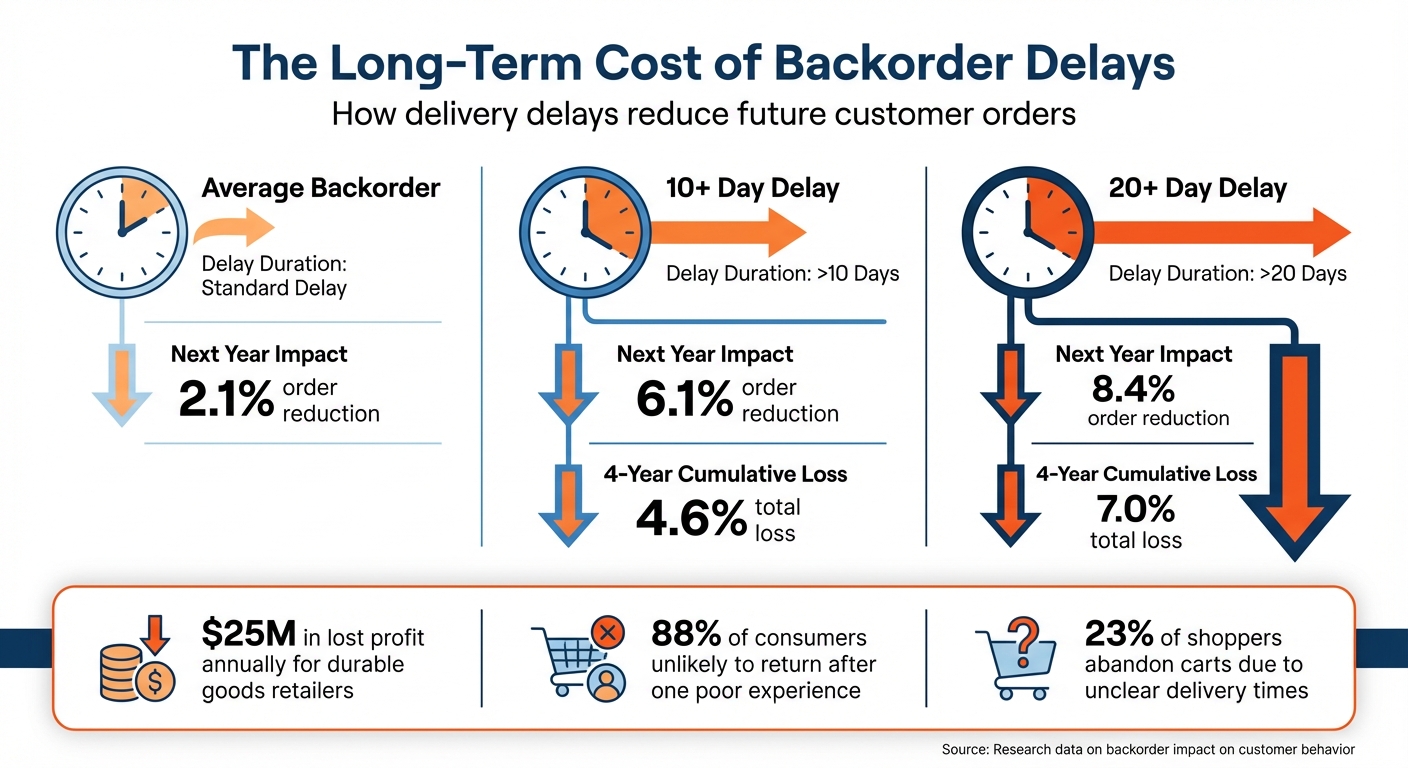
The Long-Term Impact of Backorder Delays on Customer Orders
Backorders disrupt shipments and strain the trust between customers and brands. The effects extend well beyond a single delayed order, influencing how customers perceive your business and whether they choose to return.
Customer Frustration and Cart Abandonment
Backorders create uncertainty and inconvenience. In 2022, over half of global online shoppers couldn’t buy the products they wanted due to stock shortages. This issue is a major cause of cart abandonment. When customers encounter unclear timelines or discover items are backordered during checkout, many simply leave. In fact, 60% of global shoppers said product unavailability affected their buying habits, leading to more than 10% in lost sales and $71.4 billion in global losses during 2020 alone. This dissatisfaction doesn’t just end at the checkout - it can snowball into a broader erosion of trust and brand loyalty.
Damage to Brand Reputation
Delayed orders chip away at a brand’s reliability. Backorders, especially when frequent, can make customers question whether a business can keep its promises. As Dhey Avelino from Racklify explains:
Handling backorders well is as much about customer experience as logistics.
The consequences are long-lasting. A single backorder delay can reduce customer orders by 2.1% to 2.2% the following year. If the delay stretches beyond 10 days, the reduction jumps to 6.1%. For delays over 20 days, orders drop by 8.4% the next year, with a 7% cumulative reduction over four years. Each stockout adds to customer dissatisfaction, and repeated experiences can push buyers to abandon the brand entirely. During the pandemic, stockouts in the U.S. more than doubled, climbing from 14% to over 35% by May 2020. This spike heightened consumer sensitivity to delivery failures, underscoring the critical need for dependable fulfillment.
Lost Revenue and Future Sales
Backorders don’t just frustrate customers - they also lead to significant financial losses. For durable goods retailers, backorder delays can result in up to $25 million in lost profit annually. The fallout doesn’t stop there. These delays reduce how often customers order and even shrink the size of their future purchases.
| Delay Duration | Next Year Order Reduction | 4-Year Cumulative Loss |
|---|---|---|
| Average Backorder | 2.1% | - |
| > 10 Days | 6.1% | 4.6% |
| > 20 Days | 8.4% | 7.0% |
Backorders can impact customer purchasing behavior for years, reducing lifetime value and revenue potential. What might seem like a minor inventory hiccup today can translate into years of diminished loyalty and spending. As Eric T. Anderson, Professor at Kellogg School of Management, points out:
The impact of stockouts extends well beyond the current order. Firms cannot hope to implement optimal inventory policies without measuring these long-run effects.
Offering discounts to encourage backorders instead of cancellations rarely works. The frustration customers feel often outweighs any small incentive. This long-term decline in revenue highlights the importance of proactive inventory management to avoid backorders in the first place.
How to Reduce Backorders and Improve Customer Satisfaction
Preventing backorders starts with addressing their root causes: poor forecasting, limited inventory visibility, and weak supplier coordination. By tackling these challenges head-on, businesses can ensure smoother operations and happier customers.
Use Better Demand Forecasting
Accurate demand forecasting is key to avoiding backorders. By analyzing historical sales data - like seasonal trends and past promotional performance - businesses can identify patterns in demand. Adding external factors such as market trends, holidays, and marketing campaigns further sharpens these forecasts.
AI and machine learning tools take this a step further. They allow businesses to adapt to market changes in real time, making predictions more precise. As Dr. Sarah Thompson from Harvard University explains:
Accurate demand forecasting significantly enhances customer satisfaction by reducing stockouts, improving delivery reliability, and aligning inventory with consumer needs.
Collaboration across departments - like purchasing, operations, and marketing - ensures that forecasts align with upcoming promotions and customer expectations. Sharing these forecasts with suppliers also helps them prepare for demand shifts.
To safeguard against unexpected supplier delays or demand surges, businesses can calculate safety stock using this formula:
Safety Stock = (Max daily usage × Max lead time) – (Average daily usage × Average lead time). Pair this with automated reorder points driven by real-time data to avoid running out of stock.
Once forecasts are accurate, maintaining real-time inventory visibility becomes the next priority.
Implement Real-Time Inventory Tracking and Automation
Real-time inventory tracking integrates data from point-of-sale systems, warehouses, and apps, creating a unified view that eliminates stock discrepancies. This approach also triggers automated reordering when stock levels approach the reorder point. In fact, using real-time data within a warehouse management system can achieve inventory accuracy rates of up to 100%.
To set triggers for replenishment, businesses can rely on this formula:
Reorder Point (ROP) = Demand during lead time + safety stock.
Multi-channel visibility is another critical component. Centralized systems allow businesses to monitor inventory across multiple warehouses and sales channels simultaneously, preventing overselling and ensuring efficient order fulfillment. Syncing Inventory Management Systems (IMS) with Order Management Systems (OMS) ensures product availability is updated in real time across all sales platforms.
Automation also reduces human error in tasks like inventory counting, data entry, and item tracking - common causes of backorders. Advanced systems can even prioritize backorder fulfillment based on factors like order volume, customer value, or order date. Leveraging real-time data for smarter fulfillment strategies has been shown to increase shipments by 2.5x.
While automation smooths inventory management, strong supplier communication ensures a steady supply of stock.
Improve Supplier Communication
Building strong relationships with suppliers is essential for timely replenishment. Sharing demand forecasts early allows suppliers to plan their production schedules and inventory levels more effectively. Regular planning sessions to discuss potential challenges and create contingency plans further strengthen these partnerships.
Diversifying the supplier base is another safeguard against disruptions. Relying on multiple vendors ensures flexibility if one supplier faces delays. Centralized platforms can provide insights into suppliers’ production schedules, inventory levels, and lead times, helping businesses stay informed. Tools like Electronic Data Interchange (EDI) and integrated ERP/WMS systems also streamline the sharing of orders, shipping notices, and inventory updates.
As Dave Butterly, Director of Strategic Accounts at FIDELITONE, explains:
Using FIFO inventory allocation, we are able to fulfill backorders straight from the receiving dock on the day the inventory arrives.
Regularly updating lead times and requesting production updates can further strengthen supplier communication. In B2B settings, clear Service Level Agreements (SLAs) and contractual obligations ensure backorder management stays on track. Poor communication can lead to the "bullwhip effect", where minor demand changes snowball into larger supply chain disruptions, driving up costs.
How to Communicate with Customers During Backorders
Backorders happen, but how you handle them can make or break customer trust. Research shows that 88% of consumers are unlikely to return after a single poor experience, like a mishandled backorder. On the flip side, companies that excel at communication during delays can grow revenue by 5% to 10% and cut costs by 15% to 25% within a few years.
The secret? Transparency and quick action. Reach out to customers as soon as you know about a delay to avoid frustration. As Jeff Toister, a Customer Service Consultant, puts it:
The way you communicate goes a long way to retaining your customers' trust.
Keeping customers informed not only encourages loyalty but also reduces the number of inquiries your customer service team receives. Below, we’ll explore how to set delivery expectations and provide alternatives to keep customers satisfied.
Provide Accurate Delivery Estimates
When communicating delivery timelines, always err on the side of caution by giving the worst-case scenario. Customers are much more forgiving of early arrivals than missed deadlines. If an exact date isn’t available, let them know when they’ll hear from you next - like "We’ll update you in 30 days" - to show you’re staying on top of their order.
Your estimates should cover the entire process, from port arrivals to warehouse handling and final delivery - not just when the supplier ships the product. Use multiple channels, such as email, SMS, and phone calls, to ensure customers receive the information in a way that feels personal. Additionally, cloud inventory tools like tracking pages or chatbots can let customers check their order status whenever they want.
Ron Busby, President and CEO of U.S. Black Chambers, Inc., highlights the importance of keeping customers informed:
People are much easier to deal with when they're informed about what is happening. The key thing is not to lose them because of the time delay.
If precise delivery estimates aren’t possible, consider offering alternative solutions to maintain customer satisfaction.
Offer Product Alternatives and Discounts
Giving customers options can help turn a frustrating experience into a chance to build loyalty. Before notifying them about a delay, identify similar products that are in stock - different colors, sizes, or models - and include photos to make their decision easier. For orders with multiple items, you can also offer to ship the available products immediately, with the backordered item to follow later.
Incentives can go a long way in keeping customers happy. Offering free expedited shipping when the item becomes available, discounts on the current order, or promo codes for future purchases can soften the blow. Be upfront about the steps you’re taking to resolve the issue, such as sourcing from new suppliers or expediting shipping, to show you’re actively working on their behalf.
Here’s a quick look at how different options can benefit both you and your customers:
| Customer Option | Description | Benefit |
|---|---|---|
| Wait for Item | Customer agrees to the backorder timeframe. | Secures the sale; customer feels in control. |
| Choose Alternative | Suggest a similar product or different color in stock. | Immediate fulfillment; avoids lost revenue. |
| Partial Shipment | Ship available items now, backordered items later. | Customer receives part of the order immediately. |
| Cancel and Refund | Allow easy, hassle-free cancellation of the order. | Reduces negative reviews and chargebacks. |
Using Technology to Prevent Backorders
Backorders can seriously damage customer trust and hurt your bottom line by cutting into future sales. Modern inventory management platforms offer a solution by using AI and real-time data to optimize stock control. Unlike the old days of relying on spreadsheets and guesswork, these systems analyze historical sales data, seasonal trends, and market patterns to predict demand spikes with precision. They also provide instant updates across warehouses and sales channels, so you’re not left scrambling to react to stock shortages. By combining AI with real-time insights, these tools take the guesswork out of inventory management and make it more accurate than ever.
As Travis Thorson, EDI Veteran at Orderful, puts it:
Mismanaged inventory is one of the fastest ways to lose customers and profitability.
Automation is another game-changer. When stock levels reach the reorder point, these platforms automatically generate purchase orders, ensuring that replenishment happens before you run out. They also calculate the ideal safety stock levels by factoring in lead times and demand variability, creating a buffer against supplier delays and unexpected surges in demand.
With these tools in mind, let’s take a closer look at how a specialized platform tackles these challenges for Shopify brands.
How Forstock Prevents Backorders
Forstock is purpose-built for Shopify brands aiming to avoid backorders and simplify inventory management. It integrates directly with Shopify, offering a single dashboard to track stock levels, manage suppliers, and monitor performance across all locations in real time.
The platform’s AI-powered demand forecasting adapts to changes in sales trends, lead times, and seasonality, ensuring purchasing decisions are based on data, not guesswork. By analyzing past sales and promotional schedules, Forstock provides a 12-month demand plan that helps you stay ahead of customer needs.
Forstock also centralizes supplier communications, tracks on-time delivery performance, and adjusts reorder points when supplier reliability shifts. Its safety stock feature calculates the right buffer to protect against delays and sudden demand spikes, keeping your products available when your customers need them.
Whether you’re dealing with simple products or complex multi-variant catalogs, Forstock saves time, boosts cash flow, and ensures you can meet customer demand. Plans start at $79 per month, and you can try it free for 14 days.
Conclusion
Backorders can seriously damage customer satisfaction. They often result in frustration, loss of trust, and decreased revenue - especially when you consider that 88% of consumers are unlikely to return after just one bad experience. Research shows that delays over 20 days can cut orders by up to 8.4%, with those effects lingering for as long as four years.
To minimize these impacts, businesses need a strong mix of effective inventory management and clear communication. Real-time tracking helps prevent overselling, AI-powered forecasting anticipates demand surges, and timely updates keep customers in the loop. When customers are informed about delays and given accurate timelines, they’re more likely to remain loyal, even when issues arise. Tackling backorders head-on ensures businesses can maintain trust and secure long-term growth.
For Shopify brands, Forstock offers a practical way to avoid backorders altogether. Its tools include AI-driven demand forecasting, manual vs. automated purchase orders, and centralized supplier management, all designed to prevent stockouts before they happen.
Priced at $79 per month with a 14-day free trial, Forstock equips businesses with the tools to reduce backorders, improve cash flow, and strengthen customer loyalty. Meeting demand consistently not only protects revenue but also preserves your brand’s reputation.
FAQs
Should I accept orders when an item is out of stock?
It's usually a bad idea to accept orders for items that are out of stock unless you clearly communicate the situation to your customers. A better approach? Offer alternatives like backordering with precise delivery timelines or setting up notifications to alert customers when the product is available again. These steps help manage expectations and keep your customers happy.
What’s the best way to estimate backorder delivery dates?
To figure out backorder delivery dates, you’ll need to blend supplier lead times with demand forecasts and inventory tracking. Start by asking your suppliers for their lead time estimates, keeping in mind variables like production speed and supply chain issues that could cause delays. Inventory management tools are a big help here - they let you track stock levels and lead times more precisely. Finally, keeping customers informed about delays through clear communication helps set realistic expectations and boosts their trust in your business.
How do I set safety stock and reorder points to avoid backorders?
To steer clear of backorders, you can calculate safety stock with this formula: (maximum daily usage × maximum lead time) − (average daily usage × average lead time). Once you have your safety stock, determine your reorder point by adding it to your lead-time demand: (average daily usage × lead time).
It's important to revisit and adjust these numbers regularly, especially if your demand or lead times fluctuate. Using tools like demand forecasting can make this process easier and help you stay ahead, ensuring your customers remain satisfied.
Keep reading
Try Forstock free for 14 days.
AI-powered demand forecasting and reorder automation for Shopify brands. No credit card required.