
Inventory Planning for Supplement Brands: The Complete Guide
Segment SKUs, forecast by channel, set ROP and safety stock, and use FEFO plus open-to-buy to cut stockouts and expiry risk.

Inventory Planning for Supplement Brands: The Complete Guide
If you sell supplements in the U.S., bad inventory planning can lock up cash fast or leave you out of stock when demand jumps. I’d keep the process simple: segment SKUs first, forecast by channel, set reorder points and safety stock, check shelf life before every PO, and review performance every week.
Here’s the article in plain English:
-
Supplements need tighter inventory control than most e-commerce products
- Many SKUs expire
- Lot tracking matters under U.S. GMP rules
- COA issues and label errors can delay receipts
- Carrying costs often run 20%–30% of inventory value per year
-
I wouldn’t forecast every SKU the same way
- Fast movers need weekly review
- Seasonal items need season-based planning
- New launches need small first buys
- Slow movers need tighter stock limits
- Channel-level forecasting matters
-
The core math is simple
- Coverage (days) = On-hand units ÷ average daily demand
- ROP = demand during lead time + safety stock
- Order qty = target stock level − net available
- I’d watch SKUs under 14 days of cover or above 90 days
-
Shelf life should shape every buy
- Use FEFO for dated inventory
- Track lot code, expiry date, receipt date, and quantity on receipt
- Set minimum shelf-life rules at receiving
- Don’t buy more than you can sell inside your usable freshness window
-
Cash control matters just as much as forecasting
- Use a monthly open-to-buy plan
- Check MOQs, lead times, and case packs before releasing POs
- Make sure each PO fits both demand and budget
-
The review loop keeps the plan from drifting
- Weekly: fast movers, promos, subscriptions
- Monthly: full catalog, aging stock, budget, and lead times
- Quarterly: service levels, supplier performance, and policy changes
A simple way to think about it: the goal isn’t to hold the most stock or the least stock. It’s to hold the right stock, in the right amount, for the right amount of time.
That’s the full point of this guide, and the rest of the article walks through how to do it step by step.
Forecast demand by SKU, channel, and selling pattern
Start with weekly SKU-channel sales history, net of returns. Then layer in price, discounting, promotions, stockouts, and marketing flags. That part matters more than it may seem. Stockouts can hide true demand, and if you don't correct for them, your forecast ends up lower than it should be.
For supplements, small misses can get expensive fast. Expiry windows and long replenishment cycles mean even a modest forecast error can lead to too much stock or not enough. For established SKUs, use at least 12–18 months of history. Once the data is clean, forecast each SKU by channel before you set inventory targets.
Plan DTC, wholesale, marketplace, and subscription demand separately
Forecast each channel on its own because each one has a different order pattern and risk profile.
- DTC tends to swing more and reacts hard to promotions.
- Marketplace demand is often rank-driven and can move faster than trend lines suggest.
- Wholesale is lumpy; one PO can equal several weeks of DTC sales.
- Subscription is steadier and depends on active subscriber counts and churn.
Those patterns shape both when you buy and how much stock you assign to each channel.
Take a vitamin D gummy. In subscriptions, it may sell at a steady pace with only small seasonal bumps. In DTC, it might jump during a winter immunity promo. On Amazon, it may build little by little as reviews stack up. In wholesale, it can surge if a retailer gives it an end-cap feature. If you roll those four patterns into one average, you're often setting yourself up for stockouts in one channel and extra stock in another.
Pick the right forecasting method for each SKU type
| SKU type | Primary method | Data needed | Key watch-out |
|---|---|---|---|
| Established, stable SKUs (e.g., flagship multivitamin) | Moving average or simple exponential smoothing with seasonal indices | 12–18 months of clean sales history | A smoothing constant (α) of 0.3–0.5 reacts well to recent shifts; higher values respond faster. |
| Seasonal SKUs (e.g., immune support, weight-loss products) | Holt-Winters or seasonal time-series model | 2+ years of sales data | Seasonal index = average sales for period ÷ overall average sales. |
| New launches (e.g., a new collagen gummy) | Top-down targets + analog SKU benchmarks | Marketing plan, category data, comparable SKU history | Overstock risk is high; use phased buying with small initial POs. |
| Intermittent or niche SKUs (e.g., specialty nootropics) | Croston's method or simplified rules | Whatever history exists, even if sparse | Standard averages overstate demand for lumpy sellers. |
For seasonal SKUs, use this structure: Demand = Baseline × Seasonal Index × Event Uplift. In plain English, start with baseline demand, multiply it by the seasonal index, and then layer on any event lift. To get the seasonal index, divide average sales for a given period by the overall average. These forecasts then feed into reorder points and safety stock.
Adjust forecasts for promotions, bundles, and product launches
For promotions, focus on three steps:
- Measure historical lift by comparing units sold during past promotions against baseline weeks from similar periods.
- Apply that lift factor only during the event window, not forever, unless the baseline itself changed.
- For new launches, buy in phases, starting with 1–2 months of supply plus safety stock.
Bundles need their own forecast. Project demand at the bundle level, then remove bundle volume from standalone SKU forecasts so you don't double count. The basic math is simple: Component demand = standalone demand + bundle demand.
There's one more wrinkle. When a bundle launches or gets a heavy promo push, some shoppers who would have bought the items one by one may switch to the bundle. That substitution can pull down standalone SKU sales, so keep an eye on it.
Use the adjusted forecast to set reorder points, safety stock, and buying quantities. Next, turn the forecast into weekly replenishment decisions and target stock levels.
sbb-itb-f0fc809
Set reorder points, safety stock, and target inventory levels
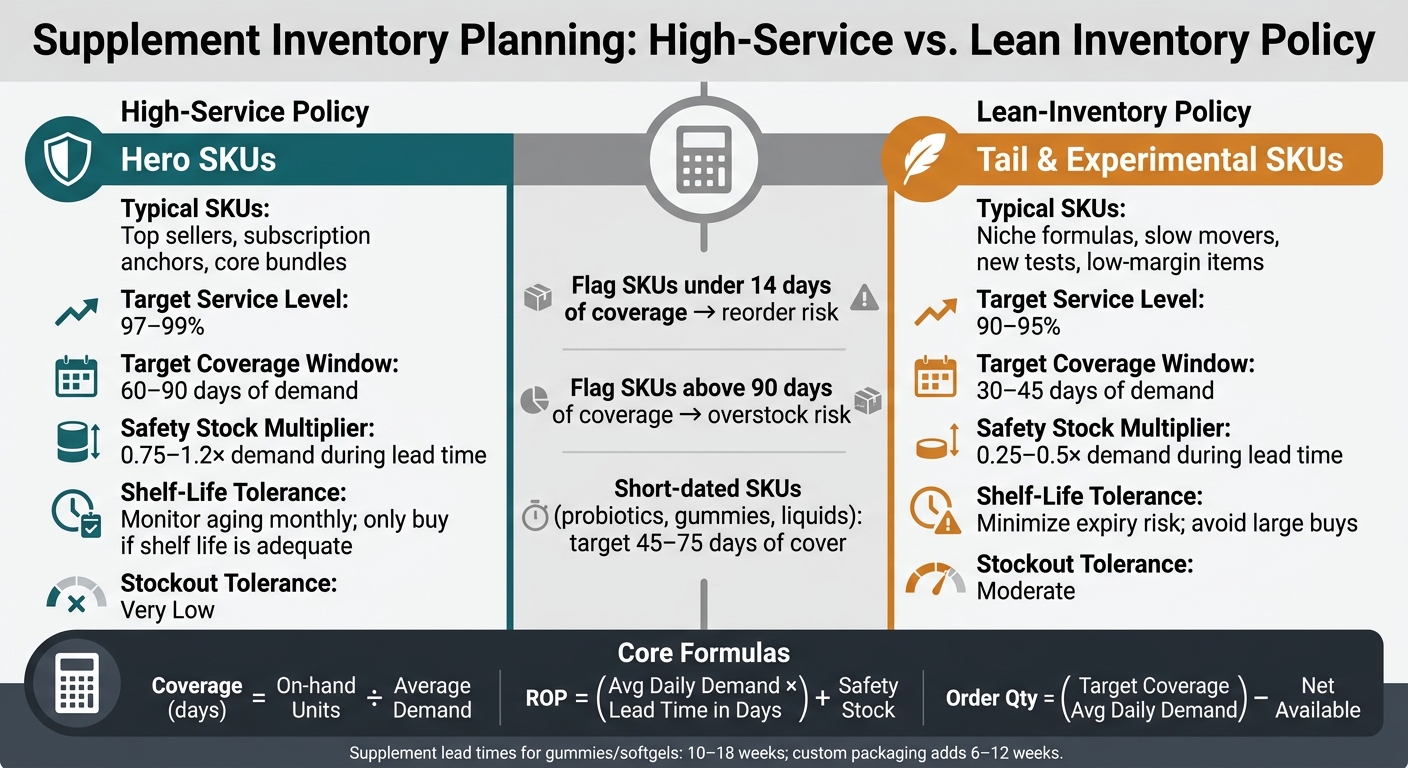
Supplement Inventory Planning: SKU Policy & Coverage Targets at a Glance
Once your forecasts are set, the next job is turning them into simple buying rules. You want three things nailed down for each SKU: when to reorder, how much to order, and how much backup stock to keep.
Core formulas for coverage, reorder points, and safety stock
Three calculations handle most of this work.
Inventory coverage shows how many days of sales your current stock can support:
Coverage (days) = On-hand Units ÷ Average Daily Demand
If you have 2,500 units on hand and sell 100 units a day, you have 25 days of coverage. Check coverage every week so you can spot SKUs that are getting too thin or piling up. Items under about 14 days of cover or above 90 days need a closer review.
Reorder point (ROP) shows when it's time to place a new purchase order:
ROP = (Average Daily Demand × Average Lead Time in Days) + Safety Stock
In plain English, reorder at lead-time demand plus safety stock. If a protein powder sells 80 units a day, has a 20-day lead time, and needs 500 units of safety stock, the reorder point is 2,100 units. When net available inventory drops to 2,100, it's time to reorder.
Safety stock is the cushion that helps when demand jumps or supply slips. A simple starting point is demand during lead time multiplied by a variability factor:
Safety Stock = Demand During Lead Time × Variability Factor
For a gummy SKU selling 50 units a day with a 15-day lead time, demand during lead time is 750 units. With a 0.5 variability factor, safety stock comes out to 375 units. Stable SKUs with short, steady lead times can use a lower factor, around 0.25–0.4×. Volatile SKUs or hero products usually need more, closer to 0.75–1.2×.
Here's the part that trips people up: lead time variability matters more than lead time length. A supplier that delivers in 60 days every single time is much easier to plan around than one that swings between 45 and 90 days. If lead time is inconsistent, plan closer to the longer end or add more safety stock to cover the risk.
With those thresholds in place, you can decide which SKUs need deeper stock and which ones should stay lean.
When to hold deeper stock versus leaner positions by SKU
Not every SKU should get the same buffer. The call usually comes down to four things: the SKU's role in the business, its gross margin, its lead time and supplier consistency, and its shelf life. Supplement lead times for gummies and softgels can run 10 to 18 weeks, and custom packaging can add another 6 to 12 weeks, so hero SKUs with long, uneven sourcing need much deeper buffers than a stock-formula capsule with a 2- to 4-week turnaround.
Start by calculating coverage and safety stock. Then place each SKU into either a high-service policy or a lean-inventory policy. From there, assign a service level and a coverage target.
| Dimension | High-Service Policy (Hero SKUs) | Lean-Inventory Policy (Tail/Experimental SKUs) |
|---|---|---|
| Typical SKUs | Top sellers, subscription anchors, core bundles | Niche formulas, slow movers, new tests, low-margin items |
| Target service level | 97–99% | 90–95% |
| Target coverage window | 60–90 days of demand | 30–45 days of demand |
| Safety stock multiplier | 0.75–1.2× demand during lead time | 0.25–0.5× demand during lead time |
| Shelf-life tolerance | Only if shelf life is adequate; monitor aging monthly | Minimize expiry risk; avoid large buys |
| Stockout tolerance | Very low | Moderate |
Short-dated SKUs like probiotics, gummies, and liquids should usually stay closer to 45 to 75 days of cover. It's often better to reorder a bit more often than to eat the cost of a batch that sits too long and expires.
Turn reorder logic into a weekly buying plan
Set one day each week to review your priority SKUs. For each one, calculate net available inventory:
- On-hand units
- Plus inbound purchase orders
- Minus backorders
Then compare that number to the reorder point.
If net available is at or below the ROP, use this formula to work out the order quantity:
Order Qty = (Target Coverage in Days × Average Daily Demand) − Net Available
Say your target is 60 days of coverage, daily demand is 80 units, and net available is 2,500 units. Your target stock level is 60 × 80 = 4,800 units. Your order quantity is 4,800 − 2,500 = 2,300 units. If the supplier's MOQ is 2,500 units, round up to the MOQ or the nearest case pack.
Before you release the PO, do one more check: make sure the incoming stock will still move inside your shelf-life limit. If the order would leave product sitting past your freshness window, trim the quantity or split it into smaller deliveries. That ties the order straight back to your forecast, lead time, and freshness window, so the planning model turns into a PO you can use.
Use that same weekly output as the starting point for inventory review and KPI tracking.
Plan around shelf life, cash flow, and replenishment execution
Reorder points tell you when to buy. Shelf life and cash flow tell you whether that purchase still makes sense.
This is where execution comes in. You need three things working together: rotation rules, a budgeted buying plan, and a final check before each PO goes out.
Use FEFO, lot control, and freshness thresholds to cut expiry risk
Most supplement SKUs have a Best By or expiration date. That means shipping order matters just as much as stock level. FEFO (First Expired, First Out) is the standard rotation method for dated supplement inventory: the lot closest to expiry ships first, no matter when it arrived. Brands that use batch-level tracking and FEFO logic can cut expiry waste by 30–50%.
But FEFO falls apart fast if receiving is sloppy.
Every inbound shipment should record:
- lot code
- expiration date
- quantity per lot
- receipt date
This needs to happen before product hits a shelf. If expiry data is missing or wrong, FEFO becomes impossible to manage later.
It also helps to set a minimum remaining shelf-life rule for inbound product. Some 3PLs require at least 12 months of shelf life at receipt and 6 months minimum for fast-turning items. If a supplier sends a lot below that threshold, reject it or quarantine it before it becomes available stock.
Use FEFO for dated, multi-lot supplement SKUs. Keep FIFO for non-dated accessories or simple single-lot items.
On the outbound side, set an internal freshness rule. A common target is to ship product within 50–70% of its total shelf life and avoid shipping anything with fewer than 6–9 months remaining. Expiry alerts in your WMS or inventory system can flag lots that are getting too close, which gives you time to run a promotion, move units to another channel, or take a write-down before the issue gets worse.
Once rotation rules are in place, cash becomes the next limit.
Build an open-to-buy plan that fits your budget and lead times
An open-to-buy (OTB) plan turns your demand forecast into a month-by-month buying schedule with dollar limits attached. In this case, its job is simple: translate forecasted demand into a purchase plan that fits your budget and doesn’t leave you sitting on aging stock.
Without that plan, it’s easy to tie up too much cash in a slow mover. Or under-buy a hero SKU because the timing felt off.
The monthly planning flow looks like this:
| Step | What You Do | Key Output |
|---|---|---|
| 1. Identify gaps | Compare projected inventory against coverage targets by SKU | Buy, hold, or cut list by SKU |
| 2. Apply shelf-life and budget caps | Flag any SKUs where projected stock would age past your freshness threshold; confirm order quantities fit within budget | Shelf-life-safe, budget-constrained order list |
| 3. Size and time purchase quantities | Factor in MOQs, case packs, and supplier lead times | Draft order quantities and timing |
| 4. Release approved POs | Review, finalize, and submit | Submitted POs and updated inventory projections |
The shelf-life gate is the part that decides the order.
Before you approve any production or purchase run, compare the days of supply that order represents - units ÷ average daily demand - against your usable shelf-life window, which is shelf life on receipt minus your minimum outbound rule. If the order’s days of supply are longer than that window, trim the quantity, split it into two deliveries, or move the second batch to a later month.
Use the approved monthly buy plan as the last check before each PO release.
A replenishment checklist to run before releasing each purchase order
This checklist is the final gate for the system you’ve already built through forecasting and reorder logic. No PO should go out without it.
Before releasing any purchase order, confirm the following:
- Current coverage and lead-time risk: Does net available inventory - on-hand plus inbound, minus backorders - cover safety stock through the next lead-time cycle? Does the order quantity and timing account for lead-time variation and MOQ rounding?
- Bundle and subscription commitments: Are planned bundle kits or subscription shipments likely to push demand above standalone sales?
- Shelf-life gate: Will total projected inventory - current stock plus this new order - sell through before your minimum outbound freshness rule kicks in?
- OTB alignment: Does this PO fit inside the current month’s budgeted purchasing dollars?
Only release the PO when every item clears. One shared inventory view helps keep lot data, forecasts, inbound POs, and budget limits lined up before release. That way, the team works from one buy plan instead of trying to patch together a mess of spreadsheets.
Use those approved POs as the baseline for the weekly review in the next section.
Monitor performance and keep the plan current
Once POs are live, the work shifts to catching drift early. Demand moves, suppliers miss delivery windows, and promotions can create spikes that throw your baseline off. Use actual sell-through, receipt dates, and aging data to reset the next buying cycle. Without a steady review habit, even a strong plan can drift out of sync fast.
At its core, the review process checks a simple thing: do your forecast, lead time, and freshness assumptions still match reality?
Track the KPIs that show when to reorder, slow buying, or move aging stock
Start with the numbers that change buying decisions, not the ones that only tell you what already happened. Five metrics cover the basics: days on hand, stockout rate, sell-through, aging inventory, and forecast accuracy. These signals tell you when to buy more, buy less, or move inventory faster.
Track them by SKU and channel, not just at the catalog level. A whey protein SKU can look fine in total, but still be overstocked in wholesale while running low on your DTC site. A gummy SKU can post strong sell-through overall while one lot ages faster in a single warehouse.
If any lot enters your freshness window, escalate it right away. That gives you time to move units through discounts, bundles, or a channel shift before that window closes.
Set a review cadence for fast movers, slow movers, and full-catalog review
Different SKU speeds need different review rhythms.
| Review frequency | Best for | Decision it drives |
|---|---|---|
| Weekly | Fast movers, promotion-sensitive SKUs, subscriptions | Reorder timing, coverage gaps, low-stock alerts |
| Monthly | Full catalog and budget review | Update aging stock, validate actual receipts against lead time assumptions, and refresh forecast assumptions |
| Quarterly | Strategic planning | Service-level targets, supplier performance, policy changes |
Weekly reviews help you catch issues before they turn into stockouts. If a creatine SKU usually sells 500 units per week but jumps to 800 during a paid campaign, that’s the time to recheck coverage and reorder timing, not month-end.
Monthly reviews are where you recalibrate. Reset the forecast from actual demand, refresh open-to-buy limits, and flag slow movers that are tying up cash. Carrying a stale forecast forward is one of the fastest ways to end up out of stock on a hero SKU or stuck with months of a slow mover you can’t sell through.
Use each review to update the next forecast, reorder point, and PO.
Conclusion: A repeatable system for fewer stockouts and less trapped cash
Good inventory planning for supplement brands isn’t a one-time setup. It’s a control loop you keep running. Segment your SKUs before you forecast. Build demand plans by channel and selling pattern. Set reorder points and safety stock using actual lead-time and demand variability data. Apply FEFO and freshness rules so aging inventory doesn’t sneak up on you. Then tie every purchase order to an open-to-buy limit so buying stays within what the business can afford.
Brands that review the right metrics on schedule and adjust fast hold less dead cash, avoid more stockouts, and cut expiry risk.
FAQs
How do I set safety stock for a new supplement SKU?
For a new supplement SKU, start with estimated numbers until you have actual sales data. Use industry benchmarks or early sales forecasts for daily sales, then pair that with your supplier’s lead time:
(Estimated Daily Sales × Estimated Lead Time) + Safety Stock
It’s smart to add a conservative buffer for demand swings and possible supply delays. Then, as real sales data starts to come in, update your estimates every 90 days so they line up more closely with actual sales velocity and lead time performance.
What should I do if supplier lead times keep changing?
Use actual lead times, not fixed estimates or what a supplier says will happen. Count the calendar days from the moment you place a purchase order to the moment the stock is ready to sell. That means including internal processing, shipping time, customs, and quality checks.
Then update safety stock and reorder points based on lead time swings, not just average lead time. Check these inputs at least every 90 days, or earlier if supplier performance changes. If a supplier keeps delivering late, add more buffer based on the average delay.
How can I avoid overbuying short-dated inventory?
Match purchasing to each product’s shelf life and how fast it sells instead of using the same inventory rule for everything. Put more attention on fast-moving items, and keep leaner buffers for slower sellers.
Review reorder points often based on current sales velocity. Also track actual lead times from the moment you place an order to the moment stock is ready to sell. Dynamic replenishment tools can help you adjust for seasonal demand and supplier shifts.
Keep reading
Try Forstock free for 14 days.
AI-powered demand forecasting and reorder automation for Shopify brands. No credit card required.