
FEFO vs FIFO: Which Should Food and Supplement Brands Use?
Use FEFO for date-sensitive food and supplements and FIFO for long-life, low-risk SKUs, plus a simple 4-factor checklist.
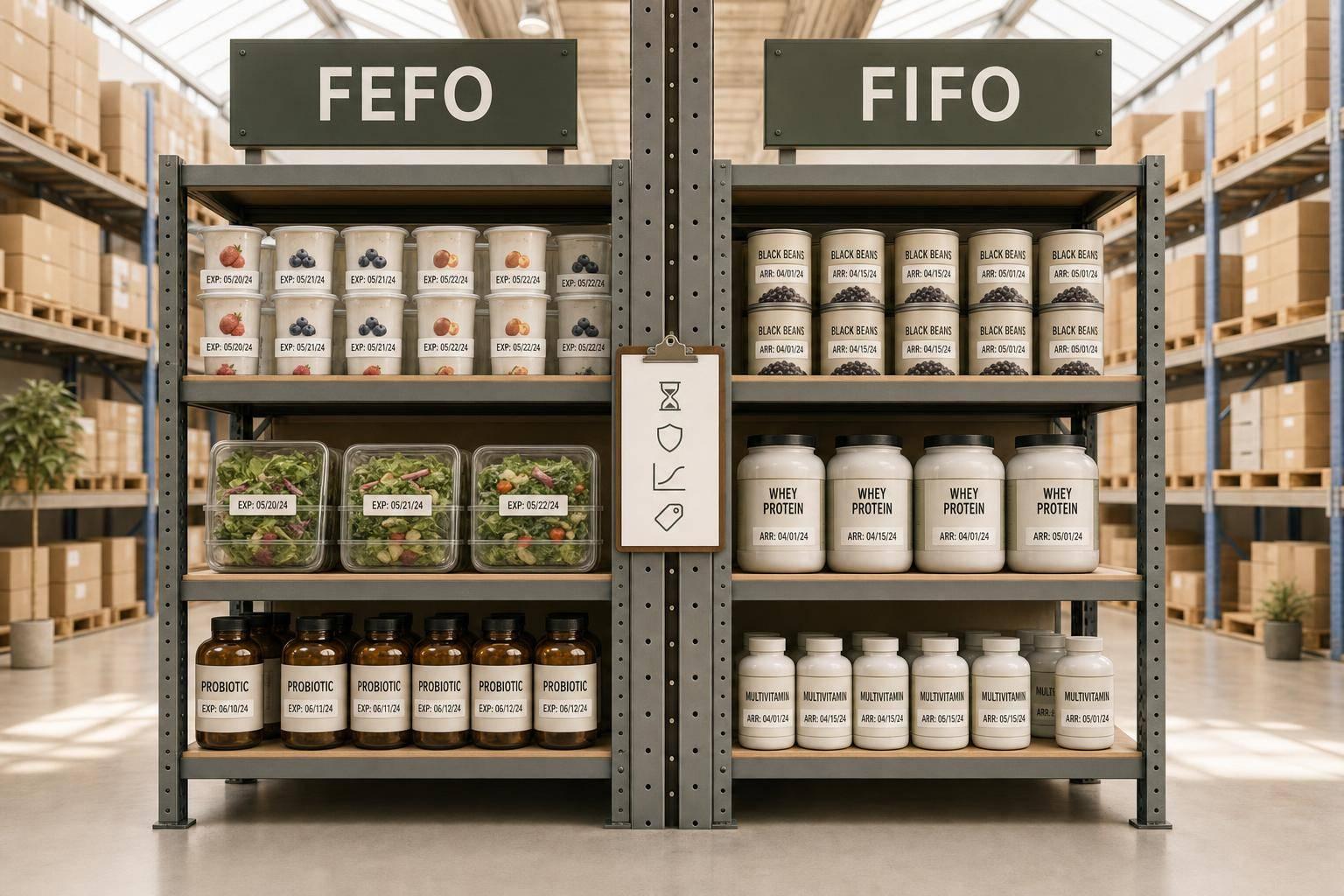
FEFO vs FIFO: Which Should Food and Supplement Brands Use?
If I sell food or supplements, I’d use FEFO for date-sensitive SKUs and FIFO for low-risk items. That’s the short answer.
Here’s the simple rule:
- FIFO = ship the oldest received stock first
- FEFO = ship the soonest-to-expire stock first
- If receipt order and expiry order match, FIFO can work
- If they do not match, FEFO is the safer choice
- For supplements under 21 CFR Part 111, lot records must be kept for at least 1 year past shelf life or 2 years past distribution of the last batch
The issue is not accounting. It’s warehouse flow, spoilage, customer shelf-life expectations, and lot tracking.
A basic example: if I receive one lot today with 4 months left and another lot later with 10 months left, FIFO could still send the older receipt first and leave the shorter-dated lot sitting. FEFO fixes that by moving the lot with the nearest expiry date first.
What this comes down to:
If I have short shelf life, mixed lot dates, more than one warehouse, or sales split across channels, I’d lean toward FEFO. If shelf life is long, dates are steady across lots, and my setup is simple, FIFO may be enough.
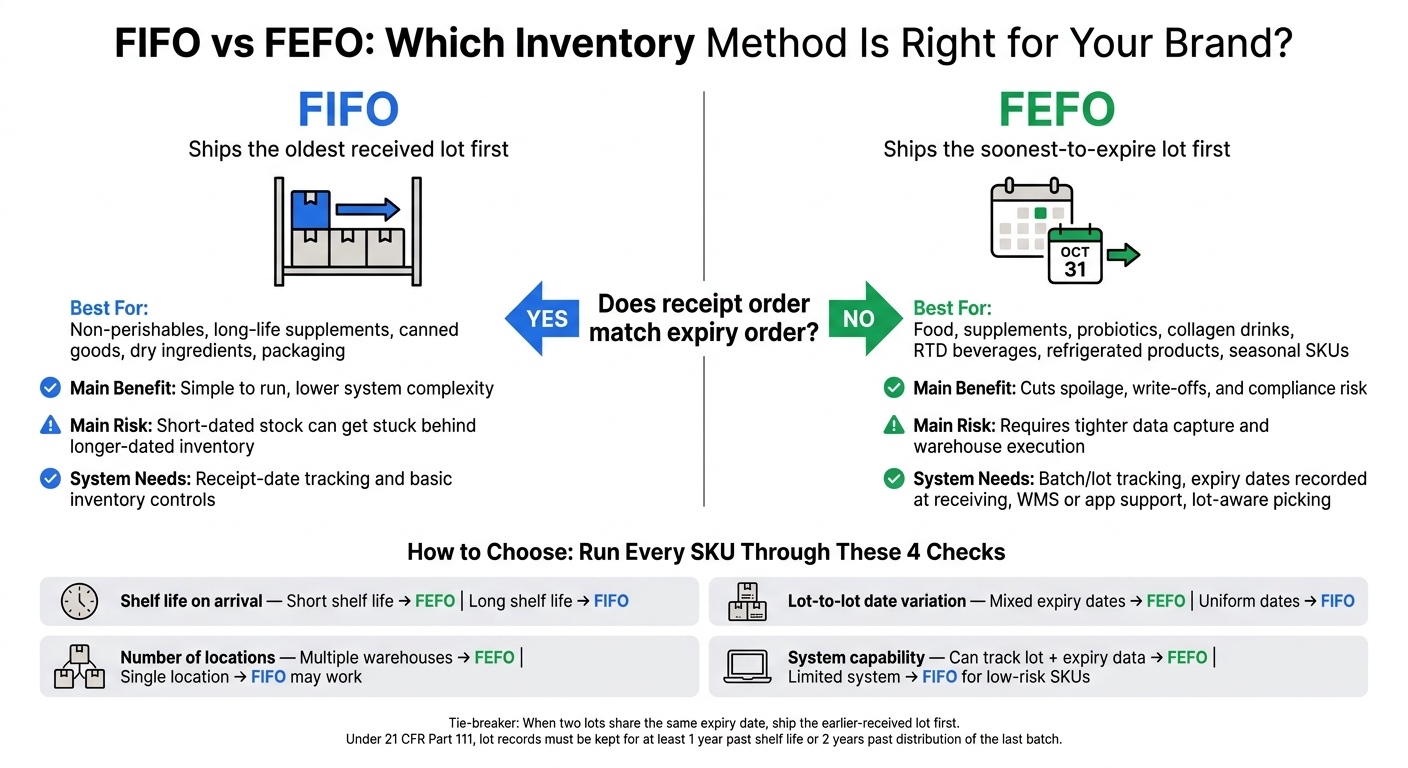
FIFO vs FEFO: Which Inventory Method Is Right for Your Brand?
FIFO vs FEFO: What’s the Difference (For Supplements)?
sbb-itb-f0fc809
Quick Comparison
| Method | What ships first | Best fit | Main upside | Main issue |
|---|---|---|---|---|
| FIFO | Oldest received lot | Long-life, low-risk SKUs | Simple daily flow | Short-dated stock can get stuck |
| FEFO | Soonest-to-expire lot | Food, supplements, drinks, probiotics | Less expiry waste | Needs lot and expiry tracking |
Tie-breaker: if two lots have the same expiry date, I’d ship the earlier-received lot first.
Below, I’d break the choice into the four checks that matter most: shelf life on arrival, lot-to-lot date changes, number of locations, and whether my system can track lot and expiry data at pick time.
How FIFO works and where it fits best
FIFO is simple: the oldest received stock ships first. In a warehouse, that often means putting new cases behind existing inventory so pickers grab from the front by default. It’s easy to teach, easy to follow, and it doesn’t depend on expiry-based picking by lot. For lean teams, that makes FIFO a solid place to start.
FIFO works best when receipt order usually matches expiry order. Put plainly, the oldest receipt should also be the shortest-dated stock.
Best use cases for FIFO
FIFO fits best when receipt order matches expiry order. That’s common with shelf-stable snacks, canned goods, dry ingredients, and long-dated supplements with consistent manufacturer dating across lots.
FIFO advantages and tradeoffs
FIFO is easier to run day to day. Teams only need to track when a shipment arrived, not the exact expiration date on every pallet. That can make receiving faster, picking rules easier, and data-entry mistakes less likely.
The downside shows up when a later shipment arrives with an earlier expiration date than stock already on hand. Under FIFO, the older receipt still ships first. As a result, shorter-dated inventory from the newer shipment can sit in storage and age out. That’s a rotation mismatch.
This gets messy when you track multi-location stock with Shopify or sales channels, where lots may arrive with different remaining shelf life. If your brand gets variable shelf life from suppliers - for example, one lot with 10 months left and a later lot with only 4 months left - FIFO by itself won’t flag the problem. In that case, check expiry dates at receiving when supplier shelf life varies.
When expiry order and receipt order stop lining up, FEFO is the safer method.
How FEFO works and when it is the safer choice
FEFO asks a simple question: which lot expires first? You record the expiry date when inventory is received, then ship the lot with the nearest expiry first, no matter when it arrived.
That matters when receipt order and expiry order don’t match. A newer lot can expire sooner than older stock. If you follow receipt date alone, that newer lot can sit behind longer-dated inventory and expire before it ever ships. FEFO fixes that by moving the shortest-dated stock first.
Best use cases for FEFO
FEFO is the safer pick for products that lose potency, safety, or quality as time passes.
Probiotics are a clear case. CFU counts drop over time, so FEFO helps protect label claims by shipping the shortest-dated lot first. Collagen drinks, ready-to-drink beverages, and refrigerated shots run into the same issue. A later delivery can expire sooner than stock already sitting on the shelf. Seasonal SKUs also do well under FEFO, because short-dated inventory is less likely to get buried behind newer stock.
That’s where FEFO tends to pull its weight most in day-to-day fulfillment.
FEFO advantages and what it requires
The biggest upside is fewer write-offs. When you ship the soonest-to-expire lot first, you cut down on near-expiry stock, protect margin, and reduce discounting.
There’s also the customer side of it. People expect enough shelf life when an order shows up. If short-dated lots keep landing on their doorstep, trust drops and refunds go up.
FEFO also helps with lot-level traceability and recall response for dated products.
The catch is that FEFO needs tight execution. You need expiry dates recorded at receiving for every lot, lot-level inventory records, and picking based on expiry across Shopify inventory locations, warehouses, and sales channels. Without system-directed picking, FEFO can fall apart fast. Near-expiry reporting matters too, so aging stock gets flagged before it turns into a loss.
The next question is how FEFO stacks up against FIFO in a live Shopify operation.
FEFO vs FIFO: side-by-side comparison for Shopify brands

The choice comes down to one practical question: does receipt order match expiration order? If it does, FIFO can work just fine. If it doesn’t, FEFO is usually the safer pick. Here’s how that plays out in daily warehouse work.
| Method | Rotation Rule | Best For | Main Benefit | Main Risk | System Requirements |
|---|---|---|---|---|---|
| FIFO | Ship the oldest received inventory first | Non-perishables, packaging, accessories, long-life SKUs | Simple to run, lower system complexity | Can leave shorter-dated stock behind if shelf life varies by lot | Receipt-date tracking and basic inventory controls |
| FEFO | Ship the soonest-to-expire inventory first | Food, supplements, probiotics, and other date-sensitive products | Cuts spoilage, write-offs, and compliance risk | Needs tighter data capture and warehouse execution | Batch/lot tracking, expiry dates, WMS or app support, lot-aware picking |
FIFO works best when shelf life stays consistent and demand is steady. FEFO is the safer route when customers expect a minimum shelf life at delivery.
What changes with multiple lots, warehouses, or sales channels
Things get trickier once inventory is spread across more than one location. Shopify tracks stock by location, not by lot expiry. So an order can be routed to available inventory in one warehouse while older lots sit untouched somewhere else.
For supplement brands running several active lots at once, that’s often where write-offs start to pile up. FEFO matters even more as locations increase, because each extra stock pool adds another chance for short-dated inventory to get left behind.
When a hybrid approach makes sense
A mixed setup often works best. Use FEFO for ingestibles like supplements, food, beverages, and other date-sensitive products. Use FIFO for packaging, labels, display materials, and accessories where age doesn’t change product quality or compliance.
The tie-breaker is simple: when two lots have the exact same expiration date, ship the earlier-received lot first. That helps the warehouse team keep flow predictable and clear space on the shelf without adding more logic to the system.
Those two rules lead straight into the checklist below.
Decision framework and conclusion
A 4-factor checklist for choosing your method
Use these four checks to turn the comparison above into a policy your team can actually use. Run each SKU or product category through the same four questions.
- How short is the shelf life when the product arrives at your warehouse? If the remaining shelf life is short when you receive it, FEFO is the safer pick. If shelf life is long and demand stays steady, FIFO is often enough.
- Do lots arrive with different expiration dates? If lots come in with different expiry dates, that leans toward FEFO. If expiry dates are almost the same across batches, FIFO carries less risk.
- Are you shipping from one location or several? A single-location setup is easier to manage. Once you add multiple locations, you need shared visibility into expiry dates across the network.
- Can your system track lot and expiry data reliably? If your system can’t track lot and expiry data in a dependable way, use FIFO for low-risk SKUs and save FEFO for the SKUs with the most expiry risk.
The pattern is pretty clear. Short shelf life, mixed lots, multiple locations, and solid system support all point to FEFO. Longer shelf life, uniform batches, simpler fulfillment, and limited system support point to FIFO or a focused hybrid.
Key points to carry into operations
Once you’ve worked through the checklist, the operating rule is simple: FIFO is simpler; FEFO reduces expiry risk. Use FEFO for date-sensitive SKUs, FIFO for low-risk items, and FIFO as the tie-breaker when expiration dates match.
Centralized visibility across SKU, location, and lot data is what turns a policy on paper into day-to-day execution. The method only works if pickers can see the right lot at the right time.
FAQs
How do I know if FEFO is worth the extra effort?
FEFO is worth the extra work when expiration dates have a direct effect on product value, safety, and compliance. If you sell perishable goods with short shelf lives, it can help cut spoilage and reduce write-offs.
It makes the most sense when:
- You manage multiple batches of the same SKU with different expiration dates.
- Expiring stock creates legal or health risks.
- Spoilage costs more than the labor needed for stock rotation.
What systems do I need to run FEFO correctly?
You need a centralized inventory system with batch-level tracking that connects with Shopify and watches lot numbers, expiration dates, and inventory movements in real time.
It should also support:
- standardized SKU data with lot or batch identifiers
- fulfillment rules that prioritize the earliest expiration date
- regular audits and consistent warehouse SOPs to keep records aligned with physical stock
Can I use FEFO for some SKUs and FIFO for others?
Yes. You can use different inventory methods for different SKUs.
Many brands do this in a very practical way. They use FEFO for perishable items with expiration dates to cut spoilage, and FIFO for non-perishable goods to keep stock rotation simple.
A smart way to handle it is to group inventory by product type or sales velocity. That helps keep your system in line with shelf-life needs and day-to-day warehouse work.
Keep reading
Try Forstock free for 14 days.
AI-powered demand forecasting and reorder automation for Shopify brands. No credit card required.