
Stockout Costs: How They Impact Profitability
How stockouts erode profit through lost sales, rush replenishment, and customer churn — and how forecasting and automation can prevent them.
Stockout Costs: How They Impact Profitability
When products are out of stock, businesses lose sales and risk damaging customer relationships. Globally, stockouts cost retailers nearly $1 trillion annually, and 71% of consumers switch brands when their desired product is unavailable. These shortages don’t just cut into revenue - they also increase costs through rush orders, customer churn, and damaged supplier relationships. For example, a Shopify store with $500K in revenue and a 4% stockout rate could lose $20K annually in direct sales alone.
Key takeaways:
- Lost Sales: Missed revenue and wasted customer acquisition costs.
- Higher Expenses: Emergency restocking can cost 3–10x more than planned shipping.
- Customer Loss: Up to 40% of customers who switch during a stockout never return.
- Long-Term Impact: Stockouts hurt brand reputation, reduce customer lifetime value, and disrupt cash flow.
Avoiding stockouts requires better inventory management. Tools like Forstock use AI to forecast demand, automate orders, and track inventory in real time, helping businesses prevent costly shortages.
How to Quantifying Stockout Cost Webinar
sbb-itb-f0fc809
Direct Financial Costs of Stockouts
When a product is unavailable, the financial impact is felt in two key ways: lost sales and the extra expenses required to address the shortage. These immediate costs hit your bottom line directly.
Lost Sales and Missed Profits
The most obvious cost of a stockout is the lost revenue and profit margin. If a customer is ready to buy but the product isn't there, you miss out on both. For instance, if 10 customers intended to purchase an item with a $100 profit margin per unit, that’s $1,000 in lost profit right there.
There’s also the wasted Customer Acquisition Cost (CAC) to consider. Businesses typically spend $10 to $50 per customer to drive sales. When a stockout occurs, that investment goes down the drain. And since nearly half of customers abandon their purchase when their desired item is unavailable, even a small stockout rate can snowball into hefty revenue losses.
These losses don’t just stop at margins - they’re compounded by the extra costs of scrambling to fix the problem.
Higher Costs from Rush Orders
Running out of stock often forces businesses to take urgent action to restock inventory. Expedited shipping, for example, can cost anywhere from three to ten times the usual freight rate. A $5,000 ocean freight shipment could balloon into a $25,000 air freight emergency.
"A $5,000 ocean freight shipment becomes a $25,000 air freight emergency." - Planster Team
But that’s not all. Emergency supplier fees, overtime wages for workers, and additional administrative expenses also pile up. For brands working with major retailers, failing to meet fill-rate requirements can result in penalties ranging from $50 to $500 per incident.
These urgent, unplanned expenses don’t just eat into profits - they also pull resources away from long-term growth efforts.
Long-Term Profitability Risks of Stockouts
Stockouts don’t just hurt immediate sales - they create ripple effects that can multiply losses by 2-5x over time. The fallout extends beyond lost revenue, impacting customer loyalty, supplier trust, and overall financial health.
Customer Loss and Reduced Lifetime Value
Stockouts can permanently fracture customer relationships. Only 13% of customers are willing to wait for an item to be restocked. The majority? They simply move on to competitors. In fact, 20-40% of customers who switch during a stockout never return. That’s a serious blow when you consider that acquiring a new customer costs 5-25x more than retaining an existing one.
And it doesn’t stop there. Customers who encounter stockouts are 60% more likely to leave negative reviews or vent their frustrations on social media. These public complaints can tarnish a brand’s reputation, making it harder to win back trust.
"When thinking about stockouts, it's not just inventory you're managing. It's trust." – Prediko
While losing customers is painful, unreliable inventory also disrupts relationships with suppliers, creating additional challenges for long-term profitability.
Damaged Supplier and Wholesale Relationships
Consistent stockouts can wreak havoc on supplier relationships. Erratic ordering patterns make it harder for suppliers to plan, causing tension and reducing trust. For wholesale businesses, the stakes are even higher. Missing a single purchase order (PO) can prompt a retailer to reassign shelf space to a competitor or drop your brand from their supply plans altogether.
"If you're supplying stores, missing even one PO can cause a retailer to move on. If they've allocated shelf space to you and the shipment is short, it's not just a fine, you lose future space." – Bani Kaur, Content Marketing Specialist, Prediko
Once a brand is seen as unreliable, it may be downgraded to a "backup" supplier. This shift makes it harder to pitch new products or negotiate better placement. In extreme cases, brands risk being delisted entirely, cutting off a critical revenue stream.
Opportunity Costs and Restricted Cash Flow
Stockouts don’t just cost sales - they limit opportunities for growth. Erratic ordering patterns tie up working capital, forcing businesses into a cycle of reactive management rather than proactive investment. For e-commerce brands, the consequences can be particularly harsh. On platforms like Amazon, stockouts can hurt your Best Seller Rank and search visibility, with recovery taking weeks or even months.
The kicker? The revenue lost during recovery often far exceeds the initial losses from the stockout itself, creating a long-term drag on profitability.
How to Calculate and Track Stockout Costs
The True Cost of Stockouts: Financial Impact Breakdown
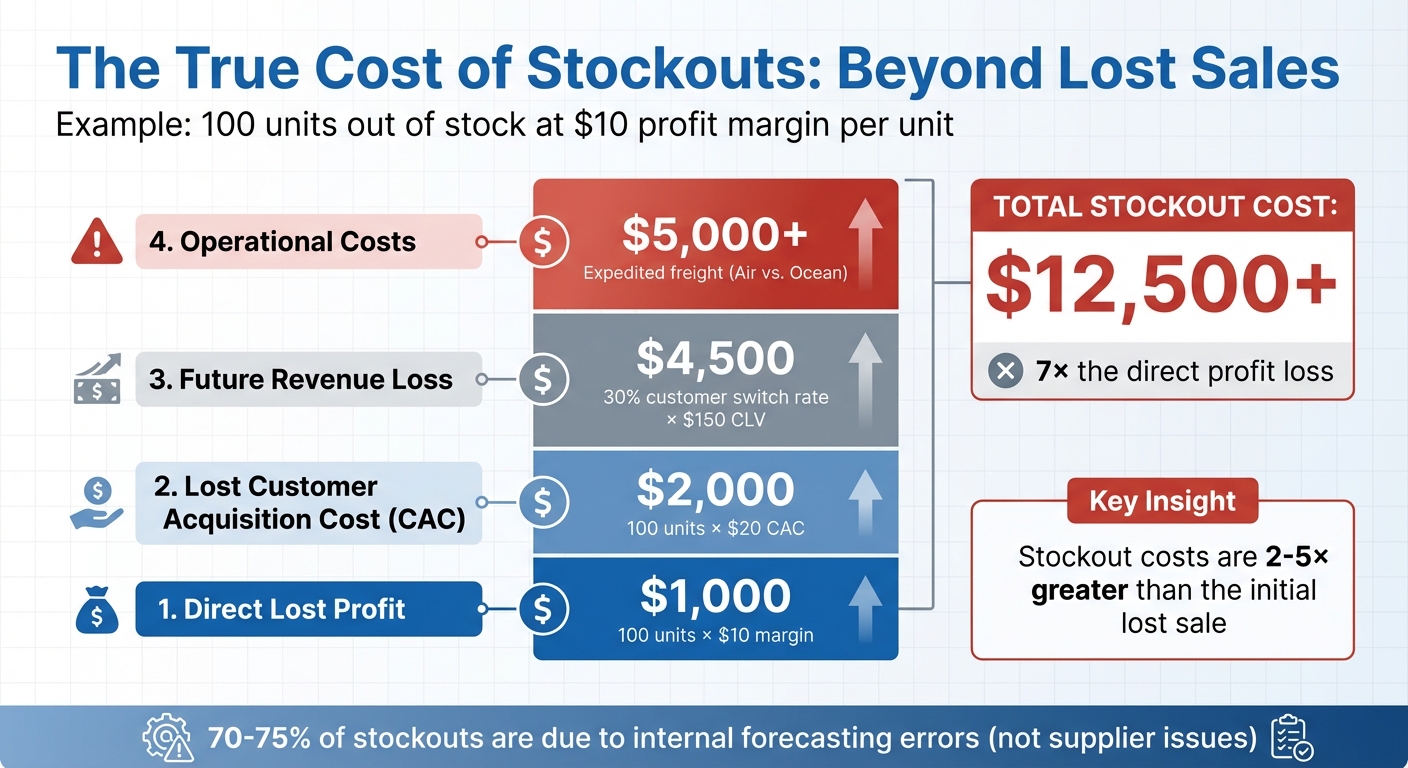
Stockout costs can be 2–5 times greater than the revenue lost from a single sale, once you factor in customer acquisition expenses, reduced lifetime customer value, and operational costs. Let’s break down how to calculate these costs and keep tabs on inventory performance to stay ahead.
Calculating Stockout Costs
The basic formula is:
(Days Out of Stock × Average Daily Units Sold × Price Per Unit).
Here’s an example: Imagine being out of stock for 5 days, selling 20 units daily at $50 each. That’s $5,000 in lost revenue. But it doesn’t stop there. Add $20–40 in customer acquisition costs for each lost sale and consider the lifetime value (CLV) of customers who switch to competitors - estimated at $150–300 per customer, with 20–40% of customers likely to make that switch. Don’t forget expedited freight costs for replenishing inventory. In this case, a $5,000 revenue loss could balloon to $15,000–$35,000.
While calculating these costs is crucial, tracking inventory metrics provides the insights needed to prevent future losses.
Using Metrics to Monitor Inventory Performance
Once you know your stockout costs, the next step is monitoring inventory metrics. Start with your in-stock rate, which measures the percentage of demand met by available inventory. Unlike the fill rate, this includes potential customers who never place an order after seeing an out-of-stock notice. Top retailers aim for an in-stock rate of 95–97% for their best-selling items, keeping their overall stockout rate below 3%.
Another key metric is the inventory turnover ratio, which reflects how often you sell and replace stock. A healthy range is 5–10 turnovers per year. Additionally, calculate your spill rate, the percentage of sales lost due to stockouts. For instance, if a product generates $500 daily when in stock but only $250 when out of stock, the spill rate is 50%.
Breaking Down Stockout Costs
Breaking stockout costs into categories can help pinpoint where the biggest losses occur. Let’s look at an example where 100 units are lost, each with a $10 profit margin:
| Cost Category | Calculation Method | Example Impact |
|---|---|---|
| Direct Lost Profit | Lost Units × Profit Margin per Unit | $1,000 (100 units × $10 margin) |
| Lost CAC | Lost Units × Customer Acquisition Cost | $2,000 (100 units × $20 CAC) |
| Future Revenue Loss | Lost Units × Substitution Rate × CLV | $4,500 (30% switch × $150 CLV) |
| Operational Costs | Expedited Freight + Rush Production | $5,000+ (Air vs. Ocean freight) |
| Total Stockout Cost | Sum of Direct and Indirect Costs | $12,500+ (7× direct profit) |
This breakdown highlights how internal issues, like poor ordering practices, can significantly drive up costs. In fact, 70–75% of stockouts are due to internal forecasting and ordering errors, not supplier problems. That’s good news - it means many of these losses are avoidable.
To tackle this, focus on better demand forecasting and inventory management. Capture daily inventory data to calculate spill rates and use ABC analysis to prioritize the top 20% of SKUs that drive the most revenue. These steps can go a long way in cutting down stockout costs.
How to Reduce Stockout Costs with Forstock
Forstock helps Shopify brands avoid costly stockouts by using AI-powered forecasting, automated ordering, and real-time inventory tracking to keep stock levels in sync with actual demand.
AI-Powered Demand Forecasting
Forstock’s demand forecasting uses real-time data - like sales trends from the past 4 to 8 weeks, marketing campaigns, and pre-order activity - to translate revenue goals into precise unit-level forecasts. It also accounts for seasonal patterns, regional differences, and market shifts. The system calculates reorder points automatically by analyzing current sell-through rates, supplier lead times, and "cover days", flagging SKUs that are at risk of running out. All this data is centralized into a single dashboard that integrates Shopify, warehouses, and 3PLs. This level of precision sets the stage for streamlined, automated ordering.
Automated Purchase Orders and Safety Stock Recommendations
Stockouts often stem from flawed internal ordering processes. Forstock addresses this by comparing inventory days to supplier lead times. For example, if a product has 28 days of stock but the supplier needs 45 days to deliver, the system flags it immediately. From there, you can generate purchase orders with a single click - complete with pre-filled supplier details, quantities, and delivery timelines based on real-time sell-through rates and forecasts.
The platform also suggests dynamic safety stock levels to protect against unexpected demand surges or supplier delays. This ensures you maintain availability without tying up cash in excess inventory. By basing reordering on live demand rather than fixed schedules, Forstock keeps your capital working efficiently while ensuring popular items remain in stock and profitable.
Real-Time Inventory Dashboards and Supplier Management
Forstock’s real-time dashboards pull together data from all your channels, making it easy to manage inventory across locations. You can track supplier performance - like delivery accuracy, lead times, and shipment issues - and adjust reorder points as needed. The platform also syncs Shopify stock levels with actual inventory, reducing the risk of overselling or canceling orders.
If one location has excess inventory while another faces a shortage, Forstock enables internal transfers, which are often quicker and cheaper than waiting for supplier restocks. You can also monitor purchase order statuses, ETAs, and inbound stock locations in real time, allowing you to spot delays early and reallocate inventory to avoid stockouts. This proactive approach helps protect your bottom line and keeps your operations running smoothly.
Conclusion
Stockouts can cost businesses 2–5 times the value of the lost sale. Beyond the immediate revenue hit, they also bring higher replenishment costs and erode customer loyalty over time. With 71% of consumers switching brands when they can’t find what they need and 32% abandoning a brand they love after just one bad experience, the risks to long-term profitability are impossible to overlook.
This highlights the importance of a solid inventory strategy. Stockouts aren’t inevitable - they can be avoided with smarter inventory management. Tools like AI-powered forecasting and lead time adjustments, automated reorder points, and real-time monitoring across all sales channels can safeguard both your cash flow and customer trust. Forstock helps Shopify merchants stay ahead by tracking demand in real time, identifying at-risk SKUs before they sell out, and generating purchase orders based on actual sell-through data.
FAQs
What are the best ways to prevent stockouts and protect profitability?
To avoid stockouts and keep profits steady, businesses should prioritize precise demand forecasting and real-time inventory monitoring. These methods help anticipate customer needs and allow for proactive stock adjustments. Using AI-driven inventory management tools can make tasks like demand planning, automated reordering, and supplier coordination much smoother.
Clear communication with suppliers is also key. Sharing supply chain data across different locations ensures timely restocking and minimizes the chances of running out of stock. By implementing these practices, companies can better handle demand shifts, prevent missed sales, and maintain healthy cash flow and profitability.
How do stockouts affect customer loyalty over time?
Stockouts can seriously harm both customer loyalty and your brand's reputation. When shoppers encounter empty shelves or unavailable products repeatedly, they often turn to competitors. In fact, research shows that a large percentage of customers switch brands after experiencing stockouts - and many don’t come back. This can lead to long-term losses in customer retention.
But it’s not just about losing sales. Stockouts can erode trust and leave a lasting negative impression. Frequent unavailability can make customers perceive your business as unreliable or poorly managed, which impacts satisfaction and reduces the likelihood of repeat purchases.
To avoid these pitfalls, solid inventory management and accurate demand forecasting are key. Tools like Forstock can help reduce stockouts, retain customers, and safeguard your brand's reputation.
How do stockouts affect your supplier relationships and operational expenses?
Stockouts can put a serious strain on supplier relationships and drive up operational costs. When businesses need to place urgent replenishment requests or reorder frequently, it can disrupt a supplier's workflow. This often translates to higher procurement costs or even delays. On top of that, businesses may face extra expenses for expedited shipping to restock quickly.
The impact doesn't stop there. Stockouts lead to more than just lost sales - they can push customers toward competitors, damaging loyalty. Over time, this means spending more on customer acquisition to replace those lost. Efforts to manage the fallout, like offering backorders or discounts to keep customers happy, can create inefficiencies and chip away at profitability. Tools like Forstock offer a way to avoid these challenges by using demand forecasting and automation to maintain the right inventory levels, saving both time and money.
Keep reading
Try Forstock free for 14 days.
AI-powered demand forecasting and reorder automation for Shopify brands. No credit card required.