
Top 5 Profitability Levers in Inventory Management
Five inventory levers—prevent stockouts, cut overstock, forecast demand, boost turnover, and streamline purchase orders—to improve cash flow and profits.
Top 5 Profitability Levers in Inventory Management
Inventory management directly impacts your business's profits. Poor practices lead to stockouts, overstock, wasted cash, and unhappy customers. But optimizing key areas can turn inventory into a revenue driver. Here’s how:
- Prevent Stockouts: Avoid lost sales and costly expedited shipping by maintaining safety stock and using automated reordering systems.
- Reduce Overstock: Free up cash by cutting excess inventory, lowering storage costs, and preventing product obsolescence.
- Accurate Demand Forecasting: Use data-driven predictions to align stock levels with actual demand, reducing errors and saving money.
- Optimize Inventory Turnover: Improve cash flow by selling inventory faster, minimizing carrying costs, and eliminating slow-moving items.
- Streamline Purchase Orders: Automate processes to reduce errors, negotiate better terms with suppliers, and improve cash flow.
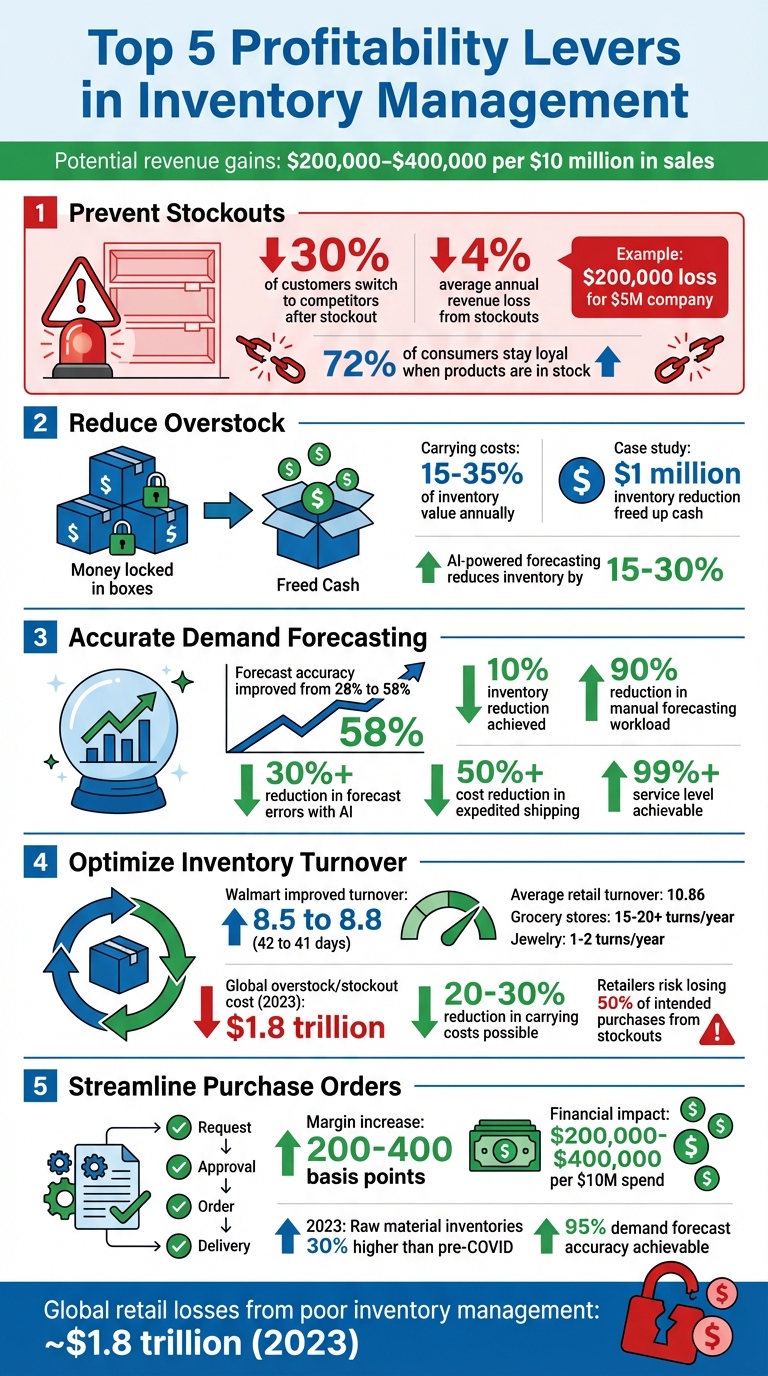
Together, these strategies improve cash flow, cut waste, and keep customers satisfied. Businesses that implement them can see revenue gains of $200,000 to $400,000 per $10 million in sales.
5 Inventory Management Levers That Drive Profitability
Inventory Analysis Defined: Boost Profitability with Key Metrics
1. Preventing Stockouts
Preventing stockouts plays a key role in maintaining profitability and smooth operations in inventory management. When inventory runs out, businesses face lost sales and disrupted cash flow. To make matters worse, they often have to rely on costly expedited shipping and emergency orders, which eat into profits and drive up holding costs. Over time, these disruptions lead to unhappy customers and increased operational expenses.
Keeping Customers Happy
Stockouts don't just hurt your bottom line - they can also damage customer relationships. Research shows that 30% of customers will switch to a competitor the moment they experience a stockout. Even worse, a single bad review can discourage 22% of potential customers from buying from you. On the flip side, 72% of consumers are more likely to stay loyal to brands that consistently have products in stock. Simply put, stockouts can quickly undo the trust and loyalty you've worked so hard to build.
Financial Impacts of Stockouts
The financial losses from stockouts extend well beyond missed sales. On average, businesses lose about 4% of their annual revenue due to stockouts. For a company making $5 million a year, that's a $200,000 hit. And that's before factoring in the added costs of expedited shipping. For example, switching from sea freight to air freight can increase logistics expenses by 30% or more. These numbers highlight the importance of proactive inventory management to avoid these costly inefficiencies.
Avoiding Operational Disruptions
One example of effective planning comes from a consumer goods company that, in late 2014, anticipated a labor strike at the Long Beach port. By using demand forecasting and placing orders early, they extended lead times and avoided the stockouts that plagued their competitors. As a result, they captured record sales during the two crucial weekends before Christmas, while their competitors’ products were stuck at the port.
The key to preventing stockouts lies in strategies like calculating safety stock with the formula: (Maximum Daily Sales × Maximum Lead Time) - (Average Daily Sales × Average Lead Time). Pair that with AI-powered forecasting and automated reordering, and you can take the guesswork out of inventory management. These steps not only cut emergency costs but also ensure your shelves stay stocked and your customers stay happy.
2. Reducing Overstock
While stockouts can hurt your revenue, holding onto too much inventory can drain your profits. Excess stock ties up cash that could be used for growing your business. This creates financial strain, leading to cash flow challenges and hidden expenses that can go unnoticed.
Impact on Cash Flow
When money is locked up in unsold products, it limits your ability to grow. That cash could be used for expansion, paying down debt, or boosting your marketing efforts. Becky Wilkinson, a Supply Chain Manager, shared an example where her company cut its total inventory value by $1 million after adopting predictive supply chain planning. This move improved cash flow and freed up funds for strategic investments.
Cost-Saving Potential
Overstocking doesn’t just tie up your money - it also piles on extra costs. You’ll face higher expenses for warehousing, utilities, insurance, security, and labor. And if products sit around for more than a year, especially in fast-moving sectors like electronics or fashion, they risk becoming outdated. This often leads to steep discounts or even write-offs.
One way to combat this is by using ABC Analysis to pinpoint slow-moving "C-items" that drain resources. Pair that with negotiating smaller minimum order quantities with suppliers and leveraging automated forecasting tools to better match your orders with actual demand. By fine-tuning your inventory, you can lower costs, free up cash, and make room for the products that truly meet customer needs.
3. Accurate Demand Forecasting
Getting demand forecasting right is key to avoiding stockouts and overstock situations, ensuring smooth operations and keeping your cash flow healthy. Here's how accurate forecasting makes a difference.
Impact on Cash Flow
When your forecasts are on point, your money stays in your business instead of sitting idle in excess inventory. By ordering based on reliable predictions, you avoid tying up capital on products gathering dust in the warehouse. Considering that carrying costs can eat up 15% to 35% of your inventory value annually, even small improvements in forecasting can significantly boost your cash flow. Businesses leveraging AI-powered forecasting often see inventory levels drop by 15–30%. This freed-up capital can then be redirected toward growth-focused initiatives, like launching new marketing campaigns or developing fresh products. Beyond the financial benefits, improved forecasting also eliminates many operational headaches.
Reduction of Inefficiencies
Relying on manual forecasting not only takes up valuable time but also opens the door to costly errors. Automating the process can reduce the workload by as much as 90%, allowing your team to focus on strategic priorities. For example, a North American consumer products company increased its forecasting accuracy from 28% to 58%, which led to a 10% drop in inventory levels while improving service levels. Better forecasting also tackles "Optimism Bias", helping businesses avoid over-ordering based on wishful thinking instead of hard data.
Customer Satisfaction Improvement
Stockouts can send 69% of shoppers straight to your competitors, but when products are consistently available, 72% of customers remain loyal. Advanced probabilistic forecasting can help businesses achieve service levels above 99%, turning inventory management into a competitive edge. Reliable stock availability builds customer trust and encourages repeat purchases, keeping your business ahead of the competition.
Cost-Saving Potential
AI-driven demand planning doesn't just cut forecast errors and lost sales by over 30%; it also reduces costs tied to expedited shipping and overtime by more than 50%. Abby Jenkins, Product Marketing Manager at NetSuite, emphasizes the importance of accurate forecasting in today’s volatile market:
"An accurate inventory forecast is invaluable, especially in times when supply chains and consumer demand are changing rapidly".
With precise forecasting, you can negotiate better deals with suppliers, optimize order quantities, and cut down on waste from obsolete or spoiled inventory. These savings add up, creating a more efficient and profitable operation.
sbb-itb-f0fc809
4. Optimizing Inventory Turnover
Inventory turnover measures how often you sell and replace your stock within a specific timeframe, typically a year. The faster you move inventory, the less cash sits idle on warehouse shelves - and idle inventory doesn’t generate revenue.
Impact on Cash Flow
Improving inventory turnover speeds up the cash conversion cycle by turning stock into cash more quickly. Efficient turnover prevents working capital from being tied up in products gathering dust on the shelves. For example, a business turning inventory four times a year ties up capital for about 91 days. Boosting that to six turns reduces the time to just 61 days. That freed-up capital can go toward growth opportunities, marketing efforts, or launching new products instead of sitting in excess stock. This quicker cash flow cycle can lead to further operational improvements.
Take Walmart Inc., for example. Between 2022 and 2024, the company increased its inventory turnover ratio from 8.5 to 8.8. This small but meaningful improvement reduced the time inventory sat on shelves from 42 days to 41 days, enabling stronger sales growth and better use of assets. For context, the average inventory turnover for retailers is 10.86, though this varies by industry. Grocery stores often achieve 15–20+ turns annually, while jewelry retailers might only manage 1–2 turns per year.
Reduction of Inefficiencies
Higher inventory turnover doesn’t just free up cash - it also cuts annual carrying costs, which include expenses like storage, insurance, taxes, and utilities, by up to 20%–30%. Lower inventory levels also reduce shrinkage, such as losses from theft, damage, or unexplained discrepancies, which typically consume 1%–3% of inventory value each year.
Automation and better data tracking play a big role in improving turnover. They reduce the need for manual inventory checks and minimize costly errors in data entry. Additionally, these tools help identify and eliminate "zombie SKUs" - slow-moving products that take up space and tie up capital without generating enough sales. In 2023, the global cost of overstocks and stockouts was estimated at nearly $1.8 trillion, highlighting the financial impact of inefficient inventory management. By addressing these inefficiencies, businesses not only cut costs but also improve their overall operations, which leads directly to better customer experiences.
Customer Satisfaction Improvement
Optimizing inventory turnover strikes a balance between fast sales and maintaining adequate stock levels, reducing the risks of stockouts and overstocking. High turnover ensures products reach customers faster, which is critical for items like perishables, fashion, and electronics, where freshness and trends matter. Consistent availability builds a reputation for reliability, fostering long-term customer loyalty.
Research shows that poor inventory management can lead to significant losses. Retailers risk losing nearly 50% of intended purchases when customers encounter stockouts. For a billion-dollar retailer, this could mean $40 million in lost sales annually. By maintaining optimal turnover, businesses keep popular items in stock, minimizing wait times and backorders that frustrate customers. This reliability strengthens customer trust and loyalty.
Cost-Saving Potential
Beyond cutting carrying costs, better turnover management can help businesses negotiate better terms with suppliers. By ordering smaller quantities more frequently, following Just-in-Time (JIT) principles, companies can reduce storage needs and related expenses. Property insurance for inventory, which typically costs 1%–2% of its value annually, also decreases with lower stock levels. Plus, efficient turnover reduces the risk of losses from products that lose value due to obsolescence or expiration.
"Inventory turnover ratio is one of the most important efficiency ratios, as it indicates how effectively companies utilize their assets to generate revenue." – Investopedia
Tools like ABC Analysis can help businesses prioritize high-value, fast-moving products, known as "A-items", which often make up the majority of inventory investment. Regular SKU rationalization also identifies underperforming products that aren’t worth their storage and capital costs. When combined with automated reorder points and real-time tracking, these strategies turn inventory management into a profit-driving operation rather than a cost burden.
5. Streamlining Purchase Orders
Outdated, manual purchase order systems can seriously harm profitability. These traditional methods often leave teams bogged down with time-consuming vendor follow-ups, error reconciliation, and preventable issues caused by fragmented communication with suppliers. By automating purchase order processes, businesses can align their purchasing operations with the efficiency of their forecasting and inventory systems. This not only improves cash flow but also minimizes operational delays, making the entire supply chain more seamless.
Reduction of Inefficiencies
Manual purchasing systems are a breeding ground for inefficiencies. Disconnected tools and email-based communication can lead to duplicated orders and inaccurate data. Regularly reviewing open purchase orders helps planners focus on ordering only what’s necessary, preventing surplus inventory and freeing up capital. A striking example: in 2023, raw material inventories for major companies were still 30% higher than pre-COVID levels, underscoring how poor order management can tie up valuable resources.
Cost-Saving Potential
The costs associated with ordering - administrative tasks, shipping, and receiving - can add up quickly. A tried-and-true method for cutting these expenses is the Economic Order Quantity (EOQ) formula, which calculates the ideal order size to minimize inventory costs: square root of [(2 x demand x ordering costs) ÷ carrying costs]. Businesses can also save by bundling orders or negotiating bulk purchase agreements, which lower per-unit costs and provide price stability. Partnering with reliable vendors and consolidating spending not only reduces administrative burdens but often results in better payment terms.
"The goal should be to reduce the amount of time between when you must pay for the inventory and when you get paid for it."
– David Guyaux, CFO, Preferred CFO
These strategies directly improve cash flow by narrowing the gap between expenses and revenue.
Impact on Cash Flow
Streamlined purchase orders are a game-changer for cash flow. Negotiating favorable vendor terms helps reduce the time between paying for inventory and receiving customer payments. Extending accounts payable periods allows businesses to hold onto cash longer, making it available for reinvestment. Improved purchase order efficiency can increase margins by 200–400 basis points - equivalent to $200,000 to $400,000 per $10 million in spend. Additionally, dynamic reorder points, which adjust based on real-time sales trends, seasonality, and supplier lead times, replace outdated static thresholds, keeping inventory levels more responsive to changing demands.
Customer Satisfaction Improvement
Efficient purchase order management doesn’t just benefit the bottom line - it also keeps customers happy. Avoiding stockouts by consolidating vendors and securing long-term contracts ensures a stable supply chain. For example, in 2014, a consumer goods company used a demand planning engine to monitor labor conditions at the Long Beach port. Anticipating a strike, they extended lead times and accelerated orders, ensuring they were well-stocked for the Christmas season. This proactive approach led to record sales during a critical period.
Streamlining purchase orders, therefore, not only drives operational efficiency but also strengthens customer trust and loyalty.
How Forstock Addresses These Profit Drivers
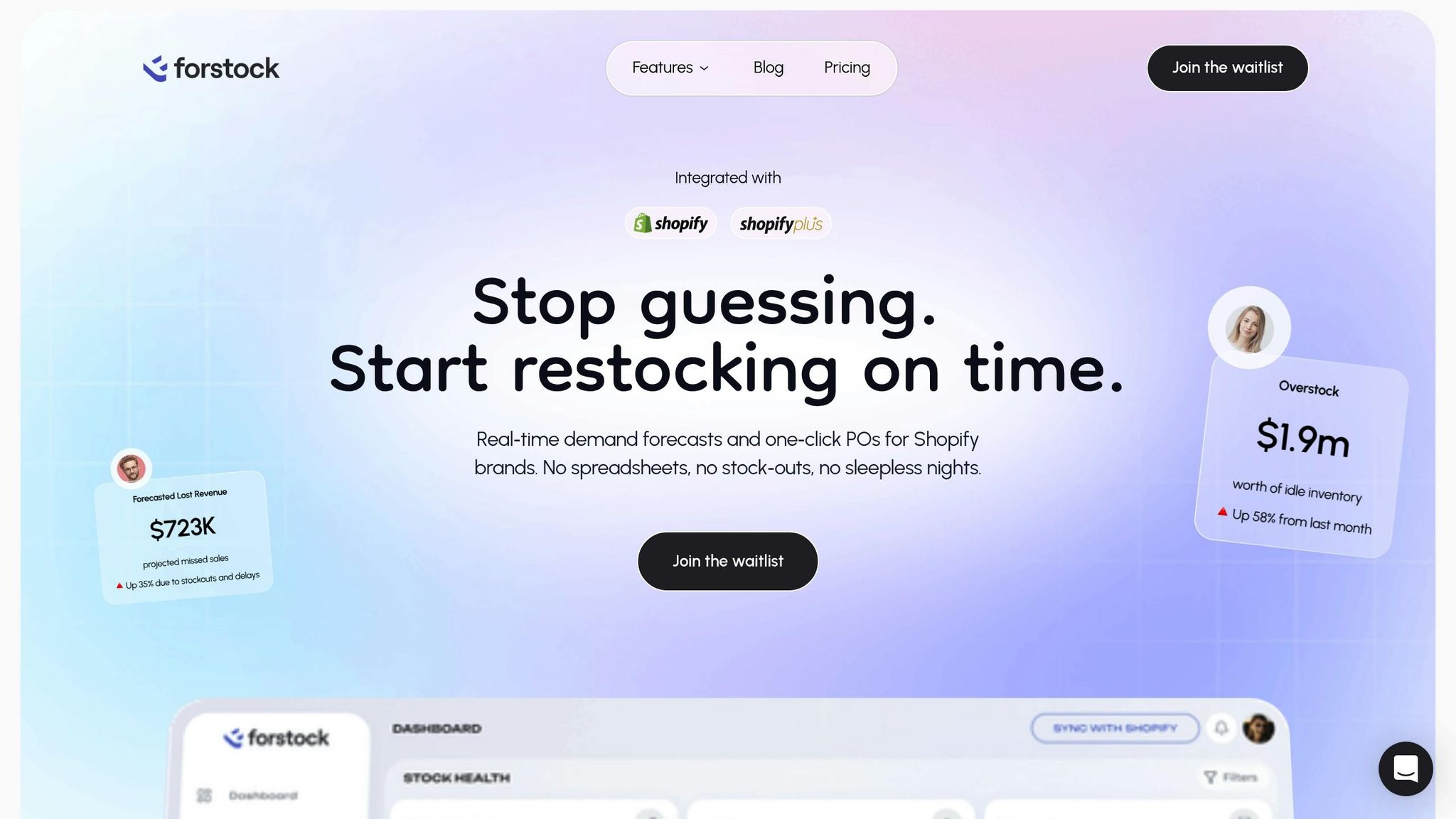
Forstock takes these profit-driving strategies to the next level by offering Shopify brands tools like real-time demand forecasting, automated purchase order creation, and inventory analytics. By analyzing historical sales data, seasonal trends, and demand patterns, the system predicts future demand with an impressive 95% accuracy. This means you’re far less likely to deal with stockouts or overstock - issues that cost retailers a staggering $1.8 trillion globally in 2023.
The platform’s automated replenishment system steps in when stock levels hit pre-set reorder points, automatically generating purchase orders so you can avoid running out of products. It also uses dynamic safety stock calculations to account for changes in demand and supplier reliability, keeping your inventory lean but effective.
"Inventory forecasting... ensures businesses have enough product to fulfill customer orders while not tying up cash in unnecessary inventory".
Abby Jenkins, Product Marketing Manager at NetSuite, highlights how Forstock’s centralized dashboard provides a bird’s-eye view of inventory across multiple locations and sales channels. This prevents duplicate orders and ensures stock is allocated where it’s needed most. On top of that, Forstock’s analytics engine identifies slow-moving items that could be tying up capital. With this insight, you can run promotions or adjust future orders to free up cash flow and make better use of warehouse space.
Forstock also helps businesses maintain an ideal inventory turnover ratio, which typically ranges between 5 and 10 for most retail industries. By continuously monitoring your inventory, the platform ensures you stay within this range, keeping your operations efficient and profitable.
In short, Forstock transforms inventory management into a strategic advantage, aligning every step of the process with the profit-driving strategies discussed earlier. It’s not just about keeping shelves stocked - it’s about turning inventory into a powerful tool for growth.
Conclusion
The five key levers we’ve discussed - preventing stockouts, reducing overstock, accurate demand forecasting, optimizing inventory turnover, and streamlining purchase orders - work together to reshape inventory management. Instead of being a cost burden, inventory can become a powerful asset. When managed effectively, it balances supply and demand, cuts down on storage expenses, reduces waste, and avoids obsolescence. The result? Improved cash flow, stronger customer loyalty, and the agility to adapt in a competitive market.
Every year, retailers across the globe lose close to $1 trillion due to stockouts and overstock issues. In the U.S., for every $1.00 in sales, retailers typically hold $1.40 in inventory, with 20% to 30% of that value eaten up by carrying costs. These figures highlight just how critical it is to get inventory management right - it’s the difference between a liability and a business growth engine.
"Inventory optimization isn't a one-time fix - it requires continuous monitoring, adaptation, and improvement." - Salesforce Commerce Cloud
This is where Forstock steps in to support Shopify merchants. By using data-driven insights, automating replenishment processes, and providing real-time inventory visibility, Forstock turns inventory management into a competitive advantage. Merchants can free up cash flow, save countless hours, and focus on scaling their businesses - without the headache of manual oversight.
Whether you’re managing a small selection of SKUs or a complex, multi-variant inventory, getting these five levers right is critical for driving long-term growth and profitability.
FAQs
How can businesses maintain the right inventory levels to avoid stockouts and overstock?
To keep inventory levels balanced and avoid the pitfalls of running out of stock or over-ordering, businesses should prioritize demand forecasting and safety stock management. Demand forecasting relies on historical sales data, seasonal patterns, and promotional schedules to estimate future needs. This approach helps align inventory with customer demand, reducing the chances of missed sales or dissatisfied customers.
On the other hand, safety stock management serves as a cushion against unexpected demand surges or supply chain hiccups. By examining lead times and past ordering patterns, businesses can determine the right amount of safety stock to maintain. This ensures they’re prepared for surprises without over-investing in inventory. Using real-time inventory management tools - such as those offered by Forstock - makes it easier to adapt stock levels to current sales trends and supply chain updates, striking a balance that supports both customer satisfaction and profitability.
How does accurate demand forecasting help improve cash flow?
Accurate demand forecasting plays a key role in managing cash flow effectively. By predicting future sales using historical data, seasonal patterns, and market insights, businesses can strike the right balance with their inventory. This means avoiding the pitfalls of overstocking, which ties up cash unnecessarily, and stockouts, which can lead to missed sales opportunities.
When forecasting is on point, companies are better equipped to plan for promotions, handle seasonal demand spikes, and adapt to market shifts. This approach not only reduces waste and cuts unnecessary expenses but also allows businesses to allocate cash toward other critical areas like expansion or operational improvements. The result? A leaner, more efficient operation that supports profitability and strengthens financial health.
How does automating purchase orders improve inventory management?
Automating purchase orders brings a host of benefits to inventory management. It reduces manual errors, saves valuable time, and ensures that stock replenishment is both accurate and timely. With automation in place, businesses can sync their stock levels in real time, making it easier to base order quantities and timing on reliable data.
This method helps avoid the headaches of overstocking or running out of stock, simplifies coordination with suppliers, and keeps inventory aligned with what customers actually need. Plus, by cutting out repetitive tasks, automation allows teams to redirect their energy toward growth initiatives and improving overall operations.
Keep reading
Try Forstock free for 14 days.
AI-powered demand forecasting and reorder automation for Shopify brands. No credit card required.