
Aligning Purchase Orders with Cash Flow
Align purchase orders with cash flow using demand forecasts, 13-week rolling projections, dynamic reorder points, and supplier terms to cut excess inventory.
Aligning Purchase Orders with Cash Flow
Running a Shopify store? Cash flow management is just as important as profitability. Missteps in inventory ordering can tie up cash, cause stockouts, or disrupt operations. Here’s how to align purchase orders with your cash flow:
- Balance Inventory and Cash Flow: Avoid overstock vs. stockouts by using sales data and cash flow projections.
- Forecast Demand: Use past sales trends, seasonal patterns, and AI tools to predict inventory needs accurately.
- Plan Spending: Cover fixed and variable costs first, then allocate remaining funds for inventory. Keep emergency reserves.
- Set Clear Limits: Use rolling 13-week forecasts to anticipate cash constraints and adjust orders accordingly.
- Focus on High-Performing Products: Prioritize fast-moving, high-margin items to free up cash quickly.
- Leverage Automation: Tools like Forstock streamline purchase orders, track inventory, and reduce manual errors.
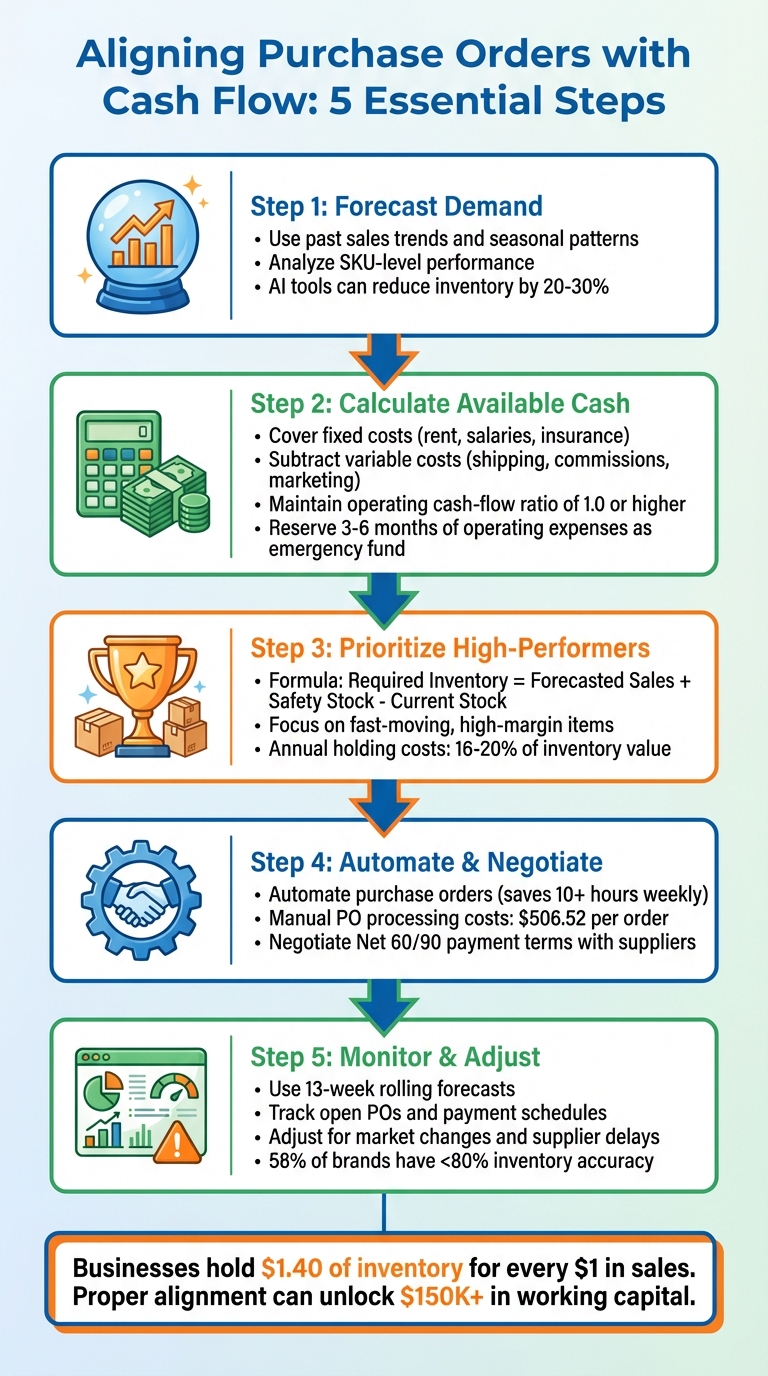
5-Step Process for Aligning Purchase Orders with Cash Flow for Shopify Stores
Smarter Inventory, Better Cash Flow - Inventory Management Tips for Small Business
sbb-itb-f0fc809
Using Sales Trends and Cash Flow to Forecast Demand
Forecasting demand involves analyzing past performance to predict future needs. Shopify sales data offers valuable insights into which products sell quickly, when customers are most active, and how much inventory you actually need.
Reviewing Past Sales Data
Start by pulling historical sales data from Shopify. To calculate your average daily sales, divide last year’s total sales by 365. For instance, if you sold 3,650 units last year, your daily average would be 10 units.
Next, dig deeper into performance at the SKU level. This helps identify which products are consistent sellers and which ones move slowly. Using AI-enhanced demand forecasting tools can even help reduce inventory levels by 20% to 30%.
When forecasting, always compare similar time periods. For example, if you’re planning for Q2 2026, use Q2 2025 as a reference. This approach ensures seasonal patterns are factored in, providing a more accurate target. Time-series analysis - breaking sales data into intervals like weeks or months - helps you spot trends, seasonal spikes, and dips. Adjust these insights to account for seasonal shifts and any changes in the market.
Accounting for Seasonal Changes and Market Shifts
External factors, like seasonality and market conditions, heavily influence future sales. For example, December might bring a surge in sales, while February could see a slowdown. Sylvia Fountaine, Owner and Founder of Feasting at Home, highlights the importance of understanding these patterns:
"Knowing which products sell out right away versus sit on our shelves for months until Christmas is important, so we can not only have adequate and appropriate inventory, but are able to order ahead so artisans have time to produce inventory".
Beyond historical data, consider upcoming promotions, marketing efforts, and shifts in the market. A major sale or ad campaign can drive demand, while factors like inflation or supply chain issues might slow it down. In 2024, nearly 90% of companies experienced supply chain disruptions. Short-term forecasting (up to six months) captures seasonal trends, while long-term forecasting (12 months or more) helps track broader changes, like shifts in consumer spending habits. Be sure to update your forecasts quarterly or whenever significant events occur.
Connecting Demand Forecasts to Cash Flow
After identifying demand trends, tie them to your cash flow projections to make informed inventory decisions. Retailers often face what’s called a "transaction timing trap" - having to pay suppliers 30 to 90 days before products are sold, creating a gap between cash outflow and incoming revenue.
A 13-week rolling forecast can bridge this gap by aligning demand with cash flow. It captures payment cycles and seasonal patterns, allowing you to calculate inventory needs using this formula: Forecasted Sales + Safety Stock – Current Stock. Then, compare the cost of this inventory with your available cash for the next 13 weeks.
Focus on high-velocity SKUs - products that sell quickly and convert back to cash efficiently. If funds are tight, prioritize items that generate revenue the fastest. As Zenstatement puts it:
"You don't feel an inventory decision when it's made - you feel it two quarters later when the markdowns and cash gaps hit".
Determining How Much Cash You Can Spend on Inventory
Figuring out how much cash you can allocate to inventory requires careful planning to avoid disrupting your daily operations. Remember, the profit shown on your P&L statement doesn’t directly translate to available cash - inventory purchases tie up cash until the products are sold. Start by covering all essential expenses, then use what’s left for inventory.
Calculating Fixed and Variable Costs
Begin by identifying your fixed costs - expenses that remain consistent, like rent, salaries, insurance, loan repayments, and software subscriptions. Next, look at variable costs, which fluctuate based on activity, such as shipping, commissions, credit card fees, and marketing. Don’t forget landed costs, which include freight, customs duties, import fees, insurance, and brokerage fees.
To calculate your Free Cash Flow (FCF), subtract fixed, variable, and one-off expenses (like equipment upgrades or tax bills) from your total cash inflows. A strong indicator of financial health is maintaining an operating cash-flow ratio of 1.0 or higher. This ratio, calculated by dividing Operating Cash Flow by Current Liabilities, ensures you can cover short-term debts while still purchasing inventory. By understanding your FCF, you can better plan purchase orders to keep inventory levels steady without straining your cash flow.
Setting Spending Limits for Purchase Orders
Once you’ve determined your available cash, it’s time to set clear spending limits. A 13-week rolling forecast can help you anticipate cash constraints before committing to large purchase orders. This forecasting method accounts for payment cycles, helping you identify potential liquidity gaps early. It’s also wise to reserve three to six months’ worth of operating expenses as an emergency fund before using extra cash for inventory.
To avoid cash flow issues, align your purchase order limits with your settlement cycles. Andrew Youderian, Founder of EcommerceFuel, emphasizes the challenges of managing cash and inventory:
"The biggest drain on cash is having to front funds for purchase orders of ever-increasing size... you've got to order goods 4-6 months ahead of time".
Negotiating better payment terms - like shifting from net-30 to net-45 or net-60 - can help you hold onto cash longer. This strategy ensures your inventory purchases stay in sync with your cash flow, allowing you to maintain both liquidity and stock levels effectively.
Creating Purchase Orders That Match Your Cash Flow
Once you've set a clear spending limit, the next step is to create purchase orders that align with your cash flow and product demand. By combining cash flow insights with demand forecasts, you can structure purchase orders to prioritize the right products at the right time, streamline repetitive tasks, and work with suppliers to match payment schedules with your incoming cash.
Ordering Based on Product Performance
Focus your spending on high-margin, fast-moving items to make the most of your cash. Use this simple formula:
Required Inventory = Forecasted Sales + Safety Stock − Current Stock on Hand
This calculation ensures you order just what you need for each SKU, avoiding overstocking on slow sellers that can tie up cash unnecessarily.
It's essential to regularly reassess your sales velocity to adapt to changing market trends. Tools like Forstock can automate this process by connecting to your Shopify store, using AI to analyze real-time sales data and adjust reorder points for Shopify dynamically. Additionally, applying Economic Order Quantity (EOQ) principles can help balance the costs of placing orders (like fees and admin work) with holding costs (such as storage and risk of obsolescence). For perspective, annual inventory holding costs typically range from 16% to 20% of your inventory's total value.
A striking example of the risks involved comes from Adidas in 2023. The company reported over €500 million in unsold Yeezy inventory after ending a partnership. This deadstock, left without a sales channel, highlighted the financial dangers of ordering trend-driven products without aligning with actual demand.
Automating Purchase Order Creation
Manually processing purchase orders can be expensive, costing up to $506.52 per order. Automation not only saves time and reduces errors but also ensures decisions are based on real data instead of guesswork. High-performing companies can process purchase orders in under five hours, while others may take over 48 hours.
Forstock simplifies this by linking directly to your Shopify store and automating purchase orders as inventory hits dynamic reorder points. Alexander, a Supply Chain Manager at FashionCo, shared his experience:
"The automated PO creation saves us 10+ hours weekly. Setup was seamless - setup took only 2 minutes".
Automation also helps prevent unauthorized or unbudgeted orders, which can drain cash reserves. Implementing tighter approval workflows can cut this type of spending by up to 64%.
Negotiating Flexible Payment Terms with Suppliers
Your payment terms significantly affect when cash leaves your business. Negotiating terms like Net 30, Net 60, or even Net 90 can delay cash outflows until after you've started generating revenue from the products. Sharing a 12-month demand forecast with suppliers can build trust and demonstrate your stability, making them more likely to agree to favorable terms.
Take the example of Lalo, a baby products brand. In 2025, they used the Cogsy platform to share their 12-month production plans with suppliers. This transparency allowed them to negotiate a 50% reduction in upfront payments for purchase orders, freeing up working capital that would have been tied up in inventory costs.
Another option is to request payment in multiple installments rather than a lump sum. This approach avoids sudden, large cash outflows. On the flip side, if your cash flow is strong, ask suppliers about early payment discounts to lower your Cost of Goods Sold (COGS) and improve margins. Always use three-way matching - comparing the purchase order, goods receipt, and supplier invoice - before making payments. This step helps catch overpayments or discrepancies in quantities.
Tracking Purchase Orders and Adjusting as Needed
Monitoring Open Purchase Orders and Payment Schedules
Keeping tabs on open purchase orders (POs) is essential to avoid unexpected cash outflows. A centralized dashboard can provide real-time updates on each order, including its status, delivery timelines, total costs, and payment progress. This level of visibility is crucial, especially considering that 58% of brands report their inventory accuracy falls below 80%.
Key milestones to track include PO acceptance, production start, goods readiness, freight booking, and transit. These checkpoints help you anticipate cash outflows and adjust payment schedules as needed. For example, if a shipment is delayed, you’ll immediately understand how it impacts your cash position. To avoid errors, always use three-way matching - comparing the purchase order, goods receipt note, and supplier invoice - before releasing payments. This process helps catch overpayments or quantity discrepancies that could disrupt your cash flow.
It’s also important to monitor "committed spend", which refers to future liabilities tied to open POs. By doing so, you can identify and prevent unauthorized purchases. Implementing stricter approval workflows has been shown to reduce unbudgeted spending by up to 64%. Additionally, analyzing inventory data alongside cash flow commitments provides a clearer picture of your financial standing.
Using Inventory Data to Understand Cash Flow Impact
Your inventory data can reveal how much cash is tied up in stock and where it’s being allocated. Integrated systems allow you to track inbound inventory and committed spend in real time, giving you a full view of cash obligations before invoices land on your desk. On average, businesses hold $1.40 of inventory for every dollar in sales, which underscores the importance of managing this balance effectively.
Tools like Forstock sync directly with platforms like Shopify, offering insights into inventory performance across all locations. Forstock also calculates landed costs - including freight, duties, and taxes - so you have an accurate understanding of cash outflows for each shipment. As Matt, Operations Lead at TechGear, shared:
"Forstock has been great. We're preventing stockouts that were costing us $50K monthly. The AI predictions are incredibly accurate."
Tracking inventory also helps pinpoint dead stock or slow-moving items that tie up capital unnecessarily. With annual inventory holding costs averaging between 16% and 20% of total inventory value, identifying these cash drains is essential for making smarter adjustments. By understanding how much cash is tied up in inventory, you can quickly adapt your orders to reflect changing market conditions.
Adjusting Plans When Conditions Change
Markets fluctuate, supplier delays happen, and sales trends shift - your purchase orders need to adjust accordingly. Before finalizing any PO, evaluate current sales velocity to ensure the timing and quantity still align with demand. If a product’s sell-through rate drops due to increased competition or market shifts, consider reducing or delaying the order to free up capital.
When facing supplier delays or freight issues, update forecasts promptly and keep stakeholders informed. If cash flow becomes tight, consider negotiating flexible payment terms with suppliers, such as moving from Net 30 to Net 60 payment schedules. This can help preserve working capital for urgent needs. Postponing shipments by a few weeks can also delay customs duties and final invoice payments, providing additional breathing room.
For example, Neil, a grocery store owner in Chicago, faced declining revenue but managed to turn things around by renegotiating supplier terms to extend payables by 30 days. At the same time, he launched a Shopify store for online orders and added an in-store deli. These changes boosted his operating cash flows by 30% within three months.
Dynamic reorder points, which adjust automatically based on real-time sales velocity, lead times, and safety stock levels, can help you avoid over-purchasing during slow periods and prevent stockouts when demand spikes. Forstock simplifies this process by continuously analyzing sales data and adjusting reorder triggers, ensuring your POs always align with current market conditions.
Using Forstock to Automate Cash-Flow-Aligned Inventory Management
Forstock takes the challenge of aligning inventory with cash flow and simplifies it through AI-powered automation.
Automating Demand Forecasts and Purchase Orders
Gone are the days of juggling spreadsheets. Forstock introduces an AI-driven reorder table that predicts exactly what needs to be reordered and when. By analyzing factors like sales trends, lead times, and seasonal patterns, it generates purchase orders in just minutes. Whether you're using templates, filters, or CSV imports, this feature cuts manual workload by 60%, freeing up time for strategic planning.
Alexander, a Supply Chain Manager at FashionCo, shares his experience:
"The automated PO creation saves us 10+ hours weekly. Setup was seamless - just 2 minutes!"
Forstock also integrates landed costs - like freight and duties - directly into purchase orders. This ensures you have a clear picture of total cash impact, eliminating the risk of underestimating expenses. With these tools, not only is order creation faster, but it also sets the stage for real-time tracking through the platform’s dashboard.
Getting Real-Time Visibility with Dashboards
Forstock’s dashboard complements its automated features by offering a real-time, centralized view of your inventory and cash flow. From tracking order statuses to monitoring expected delivery dates and payment progress, the dashboard provides everything you need at a glance. It even lets you see exactly what’s been paid and what’s still due.
Emily, an Inventory Manager, explains:
"I open the dashboard in the morning and instantly know what needs reordering, what is overstocked, and what to focus on."
The platform syncs seamlessly with Shopify, automatically updating inventory levels as goods arrive. One company reported unlocking $150,000 in working capital by using these insights to keep inventory aligned with actual demand.
Reducing Manual Work and Mistakes
Manual inventory management can be a headache, often leading to costly errors and wasted time. Forstock automates these repetitive tasks, reducing data entry mistakes and ensuring purchase orders always reflect accurate demand forecasts and available cash.
Jason, Co-founder of HomeGoods, saw the difference firsthand:
"Excess inventory was reduced by 45%, and we freed up $150,000 in working capital."
On top of that, Forstock’s AI predictions help businesses avoid stockouts, which could otherwise result in losses of up to $50,000 in monthly revenue. By eliminating errors and enabling proactive inventory adjustments, Forstock keeps your cash flow steady and responsive.
Common Mistakes When Aligning Purchase Orders with Cash Flow
Even with the best intentions, businesses often stumble when trying to match inventory orders to available cash. These missteps can tie up funds, lead to stockouts, or leave you unprepared when circumstances change. Here’s what to watch out for - and how to address it.
Overstocking from Overestimating Demand
One common error is overordering, which happens when outdated data or ignored seasonal trends lead to excess inventory. This traps essential cash in unsold stock and can cost businesses even more - deadstock is estimated to cost 30% over its original value, not to mention the 15% in missed opportunities caused by cash being tied up.
To steer clear of this, consider using dynamic reorder points that adjust automatically based on factors like current sales trends, actual lead times, and safety stock. Tools such as Forstock analyze historical data, seasonal patterns, and real-time growth rates to prevent decisions based on guesswork. Misjudging demand doesn’t just freeze up cash; it also opens the door to operational hiccups, like lead-time miscalculations.
Stockouts from Underestimating Lead Times
While overordering can strain your cash flow, underestimating supplier delivery times can be equally harmful. Fixed lead-time assumptions often fail to account for real-world delays like port congestion, customs issues, or production halts. The global retail industry loses an estimated $1.75 trillion annually from stockouts - approximately 8.3% of total sales.
The fix? Use actual delivery data to create lead-time buffers, especially for sea freight. A better method for calculating safety stock involves subtracting (average daily sales × average lead time) from (maximum daily sales × maximum lead time) to account for potential supplier delays. Tools like Forstock utilize AI-driven forecasting to adapt to changing lead times and seasonal patterns, ensuring reorders are triggered before stock runs dry and revenue slips away.
Failing to Plan for Cash Flow Changes
Another pitfall is overlooking cash flow shifts when placing orders. Relying solely on merchandising plans - without factoring in real-time liquidity - can leave businesses vulnerable.
As the ZenStatement Intelligence Team explains:
"You don't feel an inventory decision when it's made - you feel it two quarters later when the markdowns and cash gaps hit."
To avoid this, adopt rolling 13-week liquidity forecasts that update weekly to reflect daily operational changes. This approach allows for mid-quarter adjustments when cash flow fluctuates. Additionally, maintain an emergency fund covering three to six months of operating expenses to manage unexpected shortfalls. Negotiating flexible payment terms - like Net 30/60/90 or milestone-based payments - can also help preserve working capital during long lead times. Forstock’s real-time dashboards provide visibility into payment schedules and order statuses, enabling you to fine-tune plans before cash flow issues spiral out of control.
Conclusion
Aligning purchase orders with your cash flow is a smart way to ensure steady growth. By syncing inventory spending with actual liquidity, you can avoid paying suppliers 30–90 days before your sales turn into revenue. This approach keeps you from tying up too much cash in unsold products, which can lead to financial strain.
Key steps include using real sales data and seasonal trends to forecast demand, calculating available cash after covering fixed costs, and focusing purchase orders on top-performing products. Continuously monitoring open orders and adapting to market changes further helps reduce holding costs while freeing up working capital for other priorities.
Tools like Forstock make this process easier by automating demand forecasts, generating purchase orders quickly, and offering real-time insights into payment schedules and stock levels - all through a single dashboard. Brands using Forstock have reported cutting excess inventory by 45% and unlocking $150,000 in working capital. This streamlined system allows you to reinvest freed-up cash into growth opportunities.
When inventory decisions are treated as cash decisions, you not only stabilize your financial health but also improve your leverage with suppliers and lenders. This stronger position can lead to better payment terms and greater access to credit. Plus, you gain the confidence to pursue growth initiatives without risking your ability to meet financial obligations. As the ZenStatement Intelligence Team wisely puts it:
"You don't feel an inventory decision when it's made - you feel it two quarters later when the markdowns and cash gaps hit".
To get started, consider implementing rolling 13-week liquidity forecasts updated weekly, switching to dynamic reorder points, and using three-way matching to verify payments. With the right strategies and tools like Forstock, you can transform inventory management into a competitive edge.
FAQs
How do I set a safe inventory budget?
To create a safe inventory budget, focus on sales forecasts, cash flow, and demand trends. This approach helps you strike a balance, avoiding both overstocking and running out of stock. Tools like open-to-buy planning and demand forecasting are essential for aligning your inventory purchases with available cash flow.
Start by analyzing projected sales, inventory requirements, and cash flow forecasts. This will help you allocate a budget that meets customer demand while keeping your finances healthy. For added precision, consider using AI-driven demand planning. These tools can fine-tune your budget by accounting for seasonal patterns and unexpected sales fluctuations.
What’s a 13-week cash flow forecast?
A 13-week cash flow forecast is a tool that breaks down expected cash inflows and outflows on a weekly basis over the next 90 days. It offers a clear picture of short-term liquidity, enabling businesses to spot potential cash shortages or surpluses ahead of time. This forecast plays a key role in managing cash flow efficiently and ensuring financial decisions support day-to-day operations.
How can Forstock automate POs?
Forstock uses AI-powered demand forecasting and real-time Shopify data to simplify the process of creating purchase orders. By analyzing sales trends, lead times, and safety stock levels, it provides precise SKU-level purchase recommendations. Through a centralized dashboard, users can track and update purchase orders effortlessly, ensuring products are restocked on time and cash flow remains steady. This approach makes procurement more efficient while aligning inventory management with overall business goals.
Keep reading
Try Forstock free for 14 days.
AI-powered demand forecasting and reorder automation for Shopify brands. No credit card required.