
Inventory Carrying Costs: What They Are and How to Reduce Them
Understand inventory carrying costs, learn how to calculate them, and use forecasting, reorder points, and automation to cut holding expenses.
Inventory Carrying Costs: What They Are and How to Reduce Them
Every product sitting in your warehouse costs you more than just its purchase price. Inventory carrying costs - expenses tied to storing, managing, and maintaining unsold goods - can drain 20% to 30% of your inventory's value annually. For example, if you hold $100,000 in inventory, you might spend $20,000 to $30,000 just to keep it in storage.
These costs include:
- Capital costs: Money spent on purchasing inventory or interest on loans.
- Storage costs: Warehouse rent, utilities, and maintenance.
- Service costs: Insurance, taxes, and software fees.
- Risk costs: Losses from theft, damage, or obsolescence.
Reducing these costs can free up cash for growth. Strategies like demand forecasting, setting reorder points to save money, automating inventory tasks, and using methods like Just-in-Time inventory can help cut expenses while keeping stock levels efficient.
This guide explains how to calculate carrying costs, spot inefficiencies, and use tools like AI-powered forecasting to improve your inventory management.
Inventory Costs Explained | Carrying, Ordering and Shortage Costs
What Are Inventory Carrying Costs?
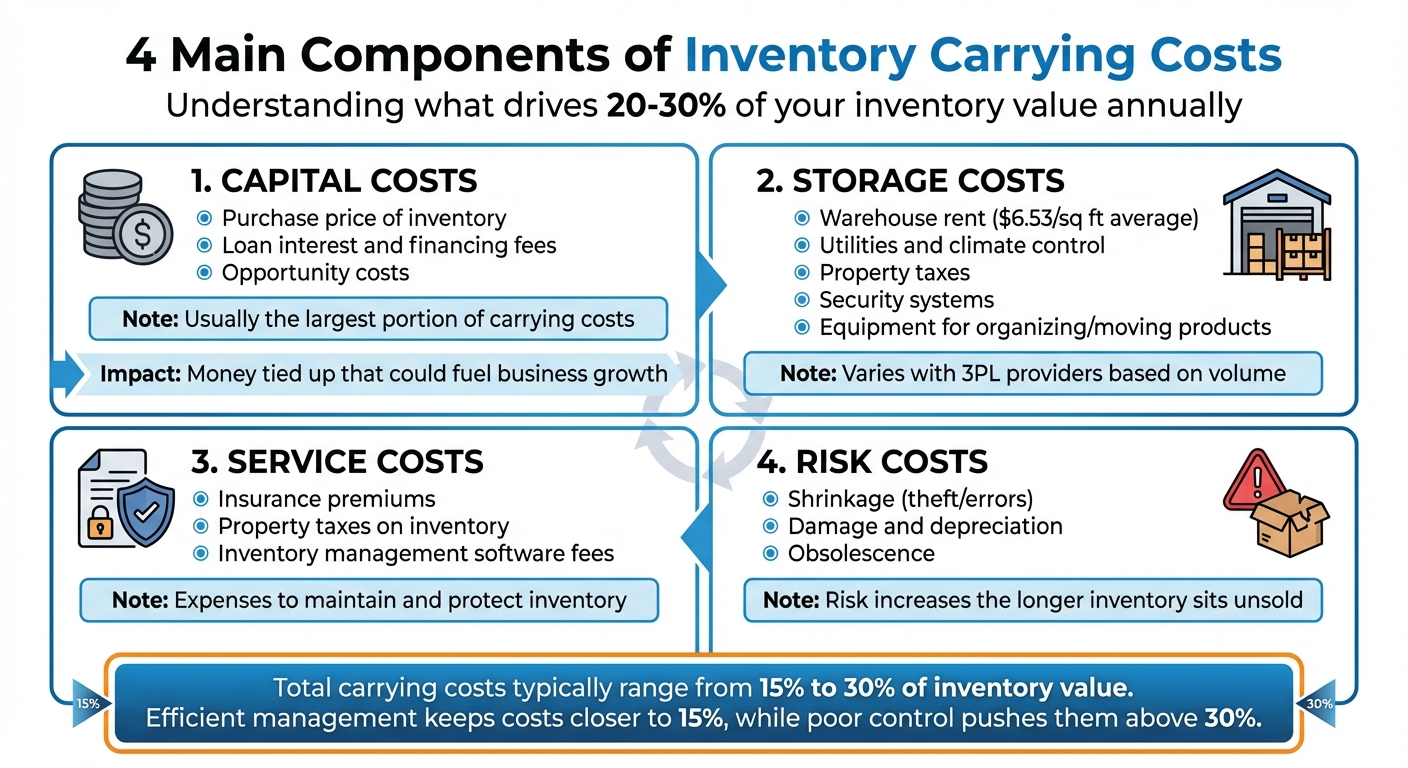
Four Main Components of Inventory Carrying Costs Breakdown
Inventory carrying costs, often called holding costs, include all the expenses tied to storing and managing inventory. These costs go well beyond just paying for warehouse space. They also cover the capital invested in inventory, insurance, utilities, and labor.
For Shopify brands, keeping a close eye on these costs is essential to maintaining healthy cash flow and improving profitability. Take the example of storing winter coats during the off-season. Not only do you pay storage fees, but you also risk style changes making the items outdated or requiring markdowns to clear them out.
As Ian McCue, Senior Associate Content Manager at NetSuite, explains:
"Inventory carrying costs - the full amount businesses spend to stock and store items before they're sold - can have a significant impact on profitability."
– Ian McCue
Some of these costs are easy to spot, like warehouse fees that show up on invoices. But others, such as the opportunity cost of having money tied up in inventory instead of being used for marketing or product development, are less obvious. These hidden costs often show up within the Cost of Goods Sold (COGS). Breaking down these costs into specific components can help businesses identify inefficiencies and areas for improvement.
Main Components of Inventory Carrying Costs
Understanding the elements of carrying costs is key to spotting inefficiencies in your inventory strategy. These costs generally fall into four main categories:
- Capital Costs: This is usually the largest chunk of carrying costs. It includes the money spent on purchasing inventory and any interest or financing fees if the inventory was bought on credit. Every dollar tied up in inventory is a dollar that could have been used to grow the business in other ways.
- Storage Costs: These cover the physical space needed to store inventory. They include warehouse rent (averaging $6.53 per square foot), utilities like electricity and climate control, property taxes, security systems, and equipment for organizing and moving products. For businesses using third-party logistics providers (3PLs), these costs will vary depending on the amount of inventory stored.
- Service Costs: These are the expenses required to maintain and protect inventory. They include insurance premiums, property taxes tied to inventory volume, and fees for cloud inventory tools.
- Risk Costs: These represent potential losses from shrinkage (due to theft or errors), damage, depreciation as items lose value, and obsolescence when products go out of style, which can be mitigated through dead stock reduction. The longer inventory sits unsold, the higher these risks become.
Here’s a quick breakdown of these components:
| Component Category | What It Includes | Why It Matters |
|---|---|---|
| Capital Costs | Purchase price, loan interest, financing fees | Represents the largest portion; ties up money that could be used for growth |
| Storage Costs | Rent, utilities, security, maintenance | Covers expenses for the physical space where inventory is stored |
| Service Costs | Insurance, property taxes, software fees | Accounts for managing and safeguarding inventory |
| Inventory Risk | Shrinkage, obsolescence, depreciation | Reflects losses from theft, damage, or declining product value |
Breaking these categories down helps businesses calculate their carrying costs and find ways to reduce them effectively.
How to Calculate Inventory Carrying Costs
To calculate inventory carrying costs, use this formula: (Total Carrying Costs ÷ Average Inventory Value) × 100. The result is a percentage that shows how much you're spending to hold your inventory compared to its value.
Total Carrying Costs include all expenses tied to holding inventory, such as capital, storage, service, and risk costs. Average Inventory Value refers to the inventory's monetary worth during a specific period, calculated based on its purchase price - not its potential selling price.
Let’s look at an example. A clothing retailer had the following annual costs:
- Storage space: $20,000
- Handling and labor: $15,000
- Insurance and taxes: $5,000
- Depreciation: $3,000
- Opportunity costs: $7,000
- Shrinkage (theft or damage): $2,000
The total holding cost added up to $52,000. With an inventory valued at $200,000, the carrying cost was calculated as ($52,000 ÷ $200,000) × 100, equaling 26%.
Now consider an ice cream supplier, whose costs were:
- Capital costs: $10,000
- Service costs (insurance and software): $3,000
- Risk costs (spoilage): $1,000
- Storage costs (refrigeration and rent): $4,000
Their total holding costs came to $18,000, and with an inventory value of $120,000, the carrying cost was 15%.
On average, carrying costs range from 15% to 30% of the total inventory value. Efficient management can keep costs closer to 15%, while poor control might push them above 30%. A quick way to estimate carrying costs is dividing your total annual inventory value by four, though the detailed formula gives a more precise picture. This calculation helps you gauge how effectively you’re managing Shopify inventory.
Fixed vs. Variable Components
Once you’ve calculated your carrying costs, it’s important to break them down into fixed and variable components. This helps you plan more accurately.
Fixed costs stay the same regardless of how much inventory you hold. This is especially true when managing multiple warehouses, where base operational costs remain constant. These include expenses like warehouse rent or mortgage payments, property taxes, and maintenance costs. For example, if you pay $5,000 monthly for warehouse space, that cost won’t change whether you store 100 units or 1,000.
Variable costs, however, change based on inventory levels. For instance:
- Insurance premiums may increase with higher inventory values.
- Utility bills can rise if more climate control is needed.
- Labor costs often grow as more items require handling.
- Costs tied to shrinkage (like theft or damage) and depreciation usually scale with stock levels.
If you use a third-party logistics (3PL) provider, your storage costs might shift from fixed to variable. These providers typically charge based on the volume or number of pallets you use. Understanding this distinction is crucial for forecasting expenses and deciding whether to adjust your inventory levels.
Why Shopify Brands Should Track Inventory Carrying Costs

Keeping tabs on inventory carrying costs is essential for understanding your true profit margins. By factoring in holding expenses, you can subtract these from your gross margins to uncover the actual profit tied to your current inventory. Without this clarity, you might assume you're making money when, in reality, slow-moving items could be eating into your profits. On top of that, knowing these costs is crucial for managing cash flow effectively.
Manual and automated inventory systems play a major role in cash flow management. Every dollar tied up in excess inventory is a dollar you can’t invest in areas like marketing, hiring, or product development. Essentially, that money is sitting in your warehouse rather than fueling business growth.
If your inventory carrying costs exceed 30%, it’s a red flag. You’re likely dealing with overstock vs. stockouts issues or holding onto slow-moving products that rack up expenses like storage fees, utilities, and labor - all without generating revenue. Tracking these costs early helps you spot inefficiencies, protect your profit margins, and improve overall financial management. This often involves optimizing inventory turnover to ensure stock moves quickly and efficiently.
For example, monitoring inventory costs has driven real-world results for Shopify brands. Bathu, a sneaker company from South Africa, boosted its revenue by 26% after centralizing inventory data across its stores with Shopify POS. According to Mario Toscano, the company’s Technology and Innovation Manager, this centralization made managing multiple locations far more efficient. Likewise, Pepper Palace, a specialty food brand, saved $20,000 annually by eliminating middleware and reducing maintenance time by 60% after switching to a unified system.
Accurate tracking doesn’t just save on operational costs - it also impacts your financial records and tax obligations. Inventory levels directly affect your Cost of Goods Sold (COGS), which means precise monitoring can help you maximize tax deductions and maintain clean accounting records. This is especially important during audits or when seeking financing.
sbb-itb-f0fc809
How to Reduce Inventory Carrying Costs
Lowering inventory carrying costs is all about working smarter with your data and automating repetitive tasks. The challenge? Doing so without sacrificing service levels or risking stockouts. These strategies can help Shopify businesses trim expenses while keeping cash flow and profitability intact.
Improve Demand Forecasting
Accurate demand forecasting is your first line of defense against excess inventory. By predicting what customers are likely to buy, you can avoid overstocking and free up cash for other priorities. Modern forecasting tools analyze historical sales data, seasonal trends, and market dynamics to provide actionable insights that evolve with your business.
AI-powered forecasting is making waves across industries. For instance, IKEA's "Demand Sensing" tool uses AI to process up to 200 data points per product, boosting forecast accuracy from 92% to 98% across 450 stores. Similarly, Procter & Gamble leveraged machine learning to analyze consumer trends, cutting their inventory levels by 15%.
"The more you know about your demand, the less uncertain you are about demand. That means you can manage your inventory better and reduce inventory levels in your warehouses, because keeping inventory is costly."
– Javad Nasiry, Management Professor, McGill University
Studies show that accurate forecasting can reduce inventory costs by 20% to 50%. Tools like Forstock’s AI-driven forecasting adapt to your sales patterns, lead times, and seasonal shifts, enabling you to make data-backed purchasing decisions instead of relying on guesswork.
Once your demand forecasting is on point, the next step is fine-tuning how and when you reorder stock.
Set Better Reorder Points and Safety Stock Levels
Reorder points and safety stock levels are critical for balancing inventory. They ensure you restock at just the right time - avoiding the costs of overstocking or the missed opportunities of stockouts.
Start by calculating lead time demand, which is the stock required during the time it takes to replenish inventory. Multiply your average daily sales by your average lead time in days to get this figure. Then, calculate your safety stock using this formula:
(Maximum daily sales × Maximum lead time in days) – Lead time demand = Safety stock.
Finally, set your reorder point by adding lead time demand and safety stock:
Reorder point = Lead time demand + Safety stock.
These calculations take the guesswork out of inventory management, helping you maintain optimal stock levels based on real sales data and supplier timelines.
Automate Inventory Management Tasks
Managing inventory manually is not only tedious but also prone to errors that can cost you. Automating routine tasks can save time, reduce mistakes, and give you real-time visibility across all sales channels.
For example, automated systems can generate purchase orders based on predefined reorder points, ensuring you replenish stock promptly. IoT-enabled inventory management systems have been shown to reduce carrying costs by 20–30% while improving inventory accuracy from 70–75% to 95–98%.
With tools like Forstock, you can automate tasks such as creating purchase orders, updating inventory levels, and even communicating with suppliers. This frees your team to focus on strategy rather than firefighting issues caused by manual errors.
Once automation is in place, you can refine your inventory strategy further with ABC analysis.
Use ABC Inventory Analysis
ABC analysis helps you prioritize your inventory based on its value and sales frequency. Products are grouped into three categories:
- "A" items: High-value products that generate around 80% of your revenue but make up only 20% of your inventory.
- "B" items: Mid-tier products that fall between "A" and "C" categories.
- "C" items: Low-value products that sell slowly and contribute less to your bottom line.
Focusing on "A" items allows you to allocate resources more effectively. For these products, you can tighten inventory controls, monitor stock more frequently, and strengthen supplier relationships. On the other hand, "C" items can be managed with a more relaxed approach, such as smaller safety stock levels or less frequent ordering.
| Strategy | Primary Benefit | Key Metric to Track |
|---|---|---|
| ABC Analysis | Focuses on high-value stock | Inventory Value / Sales Volume |
| Just-in-Time (JIT) | Reduces storage and waste | Inventory Turnover Rate |
| Demand Forecasting | Avoids overstocking and stockouts | Forecast Accuracy |
| Automation | Cuts manual errors and labor | Administrative Costs |
Apply Just-in-Time (JIT) Inventory Practices
Just-in-Time (JIT) inventory allows you to receive goods only as they are needed for sales or production. Instead of storing large quantities "just in case", you maintain lean stock levels and rely on efficient supplier coordination.
JIT can slash storage costs, minimize waste from outdated or expired products, and free up working capital. However, this approach requires precise demand forecasting and reliable suppliers to ensure timely deliveries.
For example, bulky or expensive items can benefit from a showrooming model. Display a few products in-store while fulfilling customer orders directly from a central warehouse or supplier. In 2023, Wildling, a footwear retailer, implemented Shopify POS for retail showrooms. This strategy allowed customers to try products in-store while orders were shipped from a central location, saving $10,000 and boosting stock availability by 5%.
While JIT isn’t ideal for every product or business, applying it strategically can significantly cut inventory carrying costs while keeping customers happy.
How Forstock Helps Shopify Brands Reduce Carrying Costs
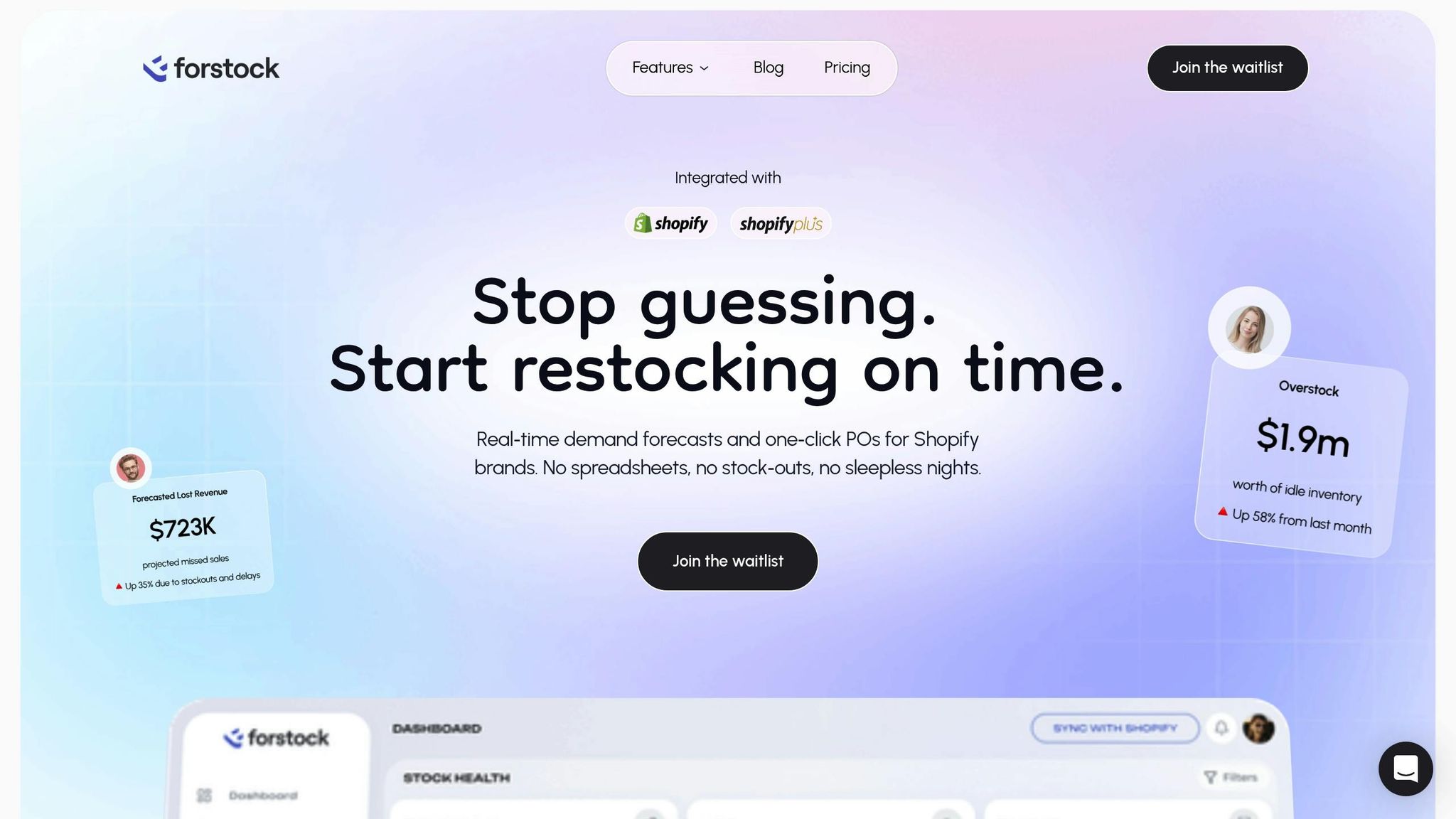
Forstock simplifies the challenge of reducing carrying costs by combining effective strategies into one intuitive platform. Forget juggling spreadsheets and manual calculations - this tool provides complete inventory visibility in a single dashboard.
One standout feature is its AI-powered demand forecasting, which uses historical sales data, seasonal trends, and market insights to predict future demand with incredible accuracy. By factoring in customer behavior and market trends, the platform fine-tunes forecasts and calculates the ideal order quantities. This precision helps optimize inventory turnover metrics to keep capital fluid. The result? Less cash tied up in surplus inventory.
Forstock doesn’t stop there. It also streamlines procurement with automated purchase orders. These are generated based on supplier lead times and sales velocity, aligning perfectly with a Just-in-Time strategy. This means you only receive inventory when you need it, cutting down on storage time and reducing the risk of overstock and automating safety stock. Plus, automation eliminates manual errors, making the process smoother and more reliable.
To round it all out, the platform includes tools like 12-month demand planning and advanced inventory analytics. These features provide a clear, forward-looking perspective on inventory needs and help identify slow-moving or dead stock before it becomes a problem.
Conclusion
Inventory carrying costs can eat up 20%–30% of your inventory's value, directly cutting into your profits. Gaining a clear understanding of these costs allows you to unlock capital that can fuel your business growth.
The good news? You don’t need to wrestle with complicated spreadsheets to bring these costs down. Modern inventory management tools make it easier than ever with features like demand forecasting, automated reordering, and real-time tracking to avoid overstock and stockouts with Shopify tools. Strategies like Just-in-Time inventory and ABC analysis help Shopify brands keep their inventory lean while still meeting customer expectations. These approaches work together to create a streamlined, efficient solution.
When you take control of these costs, you’re not just protecting your cash flow - you’re setting your business up to maximize revenue. Platforms like Forstock bring all these strategies together, using AI-powered forecasting, automated purchase order tools, and 12-month demand planning to prevent costly mistakes. It’s about optimizing inventory, not just tracking it.
For Shopify brands, tackling inventory carrying costs isn’t just about saving money - it’s about turning a challenge into an opportunity. With the right tools, you can improve cash flow, cut unnecessary expenses, and focus on what matters most: growing your business.
FAQs
What’s the best way to calculate inventory carrying costs?
To figure out your inventory carrying costs, begin by pinpointing all the related expenses. These often include storage costs, labor, insurance, taxes, depreciation, handling fees, and opportunity costs. Once you’ve identified each expense, add them up to get a complete view of your total carrying costs.
For a deeper understanding, calculate these costs as a percentage of your total inventory value. This percentage gives you a clearer sense of how much carrying inventory impacts your finances and highlights areas where you can make improvements. Knowing these costs is crucial for managing cash flow effectively and keeping excess inventory in check.
How can I reduce the financial risks tied to inventory management?
Reducing financial risks tied to inventory starts with accurate demand forecasting. When you can predict what your customers need, you avoid two major pitfalls: overstocking, which ties up valuable cash, and stockouts, which can cost you sales. Tools like Forstock simplify this process by offering real-time forecasts and automating purchase orders, helping you keep inventory levels in sync with actual demand.
Another key step is conducting regular inventory audits. These audits help pinpoint slow-moving or outdated items that can be discounted or sold off to improve cash flow. On top of that, maintaining the right amount of safety stock ensures you’re prepared to meet customer demand without overextending your resources. By blending smart technology with thoughtful planning, you can reduce risks and build a more efficient, cost-conscious supply chain.
How does AI-powered forecasting help improve inventory management?
AI-powered forecasting takes inventory management to the next level by providing precise demand predictions using real-time data. For Shopify brands, this means smarter purchasing decisions that help avoid the headaches of stockouts, overstock, and excessive holding costs.
By examining factors like sales trends, lead times, and seasonal patterns, AI adjusts to shifting market conditions, keeping inventory levels in sync with customer needs. The result? Better cash flow, fewer operational hiccups, and more time for merchants to concentrate on growing their business with peace of mind.
Keep reading
Try Forstock free for 14 days.
AI-powered demand forecasting and reorder automation for Shopify brands. No credit card required.