
Top Challenges in Multi-Location Inventory
Explore multi-location inventory issues—overselling, sync delays, split shipments, bundle errors—and how AI-driven tools improve forecasting and real-time sync.

Top Challenges in Multi-Location Inventory
Managing inventory across multiple locations is tough - especially for Shopify users. Common problems like overselling, sync delays, split shipments, and inaccurate forecasting can lead to stockouts, overstocking, and frustrated customers. In 2023, inventory mismanagement cost businesses $1.77 trillion, and 43% of small businesses still rely on outdated manual tracking methods.
Key challenges include:
- Overselling: Real-time stock visibility issues lead to canceled orders and lost trust.
- Sync Delays: Inventory updates across locations lag, creating "phantom stock."
- Split Shipments: Orders fulfilled from multiple warehouses increase costs and errors.
- Bundle Tracking: Missing inventory for one component can halt bundle sales.
- Demand Forecasting: Treating all locations the same wastes resources.
Solution: Machine learning systems, like Forstock, solve these issues by predicting demand, automating stock transfers, and syncing inventory in real time. Businesses using these tools report 20%–30% lower inventory costs and 3%–5% better service levels.
Want to avoid these headaches? Read on for a breakdown of these challenges and how smarter tools can simplify multi-location inventory management.
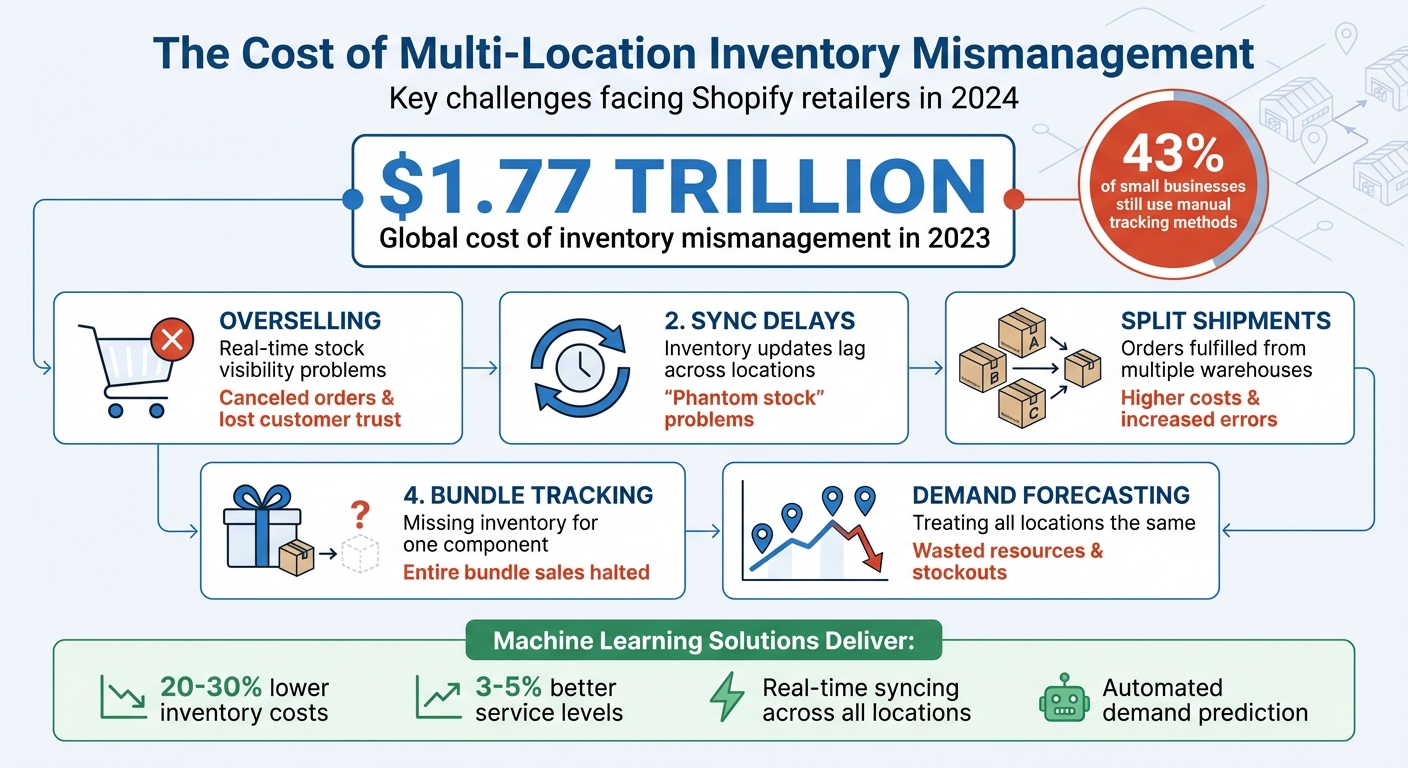
Multi-Location Inventory Management Challenges and Statistics
Challenge 1: Overselling at the Wrong Location
Problem Description
Overselling happens when a product seems available for purchase but isn't - either because it's in the wrong location or already sold. This issue often stems from a lack of centralized, real-time visibility, leaving stock counts more theoretical than practical. For instance, one warehouse might show 50 units in stock, but another location has sold through its inventory, and the systems haven’t synced yet.
Synchronization delays are a common culprit. Many systems rely on middleware, which can lag or fail, leading to orders for items that are no longer available. The problem worsens when manual data entry comes into play - staff using spreadsheets or paper records often fail to update the master inventory system. Disconnected POS, ERP, and warehouse systems further increase the risk of selling unavailable products. Marketing campaigns can add fuel to the fire. Promoting products across social media and web platforms without a unified inventory system can lead to viral items selling out in minutes. Regional demand adds another layer of complexity - high-traffic locations may run out of stock while others sit on excess inventory.
These issues reveal the limitations of many traditional inventory systems.
Shopify Limitations

While Shopify offers built-in multi-location tracking, scaling businesses often run into challenges. Its standard inventory tools struggle to handle the advanced synchronization needed for complex fulfillment networks. Studies show that some integrated commerce solutions can push operating costs up by 21% due to technical difficulties and ongoing maintenance.
When middleware fails or lags, stock counts can fall out of sync. This creates frustrating scenarios where customers place orders expecting quick fulfillment, only to receive cancellation emails hours later. These gaps not only damage customer trust but also send buyers looking for alternatives.
Forstock Machine Learning Solution
Forstock steps in to address these gaps with a machine learning-powered approach to inventory management. By combining AI-driven demand forecasting with real-time, centralized visibility, Forstock helps businesses avoid overselling. Its unified dashboard ensures stock levels are always up-to-date, showing exactly what’s available and where.
The machine learning engine goes a step further by analyzing sales velocity, lead times, and seasonal trends at the SKU-location level. This precision allows businesses to set dynamic reorder points based on actual demand, reducing the risk of stockouts and overselling. Companies using this approach have reported 3% to 5% higher service levels while cutting inventory levels by 15% to 30%. Forstock provides the tools to keep inventory aligned with customer expectations, no matter how complex the fulfillment network.
Challenge 2: Inventory Sync Delays Across Locations
Problem Description
When inventory systems don’t update instantly, businesses lose the ability to see what’s truly available in real time. This creates a risky disconnect between what the system shows and what’s actually sitting in the warehouse. The result? Sales teams might promise products that are out of stock, and websites could list items as available long after they’ve sold out. In 2023 alone, the cost of overstocks and stockouts reached a staggering $1.77 trillion.
These delays force companies into a tough spot - one warehouse ends up with too much inventory while another runs out of the same product. To fix this, businesses often rely on costly expedited shipping between locations, which eats into profits and drives up operational expenses.
Take Bared Footwear, an Australian brand, as an example. During promotions, their separate online and POS systems couldn’t sync fast enough, leading to temporary store closures to avoid overselling. Alexandra McNab, COO of Bared Footwear, highlighted the importance of a unified system:
"Having all our tooling and commerce data unified in a single platform was a real driving factor. All our sales channels display the same stock availability, and we can run a promotion online and in-store concurrently without worrying about overselling".
On top of that, manual reconciliation only adds to the problem, increasing the risk of errors.
Shopify Limitations
Shopify’s built-in tools work well for simpler setups, but when businesses operate complex fulfillment networks, integration issues arise. Many companies link Shopify to external ERPs, warehouse management systems, or third-party logistics providers using middleware. However, these connections often fail or create data silos, leading to even more delays.
Michael Keenan from Shopify explained:
"Many retailers struggle with integrated solutions that require constant maintenance, creating synchronization delays that damage customer experience and increase operational costs".
When systems aren’t fully connected, inventory numbers rarely align across platforms. Data often arrives late or inconsistently between regional hubs and flagship stores, causing mismatches between online stock and what’s physically available. Middleware-based solutions can also increase operating costs by up to 21%, and supply chain disruptions from these delays can shrink annual revenue by 6% to 10%. These gaps underline the need for a centralized, real-time inventory system.
Forstock Machine Learning Solution
To tackle these challenges, a smarter, unified approach is essential. Forstock offers a centralized, cloud-based platform that acts as a single source of truth. Every sale, return, or transfer updates instantly across all locations, eliminating the "phantom stock" issue where items appear available in the system but aren’t physically there.
Forstock’s machine learning algorithms ensure real-time syncing while delivering predictive insights. By analyzing historical sales data, market trends, and regional preferences, the platform forecasts demand for each location. This allows businesses to adjust inventory proactively, preventing stockouts or overstock scenarios.
For instance, Odaje, a French footwear brand with 16 stores, faced challenges with disconnected inventory data. After switching to a unified system, they saw a 6% boost in conversion rates and a 25% jump in international sales. With AI-driven forecasting cutting demand errors by 20% to 50%, businesses can fulfill orders confidently, avoid overselling, and keep customers happy - all while optimizing inventory across locations.
Challenge 3: Split Shipments from Multiple Locations
Problem Description
When a single customer order pulls items from multiple warehouses, the fulfillment process becomes much more complicated. Each package requires its own picking, packing, and shipping, effectively doubling the work for what should ideally be a single shipment. This not only increases labor but also drives up costs with multiple transportation fees, per-package fuel surcharges, and extra documentation expenses.
For customers, this can be frustrating. Tracking multiple shipments from different carriers often leads to conflicting delivery timelines and more support inquiries. On top of that, when inventory is scattered across distant warehouses, it can worsen visibility issues. Every additional package and handling step also increases the risk of items being lost or damaged, especially for fragile or temperature-sensitive goods. For sellers on platforms like Amazon, split deliveries can contribute to a higher order defect rate. If this rate exceeds 1%, it could even result in account suspension.
Shopify Limitations
Shopify's built-in tools don't fully address these challenges. Many merchants instead turn to cloud inventory tools for Shopify to bridge these gaps. While the platform offers a "Minimize split fulfillment" rule to prioritize shipping from a single location, it's a one-size-fits-all solution. It doesn't consider factors like shipping costs, delivery times, or labor availability. Additionally, Shopify's "fulfillable inventory" system relies on static shipping profiles and zones. This setup can unintentionally route orders to distant warehouses if closer locations are hidden due to profile restrictions. Another hurdle is integrating third-party systems like warehouse management software or ERPs. Delays in syncing inventory updates can lead to "ghost" stock issues, which can push operating costs up by as much as 21% compared to more unified systems.
Forstock Machine Learning Solution
Forstock tackles these problems with an AI-powered strategy. By analyzing historical sales data, lead times, and external factors, the platform predicts demand and strategically places popular items closer to where orders are likely to come from. Similar to its methods for avoiding overselling and sync delays, Forstock ensures inventory is distributed in a way that simplifies fulfillment. Its demand-based replenishment system keeps stock available at specific locations, reducing last-mile delivery challenges.
Challenge 4: Bundle and Component Tracking Problems
Problem Description
Selling bundled products - like a gift set with three candles, a box, and tissue paper - can make inventory tracking a logistical headache. A bundle is only available if every single component is in stock at a specific location. For example, if a warehouse in New Jersey runs out of tissue paper, the entire bundle becomes unavailable there.
This issue gets even trickier when components are sold individually as well as in bundles. Imagine your system shows a bundle as available online, but some of its components have already been allocated to individual orders. The result? Overselling, frustrated customers, and canceled orders. On average, retailers only have about 70% accuracy when it comes to inventory visibility.
The financial stakes are huge. Inventory errors, like these tracking problems, cost businesses a staggering $1.9 trillion globally. Trying to fix the issue manually - say, by using spreadsheets - just doesn’t scale. As your product catalog grows, tracking dozens of components across multiple warehouses becomes a recipe for human error and inefficiency.
Shopify Limitations
Shopify’s inventory system falls short when it comes to managing bundles. While it tracks SKUs at each location, it doesn’t offer automated de-bundling functionality. When a bundle sells, you’re often left manually adjusting component quantities or relying on basic apps that still require constant oversight. Worse, Shopify doesn’t provide real-time syncing between bundle availability and individual component stock across multiple warehouses. This makes it impossible to instantly know which location can fulfill a bundle order.
Without automated tracking, orders may end up routed to warehouses missing critical components. This leads to delays or forces you into costly split shipments. Additionally, Shopify’s shipping profiles don’t consider component availability when determining which warehouse should handle an order, creating inefficiencies in your fulfillment process.
Forstock Machine Learning Solution
Forstock offers a smarter way to tackle these bundle tracking challenges. Using multivariate forecasting, it models the relationship between bundle demand and individual component stock levels. The platform continuously monitors inventory across locations and updates bundle availability in real time whenever a component runs low. This eliminates syncing errors that plague manual systems.
The AI also predicts when specific components are likely to run out by analyzing historical sales patterns. It can then trigger automated reorder points based on supplier lead times. For instance, if your tissue paper supplier needs three weeks to deliver but your candle supplier only requires one week, Forstock accounts for these differences to ensure timely restocking.
On top of that, Forstock identifies which warehouses should stock specific components based on regional demand trends. This reduces the need for split shipments and ensures bundles can be fulfilled efficiently. By addressing bundle and component tracking holistically, Forstock helps streamline inventory management and minimize costly errors across your operations.
sbb-itb-f0fc809
Challenge 5: Missing Location-Specific Demand Forecasting
Problem Description
Treating every location the same can lead to expensive errors. Imagine a winter coat flying off the shelves in Minneapolis but sitting untouched in Miami. Generalized forecasts often result in overstock at some locations and stockouts at others.
This mismatch isn't just inconvenient - it's costly. Global retailers lose over $1.8 trillion annually due to inventory distortion. The stakes are even higher when you consider that 71% of customers will switch brands if they can't find their desired product locally. Losing that one sale could mean losing a customer forever. Despite these risks, 75% of companies still rely on spreadsheets for inventory management and optimization.
Uniform service-level goals only make things worse. High-demand items run out quickly, while slow-moving products pile up unnecessarily. Regional factors like weather, local events, and consumer habits are often overlooked, turning one-size-fits-all forecasting into a recipe for wasted resources and lost revenue.
This problem highlights the limitations of standard inventory tools.
Shopify Limitations
Shopify's inventory tools can show you stock levels at different locations, but they fall short when it comes to predicting what each location will need. The platform doesn't offer location-specific demand forecasting, leaving you guessing about how to allocate inventory.
For example, should your Dallas warehouse stock more units than your Seattle location? How do weather patterns or local events impact demand? Shopify's tools don’t account for external factors like these. When unexpected changes occur, manual adjustments often come too late to make a difference.
Forstock Machine Learning Solution
Forstock addresses these regional challenges by using hierarchical forecasting models that analyze demand at multiple levels simultaneously. It looks at national trends, regional patterns, and individual store data to create accurate predictions - even for locations with limited sales history. If a specific store has minimal data, Forstock fills in the gaps by extrapolating trends from broader levels.
The platform’s multivariate analysis connects the dots between products and locations. For instance, if sandals sell well in Florida stores when temperatures hit 75°F, Forstock can predict similar demand in Texas under comparable conditions.
By incorporating factors like weather patterns, local events, and seasonal trends, Forstock dynamically adjusts forecasts based on real-world variables. Businesses using this level of precision often see 3–5% higher service levels while cutting overall inventory by 15–30%.
Forstock’s AI continuously learns from actual sales data, refining safety stock levels for each location based on real-time demand and lead time variability. Instead of relying on excessive stockpiling at central warehouses, the system ensures inventory moves efficiently through your network. This approach reduces idle capital while making sure products are available exactly where and when customers need them.
Guide to Multi-Location Inventory Management in Warehouses
Conclusion
Managing inventory across multiple locations doesn't have to be a constant struggle. The challenges of overselling at the wrong location, sync delays, split shipments, bundle tracking, and missing location-specific forecasts can seriously hinder growth, especially for retailers still relying on outdated manual processes.
The game-changer? Machine learning. Instead of reacting to problems after they arise, AI-powered tools like Forstock anticipate and address them beforehand. These systems predict demand at individual locations, automate stock transfers, and adjust safety stock levels with AI dynamically based on real-time sales data. Shopify brands adopting this strategy often see a 20% to 30% reduction in overall inventory while simultaneously improving service levels.
This isn't just about saving money - it’s about saving time and reducing errors. With automated purchase orders, forecast-driven alerts, and the elimination of manual stock counts, merchants can focus on growing their business rather than wrestling with inventory headaches.
"Forstock has been a great support for our inventory control with precise forecasting capturing promotional impacts. A compact solution that's delivered significant cash flow improvements" - vybey, UK & EU.
In practical terms, this means consolidating data, automating location-specific replenishment, and letting AI handle the complexities. By tackling overselling, sync delays, split shipments, and inaccurate forecasting head-on, this approach solves the core issues that hold retailers back. Sticking to manual processes and generalized forecasts, on the other hand, risks losing customers to stockouts and tying up cash in excess inventory.
Forstock’s unified dashboard, AI-driven forecasting, and automated purchase order creation take the guesswork out of inventory management, ensuring products are where they need to be - when customers want them. This isn’t just about managing stock; it’s about unlocking growth and efficiency.
FAQs
How does machine learning make managing inventory across multiple locations easier?
Machine learning takes the guesswork out of managing inventory across multiple locations by providing precise, real-time demand forecasts. Traditional methods often rely on manual analysis, which can miss crucial patterns. In contrast, machine learning analyzes complex data, such as sales trends, lead times, and seasonal shifts, to predict demand more accurately. This allows businesses to fine-tune stock levels at each location, cutting down on overstock and avoiding stockouts, all while boosting efficiency.
Beyond forecasting, machine learning enhances inventory allocation by spotting demand changes at specific locations. This ensures that stock is sent where it’s needed most, minimizing delays and improving customer satisfaction. By automating repetitive tasks and offering instant access to inventory data, machine learning helps businesses streamline their processes, reduce expenses, and align stock levels more closely with actual demand.
What are the challenges of using Shopify’s inventory tools for managing multiple locations?
Shopify’s built-in inventory tools work well for basic stock tracking at single locations, but they can struggle to keep up with the demands of complex operations spread across multiple sites. For businesses managing multiple warehouses, retail stores, dropshipping, or third-party logistics providers, these limitations can lead to issues like stock inaccuracies, overselling, and inefficiencies.
Key advanced features like real-time multi-location tracking, serialized inventory, and lot tracking are missing, which are essential for businesses with more intricate fulfillment needs. As operations grow and involve higher order volumes or diverse sales channels, Shopify’s native tools often require significant customization or third-party integrations to meet these challenges. This can complicate processes like seamless order routing, maintaining accurate stock visibility, and ensuring efficient fulfillment across all locations.
How can businesses avoid overselling and inventory sync issues across multiple locations?
To tackle overselling and inventory mismatches across multiple locations, businesses should rely on real-time inventory tracking systems. These systems keep stock information updated across all locations, minimizing the chance of selling items that are no longer available.
In addition, automating inventory management with AI-driven forecasting allows businesses to anticipate demand more accurately. This helps ensure timely restocking while avoiding the pitfalls of both running out of stock and overstocking. Using a centralized inventory management platform can further simplify operations by synchronizing stock data, removing errors caused by manual updates.
Solutions like Forstock take this a step further by integrating features such as real-time demand forecasting, automated purchase orders, and detailed inventory analytics. These tools help businesses maintain proper stock levels, optimize cash flow, and consistently meet customer needs across various locations.
Keep reading
Try Forstock free for 14 days.
AI-powered demand forecasting and reorder automation for Shopify brands. No credit card required.