
How Carrying Costs Impact Cash Flow
How inventory carrying costs tie up capital, extend cash cycles, and shrink margins — practical fixes include forecasting, JIT, optimized storage, and inventory tools.

How Carrying Costs Impact Cash Flow
Carrying costs, or holding costs, refer to the expenses tied to storing unsold inventory. These costs - ranging from warehouse rent and insurance to shrinkage and opportunity costs - can account for 20-30% of a business's inventory value annually. For e-commerce businesses, this significantly affects cash flow, limiting funds for growth and daily operations.
Key Takeaways:
- Main Components of Carrying Costs: Capital costs (6-12%), storage costs (e.g., $6.53/sq ft in the U.S.), service costs (3-9%), and inventory risk costs (3-12%).
- Impact on Cash Flow: Tied-up capital, longer cash conversion cycles, and shrinking margins due to discounting unsold goods.
- Reducing Costs:
- Improve demand forecasting to avoid overstock.
- Use Just-in-Time (JIT) inventory management to minimize storage needs.
- Optimize warehouse layouts and supplier terms.
- Leverage inventory management tools for real-time tracking and smarter purchasing decisions.
Managing carrying costs is essential to maintain healthy cash flow, avoid financial strain, and support business growth. Simple strategies like better forecasting and JIT can help free up resources for critical business needs.
Cash Flow Mastery | Inventory Management Techniques: Minimizing Stock Holding Costs
sbb-itb-f0fc809
Components of Carrying Costs
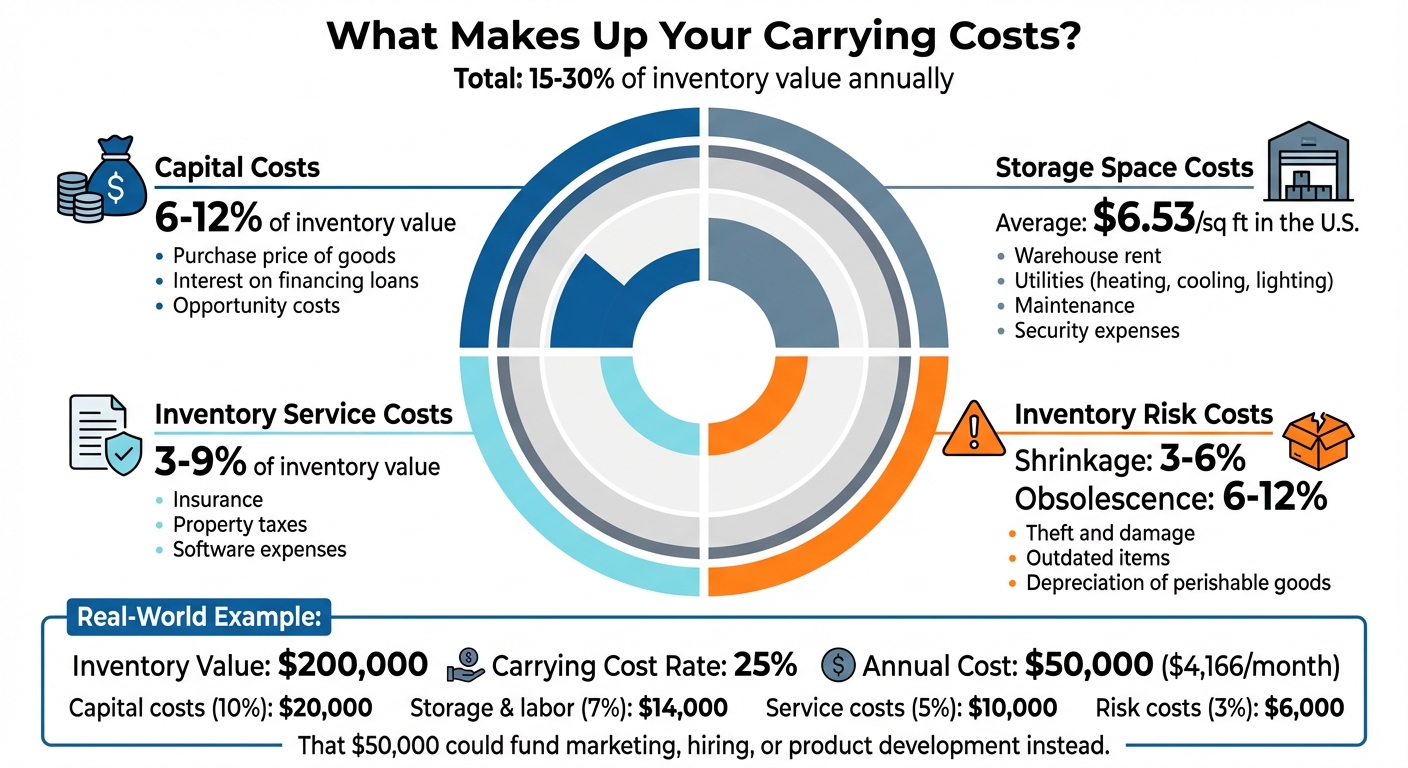
Four Components of Inventory Carrying Costs Breakdown
Main Elements of Carrying Costs
Carrying costs can be grouped into four key categories, all of which eat into profitability. Capital costs often take the largest slice, typically ranging from 6% to 12% of your total inventory value. These include the purchase price of goods, interest on loans used to finance them, and the opportunity cost - what you forgo by tying up money in inventory instead of investing it elsewhere.
Storage space costs encompass all expenses related to housing your inventory. In the U.S., storage averages $6.53 per square foot, which can help you estimate costs. Beyond rent, this category includes utilities like heating, cooling, and lighting, as well as maintenance and security expenses. Then there are inventory service costs, which typically run between 3% and 9% of your inventory value. These cover insurance, property taxes, and software expenses. Lastly, inventory risk costs - with shrinkage at 3% to 6% and obsolescence at 6% to 12% - account for losses due to theft, damage, outdated items, or depreciation of perishable goods.
When combined, carrying costs usually total 15% to 30% of your inventory value annually, though this varies by industry. For example, if your inventory is worth $100,000, you could be spending anywhere from $15,000 to $30,000 each year just to maintain it.
These components highlight the true cost of holding inventory, as demonstrated in the calculation below.
Example: Calculating Carrying Costs
Let’s break down a scenario for a business holding $200,000 in inventory with a carrying cost rate of 25%. This translates to $50,000 annually - or roughly $4,166 per month. Here’s how it adds up: capital costs at 10% amount to $20,000 in interest or opportunity costs; storage and labor costs at 7% total $14,000 for rent, utilities, and warehouse staff; service costs at 5% come to $10,000 for insurance, taxes, and software; and risk costs at 3% equal $6,000 for shrinkage and depreciation.
That $50,000 could instead be used to fund marketing campaigns, hire additional staff, or develop new products. Understanding these figures underscores how reducing carrying costs can free up cash flow for other critical business needs.
How Carrying Costs Affect Cash Flow
Capital Tied Up in Inventory
When inventory sits unsold, it ties up capital that could otherwise fuel growth opportunities like marketing, hiring, or upgrading technology. Implementing a robust Shopify inventory management system can help release this capital. Essentially, that money is stuck on the warehouse shelves, unable to contribute to the business's forward momentum.
Tracy Smith of Numerical Insights LLC highlights this challenge: "Companies are willing to carry more inventory... even though for some, it's still a struggle to get materials". This situation often forces businesses to focus on clearing out old stock rather than channeling resources into innovation. On top of that, this tied-up capital lengthens the cash conversion cycle, further straining cash flow.
Extended Cash Conversion Cycles
Carrying costs can significantly stretch the Cash Conversion Cycle (CCC) - the time it takes to turn inventory investments into cash. Danielle Bauter from Shopify offers a helpful analogy:
"Think of the cash conversion cycle as your company's financial metabolism - the speed at which the business turns investments in inventory and operations into usable cash".
When products linger in storage, Days Inventory Outstanding (DIO) increases, driving up storage costs and delaying the recovery of invested capital. This delay can tighten liquidity, making it harder for businesses to cover daily expenses or offer flexible payment terms to customers. The result? A slower financial "metabolism" that limits the company's ability to operate smoothly.
Shrinking Margins Due to Discounting
The longer inventory remains unsold, the more carrying costs pile up. Eventually, businesses face a tough decision: discount the products to move them quickly or risk losing everything to obsolescence.
Consider Burberry’s controversial move in 2018, when the company destroyed around $38 million worth of unsold goods - including clothing, accessories, and perfume - to protect its brand image rather than resorting to discounts. While this approach worked for a luxury brand, most e-commerce businesses don’t have the luxury of such drastic measures. Instead, they turn to discounting to stop the "cost clock" and generate immediate cash flow. However, this comes at a price - reduced per-unit profit. These shrinking margins emphasize the importance of effective inventory turnover management to safeguard cash flow and maintain profitability.
How to Reduce Carrying Costs and Improve Cash Flow
Improve Demand Forecasting
Getting demand forecasting right is key to avoiding the trap of tying up cash in unsold inventory. Start by diving into your sales history. Analyze daily, monthly, and yearly data to uncover trends like short-term spikes from promotions or long-term seasonal shifts. Use the 80/20 principle to zero in on the top 20% of products that generate 80% of your revenue. For even better insights, evaluate each SKU individually to determine its sales potential and ideal stock levels. Metrics like Inventory Turnover Ratio and Days Sales of Inventory (DSI) can help fine-tune your forecasts.
Take Wildling as an example. By using Shopify POS, they improved stock availability by 5% and saved $10,000 annually.
Tools like Forstock’s AI-powered forecasting models take this a step further by automatically adjusting to sales trends, lead times, and seasonal shifts. These tools offer a 12-month demand outlook, ensuring your purchasing decisions align with actual customer needs. With accurate forecasting, strategies like Just-in-Time inventory management become much easier to implement.
Use Just-in-Time Inventory Management
Just-in-Time (JIT) inventory management is all about keeping stock levels low and receiving goods as close as possible to when they’re needed. This strategy not only reduces the need for large storage spaces but also frees up cash that would otherwise be tied up in inventory.
A crucial part of making JIT work is cutting down lead times - the gap between placing an order and receiving it. Collaborate with suppliers to arrange smaller, more frequent shipments instead of bulk deliveries. This keeps inventory lean while meeting customer demand.
Centralized warehousing combined with JIT can slash carrying costs by up to 25%. Since storage and warehousing alone often account for around 20% of e-commerce inventory expenses, the savings can be substantial. To minimize risks like stockouts, maintain a small safety stock for high-demand items while applying JIT to other products. You can also negotiate extended payment terms with suppliers to better align with your cash flow cycle.
Optimize Storage and Supplier Terms
With warehouse space averaging $6.53 per square foot, efficient use of storage is a direct way to improve cash flow. Start by rethinking your warehouse layout. Place high-turnover items closer to packing stations to cut labor costs, and make the most of vertical space.
Inventory software can also help track supplier performance and negotiate better payment terms, ensuring your cash outflows align with inflows.
Take Pepper Palace, a spice-focused retail chain, as an example. They switched to a centralized inventory system to fix issues where online and in-store orders weren’t connected. This change eliminated the need for complex middleware and saved them $20,000 annually. As Corey Hnat, their Marketing and Digital Sales Manager, explained:
"Website and store orders, inventory, sales, payments, and customer data were all performing like they were detached from one another".
Conduct regular audits to identify slow-moving or “dead” SKUs. Use tools to track metrics like "last sold date" and "overstock units" so you can quickly liquidate these items through discounts or bundles. With efficient storage and supplier terms in place, inventory management becomes even more streamlined.
Use Inventory Management Tools
If you’re still relying on spreadsheets, you’re likely dealing with errors and overstocking. Modern inventory tools eliminate these issues by providing real-time visibility into your stock levels.
Forstock, for instance, integrates seamlessly with Shopify, offering a single dashboard to track inventory, manage suppliers, and monitor performance across multiple locations. The platform automates purchase orders based on reorder points and safety stock alerts, ensuring you only order what’s needed, when it’s needed.
Dynamic reorder points, calculated using demand forecasts and supplier lead times, replace outdated static numbers, removing the guesswork from ordering decisions. This approach prevents both stockouts and overstocking, keeping your cash flow healthy. Plus, Forstock centralizes supplier communication and provides detailed analytics, allowing you to identify underperforming SKUs. This frees up time for focusing on growth areas like marketing, product innovation, or improving the customer experience.
Conclusion
Carrying costs can take a big bite out of your cash flow, limiting the resources available for growth. When a large portion of your inventory's value is tied up in these costs, it means less money for things like marketing, product innovation, or hiring the right people to expand your business. In fact, how well you manage your inventory often determines whether you’re constantly battling cash flow issues or have the financial flexibility to jump on new opportunities.
To address this challenge, the path forward is clear: sharpen your forecasting, embrace just-in-time inventory methods, and streamline your storage processes to unlock cash for growth. As Nauman Poonja from Accounovation explains:
"Managing inventory goes beyond just tracking products - it directly impacts your cash flow and profits".
The key to success lies in systems that empower you to make fast, informed decisions.
Using inventory management tools like Forstock can take your strategy to the next level. With features like real-time tracking, automated processes, and AI-powered forecasting that adjusts to sales trends and seasonality, Forstock helps reduce carrying costs while protecting your cash flow. Its unified dashboard simplifies inventory tracking across multiple locations, and the 12-month demand planning feature ensures smarter ordering decisions. The result? Freed-up cash, better focus, and improved profitability.
FAQs
What are carrying costs, and how can I calculate them for my business?
Carrying costs, often called holding costs, represent the expenses a business takes on to store and manage its inventory. These costs cover a range of factors, including storage fees, labor, insurance, taxes, depreciation, shrinkage (loss of inventory due to theft or damage), and the opportunity cost of having capital tied up in inventory.
To figure out carrying costs, start by calculating your average inventory. This is done by adding the value of your beginning inventory and ending inventory for a specific period, then dividing that total by 2. Once you have your average inventory, multiply it by your total annual holding cost rate - a percentage that combines all the individual carrying cost components. By understanding and analyzing these costs, businesses can uncover inefficiencies and improve cash flow by maintaining better inventory levels.
How can I reduce inventory-carrying costs effectively?
Reducing inventory-carrying costs begins with striking the right balance between having enough stock to meet demand and avoiding unnecessary storage-related expenses. Leveraging AI-driven demand forecasting helps align your inventory with projected sales, preventing overstocking and cutting down on costs like storage fees, insurance, and depreciation. Adopting a just-in-time (JIT) strategy can also minimize the time inventory spends sitting in storage, reducing labor and handling expenses.
Today's advanced inventory management tools can identify slow-moving products, suggest ideal safety stock levels, and even automate purchase orders - keeping your inventory streamlined and efficient. You can also save on operational costs by negotiating better storage rates, consolidating warehouse locations, and introducing automation techniques like cross-docking. Additionally, improving coordination with suppliers to shorten lead times means you won’t need to hold inventory for extended periods.
For Shopify brands, Forstock offers an all-in-one solution to make this process easier. It combines real-time demand forecasting, automated purchase order generation, and detailed inventory analytics. This platform helps lower carrying costs, enhance cash flow, and ensure stock levels are perfectly tuned to meet customer demand without excess inventory.
What is the impact of Just-in-Time inventory management on cash flow?
Just-in-Time (JIT) inventory management is a smart way to improve cash flow by keeping stock levels lean and cutting down on carrying costs like storage fees and insurance. By avoiding unnecessary inventory, businesses can free up capital that might otherwise be stuck in unsold products.
This method also helps prevent overstocking, which can result in wasted resources or products becoming obsolete. With JIT, companies can use their funds more efficiently, leaving room to invest in growth or handle unexpected costs.
Keep reading
Try Forstock free for 14 days.
AI-powered demand forecasting and reorder automation for Shopify brands. No credit card required.