
How Poor Inventory Management Hurts Profits
Stockouts and overstocking drain sales and cash; AI forecasting and automation protect margins.
How Poor Inventory Management Hurts Profits
Inventory management mistakes cost businesses billions every year. Stockouts lead to lost sales and customer churn, while excess inventory ties up cash and increases storage costs. Here's the bottom line:
- Stockouts can cost 2–5x the value of a lost sale and damage customer loyalty.
- Excess inventory locks up funds and adds carrying costs, often 30% of the inventory's value annually.
- Manual tracking methods are error-prone, with inaccuracies reaching up to 50%, leading to poor decisions.
- In 2025, supply chain disruptions caused $301 billion in losses, with companies like Funko Pop writing off $250 million in unsold stock.
To avoid these pitfalls, businesses need real-time data, automated tools, and better demand forecasting. Solutions like Forstock integrate with platforms like Shopify to sync inventory, predict demand, and automate orders - saving time and money.
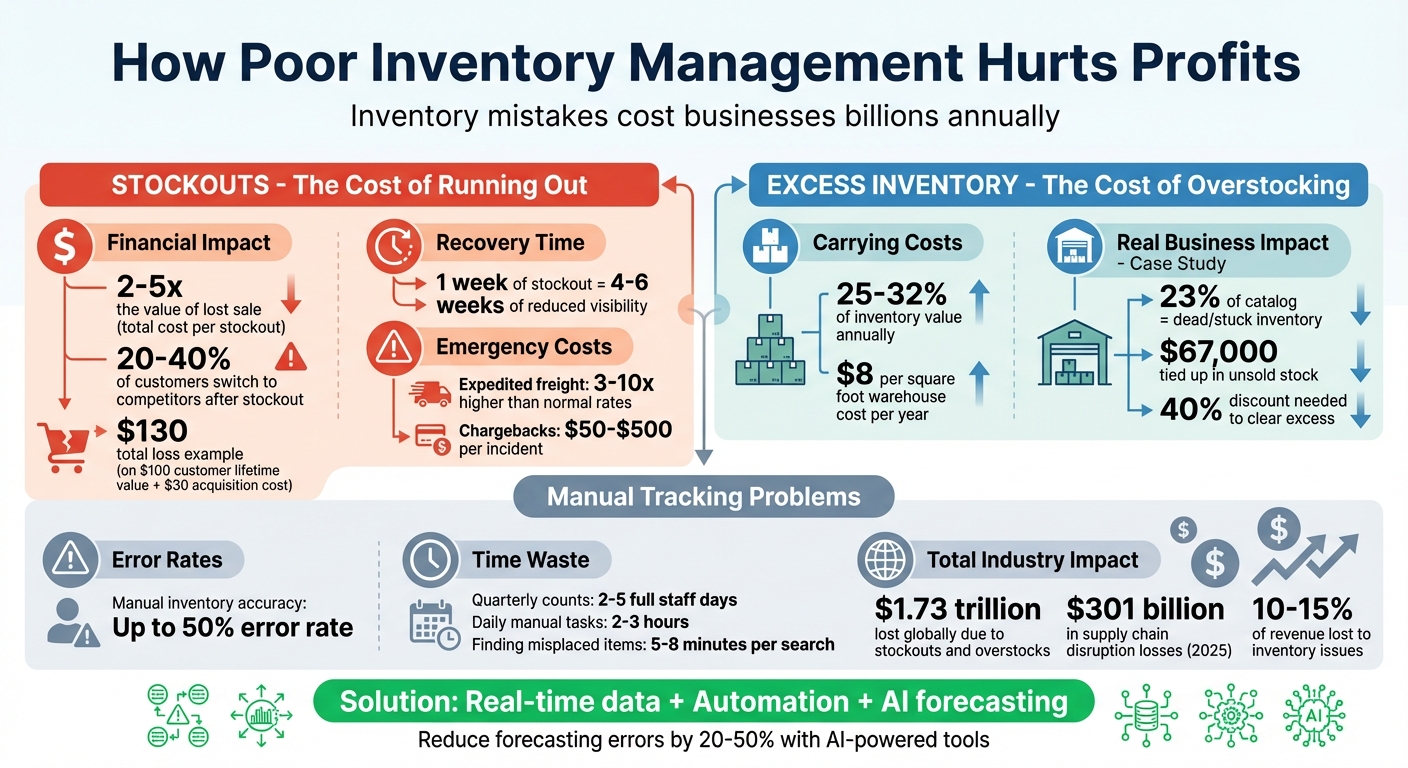
The True Cost of Poor Inventory Management: Stockouts vs Excess Inventory
How Inventory Mistakes Damage Your Bottom Line
Poor inventory management can eat away at your profits in ways that might not immediately show up on your balance sheet. Over time, though, these issues can severely impact profitability and restrict the cash flow you need to grow. Let’s break down how stockouts and excess inventory can lead to lost revenue and higher costs.
Revenue Loss from Stockouts
Seeing "out of stock" on a product page doesn’t just mean missing out on one sale - it’s often much more costly. A single stockout can cost you 2–5 times the value of the lost sale. Why? Because it wastes the money you spent on customer acquisition through ads, SEO, or influencer campaigns.
And it gets worse. Studies show that 20–40% of customers who encounter a stockout will switch to a competitor. For perspective, let’s say your average customer acquisition cost is $30 (with typical costs ranging from $10–$50), and each customer would normally spend $100 over their lifetime with your brand. A single stockout could cost you $130 in total value - the lost sale plus wasted acquisition spend.
Stockouts also have ripple effects beyond immediate sales. On platforms like Amazon, running out of stock can lower your Best Seller Rank, reduce search visibility, and even cause you to lose Buy Box eligibility. These setbacks aren’t easy to recover from. According to the Planster Team:
One week of stockout on Amazon can easily cost you 4–6 weeks of reduced visibility and sales afterward.
And then there are the extra costs. You might need to pay for expedited freight, which can be 3–10 times higher than normal rates, or face chargebacks ranging from $50–$500 per incident. But stockouts aren’t the only inventory issue that can hurt your bottom line - excess inventory brings its own challenges.
The Hidden Costs of Excess Inventory
Having too much inventory isn’t just inconvenient - it’s expensive. Costs pile up from warehousing, labor, insurance, and depreciation. With warehouse space costing about $8 per square foot per year, every unsold box represents tied-up capital.
This isn’t just a theoretical problem. Take Jessica, an apparel merchant with $450,000 in annual revenue. In late 2025, she discovered that 23% of her catalog - 412 products - was classified as dead stock or "stuck" inventory, tying up $67,000 in value. By using automated discounting rules, she managed to clear $28,000 worth of inventory in just 60 days. The cash she freed up was reinvested in trending products, leading to an 18% revenue boost the next quarter.
Excess inventory can also lead to tough choices. To free up space or recover cash, you might have to slash prices with deep discounts, which eat into your profit margins. For example, Amanda’s home goods store (with $820,000 in annual revenue) faced this issue. She had to apply 40% discounts to move slow-moving products. By identifying these items earlier and opting for smaller 15% discounts, she saved an estimated $34,000 in markdown costs over a year. Automated tracking tools can help prevent these losses.
sbb-itb-f0fc809
Problems with Manual Inventory Tracking
Many growing businesses still rely on spreadsheets, handwritten logs, and manual counts to manage their inventory. While these methods might suffice for a small operation, they become a major drain on resources as your business grows. The slow processes and lack of accurate, up-to-date data lead to costly errors and inefficiencies. Over time, these manual systems create serious challenges for maintaining consistent data and making timely decisions.
Disconnected Data and Lack of Real-Time Insights
When inventory information is scattered across spreadsheets and handwritten notes, different teams often end up working with conflicting data. Imagine this: your marketing team runs a promotion for a product that's nearly out of stock, while your purchasing team places orders based on outdated reports. This mismatch is what experts call "multi-channel chaos". For example, your website might show an item as available, even though it’s sold out in the warehouse. Meanwhile, your accounting software, e-commerce platform, and physical inventory counts all tell different stories. Manual inventory counts are prone to errors, with inaccuracies reaching up to 50%. That means half of your inventory data could be wrong.
These inconsistencies don’t just cause internal headaches - they can lead to significant financial losses. Some well-known brands have had to slash prices or write off large amounts of inventory simply because they failed to track demand accurately in real time. As Clear Spider explains:
Poor inventory management is not just about 'having too much or too little inventory.' It's about lacking visibility.
Without clear, consistent data, hidden costs pile up, eating into your profits.
Errors in Ordering Decisions
The lack of reliable, real-time data also leads to poor ordering decisions. Guesswork becomes the norm, resulting in overstocking slow-moving items and running out of popular products.
Manual tracking is also a huge time sink. Quarterly physical inventory counts can take 2–5 full staff days, while daily manual tasks often consume 2–3 hours of valuable time. On top of that, searching for misplaced items in the warehouse takes an average of 5–8 minutes per search. Multiply that by hundreds or thousands of SKUs, and the wasted time quickly adds up. These inefficiencies not only create direct losses from stockouts and excess inventory but also drain resources that could be better spent on growing your business.
The financial toll is hard to ignore. Inventory issues cost businesses 10% to 15% of their revenue. Holding excess inventory adds even more expenses, with storage, insurance, and depreciation costs totaling 25–32% of an item's value each year. When inventory problems force businesses into "crisis mode", emergency shipments and reactive measures cost 3–5 times more than proactive management.
How to Fix Your Inventory Problems
Stop losing money on inventory mishaps by replacing guesswork with data-driven strategies and automation. Tackling inventory issues effectively starts with leveraging advanced analytics and smart systems to eliminate human errors.
Forecasting Demand and Automating Orders
AI-powered demand forecasting can transform how you predict customer needs. Machine learning models evaluate factors like sales velocity, seasonality, promotions, social media trends, and even weather patterns to improve accuracy. These systems reduce forecasting errors by 20% to 50% compared to traditional methods.
Instead of relying on static reorder points, dynamic triggers adjust order quantities based on real-time demand and supplier lead times. This approach minimizes stockouts, which can cost businesses an average of 4% of annual revenue, and prevents excess inventory, which often ties up 20% to 30% of working capital.
ABC analysis is another tool that helps you focus on what matters most. For example:
- Category A items: The top 20% of products that drive 80% of revenue need frequent forecasting.
- Category B items: Require regular monitoring but less attention than Category A.
- Category C items: Can be stocked in larger quantities to reduce reordering frequency.
When paired with centralized tracking systems, these strategies provide a more efficient and comprehensive approach to inventory management.
Centralized Inventory Tracking
A unified dashboard eliminates discrepancies across your website, warehouse, and accounting systems by synchronizing inventory levels in real time. This kind of system not only resolves inconsistencies but also reduces labor hours and operating costs.
Guillaume Jaillet, Chief Omnichannel Officer at Oak + Fort, shared a key challenge they overcame:
It was hard to reliably and accurately represent which stores had certain items in stock to our digital customers when they wanted to try something on.
Centralized tracking also speeds up decision-making. With all your inventory data in one place, you can quickly identify trends, spot slow-moving products before they become dead stock, and collaborate with suppliers using up-to-date insights. Considering that the global retail industry loses $1.73 trillion annually due to stockouts and overstocks, the importance of such systems is undeniable.
How Forstock Helps Shopify Brands Manage Inventory
Forstock tackles the financial pitfalls of poor inventory management with tools designed to safeguard your profits. By directly integrating with your Shopify store, it syncs your listings, orders, and stock levels automatically. This means you can handle everything from one dashboard, eliminating the need for spreadsheets and cutting down on manual errors. With features like automated demand forecasting, purchase orders, and supplier coordination, Forstock simplifies the entire inventory management process.
AI-Powered Demand Forecasting
Forstock’s AI dives into your Shopify data to predict demand, factoring in seasonality, growth trends, and current market conditions. It calculates reorder points by combining sales velocity with supplier lead times, ensuring stock arrives right on time. Emily, an Inventory Manager, shares her experience:
I open the dashboard in the morning and instantly know which items to reorder, which are overstocked, and where to concentrate efforts.
The platform also sends alerts before stockouts occur and keeps an eye on inventory turnover, flagging slow-moving products. Sophie, an E-commerce Manager, says:
The AI forecast actually makes sense for my business. It feels like having a supply chain manager on my team.
Forstock doesn’t stop at forecasting - it simplifies ordering with automated, data-driven processes.
Automated Purchase Orders and Supplier Coordination
With Forstock’s AI-driven Reorder Table, you’ll know exactly what to order and in what quantities, eliminating the guesswork. Purchase orders can be created with a single click, split among suppliers, and tracked effortlessly. Once items are received and payments are recorded, inventory levels in your Shopify store are updated automatically. Daniel, a Supply Chain Manager, explains:
We were managing multiple suppliers and orders. With Forstock, we can create POs in minutes, track supplier performance, and forecast demand without the guesswork.
The dashboard also centralizes supplier communication, ensuring nothing gets lost during busy periods.
Better Cash Flow and Profit Margins
Forstock helps free up cash by reducing overstock and improving purchasing decisions. Its inventory health monitoring highlights products tying up capital, allowing you to focus on moving that stock. Meanwhile, AI alerts prevent revenue loss from stockouts. Liam, an Operations Director, sums it up:
We have cut manual inventory tasks by at least 60%.
Conclusion
Poor inventory management can take a serious toll on profits. Stockouts don’t just mean lost sales - they often lead customers to abandon their carts altogether. On the flip side, holding too much inventory ties up working capital, money that could otherwise be used to grow your business. And when you consider that inventory distortion costs the global retail industry a staggering $1.73 trillion every year, it’s clear that relying on guesswork and spreadsheets just won’t cut it.
To tackle these challenges, data-driven tools step in to replace uncertainty with precision. Features like AI-powered forecasting help pinpoint accurate reorder points, while manual vs. automated purchase orders ensure you restock at the right time - avoiding costly emergency shipping and missed sales opportunities. Plus, centralized dashboards give you real-time insights across all your sales channels, so you’re always in the know.
Forstock combines these tools into one solution tailored for Shopify brands. It automatically syncs inventory, identifies slow-moving products before they drain your resources, and sends reorder alerts to prevent stockouts.
Treat your inventory as a strategic asset. Make decisions based on data, not gut feelings. By addressing issues proactively, you can avoid the pitfalls of stockouts and overstocking. Every small improvement in inventory management adds to your bottom line. With the right tools, you can maintain steady cash flow, meet customer demand, and focus on growing your business rather than constantly putting out fires.
FAQs
How do I know if stockouts are hurting my profits?
Stockouts can take a serious toll on profits. They don't just mean missed sales - they also lead to higher customer acquisition costs and the risk of losing loyal customers to competitors. The fallout can be costly, often amounting to 2–5 times the value of the missed sale. Worse yet, the damage can extend beyond immediate losses, potentially causing a long-term decline in revenue.
By regularly analyzing sales data and understanding customer behavior, businesses can pinpoint these issues early and work toward minimizing their impact.
What’s the fastest way to reduce dead stock without killing margins?
To keep dead stock under control without sacrificing margins, lean on data-driven demand forecasting and automated inventory management. Tools powered by AI, such as Forstock, can pinpoint slow-moving products and fine-tune purchasing decisions to avoid overstocking.
Additionally, conducting regular inventory audits and tweaking order quantities based on demand patterns can help clear out stock more effectively. These approaches reduce the need for steep discounts, allowing you to maintain profitability while speeding up the clearance process.
When should I switch from spreadsheets to automated inventory tools like Forstock?
When spreadsheets start falling short of your business demands, it’s time to consider automated inventory tools like Forstock. You might notice the cracks when you're managing over 100 SKUs, dealing with constant stockouts or overstocking, or struggling with frequent errors. Scalability issues can also be a red flag.
If manual processes are causing delays, inaccuracies, or driving up labor costs, switching to a tool that offers real-time tracking and demand forecasting can make a big difference. It streamlines operations, reduces errors, and helps your business stay on track as it grows.
Keep reading
Try Forstock free for 14 days.
AI-powered demand forecasting and reorder automation for Shopify brands. No credit card required.