
How AI Helps Prevent Overstock and Stockouts
AI forecasting and automated ordering eliminate costly overstock and stockouts, freeing cash and keeping online stores in stock.
How AI Helps Prevent Overstock and Stockouts
Managing inventory is one of the biggest challenges for Shopify merchants. Order too much, and you’re stuck with unsold products and high storage costs. Order too little, and you risk stockouts, lost sales, and unhappy customers. Traditional methods like spreadsheets only deliver 60–70% accuracy, leaving merchants vulnerable to these costly mistakes.
AI-powered tools are changing the game. With 85–95% accuracy, AI systems predict demand, reduce inventory holding costs by 20–30%, and cut stockouts by 15–25%. These tools analyze factors like sales trends, seasonality, and even social media activity to provide smarter, data-driven forecasts. The result? Fewer inventory headaches, better cash flow, and happier customers.
Key benefits of AI in inventory management include:
- Demand forecasting: AI predicts demand with 85–95% accuracy, helping avoid overstock and stockouts.
- Automated ordering: AI generates purchase orders based on real-time data, saving time and reducing errors.
- Lower costs: Businesses see a 40% drop in excess inventory and a 45% reduction in stockouts.
- Improved customer satisfaction: Ensures products are in stock, boosting loyalty and sales.
Forstock, an AI-driven platform for Shopify merchants, simplifies inventory management with real-time forecasts, automated purchase orders, and detailed analytics. Merchants like Jason from HomeGoods have saved tens of thousands by switching from manual methods to AI tools. If you’re looking to streamline inventory and reduce costly mistakes, AI might be the solution you need.
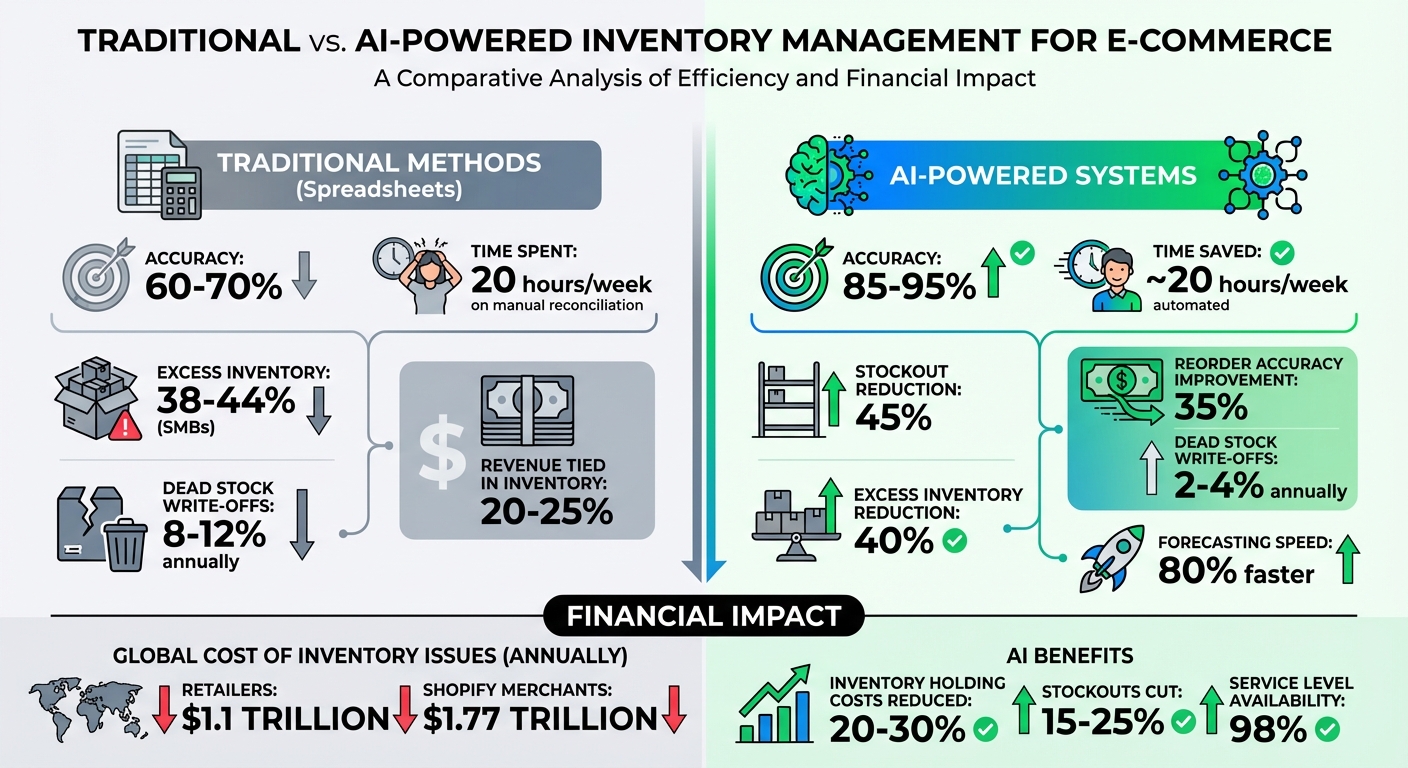
Traditional vs AI Inventory Management: Accuracy and Cost Comparison
What Are Overstock and Stockouts?
Overstock happens when a business has more inventory than customers are buying, while stockouts occur when products sell out but demand remains. These inventory missteps are expensive - costing retailers around $1.1 trillion globally and Shopify merchants $1.77 trillion annually. Overstock ties up cash in unsold goods, while stockouts lead to lost sales and frustrated customers.
What Causes Overstock
Overstock often begins with "just in case" ordering - buying extra stock to avoid stockouts, even when data doesn’t justify it. This approach, driven more by gut feelings than real-time insights, can quickly lead to excess inventory. Other common causes include overestimating seasonal demand (like overordering for a holiday that underdelivers), failing to clear out discontinued items, and ignoring slow-moving SKUs.
"Dead stock ties up working capital, wastes warehouse space, and eats into profit margins. For B2B businesses with hundreds or thousands of SKUs, dead stock is more than a nuisance - it's a strategic liability." - BetterCommerce
What Causes Stockouts and Their Impact
Stockouts, on the other hand, are often triggered by unexpected demand surges - think viral products, successful marketing campaigns, or seasonal demand arriving earlier than planned. These issues are worsened by supply chain delays and outdated inventory tracking methods like manual spreadsheets, which can’t adapt fast enough to real-time changes.
The consequences extend beyond a single missed sale. 69% of customers say stock availability influences their loyalty to a brand. When faced with an out-of-stock product, many customers will simply shop elsewhere. Stockouts can also lead to a revenue loss of over 4% and erode long-term trust in the brand.
"Nearly 75% of supply chain leaders reported significant disruption in their operations due to supply shortages and delayed shipments since 2020." - Supply & Demand Chain Executive
The Cost of Inventory Imbalances
Overstock locks up working capital, reducing funds available for other priorities like marketing, new products, or business growth. Companies relying on traditional methods often have 20–25% of their revenue tied up in inventory, with dead stock write-offs reaching 8–12% annually. On top of that, storage costs can further drain resources.
Stockouts come with their own set of problems. Beyond immediate revenue loss, they weaken a brand’s competitive edge and often require urgent restocking at higher costs. Operationally, they’re a nightmare - business owners can spend up to 20 hours a week reconciling data across platforms to prevent future crises.
| Inventory Issue | Financial Impact | Customer Impact |
|---|---|---|
| Overstock | 20–25% of revenue locked in inventory, 8–12% annual write-offs | Discounting excess stock risks devaluing the brand |
| Stockouts | 4%+ revenue loss, higher restocking costs | 69% of customers say stock availability affects loyalty |
These challenges highlight the need for smarter, data-driven inventory management. Moving away from outdated methods toward automated forecasting can help businesses avoid these costly pitfalls.
sbb-itb-f0fc809
How AI Improves Inventory Management
AI transforms inventory management by analyzing historical sales trends, seasonal patterns, marketing effects, and supplier lead times. This shift from reactive to proactive management helps businesses anticipate demand before issues arise, creating a more efficient and reliable system.
AI-Powered Demand Forecasting
AI demand forecasting uses vast amounts of data to predict customer behavior with precision. By integrating information from platforms like Shopify, Amazon, and warehouse systems into one unified view, AI helps businesses track demand across all channels. The results are impressive: companies using AI forecasting have reported a 45% reduction in stockouts, a 40% decrease in excess inventory, and a 35% improvement in reorder accuracy. These outcomes directly tackle the dual challenges of overstock and stockouts by aligning inventory levels with actual demand.
"AI demand forecasting doesn't just automate the math - it helps you see ahead." - Xorosoft Technologies
AI also enables managers to simulate "what-if" scenarios. For example, they can predict how upcoming promotions or product launches might impact inventory, ensuring stock is ready well in advance.
Adapting to Changing Sales Patterns
AI systems continuously learn and evolve with each sales cycle. They automatically adjust reorder point accuracy based on demand signals, ensuring businesses avoid both stock shortages and overstocking.
"When your AI sees signals that sales will rise, it raises reorder points automatically. When demand slows, it trims replenishment levels." - Xorosoft Technologies
For optimal performance, most AI models need 12–24 months of sales and campaign data. Over time, the system refines its understanding of "normal" demand patterns, improving accuracy with every transaction.
Automating Inventory Tasks
AI simplifies inventory management by automating repetitive tasks. It generates purchase orders based on predicted needs, consolidates data from multiple platforms, and sends proactive alerts. This automation saves operations teams about 20 hours per week, eliminating the need for manual reconciliation and calculations.
Even better, setting up a basic AI forecasting system is quick. It can be trained on historical data in just one week. After that, human oversight ensures the system stays aligned with real-time market changes through weekly reviews.
These AI-driven capabilities pave the way for Forstock's advanced solutions in inventory optimization.
How Forstock Prevents Overstock and Stockouts
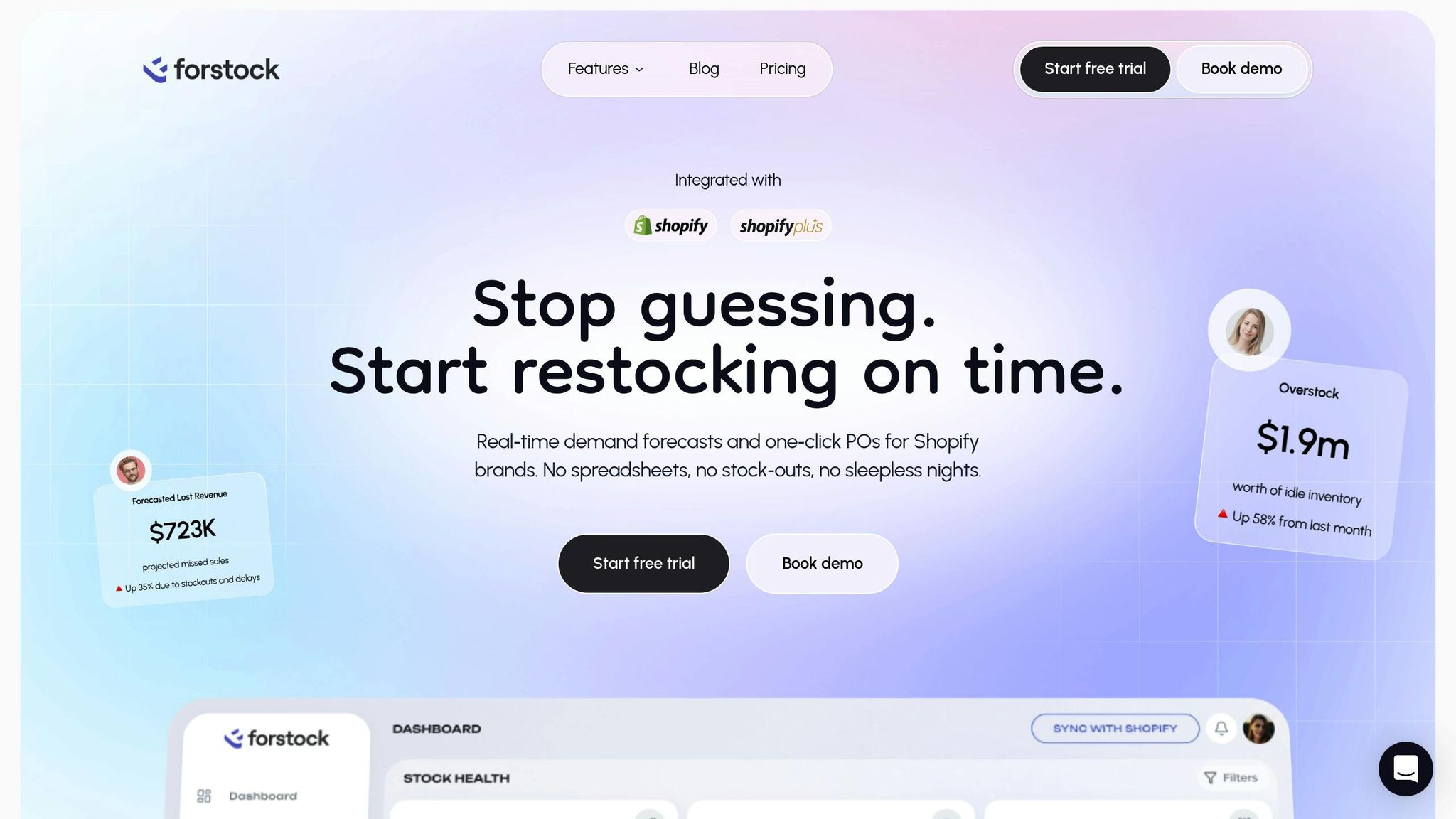
Forstock offers Shopify merchants an AI-driven solution for inventory management. The platform integrates directly with Shopify, pulling in sales data, product catalogs, and order histories to provide a complete view of inventory health. By combining this data with machine learning, Forstock tackles the challenges of overstock and stockouts head-on. Its advanced forecasting, automated ordering, and detailed analytics ensure merchants stay ahead of demand and supply issues.
Real-Time Demand Forecasting with 95% Accuracy
Forstock's AI processes Shopify data - like seasonality, historical trends, and growth patterns - to predict demand with 95% accuracy. It continuously monitors inventory across all SKUs, calculating depletion dates and reorder points so merchants can spot risks, whether it's a potential stockout or slow-moving items.
Take Jason, co-founder of HomeGoods, as an example. His business was losing $50,000 every month due to stockouts. After adopting Forstock, he reduced excess inventory by 45% and unlocked $150,000 in working capital. Another Shopify apparel brand used Forstock to prepare for Black Friday. By analyzing past trends, the platform predicted a 30% demand surge, recommending purchase quantities that avoided $50,000 in overstock costs while ensuring zero stockouts. This level of precision empowers merchants to make smarter, data-backed decisions.
Automated Purchase Order Creation
Forstock doesn’t just forecast demand - it streamlines the entire ordering process. When the system identifies items that need replenishing, it creates purchase orders automatically. These orders factor in forecasted demand, current stock levels, supplier lead times, and safety stock requirements. Orders are then sent directly to suppliers using built-in communication tools, cutting coordination time by half.
Alexander, an E-commerce Manager at PureOrganics, saved over 10 hours each week thanks to Forstock’s automated purchase order feature. Setup takes just two minutes, and the platform handles complex catalogs with ease. For example, it breaks down forecasts by size, color, and SKU, ensuring fast-moving variants stay in stock without overloading slower ones. It also calculates landed costs - including shipping and customs - so merchants know their total expenses before placing an order.
Inventory Analytics for Better Decisions
Forstock’s unified dashboard provides real-time insights into stock levels, turnover rates, supplier lead times, and 12-month demand trends. It flags items as "Running Low" or with a "Stock Gap" while identifying slow-moving inventory that ties up cash. Matt, Operations Lead at TechGear, discovered over $70,000 in slow-moving stock within a week of using Forstock’s analytics tools. The platform also tracks supplier performance, monitoring on-time delivery rates and lead time variability, helping merchants optimize their supply chain and reduce inefficiencies.
Benefits of AI-Driven Inventory Management
AI-powered inventory tools bring measurable advantages that enhance financial performance, strengthen customer relationships, and improve operational workflows. These tools leverage advanced forecasting and automation to deliver benefits in areas like cost control, customer satisfaction, and business scalability.
Lower Costs and Improved Cash Flow
For small and mid-sized businesses, excess inventory often makes up 38% of stock, and this figure climbs to 44% for larger SMBs with over 500 employees. AI tackles this issue by pinpointing slow-moving products and fine-tuning replenishment strategies. This frees up working capital, reduces storage expenses, and cuts down on inventory maintenance costs. By accurately forecasting product lifecycles, AI can lower annual write-offs of dead stock from the typical 8–12% to just 2–4%. Additionally, automation saves time - about 20 hours per week - allowing teams to focus on growth strategies instead of tedious manual tasks.
Higher Customer Satisfaction
A healthy cash flow ensures that products stay in stock, which directly improves customer trust and loyalty. AI analyzes demand at the individual SKU level, factoring in details like size, color, and variant preferences. This ensures that customers find exactly what they are looking for. By integrating data across all sales platforms, AI eliminates discrepancies where one channel shows "out of stock" while inventory is available elsewhere. Real-time adjustments to safety stock, based on demand and supplier lead times, support service levels of around 98% availability. Companies using AI forecasting have seen a 45% drop in stockouts and a 40% reduction in excess inventory within just two months. This reduces order delays and minimizes the need for costly last-minute shipments.
Easier Scaling and Reduced Errors
As businesses grow, managing more SKUs, sales channels, and warehouses becomes increasingly complex. AI handles this growth without requiring a matching increase in staff or inventory costs. Forecasting and planning processes become 80% faster with AI tools, while reorder accuracy improves by 35%. Adaptive algorithms continuously learn from each prediction cycle, adjusting to shifts in market trends and supply chain variability. This allows operations teams to move away from reactive problem-solving and focus on building efficient, scalable systems and stronger supplier partnerships.
Conclusion
AI has reshaped inventory management, shifting it from reactive guesswork to proactive, predictive strategies that rely on insights from sales trends, marketing efforts, and supplier timelines. Companies leveraging AI for forecasting have seen impressive results: 45% fewer stockouts, 40% less excess inventory, and a 35% boost in reorder accuracy.
"That's the true promise of AI demand forecasting for ecommerce - not to replace humans, but to free up time for strategic decision-making." – Xorosoft Technologies
Tools like Forstock bring these AI capabilities to Shopify merchants, automating and streamlining inventory decisions. Features like real-time stock health monitoring - flagging items as "Running Low" or identifying a "Stock Gap" - help you catch potential problems before they disrupt sales. Automated purchase orders eliminate tedious spreadsheet work, allowing operations teams to channel their energy into growth-focused initiatives.
The leap from traditional forecasting methods (with 60–70% accuracy) to AI-powered systems (achieving 85–95% accuracy) translates into fewer costly errors and improved profit margins. This heightened precision supports scalability without sacrificing control.
As your product catalog expands and sales channels diversify, AI ensures inventory remains tightly managed without increasing effort. By consolidating Shopify, warehouse, and supplier data into a single platform, you can set clear service-level goals - like maintaining 98% availability - and let AI dynamically adjust reorder points based on emerging trends. This transforms inventory management into a strategic driver of profitability and long-term success.
FAQs
What data does AI need to forecast demand accurately?
AI relies on a mix of internal and external data to make accurate demand forecasts. Internally, it examines historical sales records, seasonal patterns, supplier lead times, and inventory performance to spot trends and fine-tune predictions. Externally, it factors in elements like weather conditions, social media buzz, economic trends, and holiday schedules to anticipate changes in demand. By blending these data sources, AI helps Shopify brands strike the right balance, avoiding both stockouts and excess inventory.
How long does it take to see results after using Forstock?
Users usually start seeing noticeable results in roughly 60 days. These results often include a 45% drop in stockouts and a 40% reduction in excess inventory, driven by AI-powered forecasting that fine-tunes inventory management and purchasing strategies.
Can AI handle new products with little or no sales history?
AI can handle new products - even those with little or no sales history - by leveraging insights from market trends, seasonality, and supplier lead times. Using advanced forecasting models, AI identifies patterns and makes informed predictions by comparing the new product to similar items and factoring in external conditions. These tools continuously adjust to real-time data, improving accuracy over time. This approach helps businesses avoid stockouts or overstocking, even when historical data is scarce.
Keep reading
Try Forstock free for 14 days.
AI-powered demand forecasting and reorder automation for Shopify brands. No credit card required.