
Managing Inventory Across Multiple Countries
Centralize tracking, automate syncing, and use AI forecasts to manage SKU-by-location inventory, supplier lead times, and compliance across countries.

Managing Inventory Across Multiple Countries
Managing inventory across multiple countries is challenging but achievable with the right systems in place. Key steps include centralizing inventory tracking, automating processes, and using tools to forecast demand accurately for each region. Here’s a quick summary of how to streamline operations:
- Centralized Tracking: Use Shopify's multi-location feature to manage stock across warehouses and fulfillment centers in different regions.
- Automation: Tools like Forstock help sync inventory across sales channels, automate purchase orders, and manage supplier performance.
- Forecasting: AI-powered platforms analyze demand trends and adjust inventory for regional differences, avoiding stockouts or excess stock.
- Supplier Management: Diversify suppliers to reduce risks and track lead times to plan for delays.
- Compliance: Handle currency conversions, regional pricing, and tax regulations to meet local requirements.
With these strategies, businesses can manage international inventory efficiently, reduce errors, and meet customer demand without tying up excessive capital.
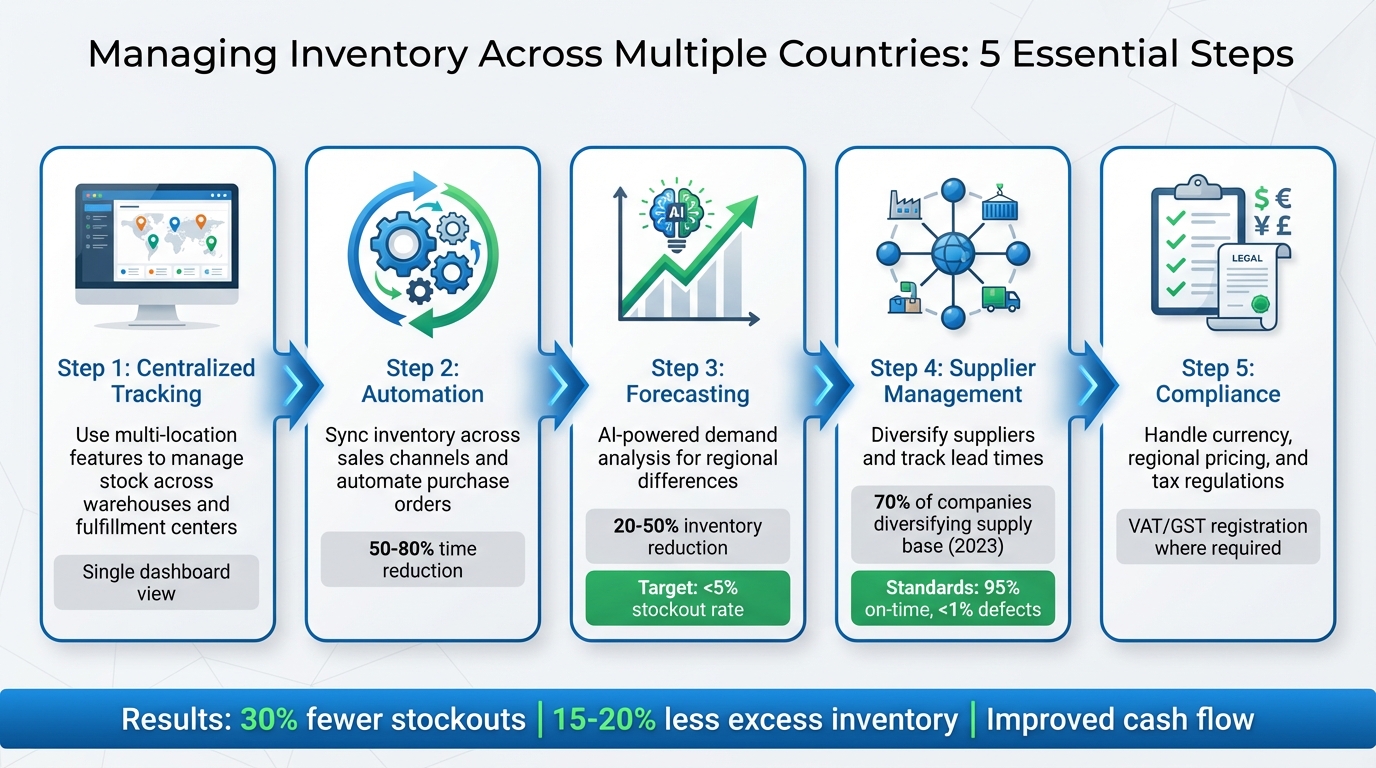
5 Essential Steps for Managing Multi-Country Inventory Operations
Shopify tutorial: How to manage inventory with multiple warehouses across the globe [with Markets]

How to Set Up Multi-Country Inventory Tracking in Shopify
If you're looking to manage inventory across multiple countries, Shopify's tools make it easier to track and sync stock at various locations. With its multi-location feature - available on Basic plans and above - you can oversee warehouses, fulfillment centers, and retail stores all from a single dashboard. Start by conducting a thorough stocktake at each location to ensure accurate inventory counts. This step is essential to avoid issues like overselling or phantom stock. Once your data is clean, you can activate multi-location tracking and allocate stock strategically based on regional demand. This setup also lets you make the most of Shopify's automation and analytics capabilities.
Turn On Shopify's Multi-Location Feature
To get started, log in to your Shopify admin and go to Settings > Locations. Click "Add location" to set up entries for each of your warehouses or fulfillment centers. For instance, you might add a warehouse in Los Angeles and a fulfillment center in London. When filling in details like address, contact information, and currency, make sure to follow U.S. standards. Assign a role to each location - such as warehouse, store, fulfillment-only, or pickup/delivery.
Next, enable inventory tracking for each location by toggling the appropriate option in the settings. This prevents overselling and ensures your stock levels remain accurate across different markets. You can also control staff access by assigning permissions for tasks like adjusting stock levels or initiating transfers.
Once your locations are active, you can start allocating inventory based on market demand.
Assign Stock to International Locations
After setting up your locations, it's time to distribute inventory according to regional needs. Navigate to Products > Inventory, select a product, and click "Manage inventory at specific locations." From there, you can manually assign quantities to each warehouse or use bulk editing for faster updates. For example, if you have 1,000 T-shirts, you might allocate 500 to a U.S. warehouse, 300 to Canada, and 200 to the U.K.
To ensure customers only see items available in their region, use Shopify's fulfillable inventory feature. Set up shipping profiles that limit visibility by shipping zone, reducing the chances of customers encountering unavailable products at checkout. For more advanced setups, create shipping profiles with multiple zone groups or locations that offer pickup or delivery options.
Don't forget to set low-stock alerts - say, at 50 units - to prompt timely reorders. Use the Analytics > Reports section to monitor inventory levels, transfers, and adjustments across all locations. By tracking sales trends and refining your stock allocations, you can aim for a stockout rate under 5%, ensuring smoother operations and happier customers.
How to Sync Stock Levels Across International Sales Channels
Selling on platforms like Shopify, Amazon, eBay, and even social media requires real-time inventory updates. Without these updates, you risk overselling products that may already be out of stock in a particular region or channel. This can lead to canceled orders and unhappy customers. The key is to connect your systems so that every sale, return, or adjustment is instantly reflected across all platforms. Automating these updates is the next step to keeping everything running smoothly.
Connect Shopify with Third-Party Tools
To keep your inventory accurate across multiple international marketplaces, you’ll need tools that link Shopify with external sales channels. API-based integrations make this possible by automatically syncing inventory across platforms. With these integrations, you can centralize your inventory management, giving you a single dashboard to track stock levels across all channels.
Forstock is one such tool that integrates directly with Shopify. It syncs your listings, orders, and inventory in real time, giving you a unified view of your entire catalog. From this dashboard, you can monitor inventory health, supplier performance, and open purchase orders - all without needing to jump between multiple systems. This streamlined approach allows you to make faster, data-driven decisions.
Use Real-Time Inventory Syncing
Taking integrations a step further, real-time syncing reduces the need for manual updates. With real-time syncing, any sale - whether it happens in Los Angeles, Toronto, or London - automatically adjusts inventory levels globally. This is especially crucial during busy periods, like holiday sales, when tracking stock manually becomes nearly impossible.
To stay ahead, monitor sales and lead times closely, and enable low-stock alerts. These alerts notify you when inventory drops below a set threshold, ensuring you can reorder before running out. Additionally, Shopify’s fulfillable inventory feature works seamlessly with syncing tools to control what products customers see based on their shipping zones. This ensures customers only order items you can deliver to their specific region, avoiding unnecessary complications.
How to Manage Suppliers for Cross-Border Operations
Managing international suppliers is more than just placing orders and waiting for deliveries. When your inventory spans multiple countries, the reliability of your suppliers can directly influence your ability to keep shelves stocked and customers happy. A delay from one supplier can ripple across your entire operation, causing stockouts and missed opportunities. To avoid this, it’s essential to integrate supplier performance into your automated inventory systems. A strong supplier strategy, combined with real-time inventory management, is key to running smooth cross-border operations.
Build a Diversified Supplier Network
Relying on a single supplier for key products is a risky move in cross-border operations. Regional disruptions - such as port closures, political unrest, or natural disasters - can stop production or shipping in its tracks. According to a 2023 Deloitte survey, over 70% of companies planned to diversify their supply base after recent supply chain disruptions, highlighting the importance of multiple sourcing and nearshoring.
The best strategy is to secure a primary and a backup supplier for each critical product, ideally located in different regions. For example, a U.S.-based Shopify brand might use a nearshore supplier in Mexico for faster replenishment and an offshore supplier in Asia for cost savings. You can set allocation rules, such as sourcing 80% from the primary supplier and 20% from the backup, and negotiate emergency capacity agreements with secondary suppliers. This setup ensures you can pivot quickly if your primary supplier encounters delays, keeping your operations running smoothly.
When choosing suppliers, evaluate their on-time delivery rates, communication, product quality, and logistics capabilities. Establish minimum standards - like 95% on-time shipments and less than 1% defect rates - before adding a supplier to your roster. Use a centralized system to track supplier data, lead times, and performance metrics, making comparisons and periodic re-qualification easier. For instance, Forstock offers a dashboard that lets Shopify brands monitor supplier performance, manage purchase orders, and track lead time consistency, enabling smarter, data-driven decisions.
It’s also important to share forecast data and promotional calendars with your suppliers so they can plan ahead and secure raw materials. Establish predictable ordering patterns, like monthly or biweekly purchase orders based on forecasts, to create a steady workflow. Regular monthly reviews with suppliers can help align expectations and address potential issues quickly.
"With Forstock, we can create POs in minutes, track supplier performance, and forecast demand without the guesswork." - Daniel, Supply Chain Manager
Once your supplier network is in place, the next step is to closely monitor lead times and customs processes.
Track Lead Times and Plan for Customs Delays
Lead times in cross-border operations are rarely straightforward. Beyond the quoted number of days, you need to account for production time, transport to the port, main transit, customs clearance, and final delivery to your warehouse. Factors like customs inspections, port congestion, or documentation errors can add days - or even weeks - to your timeline, especially during busy periods like Q4 or Chinese New Year.
Track every order’s lead time - from approval to final receipt - by supplier, product, and shipping route (e.g., China to the U.S. West Coast versus Europe to the U.S. East Coast). Record these metrics in your inventory system and calculate rolling averages monthly or quarterly. Use this data to build safety buffers based on historical customs and transit delays. For high-risk routes or peak seasons, consider adding a 20%-30% buffer to your average customs time to avoid disruptions.
For example, if your average lead time from a supplier in Vietnam to your U.S. warehouse is 45 days, but customs clearance has historically ranged from 3 to 10 days, you should plan for a total lead time of about 50 days. Adjust your reorder points accordingly. Tools like Forstock can help by factoring in these historical variances, ensuring you place orders early enough to meet demand while avoiding overstocking.
To minimize customs delays, ensure suppliers provide accurate commercial invoices, HS codes, and packing lists. Splitting shipments can also help - sending a small batch by air freight for immediate needs while shipping the bulk by ocean freight for cost efficiency. Partnering with freight companies that offer pre-clearance or expedited customs programs can further reduce delays.
Finally, segment your products by revenue, profit margin, and volume to prioritize where to focus your efforts. For high-value, tier A products, invest in multiple qualified suppliers across regions, maintain higher safety stock, and track lead times more frequently. For tier B products, one primary and one backup supplier may suffice, while tier C products can rely on a single supplier with more flexible service expectations. This segmentation ensures you allocate resources where they’ll have the most impact on your profitability.
sbb-itb-f0fc809
Use Demand Forecasting to Plan Inventory for Multiple Countries
Demand forecasting takes inventory management to the next level by adding a predictive edge, helping you avoid stock issues across regions. Managing inventory for multiple countries is tricky because demand varies widely - what flies off the shelves in the U.S. might sit untouched in Europe. A single global forecast just doesn’t cut it. Without precise, location-specific predictions, you risk running out of stock in one market while overstocking in another, tying up cash and missing sales opportunities. The solution? Forecast at the SKU-by-location level, ensuring each product is tailored to the unique needs of its market. This sets the stage for using automated forecasting tools effectively.
Demand forecasting uses data like historical sales, promotions, trends, and even external events to anticipate SKU-level demand for each country. This approach helps set accurate reorder points and safety stock levels. Research shows that companies using advanced analytics for supply chain planning can cut inventory levels by 20–50% while improving service quality. The key is gathering the right data: sales history by SKU and variant for each country, returns, stockouts, promotions, market-specific traffic and conversion rates, supplier lead times, and local seasonal events like Black Friday in the U.S. or Singles' Day in Asia.
Use AI-Powered Tools for Accurate Forecasting
When managing hundreds of SKUs across multiple countries, spreadsheets quickly become overwhelming. AI-powered tools like Forstock simplify the process by pulling in Shopify sales, inventory, and supplier data, then applying machine learning to analyze demand patterns, lead times, and seasonality for each SKU and location. Unlike static rules like “last month’s sales plus 10%,” AI tools detect real trends - whether a product is gaining popularity, declining, or staying steady. They also account for day-of-week patterns and country-specific seasonality, producing 12-month demand plans tailored to each market and product variant.
These tools continuously update forecasts as new data comes in, recalculating reorder points and safety stock for each location. They also flag exceptions, such as sudden spikes in forecast errors for a specific country. Forstock, for instance, uses real-time sales data and lead times to pinpoint exactly when and what to reorder, automating purchase orders with far greater accuracy and less manual effort than spreadsheets.
"Before Forstock, I was literally living in spreadsheets. I spent hours each week updating stock levels and trying not to miss reorder points. Since switching, I haven't had a single stockout, and I don't overorder anymore. The AI forecast actually makes sense for my business." - Sophie, E-commerce Manager
By connecting Forstock to Shopify, you can sync products, locations, orders, and inventory in real time. Simply map each fulfillment location to its respective country, set planning parameters like forecast horizons and service levels, and review exception reports to fine-tune suggested reorder points and purchase quantities. This integration ensures your inventory remains balanced across all markets.
Adjust Forecasts to Regional Trends and Seasonality
Once your automated forecasts are up and running, fine-tune them to reflect the unique dynamics of each market. Build forecasts at the country or regional level, considering local seasonal trends and event calendars. For example, focus on Black Friday/Cyber Monday and Christmas in the U.S., but don’t overlook summer peaks, public holidays, major sports events, or regional festivals in other markets. Climate differences also play a role - winter apparel demand shifts between hemispheres, so a product peaking in December in the U.S. might see its peak in June in Australia.
AI tools can identify recurring seasonal patterns from historical data, but you’ll still need to manually input unique events like product launches or major influencer campaigns in specific markets. This ensures the system adjusts forecasts accordingly. For products with drastically different demand patterns across regions - like a bestseller in the U.S. but slower-moving in Europe - forecast and plan each SKU separately by location. Tailor service levels and safety stock policies to each region, prioritizing key markets for top sellers while being more conservative with experimental products. Use ABC analysis for each country to classify items and align inventory investments. Lastly, set allocation rules to prioritize inventory for regions with the highest demand and profitability, instead of splitting stock evenly across all markets.
Automate Purchase Orders and Stock Transfers
After fine-tuning your forecasts for each location, the next logical step is automating replenishment. Relying on manual purchase orders or spreadsheets might work when you're managing a small inventory, but it quickly falls apart when you're handling hundreds of SKUs across multiple regions. The result? Missed reorder points, last-minute emergency orders, and money tied up in surplus stock. Automation solves these challenges by using real-time data - like current stock levels, sales trends, supplier lead times, and demand forecasts - to trigger purchase orders and stock transfers. This ensures you're always ahead of stockouts without overbuying.
Automate Reorder Suggestions and Purchase Orders
Start by setting reorder points for each SKU and location. A reorder point is the stock level that prompts a new purchase order. Here’s the formula: (Average Daily Demand × Lead Time in Days) + Safety Stock. For instance, if your U.S. warehouse sells 10 units of a product daily, your supplier’s lead time is 20 days, and you want 5 days of safety stock, your reorder point would be 250 units. Adjust these values for each region. For example, your EU warehouse might need more safety stock due to longer lead times or customs delays, while your U.S. warehouse can operate with less buffer thanks to faster domestic shipping.
Forstock simplifies this process by pulling real-time sales and lead time data from Shopify. It calculates reorder points and quantities for each SKU and location, then automatically generates draft purchase orders when stock dips below the threshold. These drafts consider factors like minimum order quantities (MOQs), case pack sizes, and preferred suppliers for each region. You can review and approve high-value or exception orders with a single click, and the system either sends the POs directly to suppliers or exports them for your ERP. This automation reduces the time spent creating POs by 50–80% and helps avoid last-minute rush orders that can lead to lost sales or damaged customer trust. Brands using automated replenishment typically see 30% fewer stockouts and cut excess inventory by 15–20%, freeing up cash while maintaining service levels.
"We were juggling dozens of suppliers and purchase orders every month, and things kept slipping through the cracks. With Forstock, we can create POs in minutes, track supplier performance, and forecast demand without the guesswork. It is the first tool that actually bridges inventory management and purchasing instead of forcing us to hack things together." - Daniel, Supply Chain Manager
To make the most of automation, set rules to run on a fixed schedule and review exception reports monthly. This allows you to tweak thresholds and avoid overordering. For cross-border operations, factor in customs clearance times when calculating lead times. For example, if your supplier in Asia takes 20 days to ship and customs adds another 5 days, use a lead time of 25 days to ensure POs are generated early enough. Assign preferred suppliers for each location - such as a U.S. distributor for your U.S. warehouse or an EU supplier for your European 3PL - to minimize international freight costs and import duties.
Manage Stock Transfers Between Locations
In addition to automating purchase orders, you can optimize your operations further by redistributing inventory across locations. Sometimes, the fastest way to meet demand isn’t placing a new supplier order - it’s shifting stock you already own from one warehouse to another. For example, if your U.S. warehouse has 90 days’ worth of a product but your EU warehouse is down to just 10 days, transferring stock can solve the problem without tying up cash in a new order. Compare the cost and lead time of a transfer with that of a supplier order. If shipping inventory from the U.S. to the EU takes 7 days and costs $200, while a new supplier order takes 35 days and costs $500 (including freight and duties), the transfer is the smarter option - especially if it prevents a stockout.
Forstock helps identify these opportunities by analyzing global inventory and demand across all locations. When one region is at risk of a stockout but there’s enough inventory elsewhere, the system recommends specific transfer quantities and auto-generates draft transfer orders in Shopify. After approval, you can coordinate with warehouses or 3PLs to pick, pack, and ship the goods, ensuring all export/import documentation is in place. Once the transfer is complete, inventory counts are updated at both the origin and destination. This strategy keeps stock balanced across regions, reduces working capital needs, and minimizes the risk of costly emergency air shipments.
To streamline this process, establish clear standard operating procedures (SOPs). Define who is responsible for creating transfer orders, confirming shipments, and reconciling received quantities. This is especially important when managing teams across different time zones and regions. With a structured approach, stock transfers can become a seamless part of your inventory management strategy.
Handle Currency, Localization, and Compliance Requirements
Once you’ve automated orders and transfers, the next challenge is ensuring your international operations meet local financial and legal standards. This involves aligning pricing, customer experience, and documentation with specific regional requirements. Ignoring factors like currency fluctuations, tax rules, or customs documentation can lead to reduced margins or costly delays. The solution? Build systems that keep your operations centered in USD while delivering localized experiences and staying compliant with international regulations.
Manage Currency Fluctuations and Pricing Adjustments
Set USD as your base currency in Shopify and leverage Shopify Markets to automatically convert prices using real-time exchange rates or custom rules. For major markets like the EU or UK, consider creating country-specific price lists rather than relying solely on conversion rates. This approach allows you to set prices strategically, ensuring your target gross margins remain intact after accounting for foreign exchange (FX), duties, and payment fees. Establish currency guardrails - for example, a fluctuation range of ±3–5% for key currencies relative to USD. Monitor exchange rates monthly and adjust pricing as needed (e.g., increase prices by 5% in certain markets) to protect your margins.
For B2B buyers, use 30–90 day price lists that include an FX clause to address significant rate changes. For high-volume SKUs in volatile markets, you might price slightly higher or display prices in USD with a clear local-currency estimate at checkout. Tools like Forstock consolidate cost data, demand forecasts, and lead times across markets, helping you quickly assess whether localized prices still support your margins after factoring in FX and fees - eliminating the need for juggling multiple spreadsheets.
With pricing in place, the next step is ensuring compliance with shipping and tax regulations.
Follow International Shipping and Tax Laws
For cross-border shipping, it’s critical to get the details right. Ensure your products are classified with accurate HS codes (Harmonized System codes) to determine duty rates, and confirm the country of origin, as it impacts duties and trade agreements. Use Incoterms like DAP/DDU (customer pays duties) or DDP (you pay duties) to clarify who handles import costs. For every SKU, maintain accurate HS codes (at least 6 digits), precise product descriptions, declared values, and country of origin data within Shopify or your inventory platform. Tools like Forstock can centralize this information and sync it with shipping labels and customs documents.
If you store inventory in a foreign country or exceed sales thresholds, you may need to register for VAT/GST and handle local tax filings. For example, holding stock in an EU warehouse typically requires a local VAT number. Map out your physical footprint (warehouses, 3PLs) and sales by country to identify where you’re nearing thresholds. A cross-border tax advisor can assist with registrations and filings. Configure Shopify’s tax settings to ensure the platform collects the correct taxes at checkout for each jurisdiction.
For customer-facing pricing, follow regional expectations: display tax-inclusive prices in countries like the EU, UK, and Australia, while showing tax-exclusive prices (with tax added at checkout) in the US. Use shipping partners or apps that offer real-time duty and tax calculations at checkout, especially for DDP shipments, so customers see a fully landed cost upfront, avoiding surprises at delivery. Regularly audit your top SKUs to confirm that HS codes, declared values, and origins in your system match what’s on actual shipping documents. This helps prevent customs delays, fines, or unexpected holds.
Conclusion
Managing inventory across multiple countries doesn’t have to mean drowning in spreadsheets or scrambling to fix stock issues. The secret lies in combining Shopify's multi-location tools with real-time syncing, AI-driven forecasting, and automated purchase orders. These features help keep stock levels accurate, suppliers aligned, and operations running smoothly. Add in proper currency handling, compliance tracking, and localized pricing, and scaling internationally becomes far more manageable.
Forstock provides a centralized dashboard that brings together key insights on stock levels, supplier performance, and demand forecasts across locations. It sends real-time alerts and automates purchase orders, adjusting for regional trends, lead times, and seasonal fluctuations. With these tools, merchants can cut down on manual inventory tasks and focus their energy on growing their business.
"I open the dashboard in the morning and instantly know what needs reordering, what is overstocked, and what to focus on. It is one of the few SaaS tools I would call essential for scaling." - Inventory Manager Emily
"I finally stopped panicking about stockouts, and I can focus on marketing and sales instead of worrying about inventory." - Solo Founder Matt
These testimonials underscore how automation and real-time visibility can turn the challenges of international inventory management into opportunities for growth.
Whether you’re operating in two countries or twenty, the approach stays the same: centralize your data, automate repetitive tasks, and use AI to anticipate demand. By leveraging multi-location tracking, real-time syncing, and advanced forecasting, you can transform inventory management into a powerful competitive edge.
FAQs
How can I effectively manage inventory for different regions?
To address variations in regional demand, start by diving into your sales data to uncover trends specific to each area. Tools like AI-powered forecasting platforms - for example, Forstock's Alfred AI - can help you predict demand by factoring in elements like seasonal changes and local purchasing habits. With these insights, you can fine-tune inventory levels and reorder points, ensuring you're ready to meet customer needs while avoiding excess stock.
On top of that, think about customizing your marketing efforts to match the unique demand patterns of each region. This kind of targeted strategy not only helps you keep stock levels in check but also minimizes waste and boosts customer satisfaction across all your locations.
How does AI improve inventory forecasting for Shopify brands?
AI takes inventory forecasting to the next level by examining real-time sales trends, seasonal shifts, and supplier lead times. This allows businesses to predict demand more precisely, helping them sidestep stockouts, cut down on excess inventory, and make well-informed purchasing choices.
On top of that, AI can handle repetitive tasks like reordering and coordinating with suppliers, streamlining operations and reducing mistakes. By tapping into data-driven insights, Shopify brands can efficiently manage inventory across various locations, ensuring they meet customer needs while keeping cash flow in check.
How can I stay compliant with international tax and shipping regulations when managing inventory across countries?
To navigate international tax and shipping regulations, it's essential to familiarize yourself with the import/export laws, customs duties, and VAT requirements specific to each country where you do business. By factoring these rules into your pricing and logistics plans, you can streamline operations and avoid surprise expenses.
Collaborating with local tax experts or customs officials can help you stay informed about any regulatory updates. On top of that, leveraging tools with features like real-time inventory tracking, automated purchase order management, and demand forecasting can make stock management more efficient while ensuring compliance. Taking these steps proactively can help you sidestep delays, fines, or interruptions in your global supply chain.
Keep reading
Try Forstock free for 14 days.
AI-powered demand forecasting and reorder automation for Shopify brands. No credit card required.