
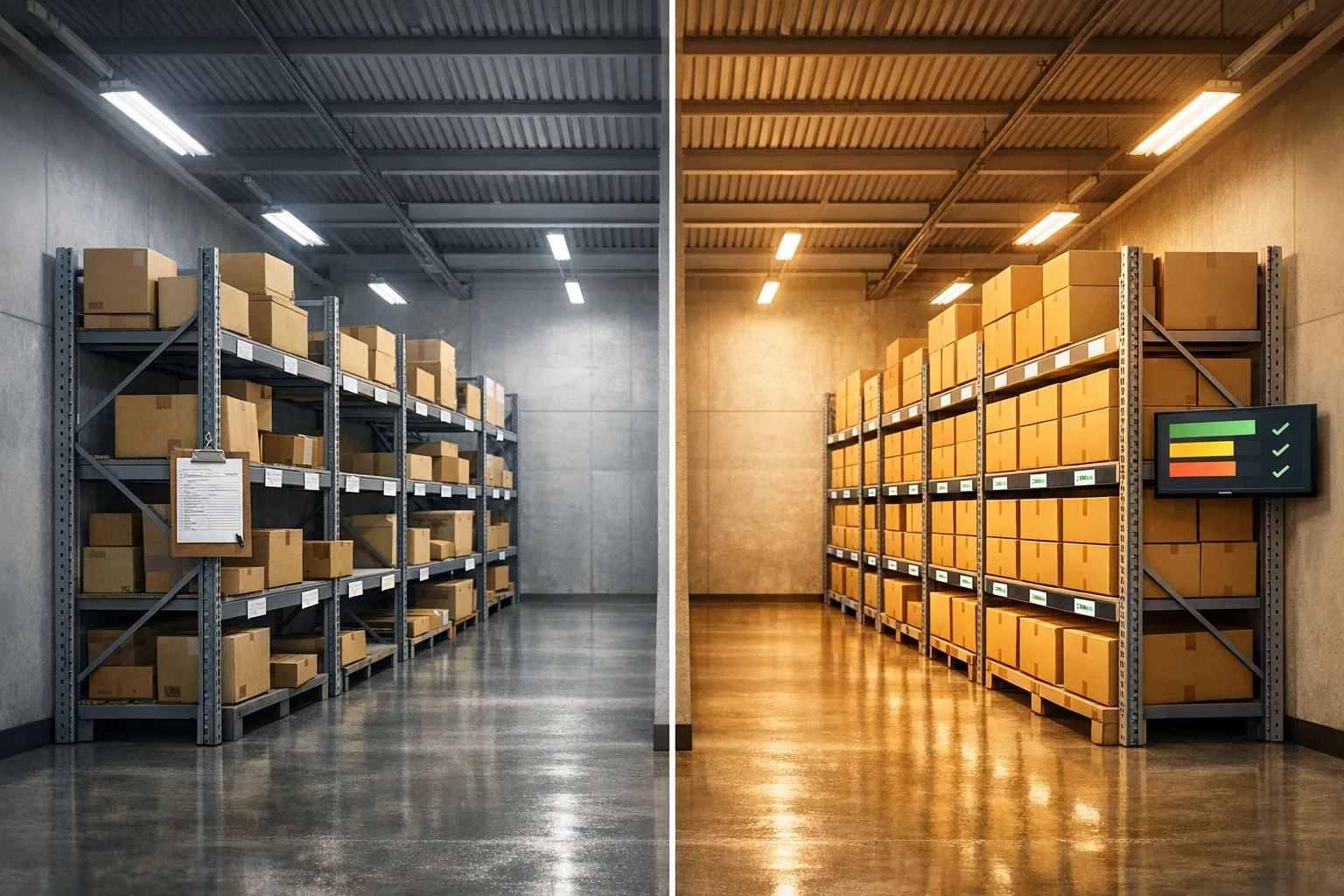
AI forecasting saves time, reduces errors, and increases profits compared to manual methods. While manual forecasting relies on static spreadsheets and human judgment, AI tools analyze real-time data, including sales, weather, and promotions, to deliver precise, SKU-level predictions. This leads to:
- Higher accuracy: AI achieves up to 95% accuracy, compared to manual methods’ 60–70%.
- Faster updates: AI adjusts forecasts instantly, while manual methods often rely on quarterly updates.
- Cost savings: AI reduces stockouts by 75% and excess inventory by 63%, freeing up working capital.
- Scalability: AI handles large inventories and multiple locations effortlessly, unlike manual systems.
For Shopify merchants, AI tools like Forstock integrate seamlessly, offering real-time insights and automating tedious tasks. Whether you're managing 50 products or 5,000, AI ensures your inventory aligns with demand, helping you avoid costly mistakes and focus on growth.
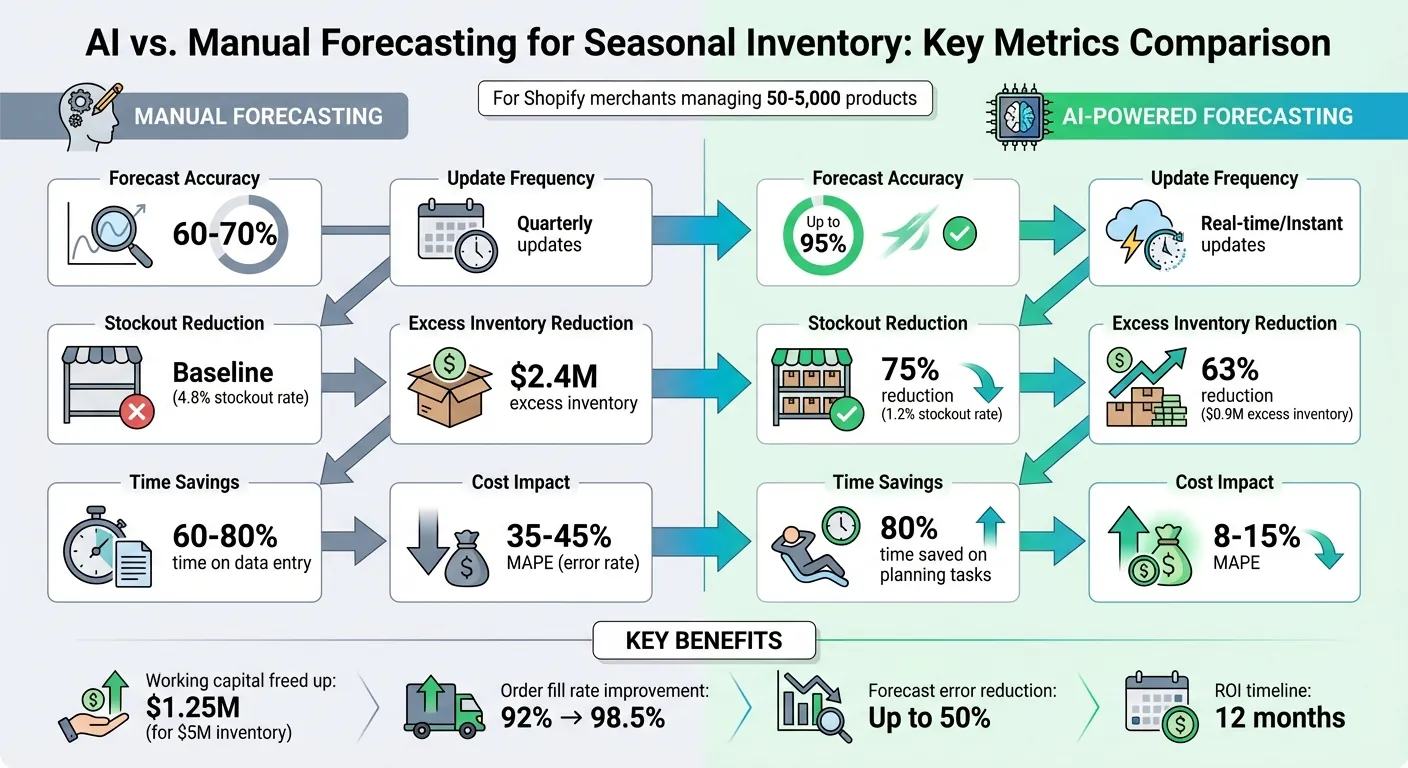
AI vs Manual Forecasting: Key Performance Metrics Comparison
5-minute Shopify inventory plan: Julius AI analysis

sbb-itb-f0fc809
Accuracy in Predicting Seasonal Demand
AI and manual forecasting operate very differently when it comes to handling seasonal demand. Manual methods often rely on basic monthly averages, which tend to smooth out demand spikes and miss critical variations. For example, seasonal businesses might see December sales soar to 250% of the average monthly demand, while August sales could dip to just 60% of the average. These extremes are often overlooked when using manual techniques.
AI-powered forecasting, on the other hand, dives deeper. It examines seasonality across multiple dimensions - yearly, monthly, weekly, and even daily trends - at the SKU (stock-keeping unit) level. This means it can pick up on patterns like cotton sweater sales quadrupling in fall and winter compared to spring and summer, or back-to-school shopping causing a 50% spike in sales. AI tools also factor in external influences like weather, holiday calendars, and promotional events, making forecasts far more dynamic and precise.
Forecast Accuracy Metrics: AI vs. Manual Methods
AI clearly outshines manual methods, especially in how it handles seasonal indexes - these are numerical measures of how much a specific period deviates from average demand. For instance, an AI system can automatically calculate a seasonal index of 2.5 for December (indicating a 250% increase in demand) versus 0.6 for August (a 40% decrease). It applies these indexes to every SKU, providing a level of detail that manual forecasting simply can’t match, particularly when managing large inventories.
| Feature | Manual Forecasting | AI-Powered Forecasting |
|---|---|---|
| Data Analysis | Relies on basic averages, missing demand spikes | Examines trends across yearly, monthly, weekly, and daily levels |
| External Factors | Ignores weather, school schedules, and promotions | Integrates factors like weather, holidays, and events automatically |
| Granularity | Limited to broad categories or store-wide data | Offers SKU-level insights with product-specific trends |
| Safety Stock | Uses static levels, risking stockouts during peaks | Dynamically adjusts safety stock with AI based on demand volatility |
| Lead Times | Overlooks supplier constraints during peak seasons | Accounts for seasonal supplier delays and lead time changes |
Forstock’s AI forecasting achieves a 95% accuracy rate by continuously learning from new data and adapting predictions in real time. It monitors seasonal triggers at the SKU level, so you know exactly what to stock - whether it’s a specific size, color, or style for peak demand periods. This level of precision ensures you’re always prepared, even as market conditions shift.
Case Study: Responding to Sudden Market Changes
When unexpected events arise - like an October heat wave, a viral TikTok trend, or a promotional sale that triples sales - manual forecasting struggles to keep up. Updating spreadsheets, recalculating projections, and notifying suppliers can take so long that the opportunity is missed by the time adjustments are made.
AI systems, however, excel in these situations. They automatically detect shifts, such as weather-driven buying behavior, and adjust forecasts in real time. For businesses with multiple locations, AI can even pinpoint regional differences - like Southern stores experiencing peak demand 3–4 weeks later than Northern stores for the same seasonal products. This level of responsiveness is nearly impossible to replicate manually, especially when managing diverse inventories across regions.
Time Savings and Efficiency
Forecasting seasonal inventory demands efficiently can make or break a business, especially when juggling hundreds or even thousands of products. The difference between manual and AI-powered forecasting isn't just about speed - it’s about how much time business owners can reclaim. With manual forecasting, you’re stuck entering data constantly. Every day, you're calculating sales figures, lead times, safety stock, and reorder points. For seasonal businesses, this process can feel like a never-ending full-time job.
Another drawback? Manual forecasts stay frozen until you update them. Most businesses revise these forecasts once per quarter, leaving them to rely on outdated data for months. If a sudden heatwave hits in October or a product unexpectedly gains traction on social media, your forecast won’t reflect those changes until you manually adjust everything and notify your suppliers.
Real-Time Forecast Updates with AI
AI-powered forecasting changes the game. Instead of waiting for quarterly updates, these tools provide instant updates based on new sales data from your point-of-sale (POS) system. Every time a customer makes a purchase, the system recalculates demand projections, adjusts safety stock levels, and updates reorder points across your entire product range. No delays, no manual effort.
This real-time tracking ensures you’re always working with the latest information, not last quarter’s outdated numbers. Forstock’s AI-driven forecasting, for example, monitors sales patterns 24/7, adapting to demand changes automatically. Whether you’re managing 50 SKUs or 5,000, the system handles the heavy lifting, allowing you to focus on growth strategies, marketing, or building better customer relationships. These continuous updates don’t just save time - they keep your business agile and responsive.
Hours Saved on Demand Planning
Manual forecasting is also incredibly resource-intensive. To conduct a proper trend analysis, you need at least two years of historical sales data. AI automation eliminates this tedious work entirely. Automated inventory reports can track quantities and daily sales percentages without requiring any manual input. Instead of spending hours updating spreadsheets, AI tools provide instant dashboards that summarize everything for you. For instance, Forstock’s unified dashboard offers 12-month demand plans, supplier coordination tools, and performance tracking across all your locations - all updated in real-time. This frees up valuable time that you can redirect into scaling your business, experimenting with new products, or enhancing customer satisfaction.
Here’s how manual and AI-powered forecasting compare in key areas:
| Task | Manual Forecasting | AI-Powered Forecasting |
|---|---|---|
| Update Frequency | Quarterly or event-driven | Real-time / Continuous |
| Data Entry | Manual spreadsheet management | Automated via POS integration |
| Historical Data Required | 2+ years for trend accuracy | Real-time demand-driven |
| Calculation Method | Manual formulas for each SKU | Automated across entire catalog |
| Visibility | Static snapshots | Ongoing tracking and alerts |
Cost Savings and Inventory Optimization
AI forecasting doesn’t just boost accuracy - it also delivers major cost savings and streamlines inventory management. While manual methods typically result in a MAPE (Mean Absolute Percentage Error) of 35–45%, AI achieves a much lower range of 8–15%. This gap often leads to costly outcomes like excess inventory or stockouts, which eat into profit margins. Companies that adopt AI forecasting often see immediate results, with excess inventory dropping by 18–28%. For a business managing $5 million in inventory, this reduction can free up around $1.25 million in working capital within just 6 to 12 months. Over time, AI-driven optimizations can increase working capital by 20–35%.
Lower Inventory Costs with AI
AI takes the uncertainty out of safety stock calculations by automatically calculating safety stock based on real-time factors like demand fluctuations, supplier lead times, and carrying costs. Unlike manual methods, which rely on static buffers and subjective decision-making, AI dynamically adapts to changing conditions. For example, businesses using manual forecasting typically achieve 6.2 inventory turns per year, while AI-powered systems increase that to 9.1 turns - an impressive 47% improvement. Tools like Forstock’s AI-driven forecasting continuously analyze demand trends and recalibrate safety stock levels, ensuring optimal inventory investment. This dynamic approach not only reduces costs but also supports better planning for seasonal or sudden demand changes.
Stockout and Overstock Rates Compared
Optimized inventory levels directly reduce stockouts and holding costs, and AI plays a key role in achieving this balance. By leveraging AI-powered forecasting, businesses can cut stockouts by as much as 75%. For high-volume retailers, even a modest 3.6% reduction in stockouts can translate to an additional $900,000 in annual value. Manual forecasting, on the other hand, struggles to keep up with sudden demand shifts caused by market trends, unpredictable weather, or pricing changes.
| Metric | Manual/Legacy Method | AI-Powered Method | Improvement |
|---|---|---|---|
| Inventory Turns | 6.2 per year | 9.1 per year | +47% |
| Stockout Rate | 4.8% | 1.2% | –75% |
| Excess Inventory Value | $2.4M | $0.9M | –63% |
| Forecast Accuracy (MAPE) | 32% (68% error) | 89% (11% error) | +31 points |
| Order Fill Rate | 92% | 98.5% | +6.5 points |
Source: Impact of AI Implementation on Inventory Metrics
Real-world examples highlight the impact of AI in inventory management. Unilever, for instance, reduced stockouts by 30% through AI-driven demand planning, while Walmart saves millions annually by optimizing inventory positioning with AI. Research from McKinsey confirms these trends, showing that AI reduces inventory errors by 20–50% and lowers supply chain costs by 15%. Many companies report achieving full ROI on AI implementation within just 12 months.
Scalability for Growing Businesses
As your Shopify store expands, picking the right forecasting method becomes critical. What works for managing 50 products often fails when you're handling 500. The complexity grows exponentially with more product variants, sales channels, and locations. AI-powered systems step in here, identifying demand trends across massive datasets while maintaining - or even improving - forecast accuracy as your business scales.
Managing Multi-Variant and Multi-Location Inventory
When it comes to manual forecasting, each location is treated as its own challenge. This method struggles to keep up with multi-variant catalogs that include different sizes, colors, and styles across retail stores, online platforms, and fulfillment centers. To put it into perspective, inventory accuracy in U.S. retail operations averages just 63%.
AI-powered systems, on the other hand, use multi-echelon inventory models to synchronize safety stock and calculate reorder points across all locations. These systems analyze real-time data alongside external factors like weather and holidays to spot patterns across your entire catalog. For instance, in February 2025, a clothing retailer discovered a four-tier demand pattern for its cotton sweaters: sales were four times higher in fall/winter, experienced a 50% spike during back-to-school season, tripled during promotions, and had a 3–4 week delay in southern stores compared to northern ones. This level of analysis enabled precise purchasing and allocation plans - something manual methods simply couldn't achieve.
Platforms like Forstock go a step further by offering a unified dashboard that captures live stock levels across all channels. This eliminates the data silos that often plague manual spreadsheet tracking. Whether you're managing basic SKUs or complex multi-variant catalogs, AI-powered forecasting adapts to shifts in sales trends, lead times, and seasonal demand across multiple locations. The result? Simplified daily management and a scalable solution that grows with your business, as highlighted in the next section on error reduction.
Error Reduction at Scale
As your business grows, the gap between AI and manual forecasting becomes glaringly obvious. AI-driven systems boast accuracy rates exceeding 90%, while traditional methods often struggle to hit 70%. The more products and sales channels you add, the more resource-intensive and error-prone manual forecasting becomes.
AI systems thrive at scale by continuously learning from real-time data. Businesses that implement AI for forecasting have seen demand accuracy jump from 60% to 80%. Some report forecast error reductions of up to 50%. Take More Retail Limited, for example. This Indian retailer improved its forecast accuracy from 24% to 76% using AI, boosting in-stock rates for fresh produce from 80% to 90% while cutting waste by 30%. Similarly, Amazon leveraged machine learning across millions of SKUs, reducing stockouts by 15% and cutting forecast errors by up to 45%.
| Feature | Manual/Traditional Forecasting | AI-Driven Forecasting |
|---|---|---|
| Accuracy Level | Typically <70% | Over 90% |
| Scalability | Limited; struggles with growth | Handles large-scale data seamlessly |
| Data Processing | Labor-intensive, prone to errors | Automated, real-time, and self-learning |
| Adaptive Responsiveness at Scale | Slow and periodic | Quickly adapts to market changes |
| Impact on Stockouts | High risk during growth | Reduces by up to 60% |
The takeaway? Manual forecasting forces you to compromise between growth and accuracy. AI-powered forecasting ensures you don't have to choose - you get both.
Implementation Considerations for Shopify Merchants
Switching from manual forecasting to AI doesn’t mean starting from scratch, but it does require careful planning. Many AI platforms designed for Shopify merchants make integration straightforward. The key to success lies in understanding your business needs and preparing effectively from the outset.
Data Requirements and Shopify Integration
AI forecasting platforms like Forstock connect directly to Shopify through API integrations, automatically pulling in sales data, inventory levels, and product details. This automation removes the need for manual data entry. Since the platform syncs in real-time, every sale, return, or stock adjustment is factored into your demand forecasts instantly.
Start by auditing your data. Map all sources - Shopify, Amazon, and accounting software - to ensure consistency and accuracy. Most AI models require at least six months of sales history across multiple SKUs to generate reliable forecasts. If your historical data is incomplete or inconsistent, address these gaps before implementation.
The shift in workflow is manageable but impactful. Instead of spending 60–80% of your time manually gathering data, you’ll focus on strategic planning. AI enables a transition from broad category-level forecasting to detailed SKU-level forecasting across all sales channels. By managing exceptions flagged by AI, you’ll spend less time on routine tasks and more on high-value decisions. These streamlined practices naturally prepare your business for AI adoption.
Evaluating Your Business Readiness
Once your data is cleaned and structured, assess whether your business is ready for AI forecasting. Not every business can jump into full-scale implementation immediately. Start with a pilot program by applying AI to high-volume SKUs or critical product categories. This allows you to validate the accuracy of AI forecasts before scaling up. Use your current Mean Absolute Percentage Error (MAPE) as a baseline to measure improvements post-AI adoption.
It’s important to remember that AI doesn’t replace human expertise. As Angela Iorio from ToolsGroup explains:
"AI forecasting is designed to support planners, not replace them. While AI handles large‑scale pattern recognition and continuous learning, human expertise remains essential for interpreting results".
Human input remains crucial for contextual insights - like upcoming promotions, new product launches, or strategic shifts that aren’t yet reflected in the data.
Choose platforms that provide transparent AI models rather than "black boxes." You should be able to explain how forecasts are generated to stakeholders or your board. For example, Forstock’s platform adapts to seasonal demand and lead time adjustments while offering visibility into 12-month demand plans. This ensures you not only know what the forecast predicts but also why. With AI-based forecasting often reducing errors by 20–50%, the benefits are clear - but only if your business is ready to adapt to the operational changes that come with it. By approaching the transition strategically, you can achieve both improved accuracy and sustained efficiency.
Choosing the Right Forecasting Method
Forecasting plays a central role in managing seasonal inventory, so picking the right method is a big deal. The decision between AI-powered and manual forecasting often boils down to four key factors: accuracy, efficiency, cost, and scalability. Manual forecasting relies on past sales data and spreadsheets to figure out reorder points and safety stock. While this can help reduce waste, it’s prone to human error and requires regular updates - often quarterly - to account for marketing efforts or seasonal trends. On the other hand, AI systems use real-time data and consider multiple factors like seasonality, price elasticity, marketing campaigns, and even weather. These differences set the stage for a deeper look at efficiency, cost, and scalability.
Efficiency
The efficiency gap between manual and AI-powered forecasting is massive. AI systems automate forecasting tasks, saving merchants up to 80% of the time previously spent on planning and calculations. This freed-up time can be redirected toward more strategic activities, like negotiating with suppliers or planning for business growth.
Cost Savings
Cost is another major consideration. AI-powered tools offer better accuracy, which translates into significant savings. These systems can cut inventory holding costs by 20–30%, lower stockouts by 15–25%, and reduce obsolete inventory by 35–40%. The result? Improved revenue and fewer headaches. In comparison, manual methods simply can’t deliver this level of precision, especially as product catalogs expand.
Scalability
For businesses that are scaling up, AI is a game-changer. Manual forecasting struggles to keep up with complex needs, like managing inventory across multiple locations or handling a large number of product variations. AI, however, handles these challenges effortlessly. For example, Forstock integrates directly with Shopify, offering real-time demand forecasting, automated purchase order creation, and a 12-month demand plan - all for just $79 per month, no matter your revenue size.
Getting Started with AI
If you’re a Shopify merchant thinking about making the switch, the process is straightforward. Start by gathering six to twelve months of clean sales data. Then, test out an AI tool during a trial period to see how it performs. Making the shift from manual to AI not only simplifies repetitive tasks but also allows you to focus on what truly drives growth. By carefully considering these factors, Shopify merchants can confidently choose the forecasting method that aligns with their goals.
FAQs
How much sales history is needed for AI forecasting?
To make accurate demand forecasts with AI, it's generally recommended to have two to three years of past sales data. This amount of historical data helps uncover trends, seasonal shifts, and recurring patterns, which are essential for reliable predictions.
How does AI handle sudden demand spikes during a season?
AI leverages real-time data to predict and respond to sudden demand surges with precision. By examining sales patterns, external influences like weather conditions, and historical trends, tools such as Forstock can adjust supplier lead times and automate purchase orders. This approach not only helps avoid stockouts but also cuts manual work by as much as 60%. The result? Inventory levels stay in sync with demand, keeping customers happy while improving cash flow management.
What’s the easiest way to switch from spreadsheets to Forstock?
Switching from spreadsheets to Forstock is a breeze thanks to its automated inventory management and demand forecasting tools. You can either export your inventory data and upload it directly to Forstock or connect your Shopify store for automatic syncing.
Once set up, you can configure AI-driven forecasting to analyze sales trends and seasonal patterns. This takes care of tasks like reorder recommendations, minimizes manual errors, and keeps your updates in real time - helping you manage inventory with greater precision and ease.