
Ultimate Guide to AI Demand Forecasting for Shopify
How AI demand forecasting improves Shopify inventory accuracy, cuts stockouts, automates reorders, and saves time with setup tips and best practices.
Ultimate Guide to AI Demand Forecasting for Shopify
AI demand forecasting is transforming how Shopify merchants manage inventory. It predicts what products to stock, when to stock them, and in what quantities - all based on real-time data like sales trends, weather, and competitor pricing. This approach helps businesses avoid stockouts, reduce overstocking, and improve cash flow.
Key benefits include:
- 18% fewer stockouts and a 3–7% revenue boost for Shopify stores.
- 30–50% fewer forecasting errors compared to outdated methods like spreadsheets.
- Saves up to 10+ hours per week by automating inventory management.
Platforms like Forstock make it simple to integrate AI into your Shopify store, offering real-time demand forecasts, reorder suggestions, and automated purchase orders - all for $79/month. If you're tired of manual processes and guesswork, AI demand forecasting is the smarter solution for staying ahead in e-commerce.
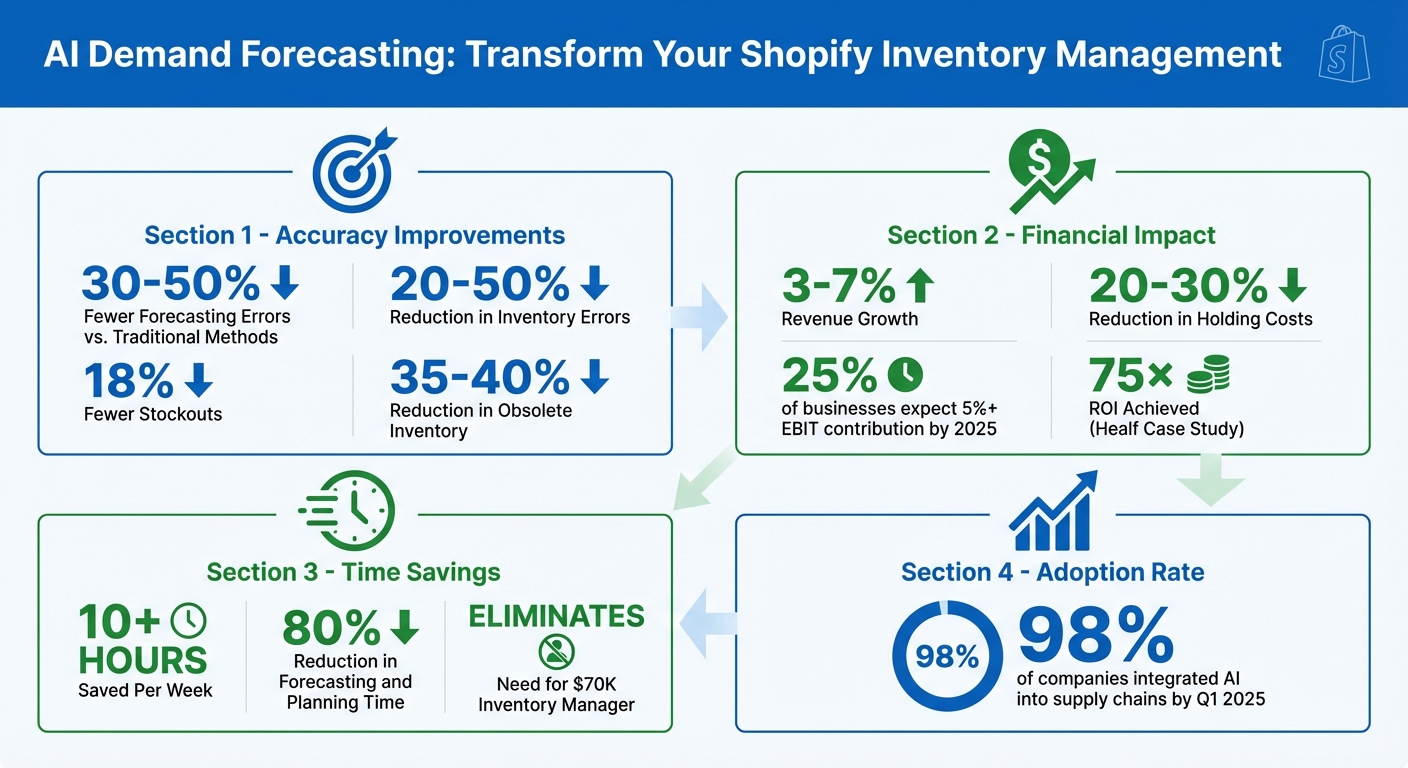
AI Demand Forecasting Benefits for Shopify: Key Statistics and ROI
5-minute Shopify inventory plan: Julius AI analysis

sbb-itb-f0fc809
What is AI Demand Forecasting?
AI demand forecasting uses machine learning to predict the inventory you'll need in the future. Instead of just looking at past sales, it pulls in a mix of data - like historical transactions, user interactions, promotional schedules, and even real-time trends (think TikTok crazes or sudden weather changes). It also factors in competitor pricing to create forecasts that adapt as conditions evolve, avoiding outdated assumptions.
Traditional cloud inventory tools update only occasionally and rely on basic methods. In contrast, AI keeps learning from new data as it comes in. This means it can spot trends, like a sudden TikTok-driven sales boom or a weather-related surge, and adjust predictions accordingly. The result? Businesses see 30–50% fewer forecasting errors and 15–25% fewer stockouts compared to older, static models.
Core Components of AI Demand Forecasting
AI forecasting stands on three key pillars:
- Internal data: This includes everything happening inside your business, like point-of-sale logs, current inventory levels, promotional calendars, and customer lifetime value insights.
- External signals: These bring in outside context, such as social media trends, local weather patterns, macroeconomic indicators (e.g., the Consumer Price Index), and competitor pricing.
- Machine learning algorithms: Tools like Random Forest, Neural Networks, and ARIMA crunch all this data to uncover hidden patterns. For instance, they might link specific weather conditions to a spike in sales within 72 hours.
Unlike traditional models that make broad predictions, AI forecasts demand for each product variant on a daily basis. This level of precision helps businesses maintain the right stock levels without overstocking or running out.
Why Shopify Merchants Need AI Forecasting
E-commerce is unpredictable. Viral trends, supply chain issues, and seasonal shifts can quickly make static forecasts irrelevant. AI forecasting tackles problems like overstocking (which ties up cash), stockouts (which hurt sales), and the hours wasted manually managing spreadsheets - often up to 80% of inventory planning time.
Take Healf, a health and wellness retailer. In late 2025, they adopted AI demand forecasting. Within just two months, stockouts dropped from 4% to 1%, while manual inventory tasks were slashed, delivering an impressive 75× ROI.
"It's saving me from hiring a $70K inventory manager! Highly recommended."
- Brends Grands Wholesale, Shopify Merchant
For Shopify merchants juggling large catalogs and multiple locations, AI demand forecasting replaces guesswork with accurate, data-driven decisions. It’s a game-changer for boosting efficiency, cutting costs, and keeping customers happy.
Benefits of AI Demand Forecasting for Shopify Merchants
AI demand forecasting isn’t just about better predictions - it’s about transforming how Shopify merchants handle inventory, profitability, and time management. By replacing guesswork with data-driven insights, merchants can make smarter decisions that lead to fewer errors, better cash flow, and more time to focus on growth.
Better Inventory Accuracy
AI-powered forecasting cuts errors by 20–50% compared to traditional methods. It works at the SKU level, ensuring merchants can manage stock with precision.
This technology pulls in real-time data from multiple sources, adjusting forecasts dynamically to reduce errors. It also calculates safety stock levels based on demand volatility and supplier lead times, rather than relying on outdated fixed percentages. For promotions or new product launches, machine learning models predict demand spikes by referencing performance data from similar items. The results? Merchants experience 18% fewer stockouts and reduce obsolete inventory by 35–40%.
Increased Profitability and Cash Flow
Improved accuracy doesn’t just reduce waste - it directly impacts a merchant’s bottom line. Avoiding overstocking and stockouts means less capital tied up in inventory and more revenue captured during peak demand.
AI-driven forecasting enables 3–7% revenue growth while cutting holding costs by 20–30%. By Q1 2025, 98% of companies had already integrated AI into their supply chains for inventory optimization. Additionally, 25% of businesses expect AI-driven demand planning to contribute over 5% of their EBIT by 2025.
Time Savings Through Automation
Beyond accuracy and profitability, automation offers a huge time advantage. Managing inventory manually can eat up hours every week, but AI simplifies this process. It automates everything from aggregating data across Shopify orders, POS systems, and third-party logistics platforms to generating purchase orders with just one click. Proactive alerts notify merchants about low or excess stock, eliminating the need for constant monitoring.
On average, merchants save over 10 hours a week on manual tasks, reducing forecasting and planning time by up to 80%.
Take Kimai, an online jewelry brand running three Shopify stores, as an example. After implementing AI, they cut delivery times by 43% and reduced production costs by 11%. The system even managed inventory transfers between locations automatically, balancing stock across regions without manual input.
"It's saving me from hiring a $70K inventory manager! Highly recommended."
- Brends Grands Wholesale
These time savings allow merchants to shift their focus to growth-oriented activities like launching new products, improving marketing strategies, and enhancing the overall customer experience, instead of getting stuck in time-consuming, spreadsheet-heavy processes.
How Forstock Works for Shopify Demand Forecasting
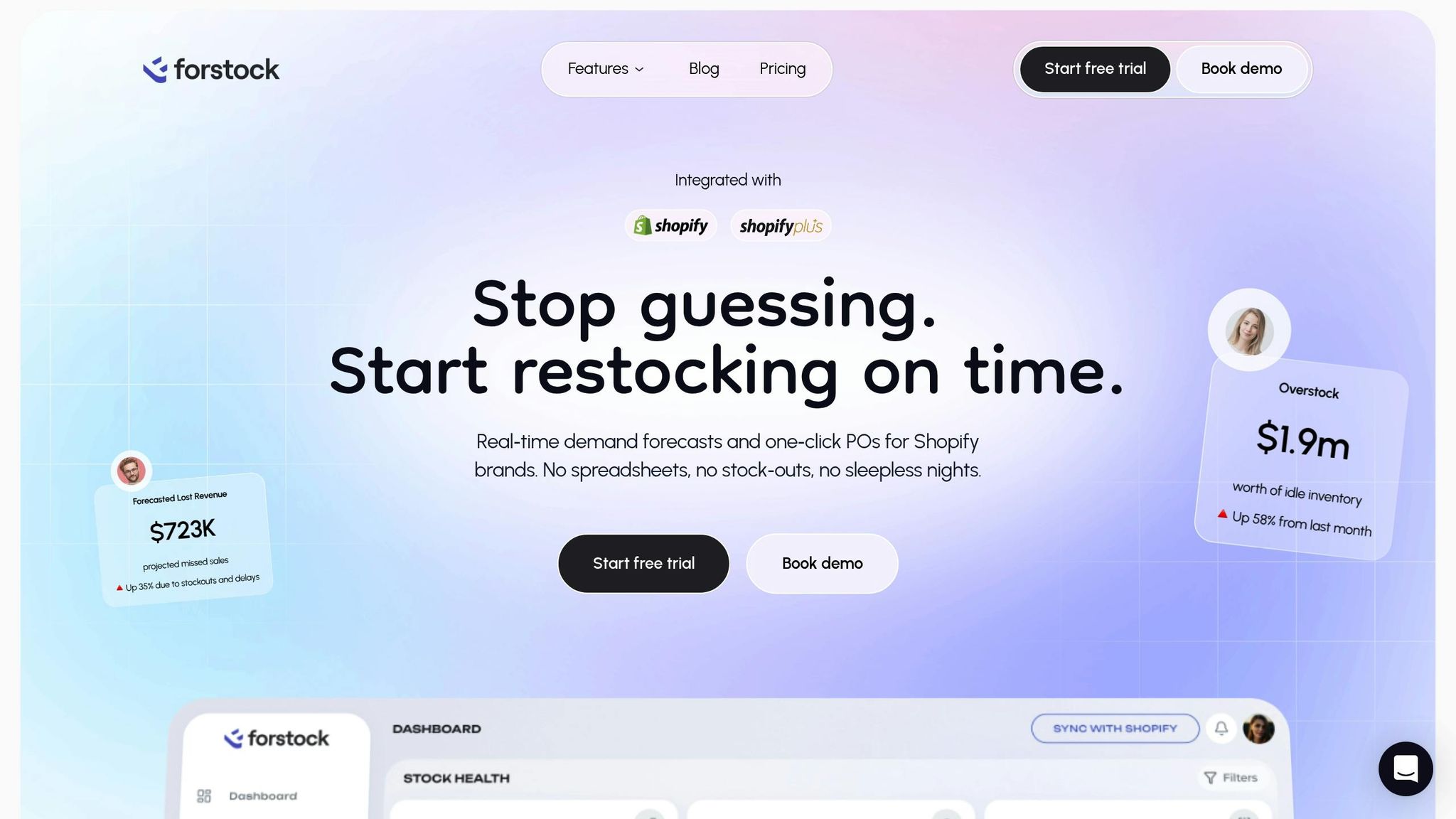
Forstock takes the power of AI forecasting and simplifies it for Shopify merchants. This SaaS platform eliminates the need for spreadsheets by using AI to generate accurate demand forecasts. By integrating directly with Shopify, Forstock automatically pulls in sales history, product data, supplier information, and warehouse details, delivering real-time demand predictions and creating automated purchase orders effortlessly. With over 100 forecasting models, it adapts to your store's unique sales trends, seasonal patterns, and supplier lead times.
Forstock Features
Forstock's suite of tools transforms Shopify data into actionable inventory insights. Key features include a real-time dashboard, machine learning forecasting, dynamic reorder points, and automated purchase orders.
- Machine learning demand forecasting: This feature looks at sales history, seasonality, and trends to predict demand up to six months ahead. It calculates optimal safety stock levels by analyzing demand fluctuations, supplier lead times, and service level targets - doing away with outdated fixed-percentage methods.
- Dynamic reorder points: These alerts are based on forecasted demand and supplier lead times, ensuring you restock in time to meet customer needs.
- Scalable AI models: Whether you're managing 50 SKUs or 5,000 across multiple locations, Forstock maintains its accuracy and efficiency.
These features work together to improve inventory accuracy and save time, making inventory management smoother and more reliable.
Forstock Pricing Plans
Forstock keeps its pricing simple. The platform costs $79/month, regardless of your revenue tier (from $0 to $40M+). Every plan includes the full range of features, such as dashboard analytics, reorder suggestions, stock intelligence, automated purchase orders, and supplier management. Plus, you get a 14-day free trial and access to live-chat support.
Setting Up Forstock with Shopify
Getting started with Forstock is quick and easy. With a single click, it connects to your Shopify store and automatically imports your sales history, product data, supplier information, and warehouse details. Once synced, its AI models analyze your historical sales data to create initial forecasts. From there, the dashboard displays reorder suggestions, safety stock levels, and demand forecasts. You can review supplier lead times, adjust service level targets, and generate purchase orders - all from one place.
Best Practices for Accurate AI Demand Forecasting
For Shopify merchants using AI for demand forecasting, following these best practices is key to maintaining the accuracy needed to streamline inventory and cash flow. Even the most advanced AI models depend on high-quality inputs to generate reliable predictions and avoid costly inventory missteps.
Use Clean and Complete Data
AI models are only as good as the data they process. Issues like format errors, duplicate entries, or missing values can skew predictions, leading to overstocking or stockouts. On average, companies lose $12.9 million annually due to poor data quality.
To ensure accuracy, audit and standardize your sales and inventory data across all systems. Eliminate duplicates, correct typos, and resolve inconsistencies to avoid misleading forecasts. Centralizing your data by integrating systems like CRM, ERP, and POS into a single platform ensures the AI model stays up-to-date as new sales data comes in. Additionally, separate actual demand from sales dips caused by stockouts - low sales during these periods don't necessarily indicate low customer interest.
"If the input is bad, the forecast is worse. Inaccurate, missing, or inconsistent data is one of the most common reasons demand forecasts miss the mark." - Bani Kaur, Content Marketing Specialist, Prediko
Once your data is clean, focus on refining your forecasts by accounting for seasonal fluctuations and market trends.
Account for Seasonality and Trends
After ensuring your data is reliable, align your forecasts with both predictable seasonal patterns and unexpected market dynamics. AI models should differentiate between seasonal cycles (like Q4 holiday sales spikes) and sudden, unpredictable trends (like viral social media campaigns or economic downturns). Using 2–3 years of historical data can help the AI recognize stable seasonal patterns. For holidays that vary annually - such as Easter or Lunar New Year - opt for forecasting tools with calendar layers instead of static, hard-coded dates.
Incorporate external factors like pricing changes, marketing efforts, competitor moves, and weather conditions to fine-tune your forecasts. For example, if you're running a big promotion, adjust your projections to account for both the sales surge during the event and the normalization period that follows. Rolling forecasts that update weekly or bi-weekly as new data comes in are far more reliable than static quarterly plans.
Review and Adjust Forecasts Regularly
AI is a powerful tool, but it's not infallible. Over 40% of companies report challenges in managing risks caused by inaccuracies in AI predictions. External disruptions - like port closures, regulatory changes, or sudden trends - may not be reflected in historical data, requiring human intervention to adjust the forecast.
Regularly review your forecasts, ideally on a weekly or monthly basis, by comparing predictions with actual sales. Track metrics like MAPE (Mean Absolute Percentage Error), where a score under 10% indicates high accuracy, and monitor forecast bias. Use the formula (Forecasted demand - Actual demand) / Actual demand x 100 to identify trends or recurring errors.
For new product launches or limited-edition items with no historical data, combine AI forecasts with input from your sales and marketing teams. Sharing campaign calendars and flagging upcoming B2B deals can give the AI additional context that raw data alone can't provide. By blending AI's efficiency with human expertise, you'll create forecasts that align closely with real-world demand and keep your inventory in check.
Conclusion
AI demand forecasting is no longer just a luxury - it’s a must-have tool for Shopify merchants looking to stay ahead. By Q1 2025, a staggering 98% of companies have integrated AI into their supply chains to optimize inventory. This shift has proven its value, slashing holding costs by 20–30% (learn more about forecasting inventory costs), reducing stockouts by 15–25%, and saving up to 80% of the time typically spent on forecasting.
The secret to success lies in blending clean data, seasonal insights, and consistent reviews with a powerful platform that does the heavy lifting. That’s where Forstock comes in. It streamlines the entire process by analyzing your sales history, delivering six-month demand forecasts, and generating automated purchase orders - all in real time. Plus, its unified dashboard integrates effortlessly with your Shopify store. The platform’s machine learning adapts to your unique sales patterns, lead times, and seasonal trends, ensuring your purchasing decisions are proactive and data-driven.
Want to take your inventory management to the next level? Install Forstock from the Shopify App Store today and let AI-driven forecasting help you save time, boost cash flow, and meet customer demand without the stress of costly mistakes.
FAQs
How much sales history do I need for AI forecasts?
For reliable AI-driven demand forecasting, having at least 12 months of clean, historical sales data is crucial. This timeframe allows the system to identify seasonal patterns and trends, leading to more precise predictions.
How does AI handle viral spikes or sudden demand changes?
AI tackles sudden demand surges and viral trends by analyzing real-time data and spotting unpredictable demand patterns. It dynamically updates forecasts, factoring in external signals like social media buzz or trending content. This allows businesses to adjust inventory promptly, ensuring they meet unexpected demand without overstocking or running out of products.
What should I set for lead times and safety stock?
Using real-time data and accounting for demand variability can help set safety stock levels more effectively. AI tools take things further by dynamically adjusting these levels based on trends, supplier reliability, and external factors. This means fewer stockouts and better accuracy in inventory planning.
When it comes to lead times, AI forecasting evaluates supplier timelines to fine-tune purchase planning. This ensures you have the stock you need without over-ordering. By leveraging these tools, businesses can simplify inventory management and make decisions backed by data.
Keep reading
Try Forstock free for 14 days.
AI-powered demand forecasting and reorder automation for Shopify brands. No credit card required.