
The Role of AI in Purchase Order Automation
AI-powered purchase order automation slashes processing time and costs while improving accuracy, demand forecasting, and supplier management for e-commerce.

The Role of AI in Purchase Order Automation
AI-powered purchase order automation is transforming how businesses manage procurement. By automating repetitive tasks like data entry, approvals, and order tracking, AI reduces processing times from days to hours while cutting costs per transaction by up to 85%. Here's what you need to know:
- Faster Processing: AI reduces purchase order times from 3–7 days to under 24 hours.
- Lower Costs: Manual processing costs $15–$40 per order, while AI reduces this to $1–$6.
- Improved Accuracy: AI achieves 99%+ data accuracy, minimizing costly errors.
- Demand Forecasting: AI predicts inventory needs using real-time data, avoiding stockouts and overstocking.
- Supplier Management: AI tracks vendor performance and automates compliance checks.
AI tools like Forstock integrate directly with platforms like Shopify, automating workflows and providing real-time insights. Businesses that implement AI can save time, reduce errors, and optimize procurement processes efficiently.
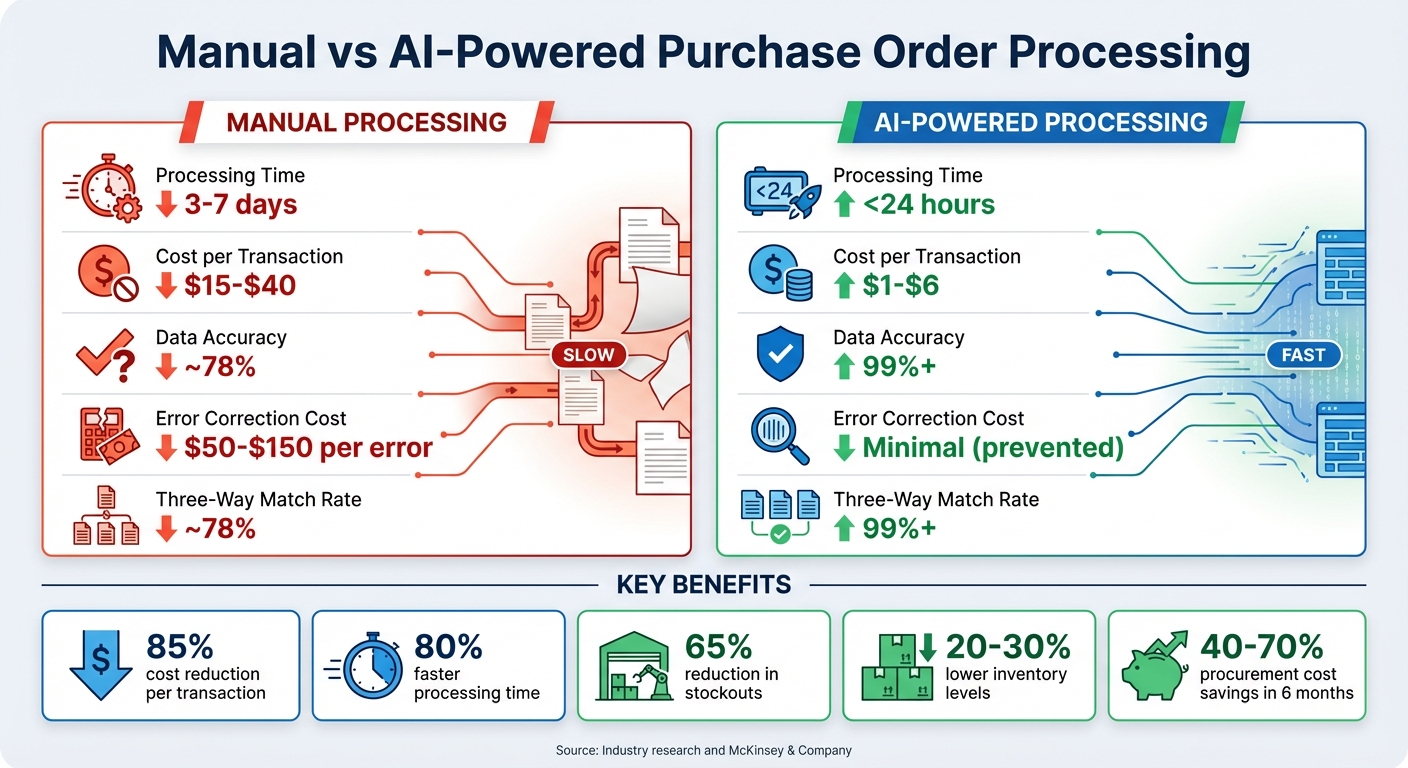
Manual vs AI-Powered Purchase Order Processing: Cost, Speed, and Accuracy Comparison
PO Processing AI Agent | Purchase Order Automation for Manufacturers
sbb-itb-f0fc809
Benefits of AI-Powered Purchase Order Systems
AI-powered purchase order systems bring speed, precision, and better control to e-commerce operations. They help businesses handle high-order volumes more efficiently while cutting costs.
Faster Processing and Lower Costs
AI dramatically reduces purchase order processing times - what used to take 3–7 days can now be done in hours or even minutes. This is possible because AI eliminates manual data entry. Using tools like OCR (Optical Character Recognition) and NLP (Natural Language Processing), these systems extract details from PDFs, emails, and scanned documents in seconds. Once processed, intelligent routing ensures orders are sent to the right approvers based on rules like department or budget limits, shrinking approval times from days to mere hours.
The financial impact is just as impressive. While manual processing costs range between $15 and $40 per transaction, AI automation slashes that to just $1–$6 per transaction. These savings also reduce the likelihood of costly errors.
Fewer Errors Through Automation
Manual purchase orders often lead to expensive mistakes, with correction costs ranging from $50 to $150 per error. AI minimizes these risks by delivering 99%+ data accuracy. Automated validation prevents duplicate orders, identifies incorrect account coding based on historical patterns, and flags incomplete information before it even enters the system.
One standout feature is three-way matching. AI automatically compares the purchase order, goods receipt, and supplier invoice to detect discrepancies. This ensures you don’t overpay or pay for items you didn’t receive.
Better Visibility and Control
AI-powered systems also provide unmatched visibility throughout the procurement process. By linking every step - from requisition to payment - into a centralized system, AI creates a single source of truth. Instead of juggling multiple platforms, you get real-time updates on every purchase order. Integration with carrier APIs even provides live shipment ETAs, and the system can automatically reorder stock when levels dip below preset thresholds.
This transparency extends to supplier performance. AI continuously tracks vendors on factors like delivery reliability, pricing accuracy, and financial stability. This makes it easier to spot underperforming suppliers before they disrupt your operations. For e-commerce businesses managing numerous suppliers and SKUs, this level of oversight helps prevent stockouts without overstocking inventory.
AI-Driven Demand Forecasting for Inventory Management
AI has transformed inventory planning into a highly data-focused process. Gone are the days of relying solely on outdated spreadsheets. Today’s systems can analyze a variety of data streams simultaneously, such as Shopify POS logs, supplier lead times, weather patterns, and even social media trends. This multi-layered approach uncovers complex patterns that traditional methods often overlook.
How AI Predicts Demand
AI-powered forecasting uses machine learning to spot patterns in historical sales, seasonal trends, and real-time market conditions. Unlike older models that update weekly or monthly, AI continuously retrains itself with new data. If a product suddenly gains popularity on TikTok or Instagram, the system detects the surge and adjusts predictions in real time.
These models can forecast demand at a granular level - by individual SKUs, specific store locations, or even daily needs. For example, a global food manufacturer using C3 AI Demand Forecasting combined data from 18 sources, which improved daily forecast accuracy and cut production scheduling time by 96%. Similarly, Idaho Forest Group slashed its forecasting time from over 80 hours to under 15 hours. With such precise and continuous predictions, businesses can manage inventory proactively and avoid stock imbalances.
Preventing Stockouts and Overstocking
AI-driven forecasts can significantly reduce the risk of stockouts and overstocking. Studies show that these systems can lower product unavailability by up to 65% and reduce inventory levels by 20% to 30%.
"AI-powered forecasting for supply chain management can reduce errors by 20% to 50% and product unavailability by up to 65%." – McKinsey & Company
Take Novolex, a packaging manufacturer, as an example. By integrating AI-powered forecasting, the company combined historical sales data with external market indicators, leading to a 16% decrease in excess inventory. Planning cycles, which once took weeks, were shortened to just days. Additionally, the system dynamically adjusts safety stock levels based on real-time risk alerts, eliminating the need for generic buffer quantities. Forstock leverages these advancements by integrating them into Shopify operations, ensuring merchants can act on these insights for smarter inventory management.
Forstock's Demand Forecasting for Shopify
Forstock brings cutting-edge AI forecasting directly to Shopify merchants, delivering real-time demand predictions with 95% accuracy. The platform unifies stock data across all sales channels - warehouses, retail stores, and third-party logistics providers - giving its models a complete view. By analyzing factors like sales trends, supplier lead times, and seasonal shifts, Forstock generates adaptive 12-month demand plans that evolve with changing conditions.
The platform goes a step further by suggesting optimal reorder quantities and timing, accounting for variable supplier lead times and potential supply chain disruptions. For merchants managing multi-variant catalogs, this means maintaining the perfect inventory balance without the hassle of manual adjustments. Automated purchase order creation turns these forecasts into actionable steps, allowing you to focus on growing your business. By combining accurate forecasting with automation, AI helps minimize stock issues and streamlines procurement processes for maximum efficiency.
Automated Supplier Management and Custom Workflows
AI has turned supplier management into a smoother, more proactive process. By centralizing supplier interactions on a single platform, businesses can continuously monitor performance and address potential issues before they escalate. Let’s dive into how AI tracks supplier metrics and simplifies communication to boost efficiency.
Tracking Supplier Performance
AI excels at monitoring key metrics like on-time delivery, order accuracy, and compliance in real time. Advanced systems can even analyze cycle times and flag suppliers prone to frequent delays or errors.
Take AI-powered "Blind Spot Detectors" as an example - they analyze historical procurement data to highlight high-risk purchase orders that might otherwise go unnoticed. These systems don’t stop there. They also perform ongoing audits of supplier performance, instantly flagging issues like late deliveries, quality problems, or pricing discrepancies. If a supplier repeatedly fails to meet delivery windows or sends incorrect quantities, the system notifies procurement teams to step in and address the problem.
Centralized Communication and Compliance
AI eliminates fragmented communication by integrating directly with ERP systems and platforms like Shopify. This creates a single, reliable hub for all supplier interactions. Tools like autonomous "Chaser Agents" keep an eye on pending purchase orders 24/7, automatically sending reminders to suppliers for acknowledgments, lead-time updates, or shipment notifications. This reduces internal back-and-forth emails and escalations by 20–30%.
On the compliance side, AI simplifies the process with intelligent three-way matching. It compares purchase orders, receipts, and invoices to flag discrepancies and prevent overpayments. The system also checks extracted purchase order data against business rules, master data, and contracts, eliminating the need for manual verification. For example, a healthcare supplier using automation cut their purchase order processing time from five days to under six hours in 2025, clearing backlogs and ensuring better vendor compliance.
"Leverage saves each of our buyers at least 50% of their time every week, and we were able to reduce our planned headcount." – Steve Andrews, Director, Systems Control
Forstock's Supplier Management Tools
Forstock takes these AI-driven insights a step further by integrating supplier management directly into Shopify dashboards. The platform automates purchase order creation based on demand forecasts and optimal reorder points, then keeps track of every order through delivery. Supplier performance metrics - such as lead times, fulfillment accuracy, and delivery reliability - are displayed alongside inventory levels, safety stock, and sales trends, all in one place.
Merchants can also design custom workflows tailored to their procurement processes. For instance, they can set automatic approval thresholds for purchase orders, define escalation paths for high-value transactions, or trigger follow-ups when suppliers fail to confirm orders within 24 hours. This centralized system eliminates the need for manual spreadsheet updates, ensuring everyone on the team has access to the same up-to-date supplier information. By automating routine tasks like communication and compliance checks, Forstock helps businesses reclaim valuable time for strategic growth efforts.
How to Implement AI in Purchase Order Automation
Introducing AI-powered purchase order automation doesn’t have to be complicated. Many businesses can get a system up and running in about eight weeks by following a step-by-step approach. The key steps include identifying your needs, integrating AI with your systems, and keeping an eye on performance metrics.
Assess Your Business Needs and Goals
Start by mapping out your current purchase order workflow from beginning to end. Pinpoint problem areas like delays in approvals or frequent data entry mistakes. Take note of your baseline metrics so you can measure improvement later.
Decide where automation will make the biggest impact. Focus on repetitive, high-volume tasks first, such as processing standard purchase orders below a certain dollar amount. To get everyone on board - whether they’re in procurement, finance, or operations - highlight how automation can shift their focus from tedious admin work to more strategic tasks. For example, businesses using this phased strategy have cut processing times from three days to same-day approvals.
Before diving into automation, clean up your master data. This means removing duplicate vendors, verifying tax IDs and banking details, and standardizing SKUs. By doing this, you avoid the pitfall of "automating broken workflows" and give your AI system reliable data to work with from day one.
Once your goals are clear, move on to integrating AI with your current systems.
Integrate AI with Shopify and ERP Systems
With your needs defined, the next step is connecting AI to your existing platforms. Tools like Forstock can integrate with Shopify and ERP systems using native integrations, iPaaS (Integration Platform as a Service), or custom APIs. For Shopify merchants, native integrations are often the quickest and easiest to manage.
Forstock, for instance, links directly with Shopify to pull real-time inventory data, sales trends, and supplier details into a single dashboard. When inventory levels dip below a set threshold, the system uses AI-driven demand forecasts to automatically generate a purchase order. This PO is then synced with your ERP system - whether it’s NetSuite, Microsoft Dynamics 365, or another platform - for tracking and compliance.
To ensure smooth integration, set up secure API tokens and carefully map data fields like vendor names, SKUs, and pricing to match your ERP’s master data. If your business relies heavily on inventory, opt for real-time synchronization instead of batch updates to avoid stockouts or overselling. Also, implement three-way matching to let the system automatically compare the purchase order, goods receipt, and invoice before processing payments.
Monitor Key Performance Indicators (KPIs)
After your AI system goes live, it’s crucial to track its performance. Focus on metrics like the time it takes to process a purchase order, the cost per PO, and the accuracy of data extraction and three-way matching.
Here are some key metrics to monitor:
| KPI Category | Metric | Manual Benchmark | AI-Automated Target |
|---|---|---|---|
| Efficiency | PO Processing Time | 3–7 Days | < 24 Hours |
| Cost | Cost per PO | $15–$40 | $1–$6 |
| Accuracy | 3-Way Match Rate | ~78% | 99%+ |
In the first 30 days, focus on improving spend visibility and normalizing your data. By the 60-day mark, aim for better e-invoice rates and higher accuracy in three-way matches. Keep an eye on exceptions that still need human intervention, as this will help you fine-tune the AI system and increase the percentage of "touchless" processes over time. For instance, Coca-Cola Europacific Partners saved over $40 million by working with IBM Consulting to overhaul their procurement process using AI insights.
Future Trends in AI-Driven Purchase Order Automation
The way purchase orders are managed is undergoing a major transformation thanks to advancements in AI. Today, 94% of procurement executives use generative AI tools weekly, and 90% of leaders plan to adopt AI agents in the next year. This shift is reshaping how businesses handle purchase order creation, approval, and oversight.
New AI Capabilities
AI is evolving beyond basic automation, introducing tools that can think and act with minimal human input. Here are some of the most promising developments:
- Agentic AI: These systems don’t just follow rules - they set goals, make plans, and execute tasks autonomously. For example, they can predict inventory shortages and preemptively reorder low-risk items, eliminating delays.
- Intent capture: Instead of requiring detailed inputs, AI systems now interpret incomplete or conversational instructions. For instance, typing "need 500 units of SKU-1234 by March 15" prompts the system to generate a requisition, route it for approval, and suggest suppliers based on past performance.
- Confidence-based automation: AI platforms assign confidence scores to transactions. High-confidence tasks, like reorders from trusted suppliers, are processed automatically, while flagged cases are escalated to human reviewers with detailed context.
- Contract intelligence: AI reads contracts at scale, ensuring suppliers follow negotiated terms. If a supplier charges above the agreed rate, the system halts payment until the discrepancy is resolved.
- IoT-driven ordering: Smart devices and sensors now connect directly to procurement systems, triggering purchase orders as inventory levels dip below preset thresholds.
"AI for procurement adds brains to the rails. Where automation moves work along, AI spots patterns, flags risks, and learns preferences." - FloQast
Additionally, blockchain integration is enhancing transparency by creating tamper-proof records of the purchase order lifecycle. Smart contracts even automate payments once delivery conditions are met, helping to improve fraud detection and streamline risk management.
AI for Fraud Prevention
AI is revolutionizing fraud prevention by shifting from periodic audits to continuous monitoring. Algorithms now analyze purchasing data in real-time to identify irregularities - like duplicate orders, odd pricing, or suspicious vendor activity - before they turn into costly mistakes.
- Dynamic supplier fitness models: These track supplier behavior, such as pricing changes or late deliveries, to create real-time risk profiles. AI also pulls in external data - like credit reports or cybersecurity ratings - to assess a supplier’s stability.
- Enhanced three-way matching: AI quickly reconciles orders, receipts, and invoices, flagging discrepancies that older systems might overlook. Generative AI even predicts potential issues and resolves mismatches proactively.
Despite these advancements, 74% of procurement leaders acknowledge their data isn’t ready for AI due to quality issues or siloed systems. Without clean, structured data, AI’s ability to detect fraud and optimize processes is limited.
Preparing for the Future
To fully leverage AI’s potential, businesses must lay the groundwork now. Here’s how:
- Clean and organize data: Structured, accurate data is critical. Start by de-duplicating supplier records, verifying tax IDs, and standardizing SKUs. Poor data is the biggest obstacle to AI success.
- Start small: Test AI in low-risk areas like office supplies or basic software renewals. This allows you to refine processes and build confidence in the technology before scaling to more complex categories.
- Prioritize user adoption: Involve your team in the design process to ensure they trust and understand the system. Tools with explainable AI (XAI), which clarify decisions like flagged invoices or supplier risks, are essential for building confidence.
- Set boundaries for AI autonomy: Define clear rules for when AI can act independently and when human oversight is required.
For Shopify merchants, tools like Forstock are already embracing these trends. They offer AI-driven demand forecasting, automated purchase order creation, and real-time inventory tracking. Platforms that integrate seamlessly with Shopify and provide transparent AI capabilities will help businesses scale efficiently.
With procurement workloads projected to rise 10% by 2025 while budgets grow just 1%, the resulting efficiency gap makes AI adoption essential. Companies that act now will gain a competitive edge over those clinging to outdated manual processes.
Conclusion
Key Takeaways
For Shopify merchants aiming to grow efficiently, AI-powered purchase order automation is a game-changer. Within just six months, AI can slash procurement costs by 40%–70% while cutting processing time by 80% - transforming multi-day workflows into same-day approvals. Even better, AI achieves over 99% data accuracy, eliminating the manual errors that often lead to costly mistakes.
The advantages ripple across the entire procurement process. Automated three-way matching boosts accuracy from 78% to over 99%, helping merchants avoid overpayments and fraud. AI-driven demand forecasting goes a step further, analyzing sales patterns and seasonality to recommend precise reorder points. This ensures you stay stocked without tying up cash in surplus inventory. For Shopify brands juggling multiple SKUs and suppliers, tools like Forstock provide centralized visibility and real-time insights, empowering smarter, more confident purchasing decisions.
These benefits make a strong case for taking immediate steps to modernize your procurement process.
Next Steps for E-Commerce Businesses
If you're still relying on spreadsheets and manual approvals, it's time to rethink your approach. Start by pinpointing your biggest bottlenecks - whether it's chasing signatures, re-entering data, or managing supplier communication. For many teams, these repetitive tasks eat up as much as 15 hours per week.
For a smarter, more streamlined solution, Forstock integrates directly with your Shopify store, creating a single, reliable source of truth. At just $79/month, it’s accessible whether you're a startup or a well-established brand processing thousands of orders each month. Plus, the 14-day free trial lets you explore AI-powered procurement risk-free, with live-chat support available to guide you through setup.
As procurement demands grow, the divide between manual and AI-driven processes will only get wider. Businesses that embrace automation now will gain an edge in efficiency, accuracy, and scalability. Those who wait risk falling behind as customer expectations and operational challenges continue to rise. Why not take the first step today?
FAQs
What data do I need before automating purchase orders with AI?
To streamline purchase order automation using AI, start by collecting essential details. These include purchase order numbers, issue dates, supplier information, billing and shipping addresses, payment terms, and line item specifics like product names, SKUs, quantities, prices, and totals. Don’t forget to include notes, approval signatures, and details about shipping and taxes.
For even better results, leverage historical data. Information on demand trends, lead times, and supplier performance can help AI tools make precise forecasts and improve supplier management. This combination ensures the automation process runs smoothly and efficiently.
How does AI handle exceptions like price mismatches or partial deliveries?
AI handles issues like price mismatches or partial deliveries by examining real-time data and matching supplier invoices or delivery details against purchase orders. When inconsistencies arise, they’re flagged for further review. Additionally, automated tracking keeps order statuses updated in real time. AI doesn’t stop there - it recommends solutions and refines demand forecasts based on recurring patterns. This approach minimizes manual work, streamlines procurement processes, and helps cut down on delays.
How long does it take to implement AI purchase order automation in Shopify?
AI-powered purchase order automation for Shopify generally takes anywhere from 2 to 6 weeks to implement, depending on the complexity of your setup. However, platforms like Forstock can significantly speed things up, often allowing merchants to get started in less than a week. The exact timeline will depend on factors such as your system's requirements and how much integration work is needed, but modern tools are designed to make the process quicker and easier for businesses.
Keep reading
Try Forstock free for 14 days.
AI-powered demand forecasting and reorder automation for Shopify brands. No credit card required.