
Real-Time Forecasting vs. Traditional Methods
Real-time AI forecasting beats traditional, slow methods with faster updates, higher accuracy, and automated inventory decisions.
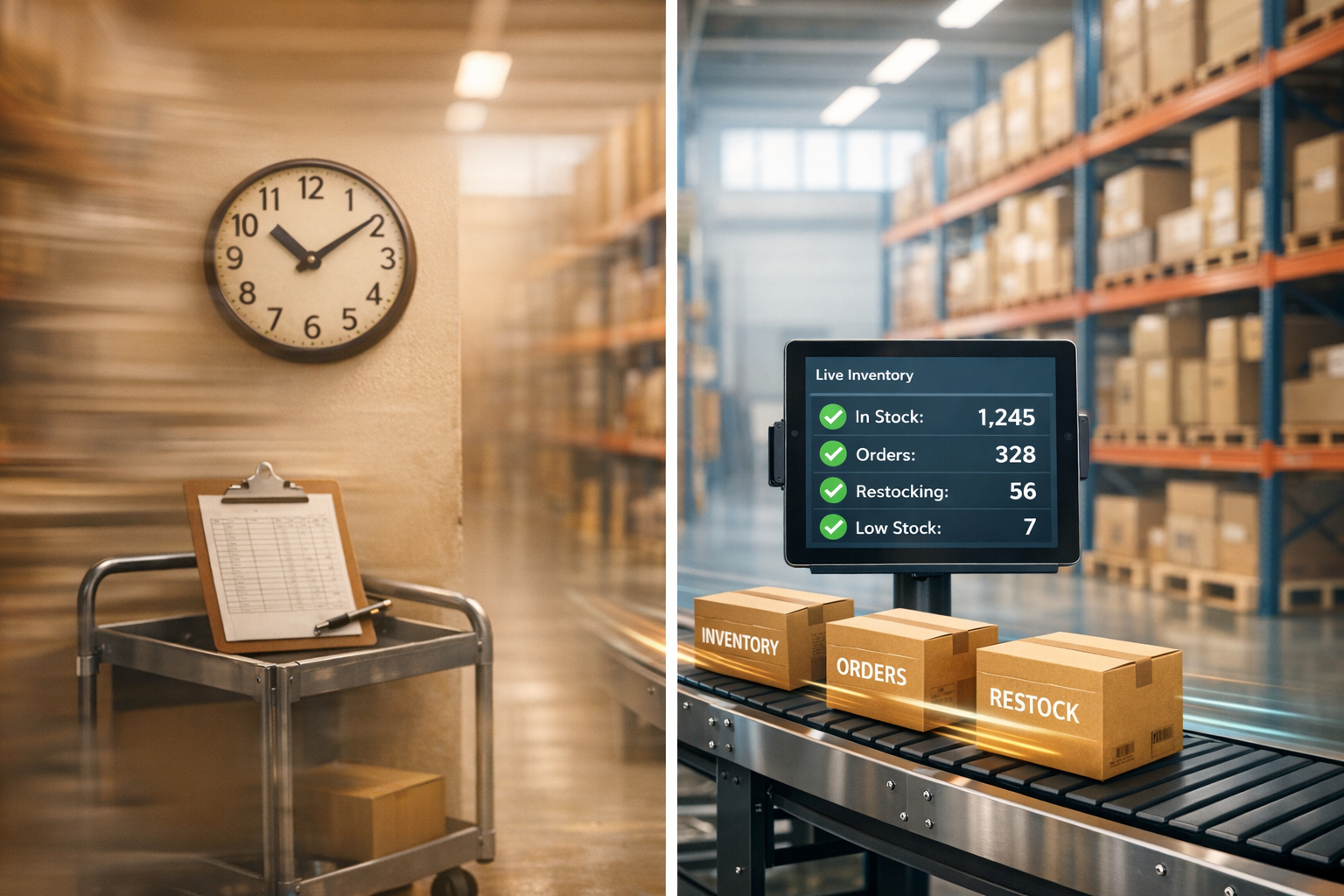
Real-Time Forecasting vs. Traditional Methods
Real-time forecasting is reshaping inventory management, especially for Shopify merchants. Unlike older methods that rely on historical data and update slowly, real-time systems use live inputs like sales, social trends, and weather to predict demand with greater accuracy. This shift reduces stockouts, minimizes excess inventory, and saves time by automating manual processes. Businesses using AI forecasting report up to 90% accuracy, 25% higher sales, and 15% lower holding costs compared to older methods.
Key Differences:
- Older methods: Depend on past data, update weekly or monthly, and have higher error rates (25–45%).
- Real-time systems: Use live data, update continuously, and offer lower error rates (8–15%).
Quick Comparison:
| Feature | Older Methods | Real-Time Forecasting |
|---|---|---|
| Data Source | Historical sales only | Live signals (POS, trends) |
| Update Frequency | Weekly or monthly | Continuous or daily |
| Accuracy (MAPE) | 25–45% | 8–15% |
| Manual Work | High | Low |
For Shopify merchants, real-time forecasting means faster responses to demand changes, automated workflows, and better decisions based on predictive analytics. It’s a smarter way to manage inventory and scale efficiently.
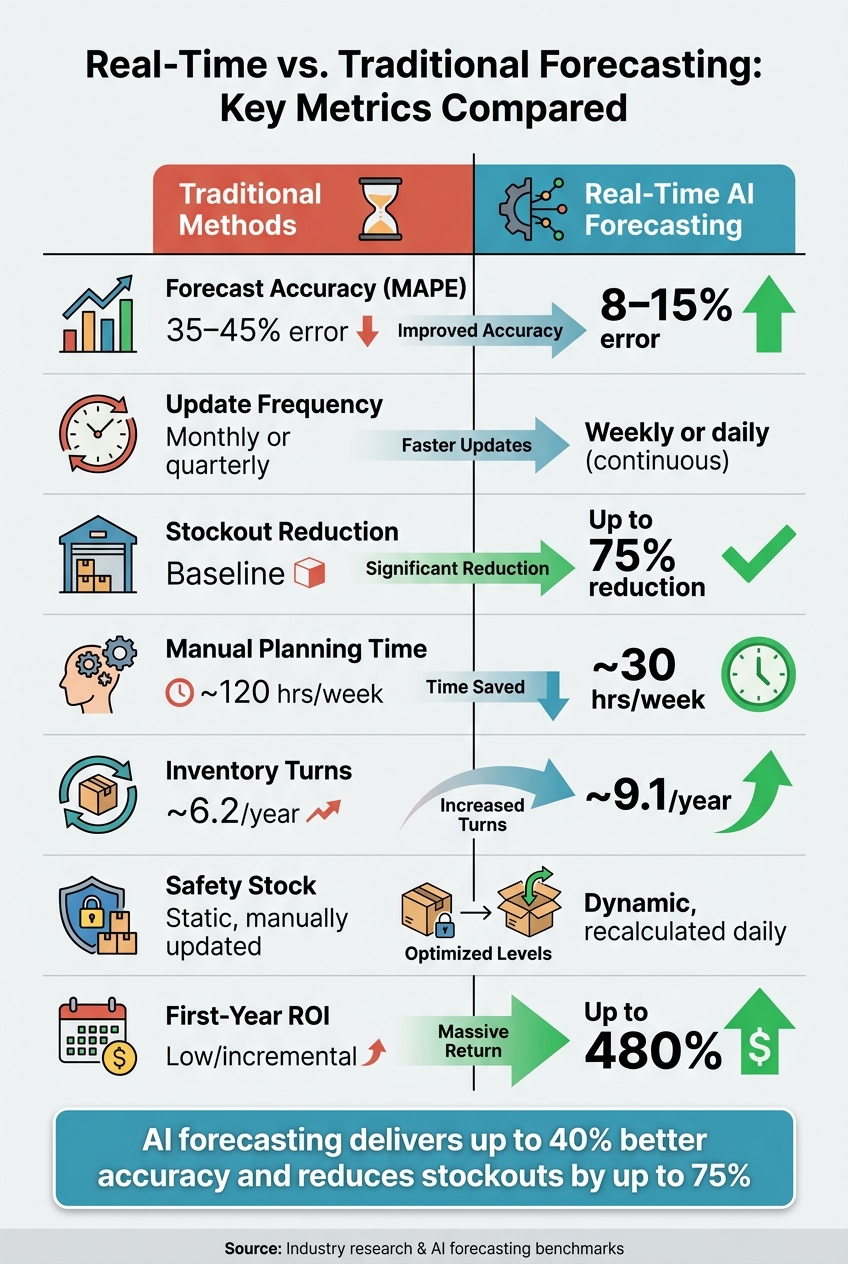
Real-Time vs. Traditional Forecasting: Key Metrics Compared
What Is the Difference Between Predictive Analytics and Traditional Forecasting?
sbb-itb-f0fc809
Key Differences Between Real-Time and Older Forecasting Methods
For Shopify merchants navigating fast-changing markets, the way data is handled and models respond sets real-time forecasting apart from older methods. The difference isn't just about technology - it's about how each approach views time, which influences everything from data collection to buying decisions.
"Traditional demand forecasting isn't broken because it was poorly designed - it's broken because the world it was designed for no longer exists." - Valasys
Data Sources and Processing
Older forecasting methods rely on structured, internal data - like 24 to 36 months of historical sales, promotional schedules, and ERP inputs. These systems process data in fixed batches, whether weekly, monthly, or quarterly. If market dynamics shift during a cycle, the model stays static until someone manually intervenes.
Real-time systems, on the other hand, handle live data streams as they come in. They integrate inputs like point-of-sale data, search trends, social media sentiment, weather updates, and geopolitical events. Machine learning algorithms identify patterns, refine forecasts automatically, and continuously compare predictions to actual outcomes. This constant feedback loop improves accuracy over time. The impact is dramatic: one agribusiness reduced production scheduling times by up to 96% just by moving from weekly to daily forecast updates.
This shift in how data is processed directly leads to the enhanced accuracy and quicker reactions that define real-time forecasting.
Accuracy and Responsiveness
In steady demand conditions, traditional methods can perform adequately. But at the SKU level - where precision matters most - error rates for older models like moving averages or ARIMA often range from 25% to 45%. That level of uncertainty is risky for planning purchases.
Real-time AI forecasting significantly reduces these errors. By incorporating external signals, machine learning models achieve a Mean Absolute Percentage Error (MAPE) of just 8% to 15%. Companies using demand sensing report up to a 40% improvement in forecast accuracy compared to traditional time-series models. Real-time systems can detect demand changes within hours, while traditional systems might not react until the next planning cycle.
| Method | MAPE (Lower is Better) | Best For |
|---|---|---|
| Moving Average | 35–45% | Stable demand only |
| Exponential Smoothing | 25–35% | Trending products |
| ARIMA | 20–30% | Seasonal patterns |
| ML Ensemble | 10–18% | Complex demand patterns |
| ML + External Signals | 8–15% | All demand scenarios |
For Shopify merchants handling seasonal items, flash sales, or trend-driven SKUs, this heightened responsiveness can mean the difference between avoiding stockouts and overstock issues - or falling victim to them.
Advantages of Real-Time Forecasting
Real-time forecasting offers clear operational advantages that can reshape how businesses handle inventory on a daily basis.
Faster Response to Market Changes
Traditional forecasting methods often fall short when demand shifts rapidly - they simply don’t update fast enough. Real-time systems, on the other hand, can detect these changes within hours.
This kind of speed is a game-changer during critical moments. Whether a product goes viral on TikTok, a competitor runs out of stock, or an unexpected weather event changes buying patterns, real-time forecasting reacts instantly. This agility can reduce lost sales and product shortages by as much as 65%. For Shopify merchants, it’s the difference between capitalizing on fleeting opportunities and missing out entirely.
"A good forecast executed quickly beats an excellent forecast that arrives too late." - Netstock
Automation and Less Manual Work
With real-time AI platforms, the entire data pipeline becomes automated. These systems pull data from POS systems, supplier feeds, and external sources without needing manual input. Even better, they can trigger automated replenishment by comparing projected inventory levels against targets. Purchase orders are created automatically, with only high-priority exceptions requiring human review. This streamlined process can reduce manual planning time by up to 75%.
For Shopify merchants juggling dozens - or even hundreds - of SKUs, this means less time spent on repetitive tasks and more time to focus on scaling their business. Tools like Forstock make this even easier by automating purchase orders, centralizing supplier communication, and offering reorder suggestions - all within Shopify’s interface.
By eliminating routine tasks, merchants gain more bandwidth to make strategic decisions, as discussed next.
Better Decisions Through Predictive Analytics
Real-time forecasting doesn’t just show what’s happening now - it also predicts what’s likely to happen next. Instead of relying on a single forecast, these systems create multiple demand scenarios, such as baseline, optimistic, and conservative projections. This flexibility allows merchants to craft smarter inventory strategies.
One practical example of this is safety stock management. Instead of maintaining a static buffer, real-time systems adjust safety stock daily based on factors like demand fluctuations, lead time variability, and supplier performance. This approach can reduce excess stock by 18% to 28%. Combined with a 12-month demand outlook, merchants can make purchasing decisions that are grounded in data, not guesswork.
Drawbacks of Older Forecasting Methods
Older forecasting methods struggle in three key areas.
Low Accuracy and Poor Flexibility
Traditional forecasting approaches, like ARIMA or basic regression, depend heavily on 24 to 36 months of historical sales data to predict future demand. This might work in stable markets, but e-commerce rarely stays stable. Trends shift quickly - whether it’s a viral product, a competitor’s flash sale, or an unexpected seasonal surge. These models can’t keep up. Their fixed update cycles mean decisions are often based on outdated information.
Error rates with traditional methods usually fall between 25% and 40%, but at the SKU level, errors can climb even higher - sometimes surpassing 40%. For Shopify merchants managing hundreds of products with multiple variants, such inaccuracies can severely impact both revenue and cash flow.
"Traditional forecasting is like driving with the rearview mirror and last quarter's map. It can work on stable roads. It struggles when demand turns because of signals that never existed in the historical average." - Applied
Beyond accuracy issues, these methods also demand significant manual effort, which hampers efficiency.
Manual Work and Time-Consuming Processes
Older forecasting systems often rely on spreadsheets and manual adjustments, which not only take up valuable time but also introduce inconsistencies. This inconsistency, known as "organizational noise", arises when different planners override data based on personal judgment rather than systematic analysis. For Shopify merchants, every hour spent juggling spreadsheets is time that could be better spent on supplier negotiations, refining product strategies, or scaling growth. As inventory grows more complex with additional SKUs, these inefficiencies only multiply.
These manual processes also contribute to costly inventory mismanagement.
The Cost of Stockouts and Overstock
Inaccurate forecasts directly impact the bottom line. Overestimating demand ties up cash in unsold inventory, while underestimating it leads to empty shelves and missed sales opportunities. To avoid stockouts, many planners over-order, locking up capital in slow-moving products. This creates further issues, like mismatched inventory across channels, with surplus in some areas and shortages in others. Such problems stem from backward-looking, aggregated forecasting methods that fail to operate at the granular SKU level.
A 2024 study on a Fortune 500 retailer showed a 25% drop in stockouts after adopting AI-powered forecasting. This demonstrates how moving beyond static data and manual processes can lead to significant improvements in inventory management.
The Impact of Real-Time Forecasting: Results That Matter
Real-time, AI-driven forecasting delivers a MAPE (Mean Absolute Percentage Error) of 8–15%, compared to the 35–45% range typical of traditional approaches. This dramatic improvement makes inventory planning much more dependable.
With real-time AI forecasting, businesses can reduce stockouts by up to 75%, increase inventory turns by 47%, and cut manual planning hours by 75%. On top of that, optimizing multi-location networks can improve working capital by 20–35%. For Shopify merchants, these efficiencies translate into meaningful savings in both costs and time.
Leading companies update their forecasts 3.2 times more often than the average, achieving an 18% boost in forecast accuracy through weekly cross-functional planning. These numbers highlight the advantage of integrated platforms for Shopify merchants.
"A good forecast executed quickly beats an excellent forecast that arrives too late." - Netstock
How Forstock Helps Optimize Inventory
Scaling these performance gains requires a specialized solution. For Shopify brands, Forstock brings these capabilities to life. The platform’s AI-powered forecasting achieves 95% accuracy, helping merchants reduce stockouts by 37% and overstock by 29%. It integrates seamlessly with Shopify, pulling live sales data into a single dashboard that monitors stock levels, supplier timelines, and demand trends.
Forstock also automates purchase order creation, removing manual bottlenecks and speeding up replenishment. Merchants gain access to 12-month demand plans, enabling them to handle seasonal demand shifts without tying up too much capital.
Performance Metrics: Real-Time vs. Older Forecasting
Here’s a snapshot of how real-time AI forecasting stacks up against traditional methods:
| Metric | Traditional Methods | Real-Time AI Forecasting |
|---|---|---|
| Forecast Accuracy (MAPE) | 35–45% | 8–15% |
| Update Frequency | Monthly or quarterly | Weekly or daily |
| Safety Stock | Static, manually updated | Dynamic, recalculated daily |
| Manual Planning Time | High (e.g., ~120 hrs/week) | Low (e.g., ~30 hrs/week) |
| Inventory Turns | Lower (e.g., 6.2/year) | Higher (e.g., 9.1/year) |
| Stockout Reduction | Baseline | Up to 75% |
| First-Year ROI | Low/incremental | Up to 480% |
Conclusion: Which Forecasting Approach Is Right for You?
The evidence is clear: real-time AI forecasting outshines traditional methods in terms of accuracy, speed, and efficiency. The old-school approach - relying on static spreadsheets and monthly planning cycles - just can't keep up with the rapid shifts in consumer demand we see today. Real-time AI forecasting aligns with the pace of modern business, offering daily updates, responding to live signals, and identifying demand changes before they spiral into stockouts or surplus inventory. Using Shopify stockout alerts can further protect your sales during these shifts.
For Shopify merchants navigating fast-changing markets, these benefits translate into smoother operations and better profitability. Traditional forecasting methods not only have higher error rates but also require significantly more manual effort, eating up valuable time that could be spent on growing your business.
"Companies that rely on outdated forecasting methods are setting themselves up for failure. The stakes are higher now, and the market is unforgiving." - Supply Chain Analyst, Warehouse Whisper
If you’re managing a growing Shopify catalog - especially one featuring seasonal items, multiple locations, or complex supplier timelines - real-time forecasting isn’t just helpful; it’s essential. Tools like Forstock make adopting these methods simple. Offering 95% forecast accuracy, automated purchase orders, and 12-month demand planning, Forstock is designed for Shopify brands and starts at just $79/month - a price point that works for businesses of all sizes.
Switching to advanced forecasting tools helps you maintain optimal inventory levels, ensuring balanced stock, steady cash flow, and the ability to meet customer demand with confidence. If your current system has you constantly playing catch-up, it’s time to rethink your approach to forecasting.
FAQs
What data do I need to use real-time forecasting?
To make the most of real-time forecasting, you need up-to-the-minute market signals that capture demand changes as they occur. This involves using live data like sales numbers, order pipeline updates, and other indicators that reveal immediate shifts in demand. Unlike older methods that depend on historical trends, real-time forecasting taps into current signals to quickly identify and respond to changes in customer needs.
How fast can real-time forecasting improve my inventory results?
Real-time forecasting allows businesses to detect demand changes within hours or days instead of weeks. This approach can cut forecasting errors by 20% to 50%, resulting in better stock management, fewer stockouts, and reduced overstock. By reacting quickly to market shifts, companies can fine-tune inventory levels, boost service quality, and reduce operational costs. It’s a fast and effective way to stay ahead in dynamic markets.
How do I set dynamic safety stock with real-time forecasts?
AI-powered inventory systems make setting dynamic safety stock a breeze by leveraging real-time forecasts. These systems constantly analyze live demand, supplier reliability, and external factors, allowing them to adjust safety stock levels automatically. This approach helps minimize both stockouts and overstock situations. By automating updates to align with shifting market conditions, businesses can maintain more accurate and responsive inventory management, staying ahead of demand changes with ease.
Keep reading
Try Forstock free for 14 days.
AI-powered demand forecasting and reorder automation for Shopify brands. No credit card required.