

Managing inventory for your Shopify store comes down to avoiding two costly mistakes: overstock and stockouts. Overstock means having too much inventory, which ties up cash and adds storage costs. Stockouts, on the other hand, happen when you run out of products, leading to lost sales and unhappy customers. Both hurt your business, but in different ways.
Here’s how they compare:
- Overstock: Excess inventory that doesn’t sell, leading to markdowns, wasted storage space, and reduced cash flow.
- Stockouts: Running out of products, causing missed sales, higher customer complaints, and potential loss to competitors.
Quick Fixes:
- Use data-driven demand forecasting to predict sales more accurately.
- Set smarter reorder points to avoid over-ordering or running out.
- Leverage tools like Forstock to automate inventory tracking and supplier coordination, reducing manual errors.
Finding the balance between overstock and stockouts protects your cash flow, keeps customers happy, and ensures your business grows efficiently. Let’s break down the details.
What Is Overstock?
Overstock Definition
Overstock happens when you have more inventory than you can sell within a typical time frame, tying up cash in products that don’t move. For Shopify and other e-commerce businesses, this isn’t just about having "extra" stock - it’s about holding onto items that sell slowly or not at all.
The difference between overstock and a healthy inventory buffer is straightforward: buffer stock sells at full or near-full price and supports your sales goals, while overstock eats into profits and ties up funds that could be better used for marketing, product development, or other growth-focused activities.
What Causes Overstock
Several common pitfalls can lead to overstock for Shopify brands. One of the biggest is ordering inventory without relying on data-driven forecasts. When decisions are based on gut feelings instead of sales trends, lead times, or seasonal patterns, it often results in excess stock.
Another common issue is over-ordering to "save on costs." Bulk buying might reduce the price per unit, but those savings can quickly evaporate if the inventory sits unsold for months. Storage fees pile up, and deep discounts may become necessary to clear out the stock. What seemed like a smart deal on paper can quickly turn into a financial burden when carrying costs and markdowns are factored in.
"Before Forstock, I was literally living in spreadsheets. I spent hours each week updating stock levels and trying not to miss reorder points. Since switching, I haven't had a single stockout, and I don't overorder anymore." - Sophie, E-commerce Manager
Expanding your product catalog without improving forecasting can also lead to overstock. Adding more SKUs or variants without tightening inventory controls creates small pockets of slow-moving items. Individually, these might seem minor, but together, they can drain significant cash.
Seasonal demand fluctuations and missteps in promotional planning are other culprits. If a marketing campaign underperforms or gets canceled, the related inventory can end up sitting unsold.
A lack of real-time inventory visibility is another trap. Without a clear view of stock levels across warehouses, sales channels, and locations, you might accidentally reorder items that are already sitting in another location. Poor tracking of aging stock or sell-through rates can also lead to unnecessary "just in case" orders, creating hidden overstock issues that only come to light when cash flow or warehouse space becomes critically tight.
While overstock ties up resources, the next section dives into the opposite problem: stockouts, where not having enough inventory means missed opportunities.
How Overstock Affects Your Business
Overstock can severely impact cash flow and profit margins. It brings extra costs for storage, handling, and financing, while price markdowns to clear out inventory eat into your profits. Unsold products often sit for months, locking up capital that could be used for growth opportunities or quick market responses.
When it’s time to clear out overstock, businesses often resort to steep discounts or liquidation, selling products at razor-thin margins - or even at a loss - compared to their original pricing plans.
Operationally, overstock creates clutter in your warehouse, slowing down picking and packing processes while increasing the chances of mispicks, damage, or shrinkage. It also takes up valuable space that could be used for faster-selling or new products, delaying launches and limiting your ability to adapt to shifts in customer preferences or market trends.
From a financial perspective, every dollar tied up in slow-moving inventory is a dollar that’s unavailable for growth-driving investments like customer acquisition or new product development.
Even your brand’s reputation can take a hit. Overstock often leads to frequent clearance sales or heavy discounting, which can train customers to wait for deals instead of buying at full price. In industries like fashion or lifestyle, an overload of clearance items can make your store feel less curated, damaging its premium appeal and long-term brand perception.
To address overstock early, monitor key metrics like days of inventory on hand by SKU, inventory turnover ratios, and the percentage of stock that hasn’t sold in 60, 90, or 180 days. Aging reports can highlight which products or dollars are tied up in long-aging inventory, helping you spot and resolve overstock issues before they spiral. Setting clear benchmarks - like keeping inventory older than 90 days under 15% - can guide better inventory management.
Understanding how overstock impacts your business lays the groundwork for tackling the contrasting challenge of stockouts in the next section.
What Are Stockouts?
Stockout Definition
A stockout occurs when your inventory falls short of meeting customer demand. For Shopify and other e-commerce businesses, this means you’re unable to fulfill orders.
Think of it as the opposite of overstock. While overstock leaves you with excess inventory collecting dust, stockouts mean there’s demand but no product to sell. The key difference between a planned "out of stock" status - like for pre-orders or intentional product holds - and a stockout is that stockouts are unplanned and disruptive. They catch you off guard, interrupt your sales flow, and create logistical headaches as you scramble to replenish inventory. Let’s break down what typically causes these shortages.
What Causes Stockouts
Stockouts often arise from a handful of recurring issues in the e-commerce world. One of the most common is poor demand forecasting. If you underestimate how much product you’ll need, you risk running out before the next shipment arrives. This problem becomes especially challenging during unexpected demand surges - like when a social media influencer gives your product a shoutout or a marketing campaign performs better than expected.
Another frequent culprit? Missing reorder points. If your inventory system is manual or outdated, it’s easy to overlook the ideal time to restock. By the time you notice inventory is running low, long lead times can result in a full stockout before new shipments arrive.
Supplier delays and extended lead times add another layer of complexity. Even with accurate forecasting and timely reordering, delays on the supplier’s end can leave you empty-handed.
"We were juggling dozens of suppliers and purchase orders every month, and things kept slipping through the cracks."
- Daniel, Supply Chain Manager
A lack of real-time inventory visibility also creates blind spots. Without up-to-date insights into stock levels across all locations and sales channels, you might not realize how quickly inventory is depleting. On top of that, inefficient purchasing processes can slow down restocking efforts, diverting attention from more strategic inventory decisions.
For businesses experiencing rapid growth, the challenges multiply.
"Growth was exciting but also chaotic. We would either run out of our best sellers or sit on piles of slow-moving stock."
- Emily, Inventory Manager
How Stockouts Affect Your Business
The financial hit from stockouts is immediate. Every customer who can’t make a purchase because of unavailable inventory represents lost revenue - sometimes permanently. Unlike overstock, where unsold products can eventually be discounted, stockouts mean sales that simply never happen.
The ripple effects don’t stop there. Stockouts often lead to costly last-minute fixes, like rush orders with expedited shipping, switching from sea to air freight, or paying premium fees to fast-track production. These emergency measures can shrink, or even eliminate, your profit margins.
Customers faced with unavailable products may abandon their carts and turn to competitors. In a market where switching is easy, repeated stockouts can damage your brand’s reputation, making your business seem unreliable.
Operationally, stockouts put extra pressure on your customer service team. Handling complaints, cancellations, and setting customer expectations takes time and resources that could be better spent on growth-oriented tasks. Over time, repeated stockouts erode customer trust and loyalty, reducing the lifetime value of your customers.
Tracking metrics like order fulfillment rates, the percentage of orders canceled due to stockouts, and the average time products remain unavailable can help you identify problems early. By spotting trends - such as specific products that frequently sell out or seasonal demand spikes - you can tackle the root causes before they escalate.
Understanding stockouts is key to managing inventory effectively. Alongside overstock issues, stockouts highlight the need for precise inventory strategies, which we’ll explore further in upcoming sections.
Forecast Accuracy | Fixing Demand Forecasting Errors: Avoid Overstock & Stockout in Supply Chain
Overstock vs. Stockouts: Side-by-Side Comparison
Both overstock and stockouts stem from poor inventory planning, but their consequences hit your business in very different ways. Overstock ties up cash and clutters your warehouse, while stockouts lead to lost sales and frustrated customers. Understanding these contrasts can help you prioritize and strike the right inventory balance.
The financial toll of each is significant but distinct. Overstock means your money is stuck in unsold products, racking up costs for storage, insurance, and handling - expenses that can add up to 20–30% of your inventory's value annually. On the other hand, stockouts result in immediate revenue loss, as customers often turn to competitors when the products they need are unavailable.
Comparison Table
Here’s a breakdown of how overstock and stockouts compare across key business factors:
| Factor | Overstock | Stockouts |
|---|---|---|
| Definition | Excess inventory sitting in storage, exceeding demand | Not enough inventory to meet customer demand |
| Cash Flow Impact | Ties up working capital in unsold goods; increases carrying costs (e.g., storage, insurance, taxes) | Cuts into revenue; may require costly rush orders or expedited shipping |
| Storage Requirements | Requires extra space and labor, leading to congestion | Less storage needed but often creates operational challenges like backorders |
| Customer Experience | Ensures availability but may force heavy discounting, which can alter price expectations | Damages customer experience with delays, canceled orders, and "out of stock" messages |
| Primary Risk | High markdowns, obsolescence, and potential write-offs, especially for seasonal items | Lost sales, reduced market share, and harm to your brand’s reputation |
| Key KPIs Affected | Lower inventory turnover, higher days of inventory on hand, inflated inventory value | Higher stockout rate, lower fill rate, reduced on-time-in-full performance |
| Strategic Focus | Cutting excess inventory, improving efficiency, and freeing up cash flow | Protecting revenue, meeting service expectations, and supporting growth |
Operationally, these challenges play out differently. Overstock creates internal headaches for your team - they have to manage, rearrange, and eventually discount surplus inventory to make room. Stockouts, however, bring external pressures, such as customer complaints, wasted marketing efforts, and potential damage to your brand’s reputation.
When demand forecasting misses the mark, you risk either ordering too much or too little. Overstock gives you some time to adjust, though at a cost, while stockouts require immediate action, often through expensive rush orders or faster shipping.
Stockouts alone cost retailers billions every year, proving that accurate inventory management isn’t just a logistical concern - it’s a strategic necessity. It directly impacts cash flow and growth potential.
Ultimately, overstock and stockouts are two sides of the same coin. Addressing both requires better forecasting, real-time inventory tracking, and data-driven restocking strategies. The next sections will dive into specific ways to avoid these costly pitfalls.
sbb-itb-f0fc809
How to Fix and Prevent Overstock
Overstock won’t resolve itself - it’s a problem that grows the longer it lingers. Excess inventory eats away at profits through storage fees, insurance costs, and tied-up cash that could be better used elsewhere. The key to solving and preventing overstock lies in shifting from reactive ordering to a data-driven approach that aligns purchases with actual demand.
This involves refining your forecasting methods, speeding up inventory turnover, and using tools that handle repetitive tasks more efficiently.
Improve Demand Forecasting
Overstock often starts with bad forecasts. Guesswork or relying solely on last season’s numbers without accounting for current trends can lead to stocking up on products that just don’t sell.
Start by reviewing 6–12 months of sales data, broken down by SKU, variant, and time period. Look for patterns: Which products sell steadily? Which spike during certain seasons? Which are losing traction? Calculate average daily or weekly sales, and take note of seasonal or promotional trends that could skew the numbers.
With this data, divide your products into three categories: fast-movers, medium-movers, and slow-movers. Fast-movers need consistent restocking, while slow-movers require stricter purchasing controls. If an item turns over fewer than three or four times a year, you’re likely ordering too much.
To smooth out short-term sales fluctuations, use moving averages. Then, refine your forecasts by factoring in known variables like upcoming marketing campaigns, product launches, or seasonal shifts. The goal? Order only what you expect to sell within a set period, typically 60–90 days, instead of stockpiling "just in case." Regularly revisit and adjust your forecasts - whether weekly or monthly - to compare projections with actual sales and fine-tune your strategy.
Increase Inventory Turnover
Even with better forecasting, you still need to move inventory quickly to avoid overstock. Boosting your inventory turnover - the rate at which you sell and replace stock - reduces the risk of excess stock piling up.
Keep a close eye on metrics like turnover ratios, days on hand, and SKU sell-through rates. If certain products are sitting too long or have low sell-through rates, take action immediately.
To clear out overstock without slashing margins, try targeted discounts on specific items instead of across-the-board markdowns. Bundling slow-moving products with bestsellers or running limited-time promotions can also help drive sales. If needed, explore alternative sales channels like online marketplaces or wholesale buyers to offload excess inventory and recoup cash.
On the purchasing side, tighten future orders for overstocked SKUs. Delay replenishment until current stock levels drop significantly, and adjust your ordering strategy based on at least a year of historical sales data. After seasonal peaks, reduce order quantities and set clear end-of-season cutoffs to avoid carrying surplus inventory into the next cycle.
Automating these processes can make managing inventory even easier and more efficient.
Use Forstock to Reduce Overstock
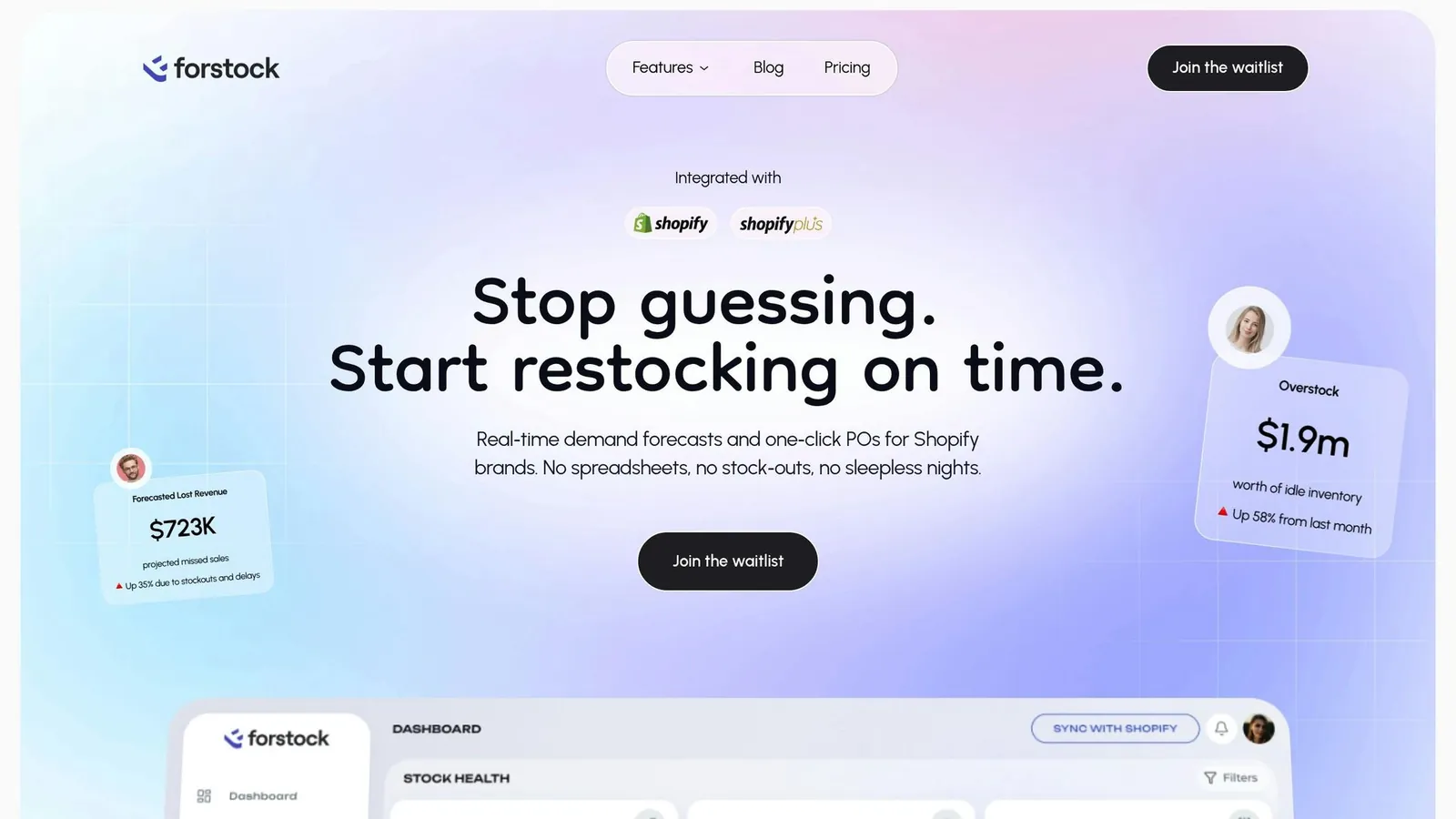
Manually managing forecasts and inventory tracking is time-consuming and prone to errors. That’s where Forstock comes in, offering a smarter way to tackle overstock early.
Forstock uses AI-driven forecasting to analyze historical sales, trends, lead times, and seasonality, providing real-time demand predictions for both SKUs and variants. These forecasts are far more accurate than intuition-based planning, ensuring your inventory aligns closely with customer demand.
But it doesn’t stop there. Forstock automates purchase order creation by factoring in forecasted demand, current inventory, and supplier lead times. This minimizes over-ordering and simplifies supplier coordination. Its unified dashboard gives you instant visibility into inventory health, turnover rates, and stock value, helping you make proactive adjustments before excess inventory becomes a problem.
"With Forstock, we can create POs in minutes, track supplier performance, and forecast demand without the guesswork." - Daniel, Supply Chain Manager
Forstock integrates seamlessly with Shopify, syncing your listings, orders, and inventory in real time across multiple locations. This all-in-one view lets you manage stock levels effectively while freeing up time to focus on growing your business.
How to Fix and Prevent Stockouts
Managing stockouts requires careful planning and precise strategies, just like dealing with overstock. Stockouts don’t just affect your revenue - they can also damage customer trust. Studies show that when faced with a stockout, 21–43% of shoppers will head to another store, while 25–45% will switch to a competing brand. For Shopify merchants, each stockout represents not only a missed sale but also the potential loss of a loyal customer.
The upside? Stockouts can be avoided with the right approach. The key lies in three main strategies: maintaining safety stock for high-demand products, improving supplier coordination to manage lead times effectively, and using automated tools to flag low-stock situations before they escalate.
Set Up Safety Stock
Safety stock acts as a cushion against the unexpected - whether it’s a sudden demand spike, a delayed shipment, or a surge from a successful campaign. It’s your safeguard to ensure you don’t run out of inventory when things don’t go as planned.
However, safety stock isn’t a one-size-fits-all solution. Applying the same buffer to every product can lead to overstocking slower-moving items and tying up cash unnecessarily. Instead, focus on critical products: fast sellers, items with erratic demand, and products with long or inconsistent supplier lead times.
Start by reviewing 3–12 months of sales data for each product. Look at average daily sales, past stockout incidents, and demand fluctuations over time. Don’t forget to assess supplier reliability - track how often deliveries are delayed and how much lead times vary. Products with more unpredictable sales or unreliable suppliers will need larger safety buffers.
A straightforward formula for calculating safety stock is to multiply your average daily sales by the number of extra days you want to cover. For instance, if you sell 10 units daily and your supplier’s lead time could extend by five days, keeping 50 units as safety stock makes sense. Over time, refine this number based on actual performance. If stockouts persist during promotions, increase the buffer; if inventory levels exceed your targets, scale it back.
Seasonal and promotional items require special attention. Anticipate demand spikes during holidays, influencer campaigns, or product launches, and adjust safety stock accordingly. After these periods, compare your projections to actual sales and fine-tune your approach. Regularly reviewing safety stock - whether monthly or quarterly - helps you stay aligned with current trends.
Once your safety stock is in place, the next step is ensuring your suppliers are on the same page.
Coordinate with Suppliers and Manage Lead Times
Even the best inventory forecasts won’t help if your suppliers fail to deliver on time. Building strong supplier relationships and accurately tracking lead times are essential for avoiding stockouts.
Start by tracking actual lead times for each supplier and product. Record the time it takes from placing a purchase order to receiving the goods, and compare these figures to the supplier’s promised timelines. For example, if a supplier claims a 14-day lead time but consistently takes 21 days, your reorder points need to reflect the longer timeframe, not the optimistic estimate.
Use this data to categorize your suppliers based on reliability. Suppliers who consistently meet deadlines and deliver accurate quantities should be prioritized, while those with frequent delays may require additional safety stock or backup plans. Key metrics like on-time delivery rates, average delays, and fill rates can help you evaluate performance and negotiate better terms.
For fast-moving or seasonal products, proactive communication is crucial. Share your demand forecasts with suppliers so they can prepare their resources in advance. Confirm lead times in writing, especially before peak seasons or product launches, and schedule regular check-ins to discuss potential challenges like material shortages or production delays.
For high-demand items, secure production slots early to ensure timely delivery. You might also consider setting up standing orders or pre-agreed reorder thresholds to automate replenishment without constant back-and-forth communication.
Diversifying your supplier base for key products can also help mitigate risk. While relying on a single supplier simplifies operations, it leaves you vulnerable to disruptions. Working with backup vendors or splitting orders between multiple suppliers adds resilience, even if it requires more coordination.
These supplier strategies work hand-in-hand with automated tools designed to keep your inventory at optimal levels.
"We were juggling dozens of suppliers and purchase orders every month, and things kept slipping through the cracks. With Forstock, we can create POs in minutes, track supplier performance, and forecast demand without the guesswork. It is the first tool that actually bridges inventory management and purchasing instead of forcing us to hack things together." - Daniel, Supply Chain Manager
Use Forstock to Prevent Stockouts
Managing reorder points, safety stock, and lead times manually can be tedious and prone to errors. That’s where Forstock comes in, automating the process to make stockouts a rarity.
Forstock integrates directly with your Shopify store, keeping an eye on real-time sales and inventory levels across all your locations and channels. Its AI-powered demand forecasting analyzes sales trends, seasonal patterns, promotional activity, and lead-time variability, constantly updating as new data comes in. When a product approaches its reorder point, Forstock automatically generates or suggests a purchase order, factoring in current stock, forecasted demand, and supplier lead times. This ensures timely restocking without the guesswork.
"Since switching, I haven't had a single stockout, and I don't overorder anymore. The AI forecast actually makes sense for my business. It feels like having a supply chain manager on my team." - Sophie, E-commerce Manager
Forstock also provides a 12-month demand plan, giving you a clear view of upcoming peaks and slow periods. This long-term perspective helps you secure production capacity for seasonal items and align your purchasing schedule with cash flow, reducing the need for last-minute restocks.
The platform centralizes all your supplier information - from contact details and lead times to minimum order quantities and performance metrics - into one easy-to-access dashboard. This unified system lets you track at-risk SKUs, monitor orders in transit, and identify bottlenecks in real time.
By automating repetitive inventory tasks and streamlining supplier communication, Forstock frees up your time to focus on scaling your business. For U.S.-based Shopify brands, this means better inventory availability, improved cash flow, and fewer headaches.
"I finally stopped panicking about stockouts, and I can focus on marketing and sales instead of constantly worrying about inventory." - Matt, Solo Founder
How to Balance Inventory Levels
Keeping inventory balanced is key to boosting profits, freeing up cash flow, cutting storage costs, and keeping customers happy. For Shopify brands in the U.S., managing this balance can directly influence your bottom line and help you stay competitive.
Because demand, supplier lead times, and product cycles are always shifting, achieving balance requires accurate forecasting, real-time tracking, and proactive supplier management. By combining these strategies, you can stay ahead of changes and avoid costly stock issues.
Use Multiple Tools Together
To maintain inventory balance, combine AI forecasting, real-time analytics, and supplier coordination. AI forecasting uses sales history, seasonal trends, and promotional schedules to predict demand for the next 3–12 months, updating continuously as new data comes in. Real-time analytics give you up-to-the-minute insights into stock levels, reserved inventory, in-transit goods, and sales trends by SKU, channel, and location. This helps you quickly spot imbalances and move stock where it’s needed most.
Supplier coordination ties all of this together. With accurate forecasts and real-time data, you can share projections, confirm lead times, and adjust order quantities based on actual performance. Instead of risking overstock with one large quarterly order, consider switching to monthly replenishment tied to a rolling 90-day forecast.
Set clear triggers to guide daily decisions. Aim for 8–10 inventory turnovers per year, keep 30–45 days of stock on hand, and maintain a service level of 95–98% for your best-selling items. These benchmarks help you identify when you’re at risk of overstocking or running out of stock.
Establish regular review cycles to stay on top of changes:
- Weekly reviews: Monitor key SKUs' sales and stock levels to catch demand shifts early.
- Monthly reviews: Check forecast accuracy and supplier performance to fine-tune your ordering and safety stock levels.
- Quarterly reviews: Evaluate your product assortment and lifecycle stages to ensure your inventory strategy aligns with your business goals.
When these tools and practices work together, you can address inventory challenges before they escalate.
"Growth was exciting but also chaotic. We would either run out of our best sellers or sit on piles of slow-moving stock. Forstock gave us clarity. I open the dashboard in the morning and instantly know what needs reordering, what is overstocked, and what to focus on. It is one of the few SaaS tools I would call essential for scaling." - Emily, Inventory Manager
Using an integrated set of tools is crucial - especially when platforms like Forstock bring everything together in one place.
Manage All Inventory with Forstock
Forstock simplifies inventory management by centralizing data, supplier metrics, and purchasing workflows into a single dashboard. Its AI-powered forecasting and automated purchase order (PO) generation help you align stock with demand while cutting down on manual tasks.
With Forstock, you get a complete view of your inventory health, turnover rates, and stock value across all locations and sales channels. You can quickly identify which products are selling fast, which are stagnant, and where stock levels need adjustment. This real-time visibility lets you make quick decisions, whether it’s reallocating inventory, tweaking safety stock levels, or running promotions to clear excess stock.
All supplier details - contact info, lead times, minimum order quantities, and performance metrics - are stored in one place, eliminating the need to sift through emails or spreadsheets. You can create, track, and process POs in just minutes.
For Shopify brands in the U.S., this streamlined approach means better margins and less stress. Instead of spending hours on repetitive inventory tasks, you can focus on growth-driving activities like marketing, product innovation, and enhancing customer experiences.
"What I love about Forstock is how approachable it is. Most inventory platforms are overbuilt and confusing, but this one just works. The forecasts are accurate, the purchase order flow is seamless, and my team actually enjoys using it. We have cut manual inventory tasks by at least 60%." - Liam, Operations Director
Conclusion
Holding onto slow-moving products ties up cash and increases storage costs, while stockouts lead to missed sales opportunities and can damage your brand reputation. Surprisingly, about 68% of manufacturers still rely on manual methods to handle inventory and supplier relationships, which amplifies the risk of these issues.
To address these challenges, it’s essential to treat inventory management as a forward-thinking process. This means using precise demand forecasting that factors in seasonality, promotions, and changing trends. It also requires real-time insights into stock levels, sales patterns, and supplier lead times. Regular performance reviews are equally important - weekly for fast-moving items, monthly for forecast accuracy, and quarterly for overall product strategy.
Forstock simplifies this process by bringing all these elements into one platform. Powered by AI, its forecasting tools help you order the right quantities based on actual sales data instead of relying on guesswork. Real-time analytics identify slow-moving products and flag items at risk of stockouts, enabling you to act before issues arise. Automated purchase orders and centralized supplier management reduce the need for manual spreadsheets. The result? Leaner inventory, fewer stockouts, and steadier cash flow - all managed through a single dashboard that integrates effortlessly with your Shopify store.
This streamlined approach aligns with the earlier discussion on achieving balance in inventory management for growth. If you’re spending too much time on inventory tasks, struggling with frequent stockouts, or watching cash sit idle in your warehouse, it’s time to assess your performance metrics. Evaluate your days of inventory on hand, stockout rates, and the percentage of revenue lost to out-of-stock events. Compare these figures to your growth and cash flow objectives. Then consider how a unified inventory platform can help you achieve those goals while cutting manual work by at least 60%.
Transforming inventory into a data-driven asset is key to sustainable growth. With the right tools and practices in place, you can meet customer demand, safeguard your margins, and keep cash circulating through your business instead of letting it gather dust in storage.
FAQs
How can I use demand forecasting to avoid overstock and stockouts in my online store?
Demand forecasting plays a crucial role in managing inventory effectively. By predicting future sales using trends, seasonality, and lead times, it helps you strike the perfect balance - keeping enough stock on hand without overloading your shelves. Forstock takes this a step further with AI-driven forecasting models that adjust to the specific patterns of your store, ensuring you order exactly what you need.
With real-time insights, you can sidestep the financial strain of overstocking, avoid losing sales from running out of products, and keep your cash flow healthy. Plus, automating this process not only reduces manual effort but also frees up your time to focus on growing your business with confidence.
How can I improve supplier coordination and manage lead times to prevent stockouts?
To keep stockouts at bay, focus on building strong, consistent communication with your suppliers. Set realistic lead times by analyzing historical data and keeping an eye on current sales trends. Make it a habit to review and adjust these timelines as circumstances evolve.
Leverage tools that offer real-time inventory tracking and demand forecasting to stay ahead of your replenishment needs. Automating purchase orders can be a game-changer, saving time and minimizing errors so you can restock the right quantities exactly when needed. By centralizing supplier management and simplifying routine inventory tasks, you’ll gain better control over your stock levels and sidestep costly disruptions.
How can Forstock improve inventory management compared to handling it manually?
Forstock takes the hassle out of inventory management by automating tedious tasks like demand forecasting, creating purchase orders, and coordinating with suppliers. With its real-time analytics, it helps you avoid the pitfalls of overstocking or running out of stock, so you always have the right products on hand.
What sets Forstock apart is its AI-driven forecasting. Instead of relying on manual methods, it analyzes sales trends, lead times, and seasonal patterns to guide smarter purchasing decisions. This not only saves you time but also boosts cash flow and ensures you're ready to meet customer needs seamlessly.