
How Much Inventory Should a Subscription Brand Hold?
By Forstock Team · Last updated July 22, 2026
Stock for upcoming renewals—not total subscribers—plus lead-time coverage and safety stock to avoid stockouts.

If I run a subscription brand, I should stock for next cycle renewals, not total subscribers or best-case growth. The basic idea is simple: start with scheduled renewals, subtract churn, skips, pauses, and failed payments, add a cautious new-subscriber estimate, then hold extra stock for lead time and risk.
Here’s the short answer:
- Base inventory on subscribers set to renew next
- Adjust for churn and skips like 4%–6% churn or 2%–5% skips
- Add new subscribers carefully, using the last 3–6 months of data
- Set reorder points from lead-time demand
- Keep safety stock based on demand swings and supplier delays
- Track inventory in days of coverage, not just units
- Review before every renewal cycle and after big changes
A simple way I’d think about it is:
Inventory to hold = expected renewals + lead-time demand + buffer stock
For example, if I have 5,000 monthly subscribers, I likely need about 5,000 units for the next ship date, then I trim that number for churn and skips instead of doubling it “just in case.” And if my supplier lead time is 45 days instead of 10 days, I need a much larger buffer.
Here’s a fast comparison of the core planning pieces:
| Item | What I use it for | Simple rule |
|---|---|---|
| Active renewals | Starting demand | Count next-cycle subscribers only |
| Churn / skips | Net demand | Reduce forecast by recent renewal behavior |
| New subscribers | Growth add-on | Use base-case estimates, not campaign hopes |
| Lead time | Reorder timing | Cover demand until new stock arrives |
| Safety stock | Risk buffer | Hold more when demand or supply is less stable |
| Days of coverage | Stock target | Convert units into time on hand |
If I want fewer stockouts without tying up too much cash, this is the model I’d use.
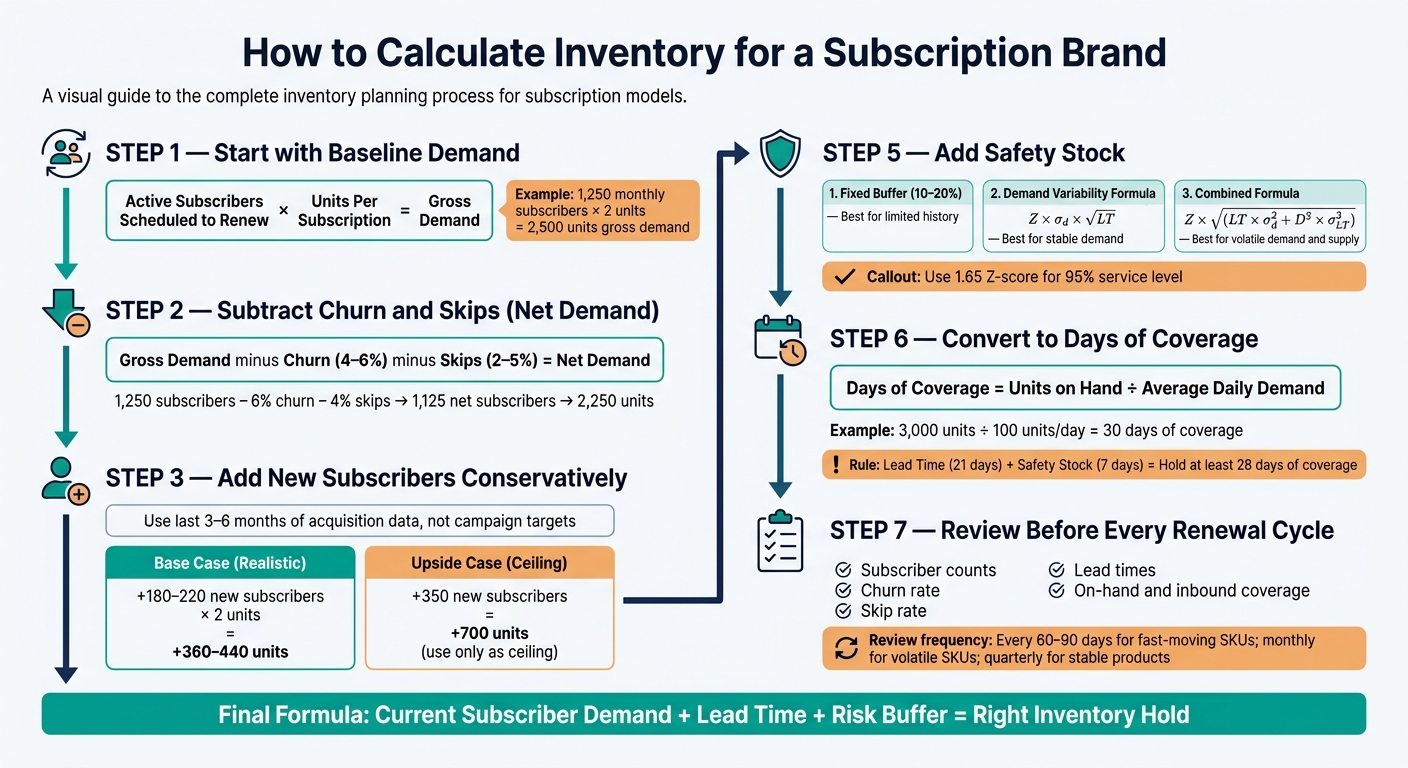
Subscription Brand Inventory Planning Formula: Step-by-Step Guide
Stop guessing how much inventory to order. Here's the exact formula.
Calculate baseline demand from active subscribers
Start with the subscribers set to ship in the next cycle. That number should drive your order, not your total subscriber count and not your growth goals.
Start with subscribers expected to renew in the next cycle
The core formula is simple: active subscribers scheduled to renew × units per subscription = baseline gross demand.
Here’s what that looks like in practice. If you have 1,250 monthly subscribers and each box includes 2 units, your gross demand is 2,500 units. If you also have 400 quarterly subscribers and each shipment includes 6 units, that adds 2,400 units. Forecast each billing cadence on its own, then add them together.
Separate gross demand from net demand
Gross demand is the total unit count if every active subscriber renews. Net demand is what remains after you subtract expected churn, skips, pauses, and failed payments.
A practical approach is to review recent renewal behavior and adjust the active base for known churn and skip activity. With 6% churn and 4% skips, 1,250 subscribers drops to 1,125. At 2 units each, net demand falls to 2,250 units.
From there, set reorder timing around the next ship date.
If pause rates climb in a meaningful way, trim the next order by the same share.
Add new subscribers conservatively
Add new subscribers last. And base that number on recent acquisition trends, not campaign targets. A good starting point is the last 3–6 months of net new subscribers, along with a separate upside case.
Say your brand has averaged 200 new monthly subscribers and you expect about the same result next cycle. A sensible base case is 180–220 new subscribers. At 2 units each, that adds about 360–440 units to net demand. An upside case, like 350 new subscribers from a planned influencer campaign, would add 700 units. Use the base case for purchase orders, and keep the upside case as the ceiling for inventory planning.
Next, adjust this baseline for churn, skips, and lead time.
Adjust inventory for churn, lead time, and reorder timing
Use a simple planning formula to adjust for churn, skips, and growth
Start with the baseline demand from the last section, then adjust it to match what will actually ship.
Projected Demand = Active Subscribers × Renewal Rate × Skip Adjustment + Projected New Subscribers
This formula accounts for two common things that throw plans off: churn and skips. Renewal Rate covers churn. Skip Adjustment covers pauses or skipped boxes. So if you have 10,000 subscribers, a 93% renewal rate, and a 5% skip rate, projected renewals drop to 8,835 before you add any new subscribers.
A simple average can hide what’s going on under the hood. Breaking subscribers into tenure groups helps keep forecasts tighter, since newer subscribers tend to churn more than long-time ones. Update those cohort rates each quarter.
Set reorder points based on lead-time demand
After you estimate demand, the next job is timing. You need to reorder early enough to cover the full lead time.
The reorder point tells you when to place the next order before inventory runs out. The formula is:
Reorder Point = Average Daily Demand × Lead Time (days) + Safety Stock
Lead time includes more than production. It also covers transit, customs, and receiving. That matters, because a long supply chain can change the math fast.
Using 300 units per day as the baseline demand, here’s how the numbers shift for a domestic supplier versus an overseas supplier:
| Supplier Type | Lead Time | Lead-Time Demand | Safety Stock (%) | Reorder Point |
|---|---|---|---|---|
| Domestic | 10 days | 3,000 units | 15% | 3,450 units |
| Overseas | 45 days | 13,500 units | 30% | 17,550 units |
The takeaway is pretty plain: more variability means you need a bigger buffer.
Work backward from the next subscription ship date
One of the easiest ways to avoid late POs is to count backward from the next ship date.
For a September 1, 2026 ship date, inventory needs to be available by August 29. The PO should go out by August 15, and the draft order should be ready by August 9–11. That gives your team enough room to pick, pack, and ship on September 1.
With an overseas supplier, the timeline moves much earlier. If lead time is 45 days, plus 5 days for customs and receiving, that same September 1, 2026 ship date pushes the PO into late May or early June.
sbb-itb-f0fc809
Add safety stock and set an inventory coverage target
Once you've set reorder timing, the next step is simple: decide how much extra stock to keep above forecast.
Choose a safety stock method based on your data quality
After you cover lead-time demand, add safety stock for demand spikes and supplier delays. Safety stock is the extra reserve above forecasted demand. It gives you a cushion when renewals jump without warning or a supplier ships late.
The best method depends on the amount of data you have and how much your supply chain swings.
| Method | Best for |
|---|---|
| Fixed buffer percentage | Brands with limited renewal history; add 10%–20% over projected demand for high-renewal subscription items |
| Demand-variability formula | Brands with stable demand history; uses Z × σ_d × √LT with a service-level factor like 1.65 for a 95% service level |
| Demand-and-lead-time variability formula | Brands with volatile demand and inconsistent supplier lead times; uses Z × √(LT × σ_d² + D² × σ_LT²) |
A good rule of thumb: start simple, then get more precise as your data gets better.
If your demand history is stable, use a variability formula. If supplier lead times also bounce around, the combined formula gives you cover on both sides.
Pick the method that fits your data quality and supply variability.
When to increase buffer stock
Some situations call for more buffer.
Increase your safety stock when:
- Churn variance is rising or hard to predict
- Skip rates are climbing
- You're launching a new subscriber cohort or seeing faster-than-expected growth
- You're onboarding a new supplier or entering a seasonal peak
- Lead times are long or inconsistent
- A vendor has had recent quality or fulfillment problems
The idea is pretty practical: more uncertainty means more buffer. When renewal patterns and supply performance calm down, you can cut that buffer back.
Convert units into days or weeks of inventory coverage
Turn the buffer into days of coverage so procurement can work from one clear target.
Days of Coverage = Units on Hand ÷ Average Daily Demand
If you hold 3,000 units and ship 100 units per day, you have 30 days of coverage.
If lead time is 21 days and safety stock is 7 days, you should hold at least 28 days of coverage.
Build a repeatable review process for better purchasing decisions
Inventory targets only help if you check them on a set schedule. Once you’ve picked a coverage target, the last piece is simple: review it before every renewal cycle.
Review stock targets before each renewal cycle and after major changes
Use the same checklist each time. That way, every cycle starts with current numbers instead of old assumptions.
Before each cycle, update:
- subscriber counts
- churn
- skips
- lead times
- on-hand and inbound coverage
If coverage is short, place the order early enough so inventory arrives before the renewal shipment goes out.
You should also run an extra review outside the normal cycle after a churn spike, an acquisition push, a lead-time slip, or a fulfillment change.
For fast-moving DTC categories like supplements or beauty, recalibrate safety stock at least every 60 to 90 days. If a SKU is volatile, review it monthly. For more stable products, quarterly deep dives into lead times and supplier reliability are a reasonable minimum.
When coverage drops below target, you can spot the gap before it turns into a stockout.
That review rhythm is what keeps your inventory target aligned with changes in demand and supplier timing.
Conclusion: Hold enough inventory to cover renewals, lead time, and risk
Hold enough stock to cover renewals, lead time, and risk using current subscriber behavior and supplier data. On-time fulfillment is not about holding as much inventory as possible. It’s about holding the right amount based on a review process that keeps your assumptions current.
Current subscriber demand + lead time + risk buffer = the right inventory hold.
FAQs
How do I forecast inventory if I have monthly and quarterly subscribers?
Normalize demand into a consistent average daily sales figure by combining unit volume from both subscription tiers and dividing by the active days in your lookback window, such as 30, 60, or 90 days.
In plain English: roll both tiers into one daily demand number so you’re not making inventory calls from fragmented data.
You’ll also want to account for the staggered renewal cadence of quarterly subscribers in a 13-week rolling forecast. That matters because quarterly orders don’t show up with the same rhythm as monthly ones, and that uneven timing can throw off planning if you treat all demand the same way.
From there, set your reorder point as (Average Daily Sales × Lead Time) + Safety Stock, and track it at the variant level. That way, each size, flavor, color, or SKU gets its own reorder trigger instead of being lumped into a broader product view.
What service level should I use for safety stock?
Most subscription brands land in the 95% to 97.5% range because it gives them the best tradeoff between inventory cost and stockout risk.
Go all the way to 99%, and things can get expensive fast. For the same item, you may need 40% to 50% more safety stock. In many cases, that extra inventory spend just doesn’t pencil out.
A simple tiered setup usually works well:
- 99% for top revenue drivers
- 95% for high-priority items
- 85% to 90% for less critical inventory
How often should I update reorder points and coverage targets?
Update reorder points and coverage targets when business conditions shift, like seasonality, promotions, or changes in supplier lead times.
Static reorder points should be reviewed on a set schedule. Dynamic reorder points need more frequent updates - ideally weekly or even daily - so they track current demand and growth.
It also helps to refresh broader forecasts every quarter or after major market events. For high-volume or priority items, review them more often ahead of key sales windows like Black Friday or Q4.
Keep reading
Try Forstock free for 14 days.
AI-powered demand forecasting and reorder automation for Shopify brands. No credit card required.