
How Demand Forecasting Reduces Shopify Inventory Costs
By Forstock Team · Last updated May 26, 2026
How demand forecasting aligns Shopify stock with sales to cut carrying costs, reduce overstock/stockouts, and free up working capital.
How Demand Forecasting Reduces Shopify Inventory Costs
Demand forecasting helps Shopify brands cut inventory costs by predicting future sales with data. It reduces the risks of overstocking, which ties up cash and leads to markdowns, and stockouts, which lose customers and sales. By analyzing sales trends, supplier lead times, and seasonality, businesses can make smarter purchasing decisions, lowering inventory carrying costs by 15–25% and minimizing excess stock by 20–40%.
Key takeaways:
- Carrying costs: Unsold inventory can cost 20–30% of its value annually.
- Overstocking: Leads to markdowns and locked cash flow.
- Stockouts: Lose sales and hurt customer trust.
- Better forecasting: Aligns inventory with demand, reduces waste, and frees up capital.
Using tools like Forstock automates forecasting, saving time and improving accuracy, so you can focus on growing your business.
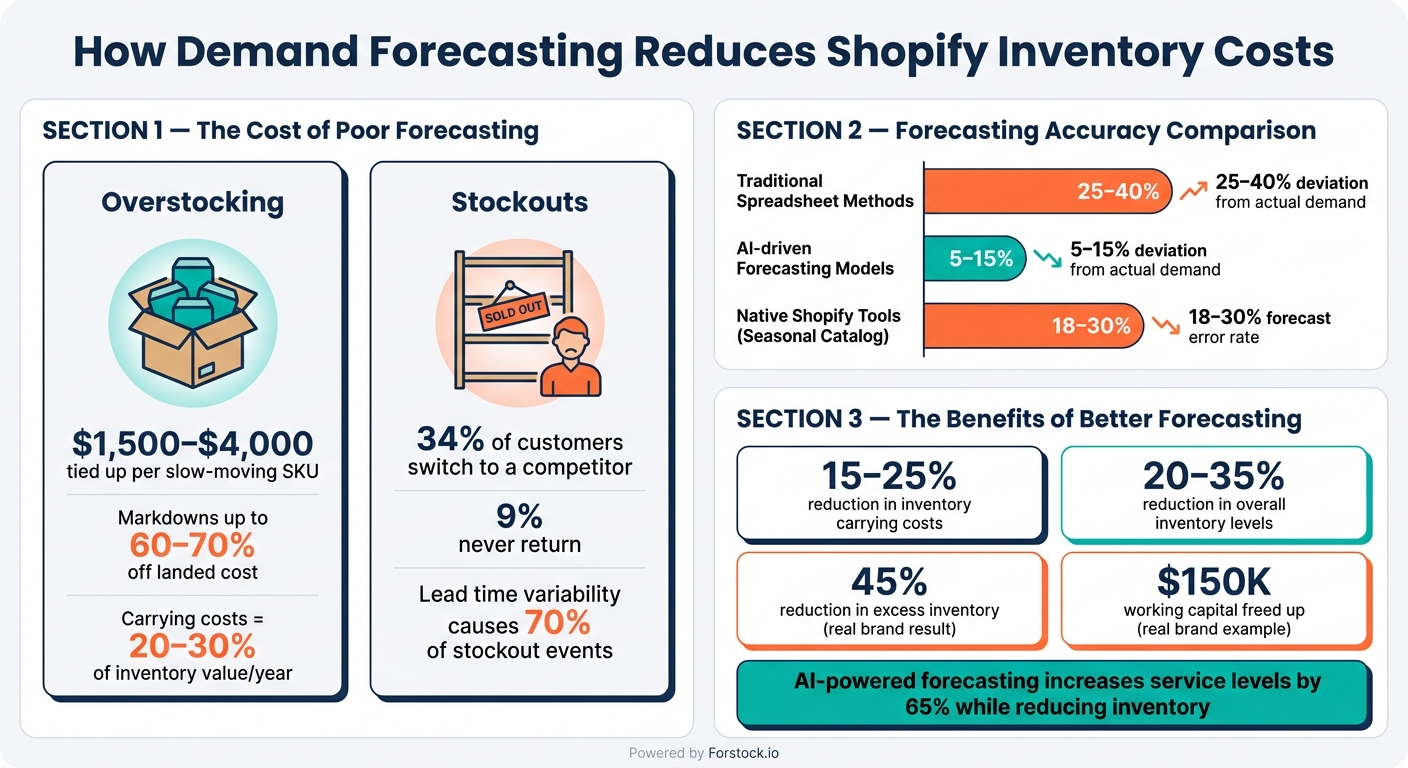
Demand Forecasting vs. Poor Forecasting: Inventory Cost Impact for Shopify Brands
Demand Forecasting Techniques for Inventory Management | Exclusive Lesson
This lesson builds on the fundamentals of Shopify inventory management to help you master advanced stock control.
sbb-itb-f0fc809
The Problem: How Poor Forecasting Drives Up Inventory Costs
When businesses depend on manual processes for inventory management, the financial strain often creeps in slowly before hitting all at once.
Overstocking: What It Costs You
Ordering too much inventory can quietly drain your resources. For example, poorly calculated Minimum Order Quantity (MOQ) orders can tie up $1,500 to $4,000 per SKU in inventory that moves at a snail's pace.
On top of that, unsold products often lead to steep markdowns - sometimes as high as 60–70% off landed cost - eating away at your profits. And it doesn’t stop there. If January’s unsold stock locks up your cash flow, you might struggle to fund April’s inventory without resorting to loans or damaging supplier relationships.
"Inventory holding costs average 20–30% of the inventory's value annually. This includes warehouse space, insurance, deterioration, and the opportunity cost of having cash locked in products instead of available for growth initiatives." - Hylke Reitsma, Co-founder, Forthsuite
While overstocking ties up your capital, stockouts come with their own set of problems, often damaging customer trust and costing you sales.
Stockouts and the Price of Emergency Replenishment
Running out of stock can be just as expensive as overstocking - or worse. 34% of customers faced with a stockout will turn to a competitor, and 9% may never return. Beyond the immediate loss in sales, stockouts can hurt your search engine rankings. When products are unavailable, search engines notice, and your rankings can take a hit.
Interestingly, stockouts are often caused by lead time variability rather than shifts in demand. This is why many merchants calculate safety stock to act as a buffer against these delays. In supply chains with lead times exceeding 30 days, variability accounts for up to 70% of stockout events. If you’re calculating reorder points to reduce stockouts based only on average lead times, you’re essentially planning for the best-case scenario every time - a risky move.
Where Shopify's Native Tools Fall Short

Shopify’s built-in tools make these challenges even harder to address. While its analytics can tell you what has sold, they don’t provide the forward-looking data you need to forecast effectively. Critical inputs like supplier lead times, multi-year seasonality trends, and the distinction between a lasting demand shift and a temporary sales spike are missing.
Here’s how Shopify’s native tools compare to what’s actually needed for accurate forecasting:
| Forecasting Input | Native Shopify Data | What Accurate Forecasting Needs |
|---|---|---|
| Demand Signal | Historical sales (lagging) | Market trends and search volume (leading) |
| Lead Time Visibility | None | Supplier production + transit time |
| Seasonality Baseline | Implied from prior year | Multi-year baseline adjusted for growth |
| Returns Impact | Deducted from net sales | Isolated from true demand signal |
For merchants managing more than 50 SKUs, these gaps can become a serious issue. When dealing with moderately seasonal catalogs, relying solely on Shopify’s data often results in a forecast error rate of 18–30%. That level of inaccuracy can lead to both stockouts and overstocking - sometimes within the same quarter.
These challenges highlight the importance of precise demand forecasting to ensure your inventory aligns with actual market needs.
How Demand Forecasting Cuts Shopify Inventory Costs
Matching Stock Levels to Actual Demand
The main goal of demand forecasting is straightforward: purchase only what you need, exactly when you need it. This involves analyzing historical sales data, variations in lead times, and seasonal trends to determine the reorder point:
(Average Daily Sales × Average Lead Time) + Safety Stock.
For safety stock, a Z-score-based formula works well:
Z-score × Standard Deviation of Lead Time × Average Daily Sales. Most Shopify brands find a 95–97.5% service level (Z-scores of 1.65–1.96) to be the sweet spot. Pushing for 99% service levels often requires much more safety stock, and the added cost rarely makes financial sense.
"Effective inventory forecasting for Shopify store owners directly reduces carrying costs by 15–25% and minimizes stockouts by aligning procurement with empirical demand data." - Closo
By fine-tuning orders with precision, businesses can avoid unexpected rush costs and improve inventory management.
Avoiding Stockouts and Rush Replenishment Costs
Accurate demand forecasting doesn’t just ensure you have enough stock - it also helps avoid expensive emergency measures. When demand exceeds expectations, businesses often resort to costly air freight or expedited production, which can eat into (or completely erase) profit margins.
Forecasting helps you anticipate demand spikes, whether they’re tied to Q4 holiday shopping, a major promotion, or recurring seasonal trends. AI-driven forecasting models, for instance, typically deliver a 5–15% deviation from actual demand, compared to the 25–40% deviation seen with traditional spreadsheet-based methods. This improved accuracy means fewer emergency orders and more predictable costs.
Cutting Dead Stock and Obsolescence
Demand forecasting doesn’t just help with over-ordering; it also reduces the risk of dead stock. Techniques like Exponential Smoothing (ETS) can identify declining trends early, giving you the chance to scale back orders before overstock becomes a problem. This proactive approach allows you to negotiate lower minimum order quantities (MOQs) with suppliers or shift focus to products with higher turnover.
The financial impact of catching these trends early is huge. Avoiding a single over-purchase of a slow-moving SKU can save $1,500–$4,000 in tied-up capital per product. Plus, clearing dead stock often requires markdowns of 60–70% off landed cost, which further erodes profitability.
Distributing Stock Across Multiple Locations
Forecasting also helps balance inventory across different locations, which can significantly reduce carrying costs. Poor allocation often leads to stock imbalances, but forecasting at the SKU and location level predicts regional demand more accurately.
By pre-positioning inventory in warehouses closer to where demand is expected, businesses can cut shipping costs and avoid cross-country rush transfers. Automated stock transfer recommendations based on demand data make it easier to rebalance inventory between locations without placing new purchase orders.
Freeing Up Cash Flow for Business Growth
Excess inventory locks up capital that could be used to grow your business. Forecast-driven purchasing helps free up this trapped cash, enabling reinvestment in areas like marketing or product development.
The numbers are compelling: AI-powered inventory systems can reduce overall inventory levels by 20–35% while increasing service levels by 65%. For example, Jason, Co-founder at HomeGoods, shared: "We reduced excess inventory by 45% and freed up $150K in working capital". That’s money that can now go toward scaling the business instead of sitting idle in a warehouse. Accurate forecasting not only cuts costs but also creates opportunities for growth.
How to Add Demand Forecasting to Your Shopify Store
Start by Auditing Your Inventory Data
The first step to improving your demand forecasting is ensuring your inventory data is accurate and complete. Focus on identifying your high-priority SKUs - these are the products that either generate the most revenue or frequently run out of stock. Next, collect historical sales data (such as 14, 30, 60, or 90-day trends) to calculate your daily sales velocity and inventory turnover. Confirm supplier lead times directly to avoid guesswork. Don’t forget to flag any seasonal items or products being phased out, as these can skew your forecasts.
To refine your process, start small. Test your forecasting strategy on one critical SKU before expanding it across your inventory.
Build a Regular Forecasting Schedule
Forecasting isn’t a one-and-done task - it requires consistent updates. Regularly reviewing your forecasts ensures your inventory stays in sync with shifting demand patterns. A weekly review schedule works well for most businesses, but during high-demand seasons - like Q4 holidays, back-to-school shopping, or major sales events such as Black Friday and Cyber Monday - you may need to increase the frequency.
Sticking to a regular schedule allows you to adapt quickly to changes. Plus, AI-powered cloud inventory tools can make updates in real-time as new data comes in.
Using Forstock to Automate the Process
If you’re looking to simplify demand forecasting, Forstock offers a fully automated solution. The setup takes just about 2 minutes.
Once connected, Forstock’s AI dives into your sales history, lead times, seasonality patterns, and growth trends to provide SKU-level demand forecasts for all your locations. What makes Forstock stand out is its clarity - it explains the reasoning behind every reorder recommendation. No more guessing why a purchase order was triggered.
"The forecasting transparency is unmatched. I can see exactly why Forstock recommends reordering now vs. later. No more black-box guessing." - Founder & CEO, DTC Beauty Brand ($8M ARR)
Forstock doesn’t stop at forecasting. It also automates purchase order creation, factoring in supplier lead times, costs, and minimum order quantities. Alexander, a Supply Chain Manager at FashionCo, shared that this feature saves his team over 10 hours of manual work each week. This kind of automation not only saves time but also aligns perfectly with broader cost-efficiency strategies.
Conclusion: What Better Forecasting Means for Your Bottom Line
Forecasting inventory costs can significantly cut your overhead. On average, inventory carrying costs amount to 20–30% of your total inventory value each year. For example, if a Shopify store holds $50,000 in excess stock, that translates to approximately $15,000 annually. Reducing these costs frees up capital that can be reinvested into marketing, product innovation, or scaling your business.
The impact of poor inventory alignment is clear, but the benefits of improved forecasting are just as striking. Brands using AI-powered demand planning have reported reducing excess inventory by up to 45% and cutting stockout rates by as much as 75%. Jason, Co-founder at HomeGoods, shared his experience:
"We reduced excess inventory by 45% and freed up $150K in working capital."
When your purchasing aligns with actual demand, the advantages ripple throughout your business. You’ll spend less on last-minute restocking, avoid steep discounts to clear unsold inventory, and keep your customers happy by minimizing stockouts. Automated forecasting not only protects your margins but also strengthens customer loyalty and market share. Plus, by automating these processes, your team can shift focus from reactive problem-solving to driving strategic growth.
The best part? These tools are easy to adopt. Setting up automated forecasting can take as little as 2 minutes, giving you instant control over your inventory. Once implemented, these systems integrate seamlessly into your Shopify store, transforming how you manage stock.
Leading Shopify brands know that smarter inventory management is key to sustainable growth. By syncing stock with real-time demand, you can lower costs and prepare your business for long-term success. Demand forecasting isn’t just about efficiency - it’s a direct path to protecting your margins and maintaining strong cash flow as you scale.
FAQs
What data do I need to forecast demand accurately in Shopify?
Accurately forecasting demand on Shopify requires gathering a few essential data points. Start with your recent sales history, typically covering the last 14–90 days, to calculate your average daily sales. Combine this with your supplier lead times to effectively plan reorders. Don’t forget to account for safety stock levels, which are usually set at 10–20% of your average demand, to help manage unexpected fluctuations.
For a more precise forecast, consider external influences like seasonal trends, promotions, or market changes. These factors become especially important when leveraging AI-powered tools, as they can analyze both your internal data and external variables to provide deeper insights.
How do I choose a service level without overspending on safety stock?
To keep safety stock costs in check, it's essential to strike a balance between demand variability, lead times, and forecast accuracy. Tools like Forstock, which leverage AI, can simplify this process by analyzing real-time sales data, seasonal trends, and supplier lead times. These tools allow you to fine-tune safety stock levels, adapt quickly to changing demand patterns, and automate reorder points. The result? You maintain the right inventory levels without overspending or risking stockouts.
When should I switch from spreadsheets to a tool like Forstock?
Switch from spreadsheets to a tool like Forstock when managing inventory manually starts causing headaches. If you're constantly dealing with stockouts, overstocking, or unreliable demand forecasts, it’s a clear sign your current system can’t keep up. Spreadsheets often fall short when it comes to handling real-time sales data, automating reorders, or reducing costly errors. A dedicated inventory management tool can help you streamline operations, make smarter decisions, and keep your stock levels on point.
Keep reading
Try Forstock free for 14 days.
AI-powered demand forecasting and reorder automation for Shopify brands. No credit card required.