
Quick Summary
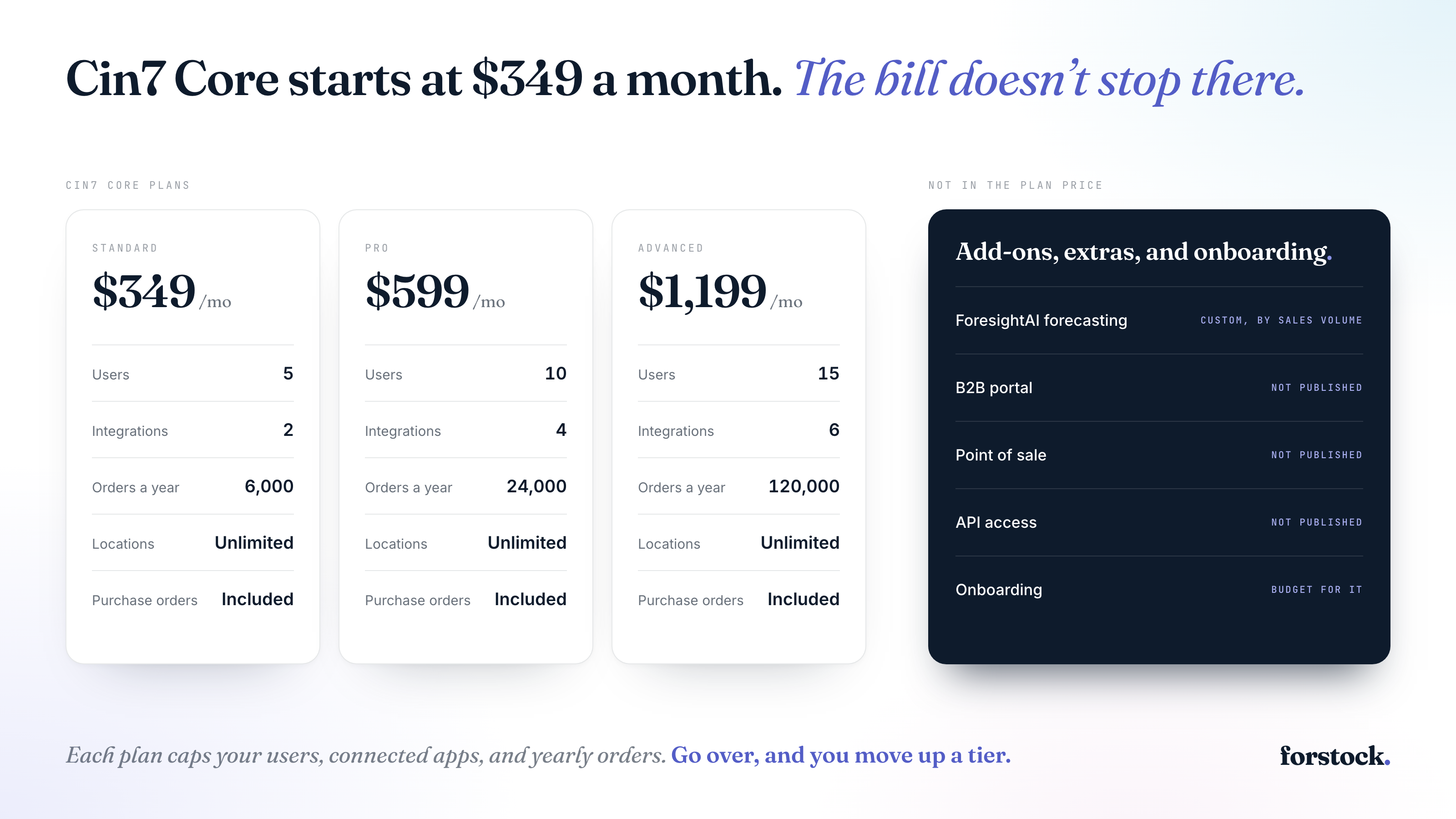
- Cin7 Core costs $349/month on Standard, $599 on Pro, and $1,199 on Advanced.
- Each plan caps your users, connected apps, and yearly orders. Extras like AI forecasting, a wholesale portal, and point of sale cost more, with no published price.
- Budget for onboarding too, and look at a lighter planning tool if forecasting is your main need.
Why Your Cin7 Bill Depends on More Than the Plan Price
Cin7 Core starts at $349/month. But that doesn't necessarily mean you'll be paying $349.
The Standard plan only covers 6,000 sales orders a year. That's 500 a month. If your store processes 20 orders a day, you'll hit that limit in about 300 days, before your first year is even over.
And orders aren't the only thing Cin7 limits. You also have to account for how many people need access, which apps you want to connect, and whether you need paid features like AI demand forecasting.
Then there's onboarding, which Cin7 charges for separately.
None of this automatically makes Cin7 too expensive. It handles a lot of work that would otherwise require several different tools. But you should know what you're paying for before you choose a plan.
Let's go through the pricing, including the extra costs that are easy to miss. We'll also look at whether a full inventory management system makes sense for your business or whether a simpler planning tool would do the job.
Why Listen to Us?
At Forstock, we work with Shopify brands that want to spend less time figuring out inventory and more time running their businesses.
Take Gentlehomme, a menswear brand in North Miami. Since using Forstock to plan its inventory, the brand reports around 50% fewer stockouts on its core styles and 20% less cash tied up in excess inventory.
We mention these because they're the outcomes that matter when you're comparing inventory software. Does it help you keep the products customers want in stock? And does it stop you from tying up too much money in products that aren't selling?
We'll keep those questions in mind as we look at Cin7's pricing.
How Cin7 Pricing Works
Cin7 has two main inventory management products: Core and Omni.
- Cin7 Core, previously known as DEAR Systems, is the more straightforward option. It has three plans with published monthly prices.
- Cin7 Omni is more customizable and geared toward businesses with more complex requirements. You'll need to speak with Cin7 to get a quote.
For Core, your monthly price depends mainly on three things:
- Users: How many people on your team need to log in.
- Integrations: How many sales channels and other apps you want connected, such as Shopify, Amazon, or ShipStation.
- Annual sales orders: How many customer orders you process across your connected channels each year.
Each plan comes with a set allowance. You can pay for more capacity, but that increases your bill.
Some features are also charged separately, including Cin7's AI forecasting tool, ForesightAI, and its B2B ordering portal.
Does Cin7 offer annual billing?
Yes. You can pay monthly or annually.
According to Cin7's Shopify App Store listing, the annual prices are:
- Standard: $3,839 instead of $4,188
- Pro: $6,589 instead of $7,188
- Advanced: $13,189 instead of $14,388
That's roughly an 8% saving, or about one month free.
Just remember that paying upfront also means committing to the full year. We'll cover Cin7's cancellation terms later.
Cin7 Core Plans and What Each One Includes
| Standard | Pro | Advanced | |
|---|---|---|---|
| Monthly price | $349 | $599 | $1,199 |
| Users | 5 | 10 | 15 |
| E-commerce and app integrations | 2 | 4 | 6 |
| Sales orders per year | 6,000 | 24,000 | 120,000 |
| Inventory locations | Unlimited | Unlimited | Unlimited |
| Purchase order management | Included | Included | Included |
| Material requirements planning | Add-on | Included | Included |
| Advanced warehouse management | Not available | Add-on | Included |
| Returns management (RMA) | Not available | Add-on | Included |
| Advanced automations | Add-on | Add-on | Included |
| AI forecasting (ForesightAI) | Add-on | Add-on | Add-on |
Prices are in USD, exclude taxes, and apply to new customers. Source: Cin7's official pricing page.
The biggest thing to watch is your order volume.
Standard gives you 6,000 orders a year, which works out to 500 a month. Pro increases that to 24,000 a year, or 2,000 a month. Advanced takes you up to 120,000, or 10,000 a month.
Say your business processes 30 orders a day. That's about 10,950 orders a year, so Standard won't cover you. You'd need to pay for more order capacity or choose Pro.
There are feature differences too.
Standard covers the basics, including inventory tracking, purchase orders, accounting integrations, and warehouse management for one location.
Pro gives you more room to grow, with higher order limits and material requirements planning. You can also purchase add-ons for advanced warehouse management and returns.
Advanced is for businesses handling much larger order volumes or more complicated warehouse operations. It includes advanced warehouse management, returns management, and advanced automations.
So, don't just compare the monthly prices. Check the features and limits against what your business actually needs.
Cin7 Omni Pricing
Omni is Cin7's second system, and Cin7 doesn't publish a price for it. It calls Omni a custom solution for larger businesses with advanced needs, so you'll get a quote from its team. The minimum term depends on that quote.
Cin7's pricing page lists 8 users and 5 connected apps for Omni. The company says it includes built-in links to electronic ordering with big retailers (EDI) and outsourced warehouses (3PLs). For a rough idea, Cin7's Shopify App Store listing for Omni shows a $749/month plan with the note "Pricing may vary."
Extra Costs to Budget for With Cin7
The monthly subscription is only one part of your Cin7 bill.
Depending on your setup, you'll probably want a few features that aren't included in the base plan.
Here's what costs extra.
| Add-on | What you're paying for | Published price |
|---|---|---|
| ForesightAI | AI demand forecasting and automated replenishment planning | Custom, based on sales volume |
| B2B Portal | Online ordering for wholesale customers | Not published |
| Point of sale (POS) | Processing in-person sales | Not published |
| API access | Building custom integrations | Not published |
| Intelligent Document Recognition (IDR) | Turning customer purchase orders into sales orders automatically | From $79/month for 600 documents |
| Premium Support | Scheduled support calls and consultations | Not published |
| Extra users, integrations, and orders | Increasing your plan's capacity | Not published |
Most of these add-ons don't have public prices, so you'll need to ask Cin7 for a quote.
ForesightAI is particularly worth checking if demand forecasting is why you're considering Cin7. It can forecast demand up to 24 months ahead and recommend replenishment quantities, but it's an additional subscription on every Core plan.
IDR is one of the few add-ons with published pricing. It starts at $79/month for up to 600 documents, with another $50/month for each additional 600 documents.
You'll also need to budget for onboarding
Cin7 offers paid onboarding to help you set up your inventory, connect apps, and get your team comfortable with the system.
According to its onboarding documentation, group onboarding typically takes 4–6 weeks, while one-to-one onboarding takes 6–8 weeks. More specialized setups may involve an implementation partner.
These aren't necessarily small commitments, especially if you're moving years of inventory and order data from another system.
Cin7's terms also say that once implementation services begin, those payments can't be cancelled or refunded.
And if you're planning to pay for a full year upfront, keep in mind that annual prepaid subscriptions are nonrefundable too.
The point isn't that these costs are unreasonable. It's that you should get the total price, including onboarding and any add-ons, before making your decision.
What Cin7 Costs for a Growing Shopify Brand
Here’s an example of how the limits add up. We'll use a brand that sells on Shopify and Amazon, ships through ShipStation, and keeps its books in Xero. It has six people who need logins and it processes 15,000 orders a year.
That brand would go over all three of Standard's limits. Shopify, Amazon, and ShipStation take up three integrations (Xero doesn't count), and Standard only allows two. It also has one more login than Standard allows, and its 15,000 orders are far past the 6,000 cap.
Pro covers all of it, with room for 10 users, 4 integrations, and 24,000 orders a year. That's $599/month, which adds up to $7,188 over a year, or $6,589 if you pay for the year upfront. If the brand also wanted ForesightAI forecasting, a B2B portal for wholesale accounts, or an onboarding package, each would be quoted on top.
Where Forstock Fits as a Cin7 Alternative
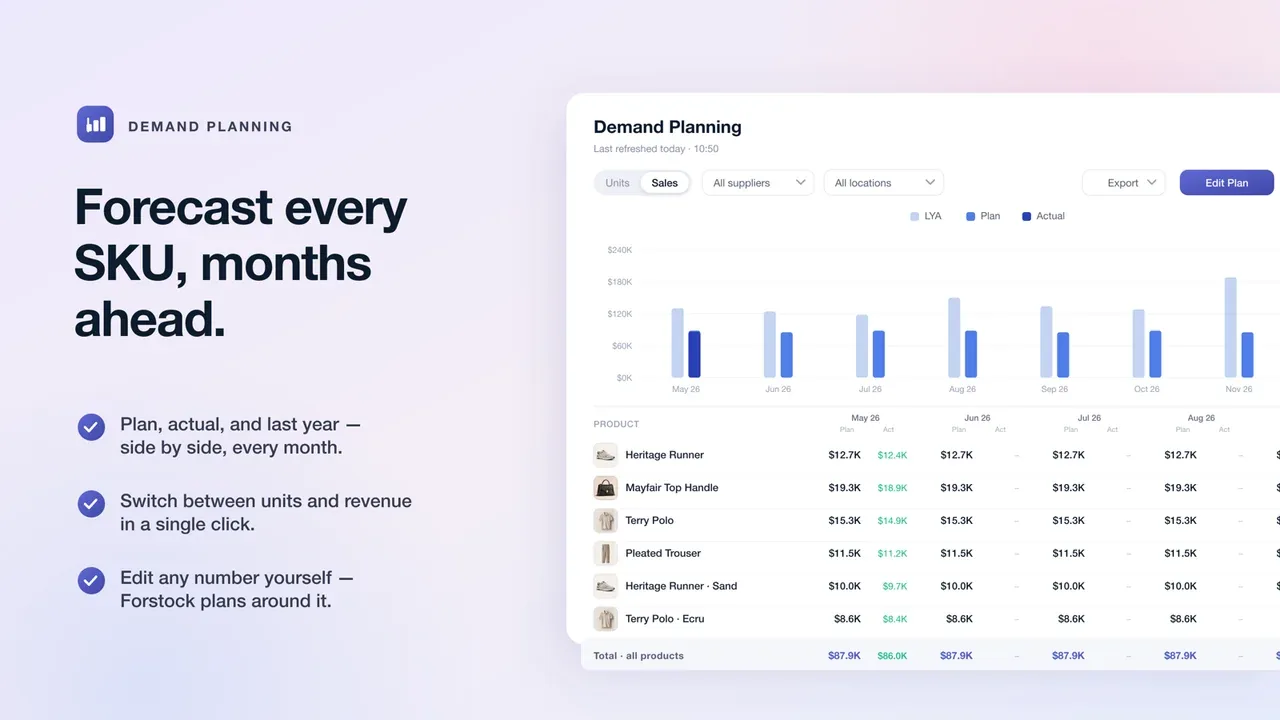
Forstock is built for a more specific job: helping ecommerce brands work out what inventory to buy, how much they need, and when to reorder.
It connects with Shopify and Amazon, brings in sales and inventory data, and uses that information to forecast demand for each SKU and location.
The idea is simple. Rather than spending hours working through sales reports and reorder spreadsheets, you get a plan you can review and act on.
How Forstock handles forecasting
Once you've connected your store, Forstock uses your order history to build a demand forecast. You can look 3, 6, or 12 months ahead.
With at least six months of order history, you can use its AI forecasting. For newer stores with less data, there's a simpler average-based forecasting method.
Forstock also accounts for things that can make your sales history misleading.
Say one of your bestsellers was out of stock for two weeks. Your sales data would show zero sales during that period, but that doesn't mean demand disappeared.
Forstock accounts for those stockout periods when calculating demand.
It also reads past promotions from your sales and discount history. So if a product sold unusually well during a 20% off sale, the forecast can distinguish that promotional spike from regular demand.
That helps you avoid buying too much stock based on a temporary increase in sales.
It helps you turn forecasts into purchase orders
Knowing how much stock you'll need is useful. But you still have to decide when to actually order it.
Forstock's reorder recommendations account for your stock on hand, incoming orders, supplier lead times, safety stock, and minimum order quantities.
For each SKU, you can see how much to reorder and when you should place that order to avoid running out.
Once you've reviewed the recommendations, you can create purchase orders for your suppliers directly from the platform.
It also takes pack sizes and minimum order quantities into account, so you're not left manually adjusting every order.
And the process doesn't require you to wait weeks for a complicated setup. Forstock says you can get your first inventory plan on the same day you connect your store.
How much does Forstock cost?
Forstock's pricing depends on your business's annual revenue, rather than your number of users or SKUs.
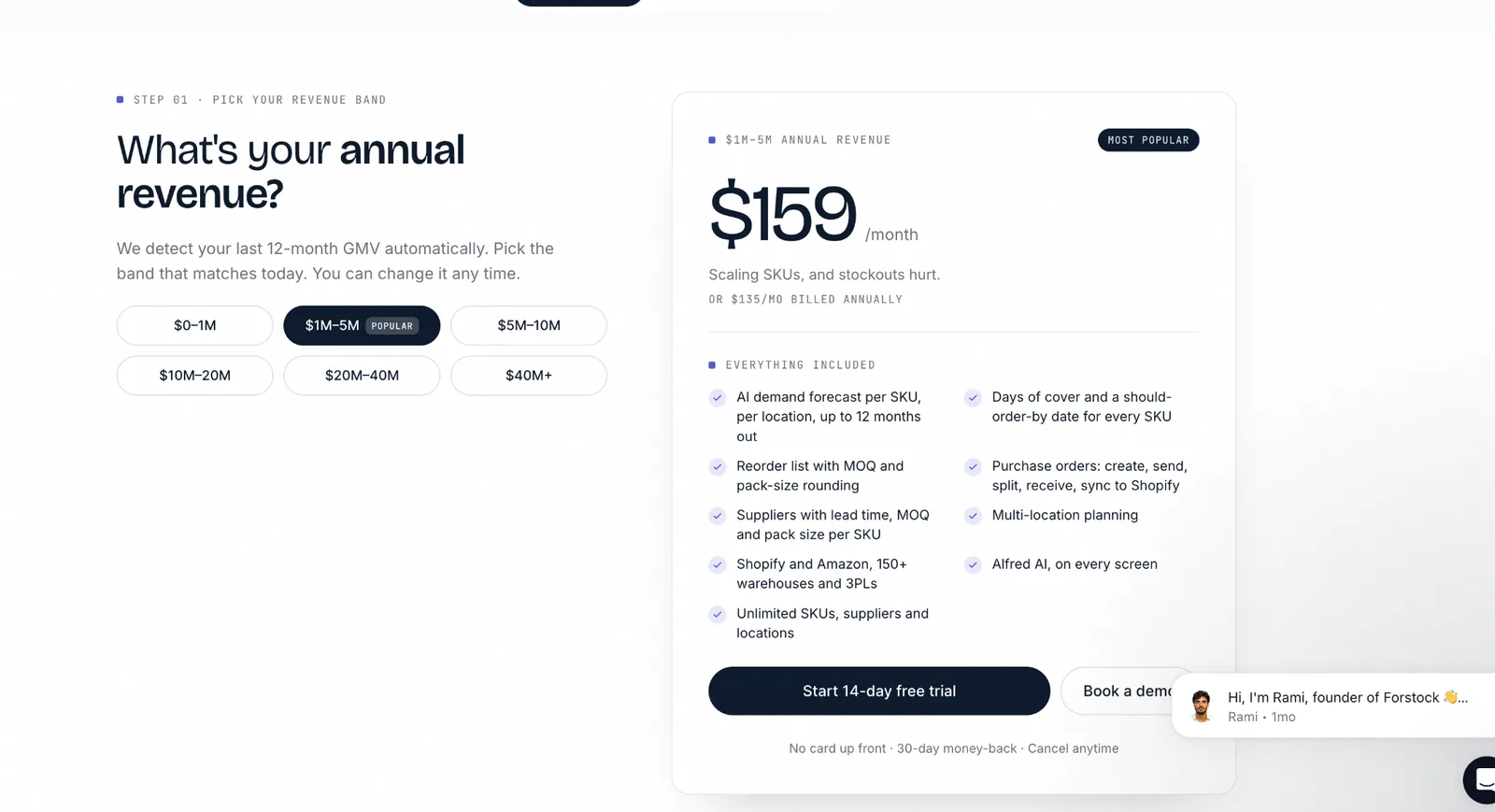
Plans start at $79/month for businesses doing up to $1 million in revenue.
For a brand doing $3 million a year, the $159/month tier applies.
Every pricing tier includes the same core features, including AI demand planning, reorder recommendations, purchase order management, and unlimited SKUs, suppliers, and locations.
There's also a 14-day free trial without a credit card.
Is Cin7 Worth the Price for Your Business?
Cin7 is worth the price when you need one system to run orders, stock, purchasing, and warehouse work across several channels. It's an even better fit if you sell wholesale or in person and need B2B or POS too. Just make sure you budget for the plan your users, channels, and order volume call for, plus the add-ons and onboarding you'll use.
But, maybe what you need most is a clear answer on what to reorder and when. In that case, you're better off with a planning tool built for that job. Start a 14-day free trial of Forstock and see your first reorder plan the same day. Or book a 20-minute demo, and we'll connect your store on the call and walk through the plan with you.
Frequently Asked Questions
Can You Cancel Cin7 or Get a Refund?
It depends on how you pay. You can cancel a monthly plan with 30 days' notice, and you pay for the days left in that period. A yearly prepaid plan can't be canceled and isn't refunded. Cin7's terms describe a strict no-refund policy on subscriptions, so ask whether your quote has a minimum term.
Does Cin7 Raise Prices at Renewal?
It can. Cin7's terms let it raise prices as long as it gives you notice first. In a 2024 Xero App Store review, one Cin7 Core customer wrote about "13-15% price increases each year for the last three years." A 13% increase would take Standard from $349 a month to $394. So it's worth asking Cin7 whether your contract caps how much the price can rise when you renew.
What Happens If You Go Over Cin7's Yearly Order Limit?
Under Cin7's terms, your sales order fees get adjusted to match your current volume on each anniversary of your subscription. You can also buy more order volume for your plan, or move up a plan to get a higher cap. Cin7 doesn't publish an overage rate, so ask how extra orders are billed before you sign.