

.png)
.png)
AI demand planning tools help businesses forecast inventory needs more accurately by analyzing real-time data and adapting to changes like social media trends or weather patterns. Traditional methods often fall short, leading to stockouts or excess inventory. With 98% of companies integrating AI into their supply chains by 2025, these tools have become essential for improving sales, reducing costs, and meeting customer expectations.
Key Takeaways:
- Accuracy Metrics: Focus on metrics like Weighted MAPE (wMAPE), Mean Absolute Deviation (MAD), and Forecast Bias to measure performance.
- Seasonal Trends: Tools should handle seasonal items, unpredictable SKUs, and new product launches effectively.
- Speed: AI tools reduce planning cycles by up to 40%, allowing faster responses to demand changes.
- Real-Time Insights: Demand sensing captures short-term trends, while external data like weather and social media boost forecast precision.
- Ease of Use: Look for Shopify integration, user-friendly dashboards, and no-code setups to simplify operations.
- Advanced Features: Scenario planning and automated purchase orders save time and improve decision-making.
Quick Comparison:
| Feature | Why It Matters | What to Look For |
|---|---|---|
| Accuracy Metrics | Reduces costly errors in forecasting | wMAPE, MAD, Forecast Bias |
| Seasonal Trends Handling | Improves inventory for fluctuating demand | Tournament models, adaptive hierarchies |
| Real-Time Updates | Responds to demand shifts immediately | Demand sensing, external data integration |
| User Experience | Simplifies adoption and daily use | No-code setup, Shopify integration |
| Advanced Tools | Supports better decisions and automation | Scenario planning, automated purchase orders |
These tools are ideal for Shopify merchants managing large inventories or scaling operations. By prioritizing accuracy, speed, and usability, you can improve inventory turnover, cash flow, and customer satisfaction.
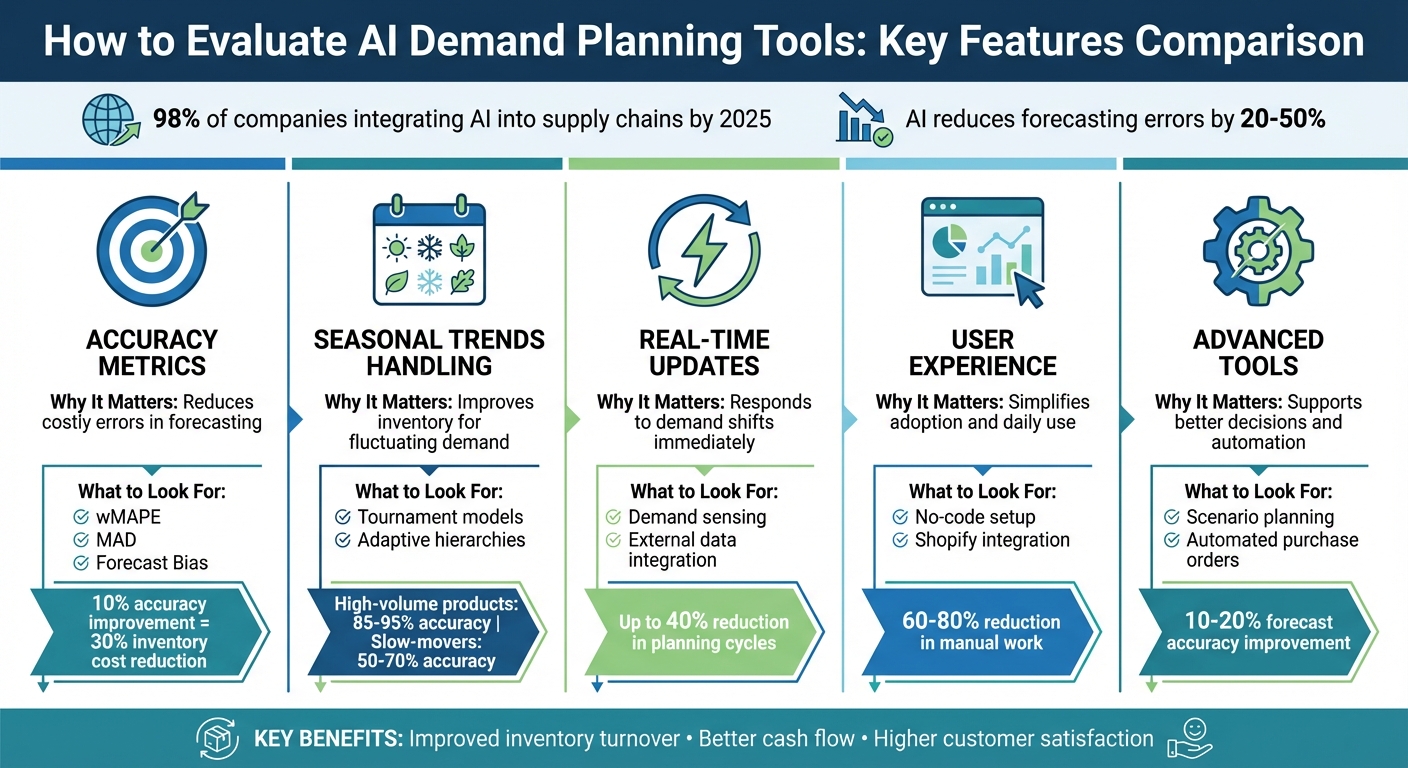
Key Features to Evaluate in AI Demand Planning Tools for Shopify
Accurate AI-Powered Forecasting to Transform Demand Planning | Case Study
sbb-itb-f0fc809
Key Metrics for Evaluating AI Demand Planning Tools
When evaluating AI demand planning tools, it's all about the numbers. Metrics can help you figure out if a tool will lower stockouts and reduce carrying costs. For Shopify merchants juggling diverse product catalogs, here’s what you should focus on.
Forecast Accuracy Metrics
Mean Absolute Percentage Error (MAPE) is a common way to measure forecast accuracy, but it has its flaws. For instance, a 1-unit error on an item that sells just 5 units results in a 20% error, while a 100-unit error on a 1,000-unit bestseller only shows a 10% error. Weighted MAPE (wMAPE) fixes this by prioritizing errors based on volume, which ensures high-revenue products get the attention they deserve. In industries like consumer goods, wMAPE typically ranges between 10–20%, while in fashion and apparel, it’s often higher (25–40%) due to the complexity of styles, sizes, and colors.
Mean Absolute Deviation (MAD), on the other hand, measures errors in raw units instead of percentages. This is particularly helpful for setting safety stock levels - if your MAD is 50 units, that can guide your buffer inventory. Root Mean Squared Error (RMSE) takes it a step further by penalizing larger deviations, making it a good fit for high-risk SKUs where major stockouts could be costly.
Another key metric is Forecast Bias, which highlights systematic forecasting errors. Over-forecasting leads to excess inventory and markdowns, while under-forecasting causes stockouts. Forecast Value Added (FVA) goes even deeper, showing whether each step in your planning process actually improves accuracy or if manual adjustments are doing more harm than good.
"Forecasting is always a means to an end. Effective accuracy measurement reveals where forecast errors actually hurt the business and where they have minimal impact." - RELEX Solutions
Improving demand prediction accuracy by just 10% can slash inventory costs by up to 30%. Plus, AI-powered forecasting can cut errors by as much as 50%. Beyond tracking accuracy, tools need to handle different SKU behaviors and seasonal trends effectively.
Handling Seasonal Trends and SKU Variability
Not all SKUs are created equal. High-volume, stable products need a different approach compared to sporadic sellers or seasonal items. Advanced AI tools often use a tournament approach, testing various forecasting models (like Moving Average, Holt-Winters, or machine learning algorithms) for each SKU and picking the one with the lowest backtested error for the upcoming period.
For low-volume or unpredictable data, forecasting at a higher level - like by category or brand - can make the demand signal clearer. These results can then be broken down to individual SKUs using an adaptive hierarchy, reducing the risk of overfitting to random noise.
Seasonal items require even more nuance. External factors like weather, social media trends (think TikTok virality), and promotional calendars often drive demand beyond historical sales data. If a tool can’t explain why it predicts a spike, it’s hard to trust its accuracy during unusual periods.
For slow-moving SKUs, specialized methods like Croston’s algorithm - which separately models demand size and intervals - are often more effective than standard forecasting techniques. When launching new products without sales history, analogous forecasting can help by mapping them to similar existing items to estimate demand.
"The algorithm that predicts your high-volume, stable 'cash cow' products with 98% accuracy might fail miserably when applied to a sporadic, low-volume spare part." - DemandPlan
AI can reduce forecasting errors by 20–50%, especially in promotional or seasonal scenarios. High-volume products often achieve accuracy levels of 85–95%, while slow-movers with irregular patterns typically range between 50–70%. These strategies make AI tools adaptable to varying demand patterns, a must for Shopify merchants aiming to optimize inventory.
Planning Cycle Time
Accurate forecasts are only half the battle - speed matters too. Planning cycle time measures how long it takes to go from raw data to actionable purchase orders. Traditional systems often rely on batch updates, recalculating weekly or monthly, which can leave you lagging behind sudden demand shifts. AI tools, however, can update forecasts instantly, allowing for quicker responses.
Switching to AI can cut planning cycles by up to 40%. Traditional teams often spend 40 hours a month managing Excel updates, but AI automation reduces manual work by 60–80%, freeing up time for strategic decisions.
"A shorter cycle time indicates a more agile and responsive organization, capable of adapting quickly to market changes." - Intuendi
Faster cycles also improve cash flow by ensuring inventory isn’t stuck due to outdated forecasts. Tools with API-first designs that connect directly to Shopify can streamline data collection, while monitoring "tail latency" (the slowest 5% of responses) ensures urgent decisions aren’t delayed.
Real-Time Adaptability and External Data Integration
Monthly updates to static forecasts just can't keep up with the fast-changing pace of today's markets. To stay accurate, AI demand planning tools need to respond to shifts as they happen and incorporate external data sources.
Demand Sensing and Anomaly Detection
Demand sensing focuses on short-term forecasting, typically within a 0–8 week window. Instead of waiting for quarterly updates, it captures changes as they happen. These systems don’t just rely on historical sales data - they continuously process live feeds from Point-of-Sale systems, ERPs, and other channels, updating forecasts daily or even hourly. Using machine learning, they can spot nonlinear trends and anomalies that traditional methods often overlook. For instance, if a product suddenly gains popularity on social media or a surprise weather event spikes demand, AI flags these changes in real time. Some advanced tools can even adjust replenishment orders automatically.
Take Atria, a Northern European food supplier with about $1.65 billion in net sales. When they introduced demand sensing in 2025 for their seasonal products, they achieved 98.1% weekly forecast accuracy. This reduced manual adjustments by 13%, saving over $2 million annually in waste and bringing in an additional $3.8 million in revenue during peak periods.
"Demand sensing changed the game by giving us visibility into demand shifts as they developed, not after they'd already impacted inventory positions." – Michael Gylling, RELEX Solutions
AI-driven forecasting also has a major impact on reducing lost sales - up to 65% fewer out-of-stock situations and overstock - and lowers forecast error rates by 45% to 60% compared to human-supervised models. With its ability to predict demand at the SKU and location level, AI ensures inventory is allocated precisely where it’s needed. This level of real-time insight lays the groundwork for integrating external data to refine forecasts even further.
Integration of External Data Sources
Relying solely on historical sales data just doesn’t cut it anymore. Modern AI tools incorporate external factors like weather conditions (temperature and precipitation), social media trends, competitor pricing, and macroeconomic indicators such as the Consumer Price Index. By using APIs, these systems can pull and preprocess both structured and unstructured data from internal and external sources. Machine learning models then identify which factors correlate with demand for specific products. For example, ice cream sales might be highly influenced by temperature, while paper towel demand remains unaffected.
"The integration of AI with unstructured data sources like social media and weather patterns is transforming how companies sense and respond to demand volatility in real time." – Accenture Supply Chain Research Team
Companies adopting demand sensing often see inventory carrying costs drop by 15% to 25%. When assessing AI tools, look for systems that integrate both internal data (like ERP systems) and external signals (like competitor pricing or weather). It’s also important to choose tools that clearly explain why forecasts change - this transparency helps build trust in AI-driven recommendations. Real-time responsiveness combined with diverse data integration is key for managing inventory effectively, especially for platforms like Shopify.
Usability and Shopify Integration

Real-time data is only half the battle; tools must also be user-friendly and integrate smoothly with Shopify to turn insights into action. Even the most advanced AI forecasting won't help if your team struggles to use it. For Shopify merchants managing product launches, supplier coordination, and marketing campaigns, an intuitive interface and seamless setup are non-negotiable. A clunky system or disconnected data can lead to abandoned dashboards and wasted subscription fees. By combining real-time integration with an easy-to-navigate interface, these tools make it possible to act on insights immediately, streamlining daily operations.
Customizable Dashboards and Reporting
A centralized dashboard that pulls in real-time data from Shopify stores, POS systems, warehouses, and logistics providers becomes your single source of truth. This eliminates the need for manual data comparisons, saving time and reducing errors. The best tools display everything in one place - SKU-level demand trends, supplier performance metrics, and low-stock alerts - so you can quickly identify and address potential problems before they hurt sales.
One standout feature is exception-based alerts. Instead of overwhelming users with data on every SKU, these systems flag only the items that need immediate attention, like products nearing stockouts or those experiencing unusual demand spikes. Transparency is key here. A good dashboard will clearly explain why it’s making a reorder suggestion, helping you trust the AI's recommendations while giving you the flexibility to override them when external issues, like supplier delays, arise. The easier it is to access and understand this information, the more effectively your team can respond.
No-Code Setup for Non-Technical Users
Modern AI demand planning tools are designed to integrate with Shopify effortlessly. Using native APIs, they sync historical sales data, product details, and inventory levels without requiring custom development. The setup process is typically straightforward: connect your Shopify store, let the tool train its forecasting models using your historical data, and then review the results.
Some platforms go a step further by incorporating natural language querying. For example, Shopify's Sidekick allows users to ask questions like, "Which SKUs are likely to sell out next week?" and instantly get actionable insights. This functionality makes these tools accessible to non-technical team members, removing the need for specialized IT support. By Q1 2025, 98% of companies reported integrating AI into their supply chains, demonstrating how accessible and practical these tools have become.
Cross-Team Collaboration Features
Inventory management impacts more than just the operations team - it touches sales, marketing, and finance as well. Tools that offer broad user access enable these teams to collaborate on the same real-time data without incurring extra costs. This shared visibility ensures that everyone works from a consistent set of forecasts, reducing the risk of misaligned strategies or campaigns.
Some platforms even allow one-click purchase order creation directly from AI-generated recommendations. When a forecast suggests reordering, team members can review, tweak, and approve purchase orders without leaving the platform. As Brends Grands Wholesale put it:
"It's saving me from hiring a $70K inventory manager! Highly recommended".
Advanced Features: Scenario Planning and Automation
Once you’ve ensured that a tool integrates seamlessly with Shopify and offers an easy-to-use interface, the next step is to assess its advanced features. These go beyond basic forecasting to include tools for strategic decision-making, such as scenario planning and automation. These capabilities allow businesses to test multiple possibilities before committing resources and significantly reduce manual workload.
Scenario Planning and What-If Analysis
Top-tier AI demand planning tools don’t just predict what’s likely to happen - they also help you explore different possibilities. Scenario planning lets you tweak variables like supplier lead times, tariff adjustments, or unexpected demand spikes to see how these changes would affect key metrics like cash flow, service levels, and profit margins. These simulations, which can be run in minutes, eliminate the need for cumbersome spreadsheets while offering clear insights into trade-offs.
For instance, imagine you’re considering a 10% discount promotion. The tool can project how this price change might influence demand, inventory levels, and profit margins across your product catalog. Similarly, if a supplier’s lead time increases from 30 to 45 days, you can simulate the potential stockout risks and decide whether to increase safety stock or find a new supplier.
The adoption of AI in supply chain management has surged, doubling from 23% in 2024 to 48% in 2025. Additionally, 25% of companies now credit AI use cases, like demand planning, with contributing over 5% to their EBIT. The shift from static monthly planning to dynamic, real-time modeling allows businesses to update scenarios as conditions evolve, rather than starting over each time. This adaptability encourages cross-functional collaboration, enabling operations, finance, and procurement teams to align by reviewing the same simulated outcomes and making unified decisions.
With these insights in hand, advanced tools take efficiency to the next level by automating key processes.
Automated Purchase Order Creation
Manually creating purchase orders for a large number of SKUs can be a time drain. Automation simplifies this by using AI-driven forecasts to calculate reorder quantities and generate purchase orders that can be approved with a single click. These tools consider factors like current stock levels, supplier lead times, and demand projections to determine the best timing and quantities for reordering.
Many platforms also integrate supplier performance tracking, using lead-time variance and scorecards to adjust reorder points automatically. For example, if a supplier frequently delivers late, the system can increase the safety stock for products sourced from them. Some tools even allow for order modifications based on supplier feedback, ensuring the entire procurement process stays cohesive.
Automation also helps avoid costly errors, like reordering products nearing the end of their lifecycle. Zero-demand modeling predicts when an item’s sales are likely to drop to zero, preventing unnecessary orders for SKUs being phased out. Exception-based alerts bring attention to only the most critical issues - such as unusually large order quantities or items with high forecast uncertainty - so you can focus on what matters most.
"Forecasting is always a means to an end. Effective accuracy measurement reveals where forecast errors actually hurt the business and where they have minimal impact." - RELEX Solutions
According to McKinsey, AI can enhance forecast accuracy by 10% to 20%, leading to inventory reductions of up to 5% and revenue increases of 2% to 3%. For Shopify merchants managing product launches, supplier coordination, and marketing campaigns, this level of automation not only saves time but also ensures that reorder deadlines are consistently met.
For Shopify brands, Forstock combines scenario planning with automated purchase order creation, enabling merchants to model future outcomes and efficiently execute decisions.
Conclusion
Selecting the right AI demand planning tool means focusing on the features that genuinely impact your business outcomes. While forecast accuracy is critical, it’s essential to evaluate it using metrics like wMAPE and bias, which reveal inaccuracies that could disrupt reorder decisions. The tool should also manage SKU-level details across all sales channels and respond in real time to external factors like social media trends, weather changes, and promotional campaigns.
Ease of use is another key factor. If your team struggles to understand why the AI recommends specific forecasts, implementation will falter. Prioritize tools with explainable outputs, customizable dashboards, and no-code setups to empower non-technical users. For Shopify merchants, seamless integration with your current systems ensures data consistency and eliminates silos, allowing everyone to work from a unified data source.
Top-tier solutions often include advanced features, such as scenario planning and automated purchase order creation. These capabilities not only support strategic decision-making but also reduce manual effort and minimize costly errors in inventory management. Together, accurate metrics, intuitive design, and advanced automation contribute to smoother operations and better results.
To build a reliable demand planning process, combine these elements and test the tool on a specific category to measure its performance against historical trends. With 98% of companies now leveraging AI in their supply chains and 25% attributing over 5% of their EBIT to AI-driven initiatives, the right tool can significantly boost inventory turnover, cash flow, and customer satisfaction. For Shopify merchants aiming to optimize their operations, Forstock offers a platform that aligns with these criteria to deliver impactful results.
FAQs
What data do I need to get accurate AI forecasts?
Accurate AI forecasts depend on several critical inputs. These include historical sales data, real-time trends, promotional calendars, marketing signals, inventory metrics, and external influences like weather conditions or macroeconomic factors. By analyzing these elements, machine learning models can detect patterns and fine-tune predictions to stay aligned with current and anticipated changes.
How can I tell if the AI is over- or under-forecasting?
To spot over- or under-forecasting, start by analyzing forecast bias, which highlights patterns of consistent over- or underestimation. Alongside this, evaluate forecast accuracy metrics such as MAPE (Mean Absolute Percentage Error) or WMAPE (Weighted Mean Absolute Percentage Error) to measure how closely predictions align with actual sales. Leveraging explainable AI can also shed light on factors like seasonality or trends that may be causing errors, offering insights to fine-tune the model and boost its accuracy.
How do I run a quick pilot before rolling it out?
To quickly test an AI demand planning tool, here's how you can get started:
- Set clear objectives: Narrow your focus to specific SKUs or product categories to keep the pilot manageable and focused.
- Select evaluation metrics: Measure performance using criteria like forecast accuracy, ease of use, and how well the tool integrates with your workflow.
- Run a trial and compare: Use the AI tool alongside your current processes for a few weeks, then analyze and compare the results.
This method allows you to assess how well the tool works before committing to a full-scale rollout.


.png)
.png)
.png)
.svg)