
Real-Time Inventory Sync: Key Features to Look For
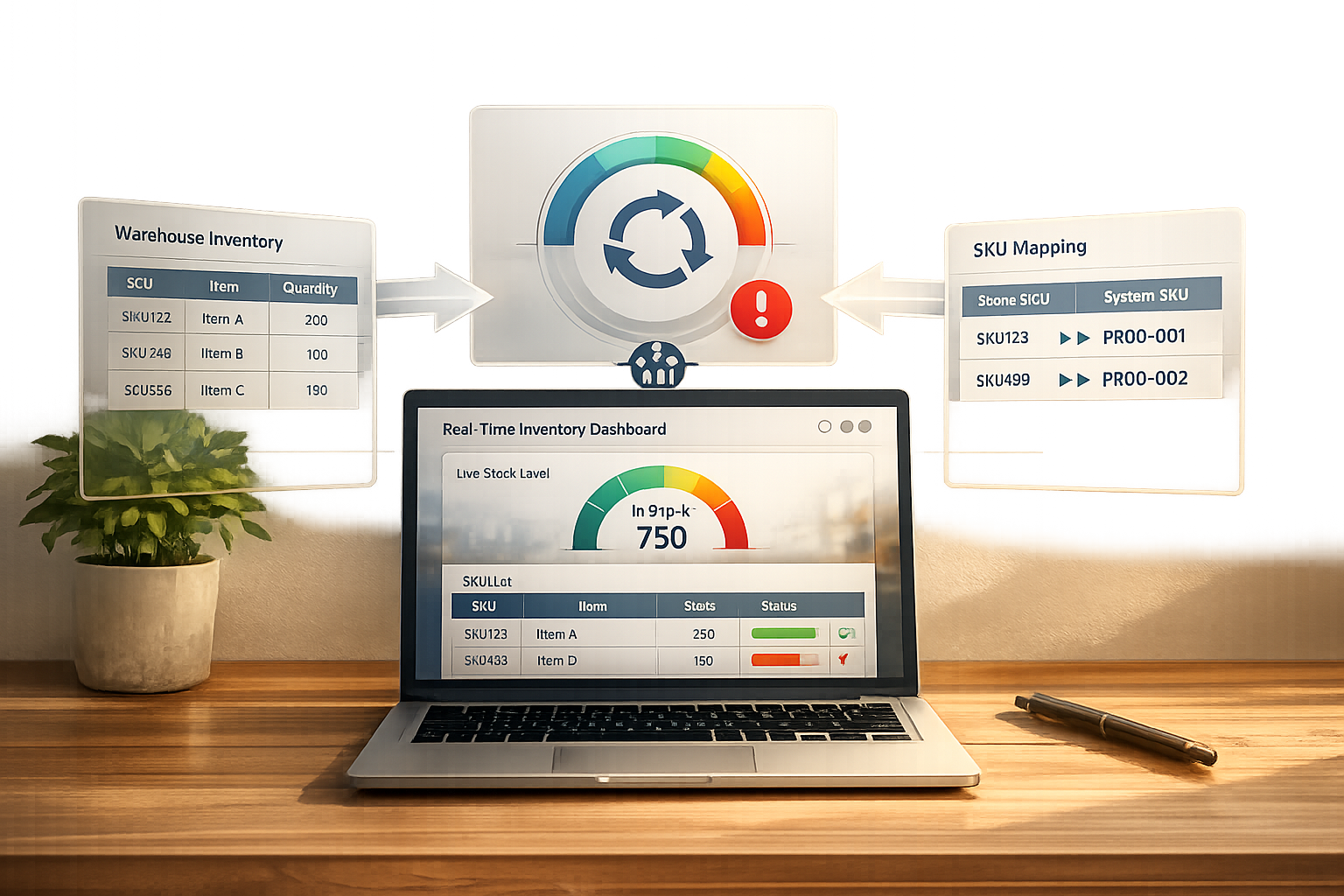
Essential features of real-time inventory sync: two-way updates, SKU matching, Shopify API integration, real-time dashboards, and error handling.
Real-Time Inventory Sync: Key Features to Look For
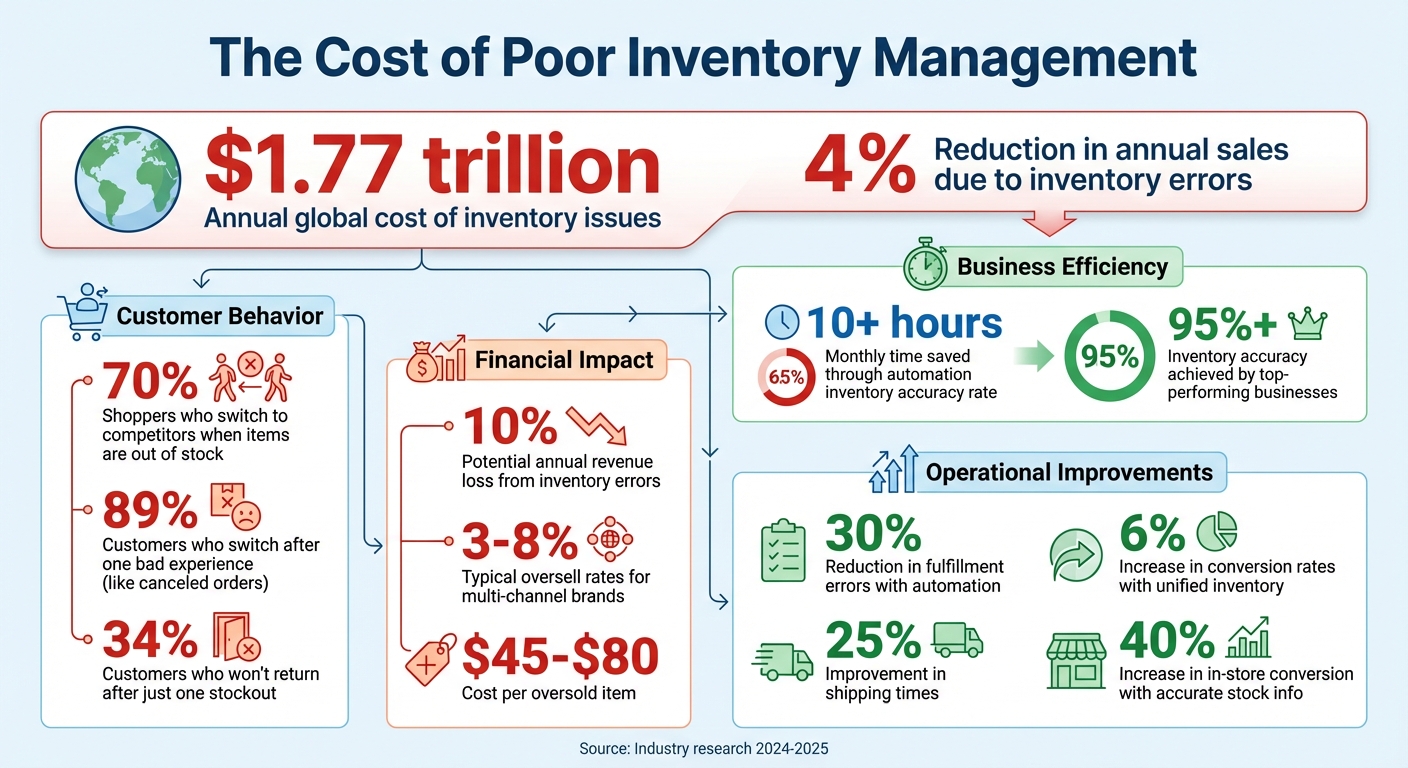
Running a Shopify store without real-time inventory sync can lead to costly mistakes. Inventory inaccuracies impact profits, with errors reducing annual sales by 4% and global inventory issues costing $1.77 trillion annually. Real-time syncing solves these problems by keeping stock levels accurate across all channels - Shopify, Amazon, physical stores, and more.
Key benefits include:
- Avoiding overselling: 70% of shoppers will switch to a competitor if an item is out of stock.
- Time savings: Automating updates can save over 10 hours per month.
- Improved fulfillment: Smart order routing and multi-location inventory views reduce shipping costs and errors.
Tools like Forstock offer real-time updates, AI-powered forecasting, and two-way syncing to eliminate manual errors and streamline operations. Features include real-time sync tools, API integration, error handling, SKU matching, and dashboards for centralized monitoring. With solutions like this, businesses can scale confidently while maintaining inventory accuracy.
Real-Time Inventory Sync: Impact on Revenue and Customer Retention
Syncing Inventory Between Shopify Stores: A Step-by-Step Demo

sbb-itb-f0fc809
1. Forstock
Forstock offers Shopify brands a way to streamline inventory management by automating updates across multiple locations and sales channels. By removing the need for manual input, it simplifies operations and keeps inventory data accurate in real time. Let’s break down its standout features.
Real-Time Syncing Speed
With Forstock's powerful sync engine, millions of inventory updates are processed every day, ensuring your Shopify store always displays accurate stock levels. Using an API-first architecture and webhook notifications, the platform updates inventory immediately after a sale, return, or stock receipt. This event-driven setup avoids the delays common in systems that rely on constant polling. Even during high-traffic events like Black Friday, Forstock’s queue management system ensures updates are processed efficiently without timeouts.
Scaling with Multi-Location and Multi-Channel Operations
Forstock supports growing businesses by centralizing control over inventory across multiple locations and sales channels. It maintains consistency by mapping SKUs and variants across warehouses, retail stores, and online platforms, making it easier to manage stock as operations expand.
Automation and Error Prevention
Manual errors and inventory mismatches are a thing of the past with Forstock’s automation capabilities. It uses intelligent conflict resolution and bidirectional data flow to prevent overselling. Additionally, its AI-powered demand forecasting, with an impressive 95% accuracy rate, helps reduce stockouts and overstock situations.
Shopify Integration and Beyond
Forstock integrates directly with Shopify through its API, creating a seamless connection. Its unified dashboard provides a clear view of stock levels, supplier management, and performance across locations. Beyond Shopify, Forstock also supports advanced API integrations, making it easy to connect with other systems. For brands juggling both physical and online stores, this integration eliminates data silos and resolves inventory-related challenges efficiently.
2. Multi-Location Inventory Support
Trying to manage inventory across multiple locations manually often leads to "ghost inventory" - when system records don’t align with what’s actually in stock. This mismatch can cause all sorts of problems, making real-time, centralized inventory management a must-have for retailers.
A strong multi-location inventory system provides a real-time, centralized view of SKU availability across warehouses, stores, and online channels. This unified perspective ensures accurate inventory syncing, which is essential to avoid overselling. Without such a system, retailers typically only achieve about 70% accuracy in inventory tracking, leaving room for costly errors.
The stakes are high: inventory distortions rack up a staggering $1.7 trillion in global losses every year. Add to that the fact that 34% of customers won’t return to a retailer after just one stockout, and peak seasons can result in revenue losses of 10%–20%.
Beyond visibility, multi-location systems enable smart order routing, automatically directing orders to the closest fulfillment center. This not only speeds up delivery but also slashes shipping costs. In fact, automating this process can reduce fulfillment errors by 30% and improve shipping times by 25%.
These systems also power services like BOPIS (Buy Online, Pick Up In Store) by reserving inventory at the nearest store and notifying staff instantly. This feature is a game-changer, as 92% of shoppers say they’re more likely to return to retailers that offer fast delivery options.
3. Automated Stock Updates
Relying on manual updates can lead to delays that put your business at risk of overselling. Automated systems, on the other hand, work in real time, instantly adjusting inventory counts when products are sold, returned, or restocked. This ensures you always have an accurate view of your stock across all sales channels.
The financial impact of inventory mismanagement is no small matter. Errors in stock handling can cost businesses up to 10% of their annual revenue through unfulfilled orders, expedited shipping fees, and higher labor costs. On a larger scale, the combination of stockouts and overstocking is expected to cost retailers more than $1.7 trillion globally by 2025. Automation helps tackle these challenges by reducing human errors and processing updates faster than any manual approach ever could.
Real-Time Syncing Speed
When it comes to inventory updates, speed isn't just about convenience - it’s about avoiding costly mistakes. Leading systems rely on an API-first design with webhook notifications that trigger updates the moment changes occur. This approach is far more efficient than traditional scheduled polling, as webhooks push data instantly, cutting out any unnecessary lag.
During high-demand periods like Black Friday - when Shopify merchants handled around $4.6 million in transactions per minute in November 2024 - having a system that can process updates sequentially without timing out or crashing is crucial. The best tools also incorporate intelligent conflict resolution, ensuring accurate stock updates even when multiple systems attempt to modify the same SKU at the same time. This level of speed and precision forms the backbone of effective error management.
Automation and Error Handling Capabilities
Automation isn’t just about syncing inventory - it’s about doing it smartly. Advanced systems include features like retry logic with exponential backoff to handle API timeouts. Automated safety stock levels (e.g., halting sales when inventory hits two units) can also prevent overselling during brief delays.
Error handling plays a key role in maintaining smooth operations. High-quality tools provide detailed error logs and real-time alerts, so your team is immediately notified if a sync fails or if data looks suspicious. Additionally, data validation features can catch issues - like a supplier file listing "N/A" instead of "0" - before they disrupt your workflow.
Even with real-time webhooks in place, automated reconciliation serves as an important safety net. Scheduled audits or nightly polling can catch discrepancies, saving over 80% of the time typically spent on manual reconciliation. These features ensure your system stays reliable and well-integrated across all platforms.
Integration with Shopify and Other Systems
Integration is what turns isolated updates into a seamless, unified system. When Shopify acts as the central hub - connecting your POS, ERP systems, and third-party logistics providers - it ensures that every channel reflects the same stock levels. This bidirectional data flow means that updates from warehouses or suppliers are immediately visible to both online customers and in-store staff.
For instance, one brand used Shopify to sync inventory across 16 stores, leading to a 6% increase in conversion rates and a 25% boost in international sales. Similarly, Danish tea retailer TeSelskabet leveraged Shopify POS with certified apps to manage product categories and bundles, preventing overselling and achieving a 25% growth in total sales.
"Having all our tooling and commerce data unified in a single platform was a real driving factor. All our sales channels display the same stock availability."
– Alexandra McNab, COO, Bared Footwear
Real-time inventory management doesn’t just save time - it saves a lot of it. Retailers report cutting over 10 hours of manual entry per month. Plus, providing accurate stock information has been linked to up to a 40% increase in in-store conversion rates. For Shopify brands aiming to pair automated stock updates with smarter demand forecasting, platforms like Forstock offer seamless integration, combining real-time syncing with AI-driven purchasing recommendations. This integration also simplifies calculating reorder points to ensure you never run out of top-selling items. This helps prevent stockouts while ensuring inventory accuracy across all locations.
4. Two-Way Sync Capabilities
One-way syncing only tells part of the story. Two-way sync ensures information flows seamlessly in both directions. For example, when a sale happens on a connected marketplace, your Shopify store updates instantly. Likewise, if you adjust stock manually in your warehouse, every connected channel reflects the change immediately. This creates a single source of truth for your systems, eliminating data silos that can lead to overselling and unhappy customers. By keeping inventory updates consistent across all platforms, two-way sync helps reduce financial losses and operational headaches.
The stakes are high - 89% of customers say they’ll switch to a competitor after a bad experience, such as a canceled order. Two-way sync addresses these risks by ensuring that systems like your POS, ERP, or third-party logistics provider all share the same up-to-date inventory data.
Integration with Shopify and Other Systems
Effective Shopify inventory management can act as the central hub to maximize the benefits of two-way sync. This approach connects all your systems in a simple hub-and-spoke model, which is more reliable than using complex middleware solutions that can lead to delays and maintenance issues. With Shopify’s API enabling real-time, bidirectional updates, changes like in-store returns, warehouse restocks, or marketplace sales are instantly reflected everywhere.
This real-time synchronization eliminates the need to shut down stores during promotions or manually reconcile inventory across locations. With consistent data across all systems, businesses can confidently run simultaneous online and in-store promotions without the fear of overselling. The result? Smoother operations and measurable boosts in conversion rates and sales growth.
5. SKU and Variant Matching
SKU and variant matching plays a key role in maintaining product data consistency across platforms, building on the reliability of two-way sync.
At its core, SKU and variant matching acts as the universal identifier, connecting your products across platforms like Shopify, Amazon, your warehouse system, and other sales channels. Without this alignment, a sale on one platform might not trigger inventory updates elsewhere, risking overselling and unhappy customers.
The complexity grows when managing products with multiple variants. Take a fashion brand selling t-shirts in five sizes and eight colors - this means tracking 40 unique items instead of just one. Each variant needs its own SKU to ensure precise inventory management. For example, when someone purchases a medium blue t-shirt, the system must deduct that exact variant, not just the overall t-shirt inventory.
"A mapping error can display zero stock for items that are available."
– Kinnari Ashar, Content Strategist, Spocket
The financial stakes are high. Multi-channel brands often face oversell rates of 3–8%, with every oversold item costing between $45 and $80 due to customer service, refunds, and potential negative reviews. Platforms like Amazon can even suspend accounts if order cancellations exceed 2.5%.
Automation and Error Handling Capabilities
Before implementing any sync system, it's crucial to audit your store for duplicate SKUs. Duplicate values can lead to unpredictable inventory issues and disrupt automated syncing. Once everything is streamlined, consider using safety stock buffers to manage costs and availability. For instance, if you have 10 units in stock, display 8 on Shopify to account for timing lags between systems and avoid overselling during peak demand.
Advanced tools can also track component SKUs within bundles. For example, when a gift set is sold, these systems automatically adjust the stock levels for both the bundle and each individual item. This prevents overselling items that are sold individually as well as part of a set.
Integration with Shopify and Other Systems
Real-time sync tools excel by instantly updating inventory whenever a matching SKU changes. For situations where SKUs aren't ideal for tracking, some systems allow syncing by barcode instead.
Consider the example of an Austin-based home goods brand. In 2025, their fragmented inventory data across Shopify, Amazon, and Walmart led to a 4% oversell rate and 40 hours of manual work per week. By adopting a real-time hub-and-spoke sync system, they slashed their oversell rate to under 0.1% and boosted revenue by 14%, thanks to accurate stock displays for fast-moving SKUs.
Another helpful feature is managing "aliases", which lets a single product exist under different codes on various platforms while staying synchronized in one central system. For instance, your internal SKU "TSHIRT-BLU-M" can correspond to Amazon's ASIN, Walmart's item number, and your supplier's product code. This ensures inventory updates are consistent across all platforms. Proper SKU mapping lays the groundwork for smooth multi-channel integration.
6. Real-Time Dashboards and Monitoring
A real-time dashboard transforms raw inventory data into clear, actionable insights, acting as the nerve center for managing multi-location operations. This centralized view builds on previously discussed sync features by providing real-time visibility, making it easier to monitor performance across all locations. Without such a unified system, U.S. retailers typically achieve only 65% inventory accuracy - leaving about one-third of stock records unreliable.
Real-Time Syncing Speed
The speed of updates determines whether your dashboard reflects the current state of your inventory or lags behind. As mentioned earlier, fast syncing ensures your systems stay aligned. Leading platforms can update stock changes in under 60 seconds, with some achieving transfer times as quick as 2 seconds between Shopify and other connected marketplaces. For example, in January 2025, the French footwear brand Odaje linked inventory data from 16 physical stores and its online shop through a unified system. This real-time integration led to a 6% boost in conversion rates and a 25% jump in international sales.
Scalability for Multi-Location and Multi-Channel Operations
A comprehensive dashboard is especially critical for businesses operating across multiple locations. It should consolidate data from all physical and digital touchpoints - 3PL warehouses, Amazon FBA (distinguishing between available and reserved units), retail stores, and consignment lots. This level of visibility enables smarter order routing, cutting shipping costs by fulfilling orders from the nearest distribution center.
Dashboards should also clearly display channel-specific allocations using ATS (Available to Sell) logic. This formula - Physical + FBA Available minus reserves, buffers, and pending orders - helps ensure inventory is accurately tracked across all channels.
Automation and Error Handling Capabilities
Modern dashboards go beyond just displaying data; they actively flag potential issues. Automated color-coded alerts highlight at-risk SKUs and log exceptions, such as sync errors or API timeouts. They can also display dynamic reorder triggers and use AI-driven forecasting and turnover optimization to minimize errors, reducing lost sales by up to 65% and cutting forecasting mistakes by 50%. Platforms like Forstock integrate these tools directly into Shopify, providing a unified dashboard that tracks stock levels, manages supplier relationships, and monitors performance across multiple locations with 95% forecasting accuracy.
Integration with Shopify and Other Systems
Real-time monitoring becomes even more powerful when integrated with platforms like Shopify. Seamless data flow between systems eliminates silos and creates a single source of truth. For instance, Italian homeware company LisolaStore adopted a unified platform in 2025 to manage its omnichannel operations, resulting in a 15% increase in Average Order Value and the lowest inventory shrinkage rate in its history.
"Having all our tooling and commerce data unified in a single platform was a real driving factor. All our sales channels display the same stock availability."
– Alexandra McNab, COO, Bared Footwear
To achieve this level of integration, prioritize API-first systems with strong Open APIs. This approach ensures seamless communication between platforms, a necessity when inventory distortions cost retailers over $1.7 trillion globally each year.
7. Direct Shopify API Integration
Integrating directly with Shopify's API sets up a smooth flow of data, allowing instant communication with external systems. This eliminates delays and bottlenecks in syncing information.
Shopify's GraphQL API stands out by using a single endpoint to fetch exactly what’s needed - nothing more, nothing less. This reduces unnecessary overhead and speeds up sync operations. It builds on the two-way sync capabilities mentioned earlier, ensuring that every change in Shopify is immediately captured and reflected across systems. As Lee Byron, co-creator of GraphQL, puts it:
"We don't think of data in terms of resource URLs, secondary keys, or join tables; we think about it in terms of a graph of objects".
Event-driven webhooks are another key feature. They send instant notifications when critical events occur - like orders being placed, returns processed, or stock levels updated. This ensures real-time data accuracy across all channels, reducing latency and preventing sync issues. For added security, Shopify uses OAuth 2.0 and HMAC verification to confirm the integrity and source of webhook data.
Managing API traffic is essential to avoid disruptions. Shopify employs a "leaky bucket" algorithm to regulate API usage. The rate limits vary by merchant plan: Standard accounts get 50 points per second, Advanced plans get 100, and Shopify Plus merchants can handle up to 500 points per second. If a rate limit is exceeded (resulting in 429 errors), it’s important to use an exponential backoff retry strategy, starting with at least a one-second delay.
Forstock, a platform leveraging Shopify's direct API, uses this integration for real-time demand forecasting and Shopify purchase order app features like automated PO creation. This ensures inventory decisions are based on up-to-date data. By maintaining a bidirectional data flow, Forstock creates a "single source of truth", where any changes in Shopify are instantly mirrored in connected systems. This helps merchants avoid costly inventory errors, which can account for up to 10% of annual revenue losses due to unfulfilled orders and expedited shipping.
Direct API integration with Shopify not only ensures data consistency but also enhances error handling and supports seamless integration across multiple channels.
8. Error Handling and Data Validation
Ensuring reliable automated stock updates requires robust error handling and thorough data validation to keep operations running smoothly.
Automation and Error Handling Capabilities
When inventory data moves between systems, errors are bound to happen. Automated error handling steps in to catch these issues before they disrupt the customer experience. For instance, real-time alert systems can flag unusual inventory activities, such as unexpected stockouts or discrepancies in data flow, helping businesses respond quickly. This is crucial - inventory mismanagement can lead to unfulfilled orders and costly expedited shipping, potentially eating up as much as 10% of annual revenue.
Systems equipped with intelligent conflict resolution can handle tricky scenarios, such as simultaneous purchases online and in-store. Without manual input, they determine the correct stock count to avoid overselling. Additionally, automated retry mechanisms, like exponential backoff, ensure failed synchronization attempts are retried systematically. These features lay the groundwork for implementing strong data validation protocols.
Integration with Shopify and Other Systems
Error handling is only part of the equation; effective data validation is just as critical. It all starts with SKU standardization - ensuring every SKU has consistent identifiers, titles, and units across Shopify, warehouses, and logistics providers. This prevents order flow mismatches and helps top-performing businesses achieve over 95% inventory accuracy through a mix of real-time updates and regular cycle counts.
To minimize errors, combining webhooks with scheduled polling creates a safety net. Webhooks handle near-real-time updates for fulfillment events, while nightly polling audits stock levels to catch any missed updates. This redundancy is essential since 89% of shoppers may turn to a competitor after a single bad experience, like a canceled order due to stock errors. Forstock employs these methods with Shopify's API to ensure inventory data is always accurate across sales channels.
Some advanced systems also use AI-driven inventory monitoring for anomaly detection to filter out false positives, ensuring only genuine synchronization issues are flagged. Coupled with consistent SKU standards, these tools help maintain a unified inventory view across Shopify and other platforms. Detailed logging further supports quick troubleshooting by generating error reports that pinpoint the root cause of sync failures.
9. Event-Based Sync Triggers
Real-Time Syncing Speed
Event-based triggers rely on a push-based system that sends updates as soon as events like sales, restocks, or inventory adjustments happen. This eliminates the delays caused by traditional polling methods.
"Event-driven syncing is the dream setup. Instead of waiting, your supplier's system automatically sends updates the moment something changes - like when a product sells or restocks." - Spocket
Using webhooks, updates are instantly communicated across connected platforms. For example, if a customer purchases the last item on Shopify, the listing is updated within seconds. This quick response is essential for managing complex operations across multiple channels.
Scalability for Multi-Location and Multi-Channel Operations
For businesses juggling multiple warehouses or selling on several platforms, event triggers ensure smooth, two-way communication without overloading systems. If a sale happens on a marketplace like Amazon, the central Shopify inventory hub updates immediately, and the changes are reflected across all linked channels.
To handle high transaction volumes, queue management systems process updates in sequence, avoiding timeouts or system crashes. This is especially critical for businesses managing simultaneous transactions across physical stores, online platforms, and Shopify storefronts.
Integration with Shopify and Other Systems
Event triggers work seamlessly with Shopify and other platforms, ensuring real-time updates and enhanced management. Shopify's webhooks and API capture key inventory actions - such as sales, returns, transfers, and new shipments - keeping data accurate across the board.
Forstock takes full advantage of these event-based triggers, combining them with Shopify Flow to automate workflows. For instance, if stock levels fall below a set threshold, the system can send Slack notifications or email suppliers to reorder instantly. This approach shifts inventory management from being reactive to proactive, helping businesses avoid stockouts and maintain smooth operations.
10. Multi-Channel Compatibility
Multi-channel compatibility takes inventory management to the next level by seamlessly connecting all your sales channels. It ensures every touchpoint in your sales ecosystem works together efficiently, building on the benefits of real-time sync and error handling.
Scalability for Multi-Location and Multi-Channel Operations
When you sell across platforms like Shopify, Amazon, eBay, TikTok Shop, and physical stores, multi-channel compatibility ensures your inventory stays in sync. For instance, if someone buys an item at your brick-and-mortar store using Shopify POS, that sale is instantly reflected on your Amazon listings and online store, keeping your stock levels accurate everywhere.
This bidirectional sync eliminates the risk of overselling. If an item is purchased on one platform, it’s immediately marked as unavailable on the others. SkuNexus highlights that 90% of customers view stock availability as a critical factor in their shopping experience. Without this real-time syncing, you risk frustrating customers and tarnishing your brand’s reputation.
Integration with Shopify and Other Systems
A unified system simplifies operations and reduces costs. Shopify’s single codebase, for example, can lower operating expenses by 21% compared to platforms that rely on pieced-together integrations.
Smart order routing is another game-changer. It directs orders to the nearest fulfillment center, reducing both shipping costs and delivery times. Take Graeter's Ice Cream as an example: in 2025, they integrated Shopify to manage inventory across more than 50 retail locations and multiple warehouses. By automating 100% of their orders - including the tricky logistics of shipping frozen products with dry ice - they achieved real-time updates across all locations and significantly reduced fulfillment errors.
"Multi-channel inventory sync isn't just a feature – it's your competitive advantage." - Yitzchak Lieblich, SkuNexus
Forstock takes full advantage of multi-channel compatibility through its Shopify integration. Its centralized dashboard monitors stock levels across all sales channels and locations, while AI-driven forecasting adapts to sales trends from every platform. Whether customers shop online, in person, or via marketplaces, Forstock ensures your inventory stays balanced and ready for demand.
Conclusion
Keeping your Shopify store's inventory in sync is no longer optional if you’re aiming to grow without being bogged down by manual processes. With global inventory issues costing over $1.7 trillion and U.S. inventory accuracy stuck at just 65%, relying on manual methods is both inefficient and expensive.
The right inventory sync tool does more than just save money - it saves time and headaches. Automating inventory management can free up over 10 hours a month by eliminating repetitive data entry. It also helps cut down on carrying costs, which made up 52% of the 19.6% surge in U.S. logistics costs in 2022. Beyond the numbers, it safeguards your brand’s reputation; nearly 70% of online shoppers will jump to a competitor if they find an item out of stock. And with stockouts costing U.S. grocery retailers $15–20 billion annually, the financial upside of automation is hard to ignore.
This is where Forstock steps in. It combines real-time demand forecasting, manual vs. automated purchase orders, and detailed inventory analytics - all for just $79/month. Its intuitive dashboard breaks down data silos, uses AI to forecast demand, and ensures your decisions are backed by data. By syncing all sales channels and automating key tasks, you can avoid overselling and streamline operations.
Whether you’re managing a single Shopify store or juggling multiple channels, spreadsheets are a thing of the past. Forstock offers a 14-day free trial with live-chat support, so you can see firsthand how features like real-time syncing, automated reordering, and smart forecasting can turn inventory management into a strength. In a competitive market where poor product availability can chip away up to 8% of your revenue, choosing a reliable inventory solution isn’t just smart - it’s necessary.
FAQs
How fast should real-time inventory sync be?
Real-time inventory synchronization must happen instantly, updating stock levels the moment a sale or adjustment occurs. This approach ensures precise inventory tracking, helps prevent overselling, and eliminates stock mismatches.
Do I need two-way sync or is one-way enough?
Whether you choose one-way or two-way sync depends on how your inventory is managed. One-way sync works best for straightforward setups, where stock updates flow in a single direction - perfect for businesses with a controlled and predictable supply chain. On the other hand, two-way sync is ideal for more intricate operations, such as those involving multiple sales channels or locations. It keeps your inventory updated in real-time between your store and suppliers, helping to avoid overselling, minimize stock errors, and cut down on manual updates.
How do I prevent SKU and variant mismatches across channels?
To avoid SKU and variant mismatches, implement a reliable inventory management system with real-time synchronization and automated updates. Tools such as Forstock can help maintain consistent SKU mapping and accurate stock levels across all sales channels. Create unique, standardized SKUs and adopt clear naming conventions to minimize confusion. Conduct regular inventory audits and use analytics dashboards to spot and address discrepancies swiftly, ensuring your product data stays consistent across every platform.
Keep reading
Try Forstock free for 14 days.
AI-powered demand forecasting and reorder automation for Shopify brands. No credit card required.