
TL;DR
- Most Shopify inventory apps track current stock. Forstock forecasts demand, recommends reorder quantities, and creates purchase orders from those forecasts.
- Forstock best serves multi-channel Shopify brands that manage frequent reorders, changing supplier lead times, and inventory across locations.
- Forecasts update daily at the SKU, location, and sales channel level. Forstock uses more than 40 signals per SKU and projects demand up to 12 months ahead.
- You can start a free 14-day trial without a credit card, or book a demo for a guided evaluation.
What is an inventory management app, and what is demand forecasting?
An inventory management app is software that records how much stock a business holds and updates inventory quantities as merchants receive products and fulfill orders. For Shopify merchants, the app can synchronize stock data across store locations and sales channels.
Demand forecasting is the process of estimating how many units customers will buy during a future period. Inventory forecasting software uses sales history and other demand signals to estimate future sales by SKU, location, or channel.
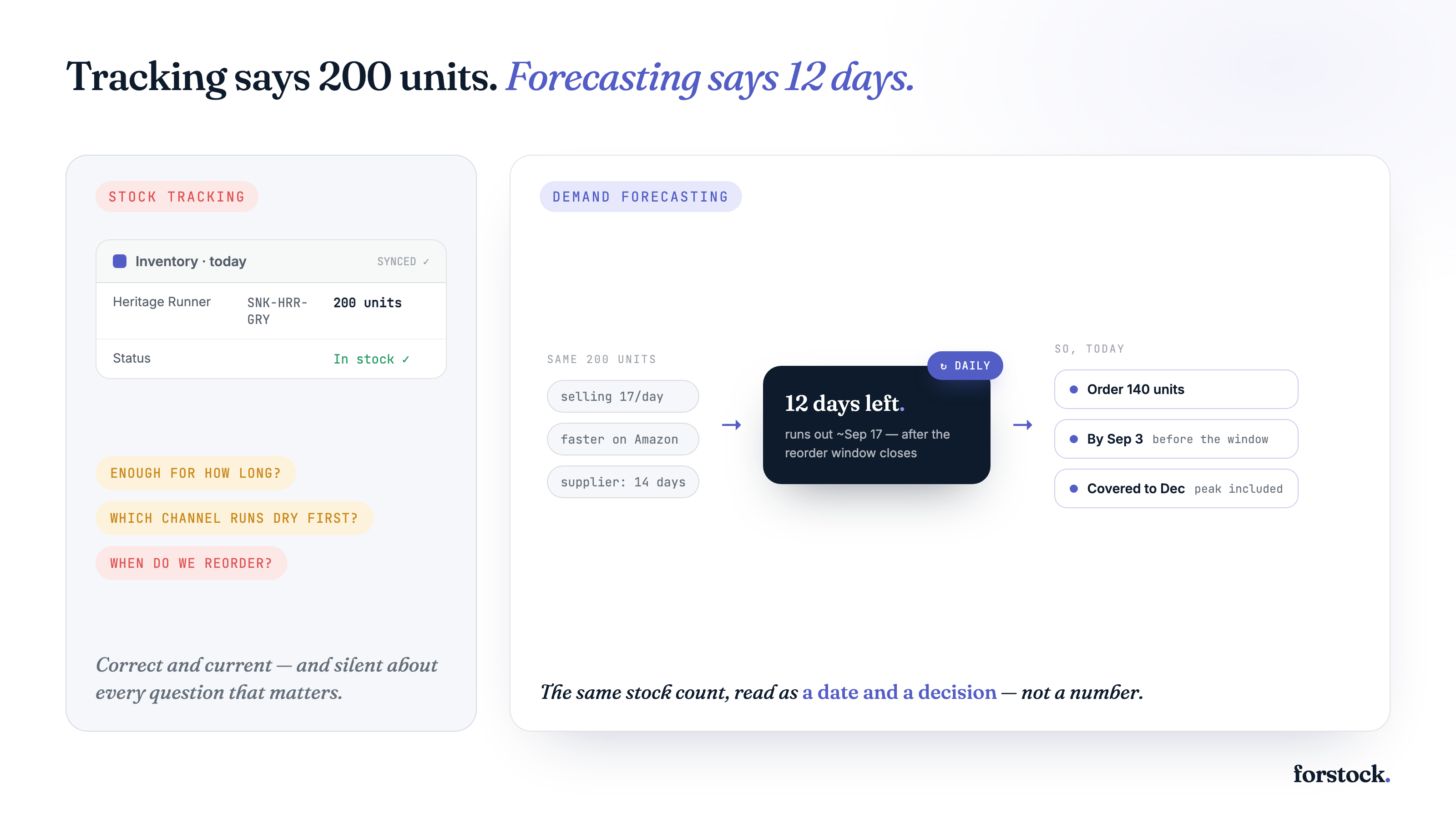
Stock tracking and demand forecasting answer different operational questions. Tracking shows what you have now, while forecasting estimates what you will need later. A tracking-only app cannot determine when each SKU will run out or how much you should order based on future demand and supplier lead times.
Forstock combines current inventory data with demand forecasts to produce reorder recommendations and support purchase order management. Shopify merchants can use those recommendations to plan purchases before stock runs out without relying on manual spreadsheet calculations.
Why forecasting accuracy is the real inventory problem
Stock counts cannot tell you whether current inventory will cover demand until the next replenishment arrives. A Shopify merchant selling through Amazon or Walmart may hold enough units overall while placing them in the wrong location or reserving them for the wrong channel. Tracking software records the available quantity, but the merchant still needs a forecast to decide where and when shortages will occur.
An inaccurate forecast creates two expensive errors. When the forecast falls below actual demand, a popular SKU sells out before a supplier can deliver the next order. When the forecast exceeds actual demand, the merchant buys units that sit on the shelf and tie up cash that could fund faster-selling products.
Shallow forecasting also pushes planning back into spreadsheets. You may need to combine channel sales, current stock, open purchase orders, and supplier lead times before calculating reorder quantities. Each export becomes outdated as new orders arrive, so frequent reconciliation adds work without giving you a dependable view of future inventory.
Forstock forecasts each SKU separately by location and sales channel. Its models use more than 40 signals per SKU, update daily, and project demand up to 12 months ahead. That level of detail helps distinguish a channel-specific demand increase from a broad sales trend and gives longer supplier lead times a place in the plan.
Forecast accuracy becomes useful when it changes a purchasing decision. Forstock connects predicted demand with expected stockout dates, supplier lead times, and recommended order quantities. You can order earlier when demand rises or buy fewer units when sales slow, reducing both stockout risk and excess inventory.
Who Forstock is built for
Forstock fits growing Shopify brands that must plan inventory across multiple sales channels, locations, and suppliers. It combines SKU-level demand forecasts with predicted stockout dates, supplier lead times, and recommended order quantities. You can then create and manage purchase orders using the same sales and inventory data.
Several operating patterns indicate that you have outgrown a tracking-only app. You may sell through Shopify, Amazon, or Walmart and regularly reconcile stock between channels. Supplier lead times may vary between orders, while promotions or seasonal demand change how quickly each SKU sells. Frequent reorder decisions and recurring spreadsheet work also suggest that current stock counts no longer provide enough information.
Forstock can help when ordering too late causes stockouts and ordering too early ties up cash. Daily forecasts help you decide what to buy and when to place each order. Supplier records and purchase order tracking keep those decisions connected to actual lead-time history.
A simpler inventory management app is often the better choice for an early-stage, single-channel store with few SKUs. If you mainly need current stock counts and basic low-stock alerts, forecasting and supplier management may add more capability than you need. Forstock becomes more useful as your catalog, channel mix, and reorder workload grow.
Forstock vs. Prediko vs. Inventory Planner
The most useful comparison focuses on how each app turns Shopify data into purchasing decisions. Forecast depth determines how precisely you can plan, while reorder and purchase order features determine how much spreadsheet work remains.
| Capability | Forstock | Prediko | Inventory Planner |
|---|---|---|---|
| Forecasting depth | Forecasts by SKU, location, and sales channel for up to 12 months. Models use more than 40 signals per SKU and update daily. | Confirm current forecasting scope with Prediko. | Confirm current forecasting scope with Inventory Planner. |
| Reorder automation | Calculates predicted stockout dates and recommended order quantities using supplier lead times. | Confirm how recommendations account for supplier lead times. | Confirm how recommendations account for supplier lead times. |
| Purchase orders and suppliers | Supports drafting, sending, tracking, and receiving purchase orders. Supplier scorecards use actual lead-time history. | Confirm current purchase order and supplier management coverage. | Confirm current purchase order and supplier management coverage. |
| Shopify integration | Uses a live Shopify catalog as its core data layer and can combine inventory data across other sales channels. | Confirm the depth and update frequency of the Shopify integration. | Confirm the depth and update frequency of the Shopify integration. |
Prediko and Inventory Planner may support some or all of these functions, but their current feature depth should be verified directly before purchase. The available product information gives Forstock the clearest documented advantage in SKU-, location-, and channel-level forecasting tied directly to lead-time-aware reorders and purchase order execution.
Start your free 14-day trial
Start your free 14-day trial with no credit card required. Connect your Shopify store and explore Forstock with your own inventory data. If you prefer a guided introduction, book a demo instead.
Common questions about Shopify inventory forecasting
How does forecasting work for new SKUs?
New-SKU forecasting begins with limited evidence and improves as actual sales accumulate. Forstock trains forecasts on your sales history and updates them daily as new demand data arrives. You can adjust purchasing decisions as the product establishes a clearer sales pattern.
Can inventory forecasting account for seasonality?
Seasonal forecasting estimates how recurring demand changes affect future sales. Forstock uses more than 40 signals per SKU and produces forecasts up to 12 months ahead. You can plan inventory before seasonal peaks without applying the same growth assumption to every SKU.
How do reorder recommendations account for supplier lead times?
Lead-time planning calculates when you must order so inventory arrives before projected stock runs out. Forstock combines predicted stockout dates with supplier lead times and recommended order quantities. You can place purchase orders earlier for slower suppliers and avoid overordering from faster ones.
Does Forstock work with sales channels outside Shopify?
Multi-channel forecasting combines demand and inventory data across every marketplace where you sell. Forstock connects Shopify data with channels such as Amazon and Walmart, then forecasts demand by SKU, location, and channel. You can plan shared inventory without reconciling separate spreadsheets for each marketplace.