
TL;DR
- Forstock combines SKU-level forecasting, replenishment planning, supplier management, and purchase order execution in one Shopify-native platform.
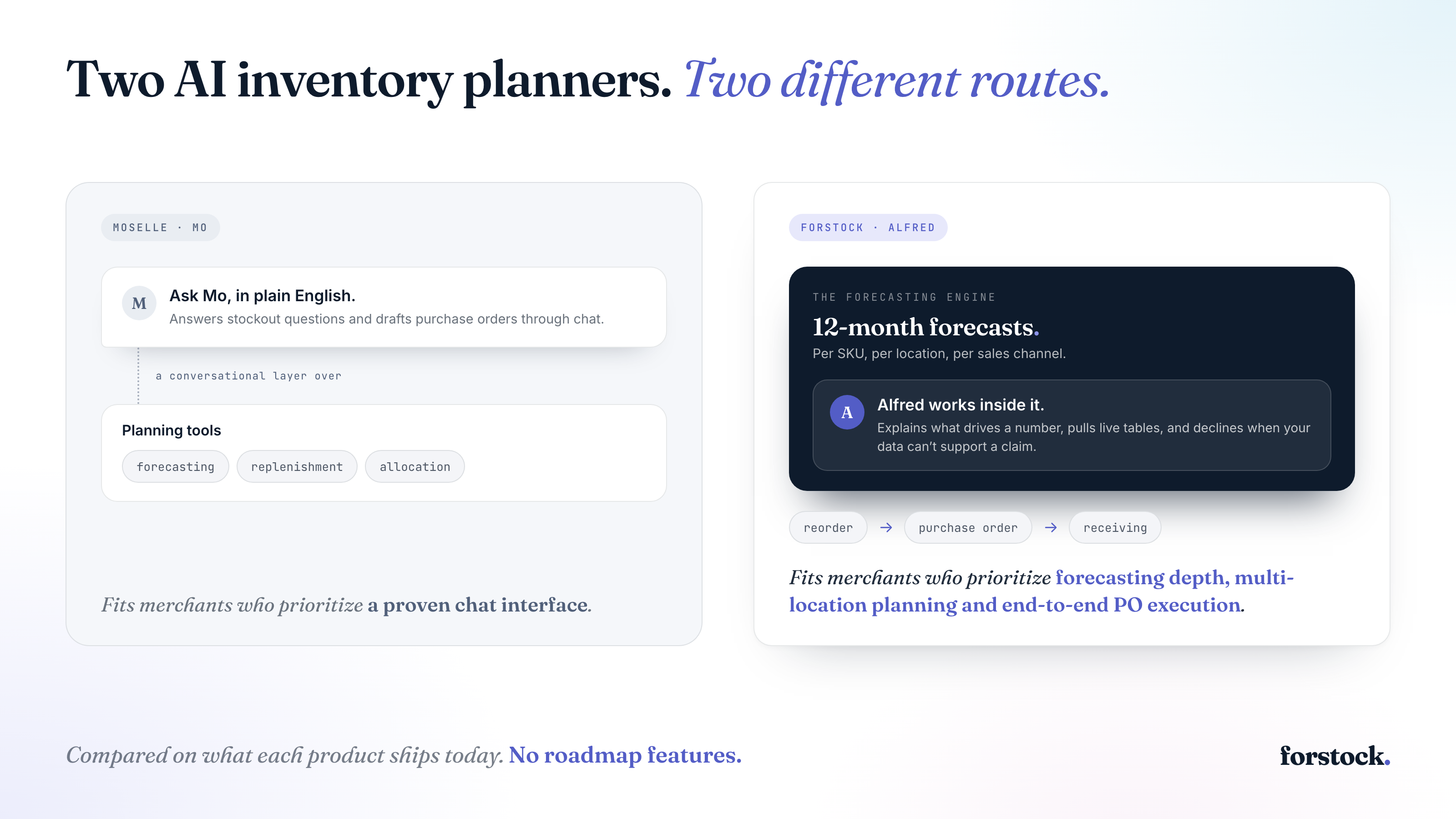
- Moselle centers its planning experience on Mo, a shipped conversational assistant that answers inventory questions and generates purchase orders through chat.
- Alfred runs natively on Forstock’s forecasting engine and analyzes live sales, stock, supplier, location, and purchase order data.
- Alfred can explain what is driving a forecast number, pull live tables on demand, and declines to answer when store data cannot support a claim.
- Moselle fits merchants who prioritize a proven chat interface. Forstock fits merchants who prioritize forecasting depth, multi-location planning, and end-to-end purchase order execution.
What Forstock and Moselle do differently
Forstock and Moselle take different routes to easier inventory decisions. Forstock centers its product on a forecasting engine that uses more than 40 signals per SKU, live Shopify data, and supplier information to guide replenishment and purchase orders. Its Alfred agent works directly with that engine to explain forecasts and analyze store data. Moselle centers the user experience on Mo, its shipped conversational assistant. Merchants can ask Mo plain-English questions about stockouts and generate purchase orders through chat. The practical distinction concerns how each assistant connects to the planning workflow. Mo provides a conversational layer over Moselle’s planning tools, while Alfred operates within Forstock’s forecasting and purchasing data model.
Forstock vs Moselle at a glance
The main differences concern forecasting inputs, replenishment structure, purchase order workflows, and how each AI assistant accesses planning data.
| Capability | Forstock | Moselle |
|---|---|---|
| Forecasting approach | SKU, location, and channel forecasts using 40+ signals per SKU | SKU-level machine learning forecasts with seasonality, trend separation, and anomaly detection |
| Replenishment and multi-location logic | Unified reorder recommendations using stockout dates, quantities, locations, and supplier lead times | Separate replenishment and allocation plans, with manual plan rebuilding after forecast changes |
| Supplier lead time handling | Reorder timing plus supplier scorecards based on actual lead time history | Lead time management, safety stock optimization, and reorder alerts |
| PO automation | Drafting, sending, tracking, receiving, and supplier performance records | One-click PO generation plus chat-based drafting and approval |
| AI assistant capability | Alfred, a native agent using live inventory and forecasting data | Mo, a conversational agent for questions, analysis, alerts, and approved actions |
| Core interface paradigm | Forecasting and operations platform with a native agent layer | Planning workspace with a conversational agent layer |
Forstock best fits Shopify merchants who want detailed forecasting and end-to-end purchase order execution in one platform. Moselle best fits merchants who prioritize a shipped conversational interface for planning questions and actions.
How we compared them
We compared Forstock and Moselle using published product documentation and capabilities available to merchants today. We excluded roadmap announcements and unreleased features.
The comparison covers SKU and variant forecasting, multi-location replenishment, supplier lead times, purchase order workflows, and AI assistants. These criteria show how each product turns store data into forecasts, reorder decisions, and approved purchase orders.
SKU- and variant-level demand forecasting
Forstock builds 12-month forecasts at the SKU, location, and sales-channel level. Its engine evaluates more than 40 signals per SKU, including sales history, current inventory, supplier data, and changes across connected channels. Forstock updates forecasts daily against the store’s live catalog, so Shopify variants retain their own demand patterns rather than inheriting a product-level average.
Moselle also forecasts demand at the SKU level across a 12-month horizon. Its machine learning model establishes typical weekly demand, separates recurring seasonality from longer trends, and identifies anomalies such as bulk orders or viral sales. Moselle describes the initial forecast as “80% of the way there on day one” and tracks error through MAPE by SKU, channel, and period.
Both engines need merchant input for events that historical data cannot predict. In Moselle, you manually override the forecast for information such as a planned promotion, supplier delay, or product launch, and Mo then recalibrates the projection. New sales trigger automatic forecast updates, so routine incoming data does not require manual revision.
Forstock suits stores that want variant-level forecasts grounded in a wider set of inventory and operating signals. Moselle gives merchants a clear statistical baseline and visible accuracy tracking, but merchants still need to supply future business context that its historical model cannot infer.
Multi-location replenishment planning
Forstock uses one reorder logic across SKUs, locations, and sales channels. Its daily forecasts combine each location’s expected demand with current inventory, predicted stockout dates, supplier lead times, and required order quantities. The Shopify-native data layer keeps recommendations connected to the live product catalog and current inventory position.
Moselle separates purchasing from inventory distribution. A Replenishment Plan calculates how much new inventory to buy from suppliers, while an Allocation Plan distributes inventory you already own across stores, locations, or channels. That separation gives you a dedicated workflow for allocating available stock.
Moselle builds each plan from a selected forecast scenario. If you change the underlying forecast, the existing plan does not refresh automatically. You must rebuild the plan to incorporate the updated demand signal. Forstock updates forecasts daily and feeds those changes into its unified reorder recommendations, which reduces the need to reconcile separate forecast and replenishment plans.
Moselle fits merchants who want purchasing and allocation handled as distinct planning tasks. Forstock fits merchants who prefer a shared forecast and reorder workflow across locations and channels.
Supplier lead time management
Forstock connects reorder timing to supplier performance. Its recommendations combine predicted stockout dates with changing lead times, while supplier scorecards use actual lead-time history to show whether vendors deliver as expected. You can use that record to revise future lead-time assumptions before late deliveries cause stockouts.
Moselle lists lead time management, reorder point alerts, and supplier tracking among its planning features. However, its published materials do not explain how recorded delivery dates affect future reorder calculations or whether Moselle measures supplier reliability against historical performance.
Forstock provides the clearer documented feedback loop for stores that need to evaluate supplier consistency. Moselle covers lead times within procurement planning, but merchants should confirm its historical tracking and scorecard capabilities during a demo.
Purchase order automation
Forstock manages the full purchase order lifecycle inside one platform. Its PO workflow covers drafting, sending, tracking, and receiving orders. Supplier scorecards then use actual lead-time history to help you assess reliability and improve future reorder timing.
Moselle emphasizes faster PO creation. You can generate purchase orders from replenishment recommendations with one click, while Mo can plan an order and draft the PO through chat. Mo presents the completed draft for approval before sending it, and you can ask for the status of an existing PO in the same conversational interface.
Forstock fits stores that want purchasing records to feed supplier performance and later replenishment decisions. Moselle fits stores that value conversational PO creation and a clear approval step. Moselle’s published materials describe PO generation, approval, and status queries, but they do not document an equivalent flow connecting receiving records to supplier scorecards.
Alfred vs Mo: the AI assistant layer
Mo gives merchants a shipped conversational interface for inventory planning. You can ask which products will run out, check a purchase order, chart sales against forecast, or model a demand spike in plain English. Mo can then inspect live inventory, draft a purchase order, and wait for approval before sending it. Moselle also documents proactive alerts and scheduled briefings, which help merchants monitor stockouts and demand anomalies without opening a dashboard.
Mo can also accept conversational forecast edits and produce custom charts. Those capabilities give Moselle a genuine advantage for merchants who want to operate through chat today. Its assistant connects conversational commands to Moselle’s wider planning workflow, including supplier and warehouse information.
Alfred takes a more data-native approach. It runs directly on Forstock’s forecasting engine, which evaluates more than 40 signals per SKU. The agent queries live sales and stock records together with forecasts, purchase orders, supplier records, and location data. Alfred pulls the live numbers behind the specific question — reorder recommendations, demand-plan data, supplier lead times — and answers with those figures instead of directing the merchant to a preset report.
Alfred is also deliberately conservative about touching your plan. Forecast overrides in Forstock happen in the planning screens, at the SKU, month, and location level, where a change is explicit and reviewable. Alfred explains the main factors behind a forecast number without presenting unsupported precision, and it will not silently rewrite your plan from a chat message.
Forstock has also tested Alfred to reject false premises and decline answers when store data cannot support them. That behavior reduces the risk of a confident answer based on missing inventory records or supplier details. Mo offers a proven conversational workflow, while Alfred gives merchants an agent embedded directly in forecasting, reorder logic, and purchase order data.
Which tool fits your store
Moselle is best for merchants who place the highest value on an available conversational interface for inventory planning. Mo answers planning questions in plain English and can generate purchase orders through chat, which reduces reliance on dashboards and manual navigation.
Forstock is best for Shopify merchants who want deeper forecasting and end-to-end purchase order execution in one system. Forstock connects its live Shopify data layer to forecasts built with more than 40 signals per SKU. Its Alfred agent uses the same forecasting engine and store data to explain forecasts, surface the numbers behind them, and support inventory decisions.
FAQs
What is Moselle’s Mo?
Mo is Moselle’s shipped conversational AI planner. It answers questions about forecasts, stockouts, and purchase orders using connected inventory data. Merchants can investigate inventory issues and approve actions within the conversation.
What is Forstock’s Alfred?
Alfred is Forstock’s AI agent for inventory analysis. It uses live sales, stock, forecast, supplier, location, and purchase order data from Forstock. Merchants can ask questions in plain language and get analysis grounded in their own store’s numbers.
Does Forstock have an AI assistant like Mo?
Yes. Alfred sits directly on Forstock’s forecasting engine, while Mo provides conversational access to Moselle’s planning workflow. Alfred declines to answer when supporting data is unavailable rather than inventing numbers.
How do Forstock and Moselle forecast demand differently?
Forstock updates forecasts daily for up to 12 months using more than 40 signals per SKU. Moselle creates directional forecasts from historical patterns, seasonality, and trends, then supports manual guidelines and edits. Forstock suits continuous forecasting, while Moselle gives merchants more explicit refinement tools.
Can Forstock and Moselle generate purchase orders automatically?
Both products can generate purchase order drafts from inventory plans. Forstock manages drafting, sending, tracking, and receiving, while Mo can prepare a purchase order through chat for merchant approval. Both retain a confirmation step before execution.
The bottom line
Depth of data integration separates Forstock and Moselle. Mo provides a shipped conversational interface for querying planning data and initiating actions. Alfred connects directly to Forstock’s forecasting engine and live inventory data, which lets it ground every answer in the same numbers that drive your reorder recommendations.
If that native connection fits your inventory workflow, start a free trial or book a demo.