
How to Build Long-Term Supplier Partnerships
Seven practical steps to secure long-term supplier partnerships: choose key vendors, set shared goals, communicate, track KPIs, share risk, and use tech.

How to Build Long-Term Supplier Partnerships
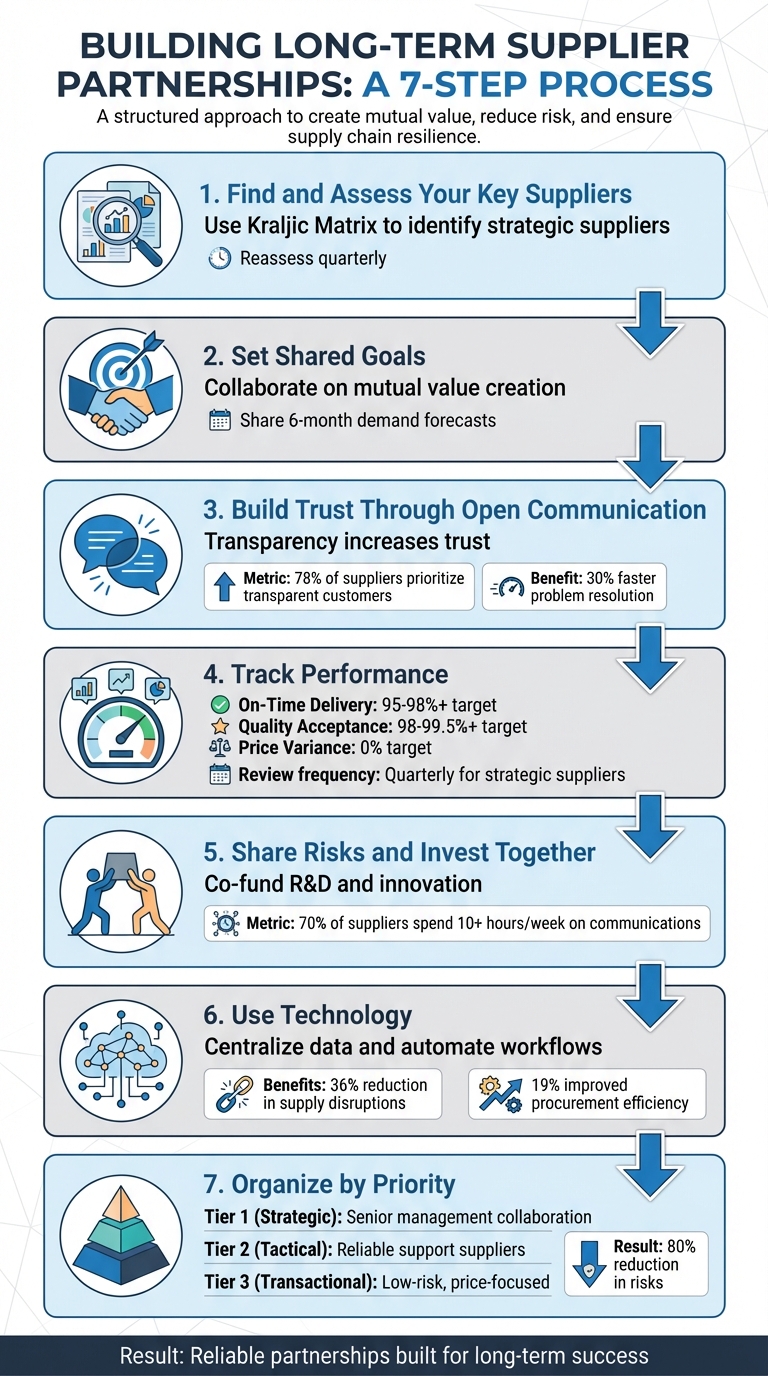
Building long-term supplier partnerships can protect your business from supply chain disruptions, improve profitability, and drive growth. Instead of focusing solely on low prices, prioritizing strong relationships with key suppliers ensures reliability, innovation, and mutual benefits. Here’s a quick summary of the steps to create successful supplier partnerships:
- Identify Key Suppliers: Use tools like the Kraljic Matrix to find suppliers critical to your business. Evaluate them based on financial impact, technical alignment, and ESG standards.
- Set Shared Goals: Collaborate on objectives that benefit both parties, such as improving production capacity or co-developing new products.
- Build Trust with Open Communication: Share forecasts, address challenges transparently, and use centralized tools to streamline communication.
- Track Performance: Monitor metrics like on-time delivery, quality acceptance, and price variance. Hold regular reviews to address issues and improve processes.
- Share Risks and Invest Together: Split risks fairly and co-fund projects to encourage supplier innovation and stability.
- Leverage Technology: Use platforms like Forstock to automate workflows, share real-time data, and improve coordination.
- Organize Suppliers by Priority: Segment suppliers into tiers to focus resources on those most critical to your operations.
These steps create partnerships that are reliable, efficient, and built for long-term success.
7 Steps to Build Long-Term Supplier Partnerships
Step 1: Find and Assess Your Key Suppliers
Identify Your Most Important Suppliers
To pinpoint your key suppliers, the Kraljic Matrix is a valuable tool. It helps categorize suppliers based on two factors: their impact on your profits and the risk associated with their supply. Suppliers that rank high in both areas - known as strategic suppliers - should be prioritized for long-term partnerships. For example, exporting 12 months of sales data can reveal partners who significantly influence your revenue and profit margins. A great case study is Bala, a fitness brand, which used Shopify Collective in June 2025 to integrate eight partner brands into its "Movement Store." This approach allowed them to sync select SKUs in less than 24 hours without purchasing inventory upfront. The result? An impressive 45% of the store’s sales came from entirely new customers.
But it’s not just about inventory cost metrics. Technical alignment is equally crucial. As Nicholas Fiorentino, owner of The Meatery, shared:
"Maintaining an excellent relationship with our suppliers is critical to our business. I'm sure you've read there are beef shortages. We've never felt a moment of that, and I cannot help but credit it to the relationships we've built".
It’s a good idea to reassess your supplier segmentation every quarter or after significant demand changes. This ensures that new, emerging suppliers with potential to drive growth are included in your strategy. Once you’ve identified your key suppliers, the next step is to evaluate their performance and alignment with your long-term goals. This evaluation often includes analyzing inventory turnover metrics to see how efficiently a supplier's goods move through your system.
Create a Supplier Evaluation System
Building a reliable evaluation system is essential. A simple 1–5 rating scale combined with Dr. Ray Carter’s 10 Cs Framework can provide a comprehensive assessment. The framework looks at ten key areas: Competency, Capacity, Commitment, Control, Cash, Cost, Consistency, Culture, Clean (sustainability), and Communication. This shifts the focus from just the lowest initial price to a broader perspective, considering total cost of ownership, quality, lead times, and risk management.
Factory audits are another critical step. Partner with professional firms to inspect operational details like network reliability, safety signage, and even break room conditions. These inspections help confirm the supplier’s quality, capacity, and compliance. To ensure priority service, aim to represent a significant portion of the supplier’s business - ideally the top third by volume. This reduces the risk of being deprioritized during supply chain disruptions.
Sustainability is also becoming a non-negotiable. Today, 92% of brands use scorecards to ensure suppliers meet environmental, social, and governance (ESG) standards. A thorough evaluation process ensures that only suppliers aligned with your strategic objectives and values become long-term partners.
sbb-itb-f0fc809
Step 2: Set Shared Goals with Your Suppliers
Work Together on Common Objectives
After identifying your key suppliers, the next step is to define shared goals that benefit both parties. This isn't just about negotiating better prices - it's about building mutual value. Doug Roginson, Head of Supplier Relationship Management at JPMorganChase, explains it well:
"The goal is to get beyond negotiating rates, service levels and delivery schedules and work toward market-making, brand-differentiating joint value creation".
Aligning supplier goals with your business strategy is crucial. Whether you're aiming to expand production capacity or develop new products, working collaboratively can deliver impressive results. A McKinsey survey of over 100 large organizations revealed that companies actively collaborating with suppliers achieved higher growth, reduced operating costs, and increased profitability compared to their peers.
Transparency is key. Share demand forecasts with suppliers - ideally, providing a 6-month outlook. This helps them plan production schedules and logistics more effectively, reducing risks like capacity shortages. Offering minimum order commitments in return can encourage suppliers to invest in capacity or technology upgrades that directly support your business goals.
Once you've agreed on shared objectives, formalizing them ensures clarity and long-term alignment.
Put Goals in Writing
Documenting shared objectives not only promotes accountability but also provides continuity if team members change. Written agreements solidify the partnership by outlining measurable targets. Steve Peplin, CEO of Talan Products, highlights the value of "evergreen contracts" - agreements that automatically renew annually for two years. These contracts encourage both parties to resolve challenges rather than abandon the partnership. Some of Talan's supplier relationships have thrived for over 20 years under this model.
To ensure success, include specific KPIs in your agreements and store them in a centralized system. For example, Elkem, a global leader in silicon-based materials, implemented the Ivalua platform to centralize supplier data. This created a "single source of truth" for managing thousands of suppliers, enabling them to integrate ESG objectives and standardize qualification processes. Today, 100% of their suppliers are managed through a single, transparent system.
Additionally, tying payments to milestones can reinforce accountability. For instance, splitting payment terms - such as 30/70 or 50/50 - based on quality inspections ensures both parties remain committed to meeting established standards.
Step 3: Build Trust Through Open Communication
Share Information Openly
Trust isn’t built overnight - it grows gradually through consistent actions. One key way to earn trust with suppliers is by sharing information openly. When businesses take the time to understand and address their suppliers’ operational challenges, they create partnerships that go beyond simple transactions. In fact, 78% of suppliers are more likely to prioritize customers who show this level of understanding.
Transparency is especially powerful when delivering bad news. SupplyHive highlights that "when a partner is transparent, even with bad news, trust increases". Open communication in tough situations allows for faster joint problem-solving - up to 30% quicker resolution of challenges.
Proactive sharing is equally important. Providing demand forecasts, updates on market trends, and insights into potential challenges can make a big difference. For example, quarterly "supply reviews" can serve as a platform to identify bottlenecks and solve supplier performance issues. This consistent, two-way communication can help you earn "customer of choice" status, which often translates into perks like better pricing, priority production, and preferential treatment during high-demand periods.
Use Centralized Communication Tools
Scattered emails, phone calls, and spreadsheets often lead to confusion and overlooked details. Centralized communication tools simplify this by creating a single source of truth that everyone can access. For Shopify brands, tools like Forstock can be a game-changer. Forstock’s unified dashboard integrates supplier communication, inventory tracking, and purchase order management, ensuring that teams have real-time data at their fingertips and can stay aligned.
Doug Roginson, Head of Supplier Relationship Management at JPMorganChase, explains the value of centralization:
"When you have a singular view of comprehensive data, you can save time on data extraction and analysis and use it to build more trust and develop better strategies that create shared value".
With a platform like Forstock, businesses can easily share demand forecasts, track performance metrics, and coordinate purchase orders - all in one place. This not only reduces miscommunication but also frees up time for strategic growth instead of getting bogged down by administrative tasks. Centralized tools make collaboration smoother and trust stronger.
Step 4: Track Performance and Schedule Regular Reviews
Choose the Right Metrics to Track
Measuring the right metrics is the backbone of improving supplier relationships. Without clear tracking, it's impossible to identify areas needing attention or opportunities for growth. Focus on 5–10 key metrics that directly influence your business operations. Tracking too many can dilute your efforts and make it harder to act effectively.
One of the most important metrics is On-Time Delivery Rate (OTDR). Top-performing companies aim for a delivery rate of 95% or higher. You can calculate this by using the formula:
OTDR = (Orders On-Time ÷ Total Orders) × 100.
Delays in delivery can lead to stock shortages or disrupt campaigns, so keeping this metric high is essential.
Another critical metric is the Quality Acceptance Rate (QAR), which measures the percentage of goods meeting quality standards. Leading suppliers typically achieve 98%–99.5%+. Poor quality can drive up costs due to returns or rework, so this is a key area to monitor.
Price Variance (PV) is also worth tracking. This metric compares the actual invoice cost to the quoted price, with a target of 0% variance. As Lara from Move Supply Chain wisely points out, "The cheapest supplier is almost never the cheapest supplier".
For a more comprehensive view, include Total Cost of Ownership (TCO) in your evaluations. This metric goes beyond unit price to account for shipping, duties, quality issues, and administrative time. Collaborating with your finance team to calculate the true landed cost can reveal that a supplier with a slightly higher unit price might actually provide better overall value. For strategic suppliers, also keep an eye on Innovation and Collaboration, such as joint projects or co-innovation efforts.
| Metric | Formula | Target Benchmark |
|---|---|---|
| On-Time Delivery (OTDR) | (Orders Delivered On Time ÷ Total Orders) × 100 | 95% - 98%+ |
| Quality Acceptance (QAR) | (Units Accepted ÷ Units Received) × 100 | 98% - 99.5%+ |
| Price Variance (PV) | ((Actual Price - Quoted Price) ÷ Quoted Price) × 100 | 0% (to contract) |
Once you've established these metrics, regular reviews will help ensure they drive continuous improvement.
Hold Regular Performance Reviews
Defining metrics is just the first step. To make real progress, you need to turn data into actionable insights through scheduled reviews. The frequency of these reviews should depend on the supplier's importance: quarterly for strategic partners, monthly for critical suppliers, and annually for less essential vendors.
These meetings should feel more like collaborative problem-solving sessions than formal audits. Doug Roginson, Head of Supplier Relationship Management at JPMorganChase, explains:
"We can't pragmatically talk about business development and innovation if we have lingering issues that aren't being successfully addressed and remediated".
Use these reviews to address the root causes of problems - like material shortages or workforce challenges - rather than just tackling surface-level symptoms. Encourage suppliers to provide feedback on your operations, as this can reveal internal bottlenecks impacting performance.
When issues arise, work with suppliers to create recovery plans that include short-term goals and regular checkpoints. Avoid cutting ties immediately unless absolutely necessary.
Companies that integrate risk monitoring and collaboration tools into their processes can reduce supply disruptions by 36%. For Shopify brands, tools like Forstock's unified dashboard simplify supplier performance tracking by centralizing metrics. This shift from manual tracking to strategic decision-making can improve procurement efficiency by 19% and boost delivery reliability by 22%.
For maximum impact, involve senior leadership and cross-functional teams - such as marketing, production, and finance - in these reviews. Their participation highlights the importance of the supplier relationship and ensures challenges are addressed promptly. Finally, don't forget to reward top-performing suppliers. Recognizing their excellence with perks like preferred vendor status, longer contracts, or even public acknowledgment can motivate them to maintain high standards.
Step 5: Share Risks and Invest in Innovation Together
Split Risks Fairly
When you share risks with suppliers, they stop being just vendors and become true strategic partners. One way to do this is by guaranteeing minimum order commitments and breaking payments into milestones. This approach helps suppliers secure financing and maintain production capacity, even during unpredictable market disruptions.
In tech-related projects, co-funding research and development (R&D) can lead to new products or processes that benefit both parties. Supply chain finance programs can also help by improving working capital. These programs allow suppliers to receive early payments, reducing cash flow issues that might otherwise disrupt the supply chain.
Here’s a staggering fact: 70% of suppliers spend more than 10 hours a week responding to buyer communications, and 32% lose over $260,000 annually due to this administrative burden. Simplifying communication and establishing clear risk-sharing agreements not only reduces this friction but also frees up time for both sides to focus on growth and innovation.
Once risks are shared fairly, the foundation is set for turning this trust into collaborative innovation.
Work Together on New Ideas
With risks balanced, you can work hand-in-hand with suppliers to transform stability into new opportunities. Regular collaboration with suppliers has been shown to drive growth, cut costs, and boost profitability. The key? Treat suppliers as partners in product development, not just as order takers.
Getting suppliers involved early is crucial. When they’re part of your business planning and product design from the beginning, they’ll better understand your goals and can align their capabilities accordingly. This early alignment often sparks fresh ideas that might otherwise be missed.
Take Unilever and Novozyme as an example. Unilever shared detailed data about stains and materials, while Novozyme brought enzyme expertise to the table. Together, they developed two enzyme innovations that not only improved detergent performance at lower temperatures but also reduced CO2 emissions. Similarly, ASML uses value-sharing models to ensure suppliers maintain healthy margins. They offer financial support for infrastructure and staggered purchase guarantees, creating a buffer against market volatility.
For brands like Shopify that juggle complex supplier relationships, tools like Forstock can make a big difference. These platforms centralize demand forecasts and inventory data, giving suppliers a clear picture of 12-month plans and real-time stock levels. Armed with this information, suppliers can plan production more efficiently and even suggest process improvements based on actual trends.
Another great example is L’Oréal’s "Cherry Pack" exhibition. This event gives suppliers a sneak peek at upcoming consumer trends and invites them to pitch innovative packaging ideas. Suppliers can present concepts still in development, accelerating the innovation process. You might consider creating similar structured programs where suppliers can submit ideas through defined processes. Adding innovation-focused KPIs - such as tracking the number of co-developed products or process improvements - can also set clear expectations and encourage collaboration.
Step 6: Use Technology to Coordinate with Suppliers
Improve Supplier Management with Forstock
Relying on manual processes to coordinate with suppliers can drain resources and lead to costly inefficiencies. Research highlights the significant time and expense burdens this creates, but Forstock offers a solution by centralizing supplier management through a single, accessible platform.
Forstock simplifies supplier coordination for Shopify brands with real-time dashboards and automated purchase orders, cutting down on manual errors and speeding up fulfillment. These dashboards provide clear insights into 12-month demand plans and current stock levels, helping suppliers better align production schedules and avoid expensive mistakes. The platform also consolidates communication, making order confirmations and contract details easy to access in one place - no more sifting through endless email threads. By automating workflows and leveraging real-time data, Forstock reduces errors and builds the trust necessary for long-term supplier relationships.
One standout example: In 2024, fitness brand Bala used Shopify Collective to onboard eight partner brands in less than 24 hours. This move resulted in 45% of their sales coming from brand-new customers. With tools like Forstock, businesses can streamline supplier coordination and lay the groundwork for more data-driven, collaborative strategies.
Make Decisions Based on Data
Technology doesn't just simplify daily tasks - it also provides the foundation for smarter, data-based decisions. As Richard Teuchler, Head of Demand Generation at Kodiak Hub, puts it:
"Good partnerships are built on facts, not just feelings. Collecting and analyzing the right data helps both companies make better decisions and track progress".
Forstock takes this to the next level with its AI-powered forecasting tools, which transform raw data into actionable insights. Sharing these demand forecasts with suppliers reduces the unpredictability of order volumes - helping suppliers avoid the need to maintain excess capacity or scramble to meet sudden demand spikes. Forstock’s forecasts account for sales trends, lead times, and seasonality, providing rolling volume estimates that suppliers can trust for more efficient planning. This kind of proactive planning can flag potential disruptions before they become full-blown crises. Companies that integrate risk monitoring and collaborative tools report a 36% drop in supply disruptions and a 19% boost in procurement efficiency.
Predictability builds trust, which strengthens supplier relationships. When suppliers have access to clear KPIs on shared dashboards, they’re more likely to invest in improvements that benefit both sides. It’s no surprise that 92% of brands now use digital scorecards to ensure suppliers meet performance standards.
Step 7: Organize Suppliers by Priority Level
Group Suppliers into Tiers
When managing suppliers, not all deserve the same level of attention. By organizing suppliers into tiers, you can focus your resources where they matter most. This approach ensures that critical suppliers receive the attention they need, while less vital ones are managed efficiently.
A common method divides suppliers into three tiers:
- Tier 1 (Strategic): These are your most important partners, providing goods or services that are essential to your competitive edge. Managing these relationships often involves collaboration at the senior management level.
- Tier 2 (Tactical/Approved): These suppliers support your Tier 1 partners by delivering reliable materials or sub-assemblies that keep operations running smoothly.
- Tier 3 (Transactional/Basic): Vendors in this tier handle low-risk, easily replaceable items, such as office supplies. Here, the focus is on price and efficiency.
Using tools like the Kraljic Matrix, you can map suppliers based on their profit impact and supply risk. This creates quadrants for strategic, bottleneck, leverage, and non-critical suppliers. For instance, JPMorganChase’s Gold Supplier Program highlights how to treat high-priority suppliers by offering them exclusive communication channels and strategic insight. This moves the relationship beyond price negotiations to foster mutual growth.
The goal is to align resource allocation with supplier importance. For non-critical suppliers, minimal oversight suffices, while strategic partners demand closer collaboration. As Pat Edmonds, a Supply Chain Consultant at Point B, explains:
"A strategic supplier relationship carries intrinsic value".
Businesses that nurture these top-tier relationships often experience an 80% reduction in risks, including stockouts and production halts.
Once your tiers are in place, the next step is distinguishing between short-term and long-term supplier relationships.
Compare One-Time vs. Long-Term Relationships
After categorizing suppliers, it's important to separate transactional relationships from strategic partnerships. Here's a breakdown of their key differences:
| Feature | Transactional Relationship (Tier 3) | Long-Term Strategic Partnership (Tier 1) |
|---|---|---|
| Primary Goal | Focused on the lowest price and fulfilling short-term needs | Aimed at consistent value creation, innovation, and alignment with strategic goals |
| Communication | Reactive and centered around orders | Proactive, transparent, with regular reviews |
| Risk Level | Low impact if replaced; plenty of alternatives available | High impact; difficult to replace |
| Management Style | Managed through automated processes like purchase orders | Involves senior leadership and collaborative decision-making |
| Value Creation | Minimal, focusing on cost savings | High, contributing to competitive advantage and innovation |
To keep this system effective, review supplier segmentation every three months. Market changes or sudden shifts in demand can alter a supplier's importance. For Tier 1 partners, create a Joint Business Plan (JBP) - a one-page document outlining annual forecasts, cost-reduction targets, and shared goals. This helps both sides stay aligned and work toward common objectives.
Key Principles of Supplier Relationship Management
Conclusion
Building long-term supplier partnerships means shifting from simple transactional deals to deeper alliances that promote growth and stability. The seven steps in this guide - like identifying key suppliers and prioritizing them - lay out a practical approach for creating partnerships that can weather market challenges and enable scalable growth.
Doug Roginson, Head of Supplier Relationship Management at JPMorganChase, puts it well:
"The goal is to get beyond negotiating rates, service levels and delivery schedules and work toward market-making, brand-differentiating joint value creation. That takes trust created through truth and transparency".
This approach calls for open communication, shared goals, and performance reviews that focus on improvement rather than blame. Trust becomes the foundation for these relationships, and technology helps bring these principles to life.
Forstock plays a key role here, offering tools that help Shopify brands streamline supplier communication, use Shopify purchase order apps to automate workflows, and share real-time demand forecasts. Features like AI-powered forecasting and automated scorecards give suppliers the insights they need to plan effectively while ensuring performance metrics stay on track.
Of course, not all suppliers require the same level of attention. Segmenting suppliers allows businesses to concentrate on the partnerships that matter most. For Tier 1 suppliers, creating Joint Business Plans with shared forecasts and cost-reduction goals can keep everyone aligned on long-term objectives.
Strong partnerships demand ongoing effort from both sides. Regular reviews, equitable risk-sharing, and collaborative problem-solving are essential. By following the strategies outlined in this guide and leveraging tools like Forstock, businesses can secure reliable supply chains and unlock growth opportunities. Together, these steps provide a solid framework for building supplier relationships that not only support day-to-day operations but also drive future success.
FAQs
How do I choose which suppliers to partner with long term?
To select suppliers for the long haul, it's essential to look beyond just the price tag. Focus on how well they align with your business goals, their quality standards, and their reliability. Dive deeper by evaluating their production capacity, adherence to industry standards, and regulatory compliance - this can be done through audits and performance reviews.
Strategic suppliers stand out because they’re not just vendors; they’re partners. They invest in the relationship, collaborate on new ideas, and actively support your objectives. Building trust with these suppliers requires open communication, clearly defined shared goals, and consistent performance tracking. This helps ensure they remain dependable partners as your business grows.
What should I include in a supplier scorecard and contract KPIs?
A supplier scorecard should monitor critical metrics such as on-time delivery rates, defect rates, product quality, and cost stability. It's also important to evaluate factors like responsiveness, regulatory compliance, and communication effectiveness to get a full picture of supplier performance.
When it comes to contract KPIs, they should tie directly to your strategic goals. Focus on measurable targets like delivery times, defect rates, and service levels. Regular reviews of these metrics not only ensure transparency but also help identify areas for improvement and build stronger, more reliable supplier relationships.
How can Forstock help me coordinate forecasts and purchase orders with suppliers?
Forstock makes managing suppliers easier with tools like real-time demand forecasting, automated purchase order creation, and detailed inventory analytics. Its AI-driven models adjust based on sales patterns, lead times, and seasonal changes, helping businesses plan demand accurately and handle orders more efficiently. By simplifying communication and promoting decisions backed by data, Forstock supports stronger and more dependable relationships with suppliers.
Keep reading
Try Forstock free for 14 days.
AI-powered demand forecasting and reorder automation for Shopify brands. No credit card required.