
AI Inventory Optimization: Save on Overstock Costs
Use AI-driven forecasts to cut overstock, automate reorders, and free working capital for Shopify stores.

AI Inventory Optimization: Save on Overstock Costs
Overstocking drains your cash flow and profits. For Shopify merchants, excess inventory means wasted money on storage, insurance, and markdowns. On average, holding inventory costs 20–30% of the product's value annually. For example, $50,000 in surplus stock could cost you up to $15,000 a year before markdown losses.
AI-powered inventory tools solve this problem. By analyzing sales trends, lead times, and seasonal demand, AI ensures you order the right amount at the right time. Unlike manual systems, it continuously updates reorder points and safety stock levels to prevent overordering or stockouts.
Key benefits:
- Reduce overstock costs by up to 45% (e.g., $150K freed in working capital).
- Automate purchase orders, saving hours of manual work.
- Improve accuracy with real-time data and forecasts.
Platforms like Forstock make it easy to manage inventory smarter, saving time and money while boosting efficiency. For just $79/month, Shopify merchants can streamline operations and focus on growth.
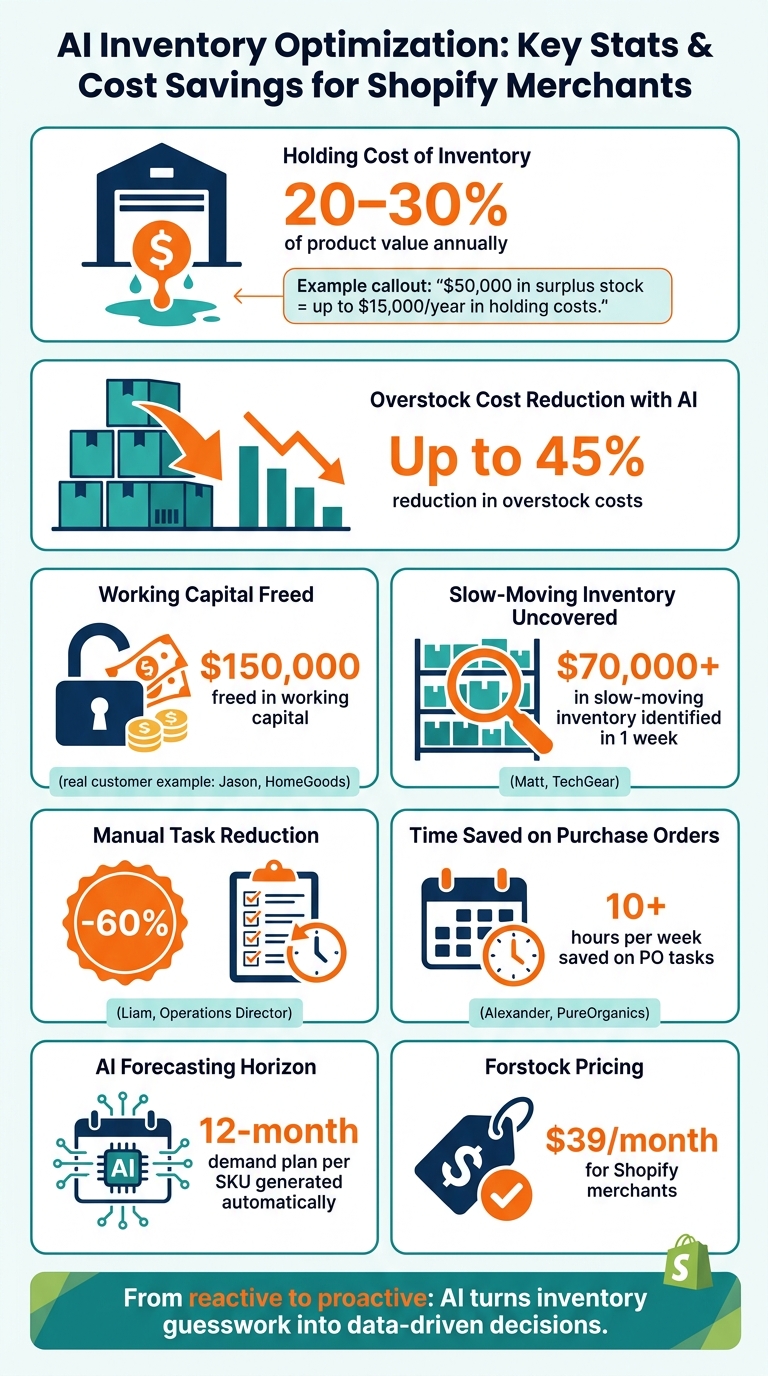
AI Inventory Optimization: Key Stats & Cost Savings for Shopify Merchants
Reorder Points and Safety Stock Explained
What Reorder Points, Lead Times, and Safety Stock Actually Mean
When it comes to keeping your Shopify store running smoothly without tying up too much cash in inventory, three metrics are key: reorder point (ROP), lead time, and safety stock.
The reorder point is the inventory level that signals it’s time to place a new order. Think of it as the threshold you don’t want to cross - order when you hit it, not before or after. It’s calculated using this formula: (Average Daily Sales × Lead Time in Days) + Safety Stock.
Lead time refers to the total time it takes for an order to go from placement to being ready for sale. This includes processing, shipping, and receiving. Meanwhile, safety stock acts as a cushion, protecting you from unexpected demand surges or delays in delivery.
Here’s how these three pieces fit together: the reorder point ensures you’ll have enough stock to cover expected sales during the lead time, while safety stock provides a buffer for the unexpected. When calculated correctly, your new shipment should arrive just as your safety stock starts to come into play.
| Component | Definition | Role in Inventory Balance |
|---|---|---|
| Lead Time Demand | Avg. Daily Sales × Lead Time | Covers expected demand during the lead time |
| Safety Stock | Buffer inventory | Protects against delivery delays or demand spikes |
| Reorder Point | Lead Time Demand + Safety Stock | Prevents both stockouts and overstock |
Mistakes with these calculations are common when using manual systems.
Common Errors in Manual Inventory Workflows
Manual inventory management often leads to errors, especially when the formulas aren’t applied correctly. A frequent issue is relying on static safety stock numbers - setting a fixed buffer and never updating it. This approach can leave you vulnerable to stockouts if sales patterns change.
Another misstep is overlooking seasonality. Using last quarter’s averages might result in over-ordering during slow months or under-ordering before busy periods. Additionally, many manual systems rely on supplier-provided lead times instead of actual historical data. Since suppliers rarely deliver on the dot, basing your calculations on real-world lead times ensures accuracy.
One practical adjustment is to exclude stockout days when calculating average daily sales. Including these days lowers your average sales figure and can lead to underordering.
Switching to AI-driven forecasting tools can help eliminate these manual errors and keep your inventory levels precise.
The Full Cost of Overstocking: Visible and Hidden
Excess inventory doesn’t just tie up cash; it comes with a range of other costs. The obvious ones include warehouse fees, but there are hidden costs too - such as the inability to reinvest locked-up cash into marketing, launching new products, or taking advantage of supplier discounts for early payments. Over time, excess inventory often forces discounted pricing, which eats into profit margins.
"We reduced excess inventory by 45% and freed up $150K in working capital." - Jason, Co-founder at HomeGoods
sbb-itb-f0fc809
How AI Improves Inventory Management for Shopify Stores

The Data AI Uses to Forecast Inventory Needs
AI inventory tools rely on data to make accurate predictions. By analyzing 12–24 months of Shopify order history, inventory trends, supplier lead times, and product-specific details, these tools can anticipate demand changes. They also consider external factors like promotions, marketing efforts, and seasonal events (think Black Friday) to adjust reorder points before demand surges. This approach not only minimizes overstock expenses and stockouts but also ensures stores are ready for peak periods. Essentially, AI identifies demand patterns early, giving businesses a proactive edge.
How AI Adjusts Reorder Points and Safety Stock Over Time
The standout feature of AI in inventory management is its ability to adapt constantly. AI systems don’t just set reorder points once - they update them daily as fresh data comes in. Supplier lead times are monitored closely, and safety stock levels are recalculated using statistical methods to handle delivery fluctuations. When unexpected demand spikes occur, the system flags these anomalies, prioritizes recent data, and adjusts reorder points accordingly. Once things settle, safety stock is reduced to avoid excess inventory.
This flexibility extends across different product categories. Fast-moving items get daily forecasts and tighter safety stock levels, while slower-moving products are managed with models suited for sporadic demand and smaller order quantities. For new products with no sales history, AI benchmarks them against similar items in the same category or price range, refining its approach as actual sales data becomes available.
"The AI forecast actually makes sense for my business. It feels like having a supply chain manager on my team." - Sophie, E-commerce Manager
These ongoing adjustments lay the groundwork for automation, making inventory management more efficient.
Forstock's Inventory Optimization Features for Shopify
Forstock is designed specifically for Shopify stores, simplifying inventory management by addressing common manual errors and inefficiencies that lead to overstock costs. Its AI-powered system analyzes sales patterns, seasonal trends, and lead times to create a 12-month demand plan for each SKU, offering a clear view of future inventory needs.
The platform’s real-time dashboard pinpoints SKUs that are overstocked, nearing their reorder point, or at risk of running out - so you can focus on what truly matters. As Emily, an inventory manager using Forstock, shares:
"I open the dashboard in the morning and instantly know what needs reordering, what is overstocked, and what to focus on."
When it’s time to reorder, Forstock automates the process by turning recommendations into draft purchase orders, complete with suggested quantities for each SKU and supplier. Alexander, E-commerce Manager at PureOrganics, noted that this feature alone saved him over 10 hours a week on purchase order tasks.
AI in Inventory Management Explained | Smart Stock Optimization Systems
Using AI Insights to Cut Overstock Costs
AI doesn’t just streamline reorder points and safety stock - it also plays a direct role in slashing overstock costs.
Turning AI Forecasts into Better Purchase Decisions
AI forecasts are most effective when they actively guide purchasing decisions. By integrating these predictions into your inventory strategy, you can improve inventory flow and avoid costly overstock. Forstock's Reorder Table offers a real-time snapshot of every SKU's status, showing how many days of stock remain, identifying overstocked items, and flagging products nearing their reorder point. This lets you focus on SKUs that need immediate attention, ensuring purchasing efforts are targeted and efficient. AI also accounts for supplier lead times and minimum order quantities (MOQs), tailoring orders to align with actual demand.
Take Jason, Co-founder at HomeGoods, as an example. By leveraging these tools, he cut excess inventory by 45% and freed up $150,000 in working capital. Similarly, Matt, Operations Lead at TechGear, uncovered over $70,000 in slow-moving inventory within just one week of using Forstock's tools.
With accurate forecasts in hand, the next step is to simplify your ordering process.
Automating Supplier Coordination with Forstock
Creating purchase orders manually can be a slow, error-prone process - especially when dealing with multiple suppliers and hundreds of SKUs. Forstock eliminates this bottleneck by automating the entire purchase order workflow. AI-generated forecasts feed directly into draft purchase orders, pre-filled with suggested quantities for each SKU and supplier. The built-in landed cost calculator even includes shipping and customs fees, so you always know your total spend before finalizing an order. Plus, tracking supplier delivery performance within the same dashboard helps pinpoint unreliable lead times, enabling you to strengthen supplier relationships over time.
"We have cut manual inventory tasks by at least 60%." - Liam, Operations Director
KPIs to Measure the Impact of AI Inventory Optimization
To measure the financial and operational benefits of AI-driven inventory management, monitor these key performance indicators (KPIs):
| KPI | What It Measures | What Improvement Looks Like |
|---|---|---|
| Inventory Turnover Rate | How often stock is sold and replaced | Higher rates indicate reduced excess inventory |
| Excess Inventory % | Percentage of stock exceeding demand projections | Lower percentages reflect more precise ordering |
| Days of Supply | How long current inventory will last | Balanced levels - neither too high nor too low |
| Stockout Rate | Percentage of SKUs that run out of stock | Lower rates show improved replenishment timing |
| Working Capital Freed | Capital unlocked from slow-moving inventory | Increases as overstock is identified and cleared |
| Planning Time | Hours spent on manual forecasting and purchase orders | Significant reductions with automation |
Tracking these KPIs over 30, 60, and 90 days provides a clear view of your return on investment (ROI) and helps make the case for shifting from manual processes to AI-powered inventory solutions.
Conclusion: Using AI to Take Control of Inventory Costs
AI-driven forecasting gives Shopify merchants the tools to cut out the guesswork and better manage inventory expenses. Reducing overstock isn’t just about running out of space - it ties up cash that could be put toward growth opportunities like marketing or product development. With AI, inventory management shifts from relying on intuition to making decisions based on real data, empowering merchants to make smarter, more forward-thinking choices.
The power of AI goes beyond just forecasting - it’s about turning insights into action. By analyzing real-time demand signals, AI helps merchants fine-tune reorder points, adjust safety stock levels, and create purchase orders that align with supplier rules and lead times. This proactive approach stops inefficiencies before they snowball into bigger problems. Forstock, as highlighted earlier, exemplifies this by continuously refining these processes to give merchants a competitive edge. With a quick two-minute setup, a 14-day free trial, and a $79/month subscription, Forstock is one of the top-rated inventory solutions on the Shopify App Store.
Merchants who shift from reacting to stock issues to anticipating them will unlock the full potential of AI-powered inventory management.
FAQs
How do I calculate a reorder point for a Shopify SKU?
To figure out a reorder point, use this formula: (Average Daily Sales × Lead Time) + Safety Stock.
- Average daily sales: Divide the total units sold during a specific period by the number of days in that period.
- Lead time: Identify how many days it typically takes for your supplier to deliver.
- Safety stock: This is your buffer inventory to handle unexpected demand or delivery delays.
Tools like Forstock can simplify this process by automating the calculations and improving precision.
How much safety stock should I keep to avoid overstock?
The right amount of safety stock depends on several factors, including how much demand fluctuates, lead times, and the overall state of your supply chain. A widely used formula to calculate safety stock is: (Max Daily Sales × Max Lead Time) – (Average Daily Sales × Average Lead Time).
Modern tools, like Forstock, take this a step further by using real-time data to fine-tune safety stock levels. This helps businesses avoid overstocking or running out of stock, ensuring they can consistently meet customer demand without unnecessary inventory costs.
What data does AI need to forecast inventory accurately?
AI systems rely on several critical inputs to function effectively. These include historical sales data, supplier lead times, demand variability, and records of stockouts or backorder events. Additionally, markers for seasonality or promotional periods play a key role. Together, these inputs enable the system to anticipate demand patterns and fine-tune inventory levels with precision.
Keep reading
Try Forstock free for 14 days.
AI-powered demand forecasting and reorder automation for Shopify brands. No credit card required.