
How AI Improves Inventory Turnover for Shopify Brands
AI forecasting, automated replenishment, and unified dashboards raise turnover, cut stockouts, and free up cash for Shopify stores.
How AI Improves Inventory Turnover for Shopify Brands
AI is transforming how Shopify brands manage inventory turnover, making it faster and more efficient to sell and replenish stock. Here’s why it matters:
- Inventory turnover measures how often products are sold and restocked. A higher rate means better cash flow and less money tied up in unsold inventory.
- Many Shopify brands struggle with stockouts, overstock, and manual methods like spreadsheets, which lead to costly errors and wasted time.
- AI tools solve these problems by improving demand forecasting accuracy to 85–95%, automating replenishment, and reducing excess inventory. Brands using AI have seen turnover rates jump by 20–40% and stockouts drop by 30–50%.
- For instance, a mid-sized brand cut excess stock by $150,000 and avoided $50,000 in monthly stockout losses by adopting AI-powered systems.
In this article, learn how AI tools like Forstock optimize forecasting, automate purchase orders, and provide real-time insights to boost inventory turnover and free up cash flow.
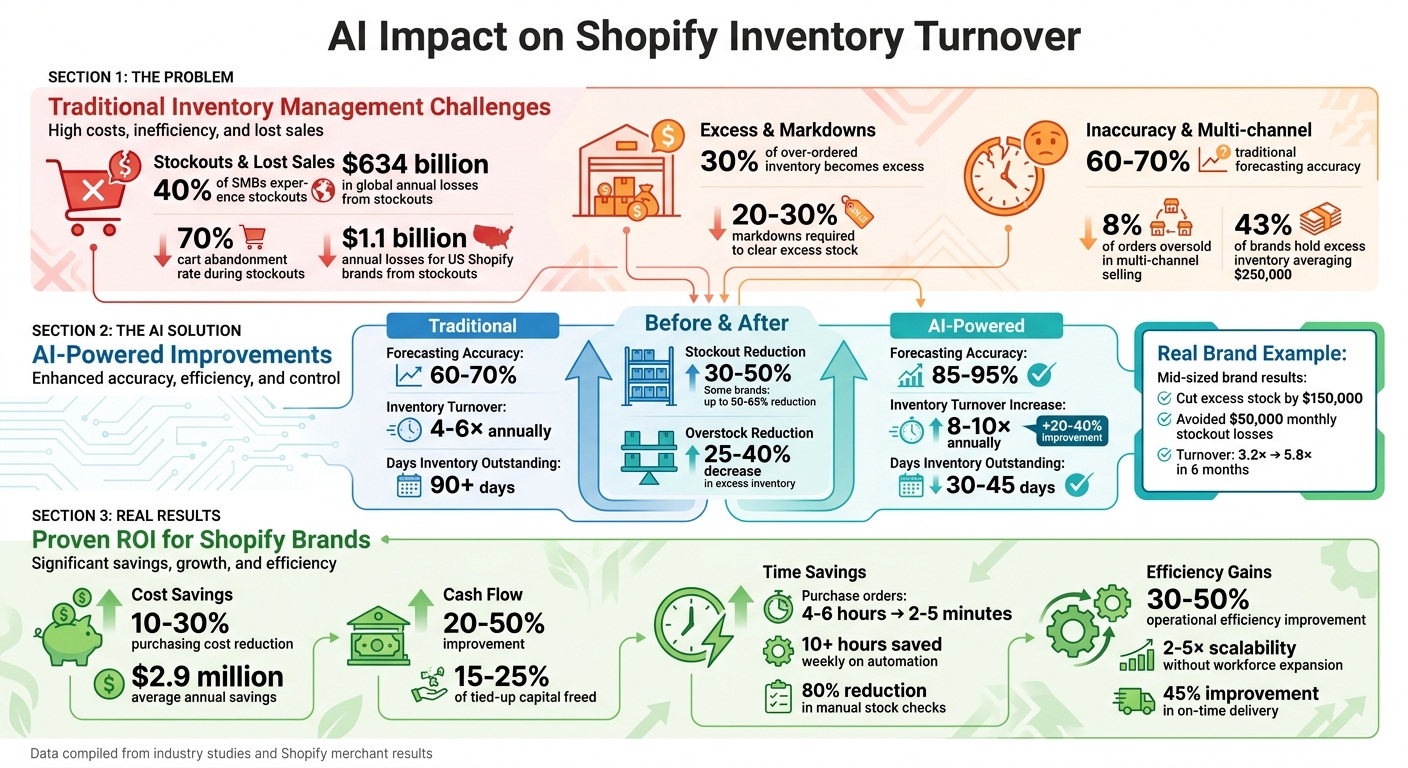
AI Impact on Shopify Inventory Turnover: Key Metrics and Benefits
Understanding Inventory Turnover for Shopify Brands

What is Inventory Turnover?
Inventory turnover measures how often you sell and replenish your stock over a year. The formula is simple: Cost of Goods Sold (COGS) ÷ Average Inventory Value. Shopify brands can pull COGS from tools like QuickBooks or Shopify reports, while the average inventory is calculated as: (Beginning Inventory + Ending Inventory) ÷ 2.
What’s considered a “good” turnover rate depends on your industry. For example, fashion brands generally aim for 4–6 turns annually, while electronics merchants often target 8–12 turns. A higher turnover rate means your products are selling quickly, freeing up cash for other areas of your business. On the other hand, a low turnover rate suggests that capital is stuck in unsold inventory. Understanding this metric is key, as it not only reflects sales efficiency but also helps you maintain the cash flow needed to grow your Shopify store.
Common Challenges in Managing Inventory Turnover
Managing inventory turnover comes with its fair share of challenges, and these issues often highlight the need for smarter inventory systems. For instance, stockouts - when you run out of popular items - affect 40% of small and medium-sized businesses and contribute to a staggering $634 billion in global annual losses, according to IHL Group. Shopify data also shows that stockouts can push cart abandonment rates to as high as 70%.
On the flip side, overstocking is just as harmful. An estimated 30% of over-ordered inventory becomes excess, often requiring markdowns of 20–30% to clear these unsold items. Both scenarios - stockouts and overstock - directly impact your turnover rate and profitability.
Selling across multiple channels adds another layer of complexity. If you’re managing inventory on Shopify, Amazon, Etsy, and even physical stores, visibility gaps can lead to overselling about 8% of orders. This often leaves stock stuck in one channel while another faces shortages, pulling your turnover rate down by 20–30%. For brands with multi-variant catalogs (think products available in multiple colors or sizes), manually tracking demand becomes even harder, increasing the risk of both excess inventory and stockouts.
Why Manual Methods Don't Work
Relying on spreadsheets and guesswork just doesn’t cut it in today’s fast-paced e-commerce world. Spreadsheets can’t keep up with real-time sales data, sudden demand spikes (like Black Friday sales surging by up to 300%), or the complexity of managing 1,000+ SKUs across multiple sales channels.
"Before Forstock, I was literally living in spreadsheets. I spent hours each week updating stock levels and trying not to miss reorder points." – Sophie, E-commerce Manager
This reliance on manual methods is costly. US Shopify brands lose around $1.1 billion annually to stockouts, while 43% of them hold excess inventory averaging $250,000 per brand. Catalogs with over 500 SKUs see a 50% increase in tracking errors, and when demand fluctuates or seasonal trends kick in, businesses often resort to reactive ordering. All of this takes a toll on inventory turnover.
In the next section, we’ll dive into how AI can tackle these inefficiencies head-on and transform inventory management.
sbb-itb-f0fc809
How AI Improves Inventory Forecasting
AI-Powered Demand Forecasting
AI takes inventory forecasting to a whole new level by analyzing a mix of historical sales data, seasonal trends, external factors like holidays and promotions, and supplier lead times. Unlike traditional methods such as moving averages, which typically hover around 60–70% accuracy, AI models - using techniques like LSTM neural networks or Prophet algorithms - can achieve accuracy levels of 85–95%.
Take the example of Gymshark during Q4 2024. By using AI-powered forecasting, the retailer fine-tuned its SKU management for 5,000 products, factoring in real-time sales trends and holiday patterns. Their forecast accuracy jumped from 72% to 94%, which helped them cut excess inventory by $4.2 million and boost turnover by 32% year-over-year. The AI system even predicted a 25% drop in demand for winter apparel after the holidays, leading to a 30% reduction in overstock. For Shopify brands, this kind of precision can improve turnover rates by 20–40%. According to Gartner, businesses adopting AI see inventory turnover increase from 4–6× annually to 8–10× by reducing both stockouts and surplus inventory.
AI also shines when it comes to predicting major events. It can anticipate spikes like Black Friday surges - often in the 200–300% range - or even sudden sales booms caused by viral social media trends. This level of foresight doesn't just prevent overstock; it also sets the stage for actionable, real-time insights.
Real-Time Sales and SKU-Level Insights
AI systems provide real-time insights by analyzing live Shopify data streams, calculating metrics like sales velocity (units sold per day or hour per SKU) and lead-time demand. For instance, if a T-shirt SKU sells 50 units daily with a 7-day lead time, the AI flags the reorder point at 350 units. This ensures you're ready for demand shifts, avoiding both overstock and stockouts.
Unlike spreadsheets, AI dives deep into SKU-level details, forecasting demand for every variant - color, size, and more - across all sales channels. It can identify trends like SKU cannibalization (e.g., when a new color variant outsells the original by 40%) or sudden sales spikes (e.g., a gadget doubling its sales after going viral). One brand noticed a 60% decline in boot sales mid-spring and adjusted by cutting reorder quantities by 50%, saving $20,000 in potential overstock costs. In 2023, Allbirds used AI to analyze two years of sales data, seasonality, and promotions, reducing stockouts from 15% to 9% (a 40% drop) and cutting overstock by 28%. This boosted their inventory turnover from 5.2× to 7.1× in just six months.
Many brands report faster stock adjustments - up to 15–25% quicker - helping to avoid over $100,000 in lost sales from stockouts. These real-time insights also streamline automated replenishment, further improving turnover rates.
"The AI predictions are incredibly accurate. We're preventing stockouts that were costing us $50K monthly." – Matt, Operations Lead, TechGear
Forstock's Adaptive Forecasting Models
Forstock takes real-time insights a step further with adaptive forecasting. These models continuously update based on live sales data, adjusting for changing lead times and seasonal patterns. By combining ARIMA models with neural networks, Forstock generates 12-month demand plans that adapt to events like Q4 holiday rushes or back-to-school shopping. For example, it can differentiate between suppliers with 14-day overseas lead times and those with 3-day domestic delivery, tailoring forecasts accordingly.
What sets Forstock apart is its transparency. Instead of offering "black-box" predictions, the platform explains why specific reorder recommendations are made. Its intelligent bootstrapping even allows accurate predictions for new product launches without prior sales data.
"Our forecasts were just educated guesses - until Forstock. It predicted demand 6 weeks ahead with 95% accuracy and prevented a stockout before Black Friday." – Operations Lead, Home Goods Brand ($5M ARR)
Shopify merchants managing around 500 SKUs have seen forecasting errors drop from 28% to 8%, cutting holding costs by about $50,000 annually (roughly 18% of inventory value). With its unified dashboard, Forstock offers proactive insights that automate purchase plans across locations, helping businesses achieve 20–30% gains in inventory turnover. This means less time spent wrestling with spreadsheets and more time focusing on growth. By aligning forecasts with actual sales trends, Forstock helps improve cash flow and operational efficiency.
Automating Replenishment and Purchase Orders with AI
Automated Reorder Points and Stock Monitoring
AI-driven forecasting is great, but automated replenishment takes inventory management to the next level for Shopify brands. These systems connect directly to Shopify, pulling in live sales data, returns, and even incoming shipments to keep a constant eye on stock levels. Here's how it works: the system calculates reorder points using real-time sales data, safety stock, and lead time demand. For example, if a product sells 50 units daily and the supplier lead time is 7 days, the reorder point would be roughly 350 units - often with an added buffer for unexpected demand spikes. This setup eliminates about 80% of manual stock checks and significantly reduces the risk of costly errors. According to McKinsey's 2023 retail AI study, automated reorder points can cut stockouts by 30–50% and reduce overstock by 25%. This level of precision sets the stage for automating purchase orders seamlessly.
Automating Purchase Order Creation and Supplier Coordination
Manually creating a purchase order is a time sink, often taking 4–6 hours. AI systems shrink that process to just 2–5 minutes. By combining demand forecasts, current stock levels, lead times, and supplier pricing, these systems generate optimized purchase orders. For instance, instead of placing frequent small orders that rack up shipping fees, the system might recommend ordering 300 units every two weeks to save costs.
But it doesn’t stop there. AI also simplifies supplier coordination by generating pre-filled emails or API-integrated messages with detailed order information, cutting communication efforts by 70%. Additionally, it predicts and adjusts for lead time variances - like extending a 5-day delivery to 7 days during port delays - and flags supplier delays over 10%, ensuring a 98% on-time delivery rate.
"The automated PO creation saves us 10+ hours weekly. Setup was seamless - just 2 minutes!" – Alexander, Supply Chain Manager at FashionCo
Forstock's Replenishment Features
Forstock takes all these capabilities and wraps them into one powerful platform. Fully integrated with Shopify, it monitors inventory across multiple locations, syncing data every 15 minutes. Reorder thresholds are dynamic, based on 12-month demand forecasts, lead times, and safety stock buffers that adapt to each SKU's sales velocity. For example, high-turnover items like accessories might have their reorder points adjusted for seasonality, helping to avoid overstock while seamlessly managing multiple suppliers.
The platform’s unified dashboard tracks supplier performance metrics like on-time delivery (aiming for above 95%) and flags issues such as demand spikes or delayed shipments. If Forstock detects a 2-day lead time delay, it automatically reroutes orders to a backup supplier, cutting stockout risks by 40% and saving hours of operational work every week. It also automates purchase order creation using customizable rules, such as minimum order values or supplier-specific pricing tiers, and sends pre-filled POs via email in minutes. These features free up cash flow by reducing excess inventory and save time by automating manual tasks.
"We can create POs in minutes, track supplier performance, and forecast demand without the guesswork. It is the first tool that actually bridges inventory management and purchasing." – Daniel, Supply Chain Manager
The results speak for themselves. A mid-sized Shopify beauty brand using similar AI tools saw inventory turnover jump from 3.2× to 5.8× in just six months. They reduced overstock by $75,000, freeing up 35% of tied-up cash, and cut stockouts by 28%. With AI handling 85% of their 150 monthly purchase orders, the operations team redirected their focus to marketing, contributing to a 22% revenue boost.
5-minute Shopify inventory plan: Julius AI analysis
The Benefits of a Unified Dashboard for Shopify Inventory Management
AI-powered dashboards do more than just predict demand - they bring all your performance data into one place, making inventory decisions easier and more effective for Shopify brands.
Real-Time Analytics and Performance Tracking
Think of a unified dashboard as the control center for your inventory. Instead of juggling spreadsheets, Shopify tools, and supplier emails, you get a single screen showing key metrics like stock levels, turnover rates, and safety stock alerts. The real advantage? Actionable insights. For instance, when a product's turnover rate dips below a certain point, the dashboard flags it right away. This gives you the chance to launch a promotion or tweak pricing before too much cash gets tied up.
Here’s a real-world example: In Q1 2024, Allbirds used a unified dashboard to cut overstock by 28% and improve inventory turnover from 3.2× to 5.1×. By centralizing data from 12 U.S. warehouses and five online channels, Inventory Director Mia Lopez freed up $1.2 million in capital and reduced stockouts by 22%. This all-in-one view gave Allbirds the ability to act quickly and avoid costly missteps.
Platforms like Forstock take this a step further by combining metrics and projections. Merchants can access 12-month demand forecasts and visualize which products are flying off the shelves versus which ones are gathering dust. This saves hours of manual work and ensures inventory data is consistent across multiple locations.
Multi-Location and Multi-Channel Integration
Managing inventory across various locations and channels can be a logistical headache. That’s where a unified dashboard becomes a game-changer. It syncs inventory data automatically, eliminating errors, overselling, and endless spreadsheet updates. For example, when a purchase is made on one channel, the dashboard instantly updates inventory counts across all locations. You can see at a glance that you have 150 units available - split between your primary warehouse, a secondary location, and Amazon fulfillment.
This kind of visibility is a major draw for e-commerce brands. In fact, 68% of mid-sized businesses cite multi-location stock tracking as one of the top benefits of dashboard tools.
Take Glossier, for example. In 2023, the beauty retailer sped up replenishment cycles by 35% using a unified dashboard integrated with Shopify. By managing inventory across three warehouses and platforms like Etsy and Amazon, COO Alex Rivera reduced excess stock by $850,000 and increased turnover to 6.8× annually.
Reducing Overstock and Improving Turnover
Unified dashboards shine when it comes to tackling overstock and improving turnover. They provide a clear view of where your money is tied up and help you act fast. For instance, by tracking metrics like the inventory turnover ratio (Cost of Goods Sold ÷ Average Inventory Value) and days inventory outstanding (365 ÷ Inventory Turnover Ratio), you can spot inefficiencies. Reducing average inventory levels by just 25% could save around $62,500 annually on a $1 million inventory base, assuming carrying costs are 25% of inventory value.
Forstock’s inventory table identifies slow-moving stock almost immediately. TechGear’s Operations Lead, Matt, discovered $70,000 in stagnant inventory within his first week on the platform.
"We reduced excess inventory by 45% and freed up $150K in working capital." – Jason, Co-founder at HomeGoods
The results speak for themselves. Brands using centralized dashboards report inventory turnover improvements of 25–40% thanks to real-time analytics. Shopify merchants, in particular, have reduced stockouts by 30% and overstock by 20–35%, freeing up 15–25% of tied-up capital.
Measuring the Impact of AI on Inventory Turnover
Measurable Benefits of AI in Inventory Management
AI is changing the game for inventory turnover, delivering measurable results in several key areas. By optimizing purchasing and replenishment, businesses are seeing 10–30% cost savings, a 40% reduction in excess inventory, and 20–50% improvements in cash flow as funds tied up in slow-moving products are freed for reinvestment.
Forecasting accuracy has also taken a leap - from 60–75% with manual methods to 85–95% with AI models. This improvement directly reduces stockouts by 50–65%. Holding costs are dropping too - Forstock users, for instance, report a decrease from 25% to 15% of inventory value on average.
When it comes to inventory turnover ratios, the impact is equally impressive. Companies using AI often see their turnover increase from 4–5 times per year to 7–10 times annually. Days Inventory Outstanding (DIO) also improves, shrinking from over 90 days to just 30–45 days. This means products move faster, and capital cycles more efficiently.
Success Stories from Shopify Brands
Real-world examples make the case for AI's effectiveness even stronger. Shopify brands like True Classic and Warby Parker have experienced dramatic results.
In 2023, True Classic used AI-powered forecasting to cut inventory by 30% and boost turnover from 4× to 7× annually, avoiding $1.2 million in overstock costs across 500+ SKUs. Similarly, in Q1 2024, Warby Parker implemented AI forecasting through Impact Analytics, reducing stockouts by 50% and excess inventory by 25%. This adjustment increased turnover by 35%, unlocking $50 million+ in optimized working capital.
"The automated PO creation saves us 10+ hours weekly. Setup was seamless - just 2 minutes!" – Alexander, Supply Chain Manager at FashionCo
The Long-Term Value of AI for Shopify Merchants
AI doesn’t just deliver short-term wins - it sets businesses up for sustained growth. Shopify merchants using platforms like Forstock report 2–5× scalability without needing to expand their workforce. These tools easily manage multi-channel operations and handle 10,000+ SKUs with ease. Over time, merchants see efficiency gains of 30–50%, supporting annual growth rates of 15–20%. Many report sustained 25% increases in turnover over three years, highlighting the reduced manual workload and improved cash flow.
On a broader scale, companies adopting AI for supply chain management save an average of $2.9 million annually and improve on-time delivery rates by 45%. For Shopify merchants, this means predictable cash flow, fewer emergency orders, and the ability to scale confidently without the constant worry of stockouts or overstock draining resources. These benefits underscore the transformative role AI plays in inventory management for Shopify businesses.
FAQs
What inventory data is needed for accurate AI forecasts?
To create accurate AI-driven forecasts, it's crucial to collect detailed data on several key factors: historical sales figures, supplier lead times, current inventory levels, seasonal trends, and demand patterns. By feeding this information into AI models, businesses can generate predictions based on real data, leading to better inventory management and smarter decision-making.
How long does it take to see turnover improvements after switching to AI?
Inventory turnover often sees noticeable gains with AI in just a few months. Many businesses experience clear advantages - like fewer stockouts and improved efficiency - within 3 to 6 months. However, the exact timeline can depend on factors such as sales patterns and the complexity of operations.
Can AI manage multi-channel and multi-warehouse inventory in Shopify?
AI is a powerful tool for managing multi-channel and multi-warehouse inventory in Shopify. It analyzes sales data, identifies trends, and accounts for seasonality to predict demand accurately. This allows businesses to optimize stock levels across various locations and sales channels. The result? Smoother inventory management, fewer errors, and the ability to meet customer demand more effectively.
Keep reading
Try Forstock free for 14 days.
AI-powered demand forecasting and reorder automation for Shopify brands. No credit card required.