
AI Demand Forecasting for Purchase Orders
By Forstock Team · Last updated July 10, 2026
AI demand forecasting aligns SKU, channel, and warehouse demand to drive better-timed, right-sized purchase orders.
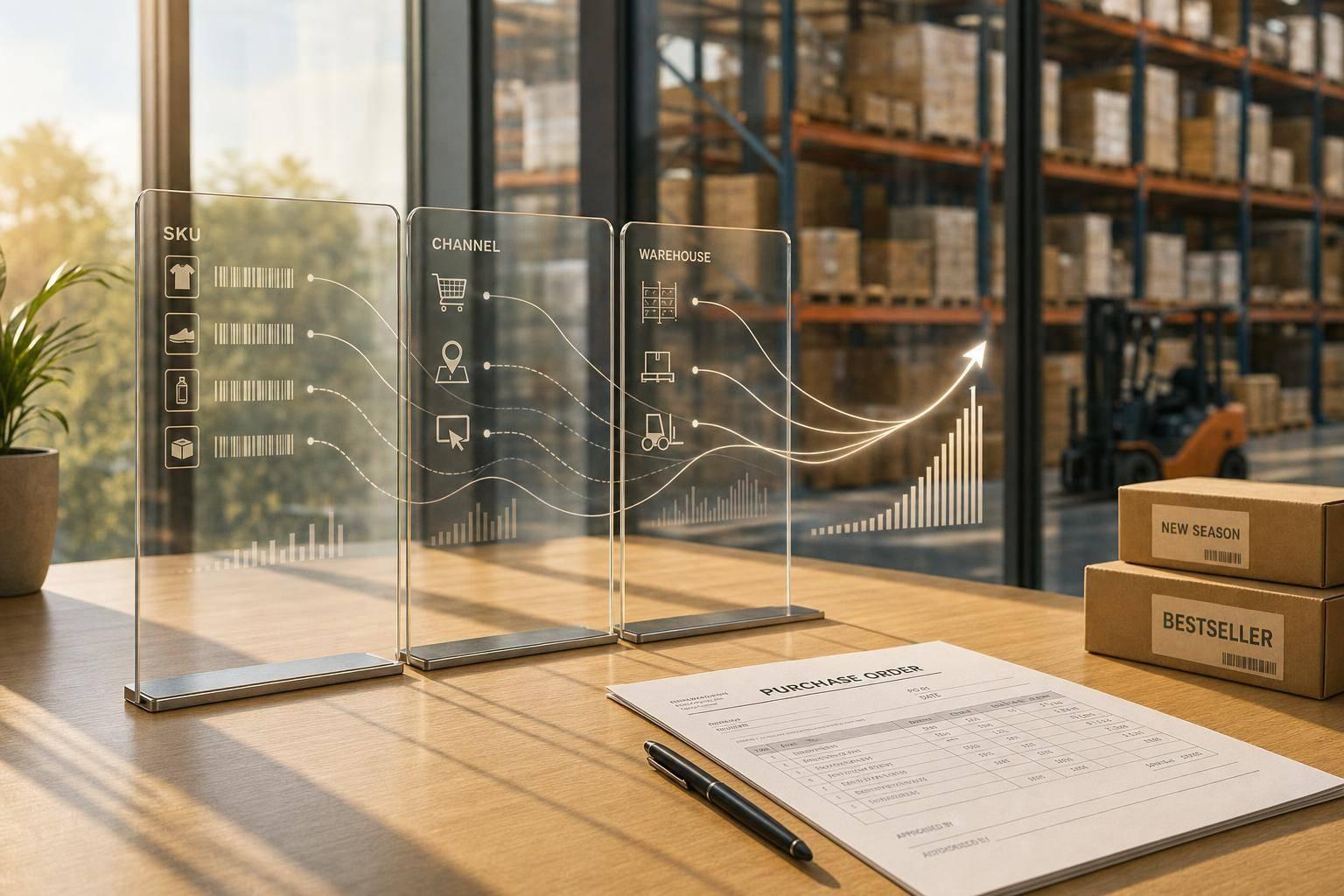
Bad demand planning leads to two expensive outcomes: stockouts or too much inventory. If I want better purchase orders, I need demand forecasts that tell me when to buy, how much to buy, and where to send it by SKU, channel, and warehouse.
In plain terms, this article shows that weak forecasts often cause:
- Late POs that miss lead times and trigger rush freight
- Oversized POs that tie up cash and sit too long
- Wrong-location inventory when demand is blended across channels or warehouses
- Bad reorder timing when supplier lead times shift
It also explains the fix:
- Forecast demand at the SKU, channel, and location level
- Net forecasted demand against on-hand and inbound inventory
- Set reorder dates and order quantities from that plan
- Track metrics like MAPE, stockouts, days on hand, sell-through, and lead time
- Use scenarios for events like promotions, launches, and supplier delays
Here’s the core idea: a purchase order should not come from a static spreadsheet rule. It should come from a connected flow: data → forecast → replenishment plan → approved PO.
A useful stat to keep in mind: even small forecast error rates can lead to more rush orders, more markdowns, and more cash tied up in inventory across a large SKU catalog. That is why forecast quality has a direct effect on PO timing and PO size.
AI in Action: How AI Transforms Inventory Management
Quick Comparison
| Area | Weak forecasting | AI forecasting |
|---|---|---|
| Reorder timing | Fixed rules | Changes with demand and lead time shifts |
| Order quantity | Manual estimates or averages | Based on forecast, stock on hand, and inbound units |
| Channel planning | Blended demand | Separate demand by DTC, wholesale, and marketplaces |
| Warehouse planning | Misses location gaps | Plans by warehouse |
| Risk | More stockouts and overbuys | Lower inventory swings |
If I had to sum it up in one line: better forecasts lead to better-timed, better-sized purchase orders.
The Problem: Weak Forecasts Lead to Late or Oversized Purchase Orders
A buyer updates a spreadsheet, checks a reorder point, and sends a purchase order based on recent sales. That can work when you have a small SKU count and one sales channel. But once the catalog grows, channels stack up, and supplier lead times start moving around, that simple process starts to crack.
Static reorder rules don't hold up when demand changes, lead times drift, or inventory shifts across locations. Then the business starts making purchase orders that land too late, come in too big, or go to the wrong place.
Under-Forecasting Causes Late Purchase Orders and Stockouts
When a forecast is too low, reorder points fire too late. By the time the team spots the need to reorder, the lead time may already be gone. That throws purchasing into scramble mode, with rush decisions, manual fixes, and expedited logistics.
That gets expensive fast. Expedited shipping costs more, and a stockout during peak demand can mean lost revenue that never comes back. Stockouts also mess with future forecasts because recorded sales drop below actual demand. If the forecast is off, the purchase order will be off too.
This gets even harder when lead times are volatile. A supplier that usually ships on a steady rhythm can suddenly take much longer during a disruption. If the reorder point is built on a fixed lead-time assumption, it won't catch that change until it's already too late.
Over-Forecasting Causes Oversized Orders and Excess Inventory
Over-forecasting creates the other problem: purchase orders that are too large.
The order may arrive on schedule, but it brings in more stock than the business can sell at full price in a reasonable time frame. That extra inventory adds storage cost, increases markdown risk, and ties up cash.
And that cash matters. Money stuck in slow-moving stock can't be used for new product launches, promotions, or core replenishment for SKUs that are actually moving. So instead of running short, the business ends up with too much inventory in the wrong place.
Channel and Warehouse Blind Spots Distort PO Decisions
Looking only at aggregate demand can hide gaps at the SKU, channel, and location level. A brand might look at total sales and think inventory is in good shape, while one warehouse is nearly out and another is sitting on plenty of stock. What should have been a manageable imbalance turns into a regional stockout, even though the total inventory picture looks fine.
The same issue shows up across sales channels. Demand from a DTC store doesn't behave the same way as wholesale orders or marketplace velocity. When those channels live in disconnected systems, the forecast turns into a blended view that doesn't match what is happening in any one channel.
That blended view leads to bad PO decisions. The reorder quantity ends up wrong for each channel, and the reorder location ends up wrong across warehouses. Forecast error and bias make this problem measurable. AI forecasting fixes it by modeling demand at the SKU, channel, and location level before orders are placed.
sbb-itb-f0fc809
The Solution: Use AI Forecasting to Set Order Timing and Quantity
AI demand forecasting takes expected demand and turns it into actual purchasing decisions: when to reorder and how much to order for each SKU, channel, and location. That’s the point where a forecast stops being just a number in a dashboard and starts shaping a purchase order.
Forecast Demand at the SKU, Channel, and Location Level
AI models forecast demand where order decisions are made: by SKU, by channel, and by location. That matters because the same SKU can behave very differently across the business.
A DTC channel and a wholesale account won’t move at the same pace. One region’s warehouse may sell through product much faster than another. If you blend all of that into one average, you get a number that looks neat on paper but doesn’t match what’s happening anywhere.
Keeping those signals separate means reorder dates and order quantities line up with actual demand in each channel and location, not a mashed-together average that helps no one.
Once demand is forecast by SKU, channel, and location, it can drive the reorder date and quantity.
Turn Expected Demand into Reorder Dates and Order Quantities
AI forecasting closes the gap between a demand forecast and a purchase order. It translates expected demand into two outputs:
- When to reorder
- How much to order
Forecasted demand, minus on-hand and inbound inventory, sets the reorder date and quantity. And unlike a fixed spreadsheet rule, those outputs change as demand changes.
Lead-time shifts feed into the reorder point too. So if suppliers start running late, teams can react before a stockout is baked in.
Cut Both Stockout Risk and Overstock Risk
Better forecasting lowers stockout risk and excess inventory risk at the same time. When the forecast is closer to actual demand, order quantities are more likely to match what the business needs. That usually means fewer emergency orders and less aging inventory.
Here’s how AI-driven forecasting stacks up against weak forecasting in the purchase-order decisions that matter most:
| Decision Area | Weak | AI |
|---|---|---|
| Reorder timing | Based on fixed reorder points; can miss lead time shifts | Adjusts to lead time variability and demand changes |
| Order quantity | Based on broad averages or manual estimates | Based on SKU-level forecasted demand minus available and inbound stock |
| Safety stock | Static buffer, often set once and forgotten | Sized to each SKU's demand variability and lead time risk |
| Channel visibility | Blended across channels; hides imbalances | Modeled per channel; DTC, wholesale, and marketplace demand tracked separately |
The result is fewer rush orders and smaller inventory swings. Next, those forecasts move into replenishment planning and purchase-order generation.
From Forecast to Purchase Order: The Day-to-Day Workflow
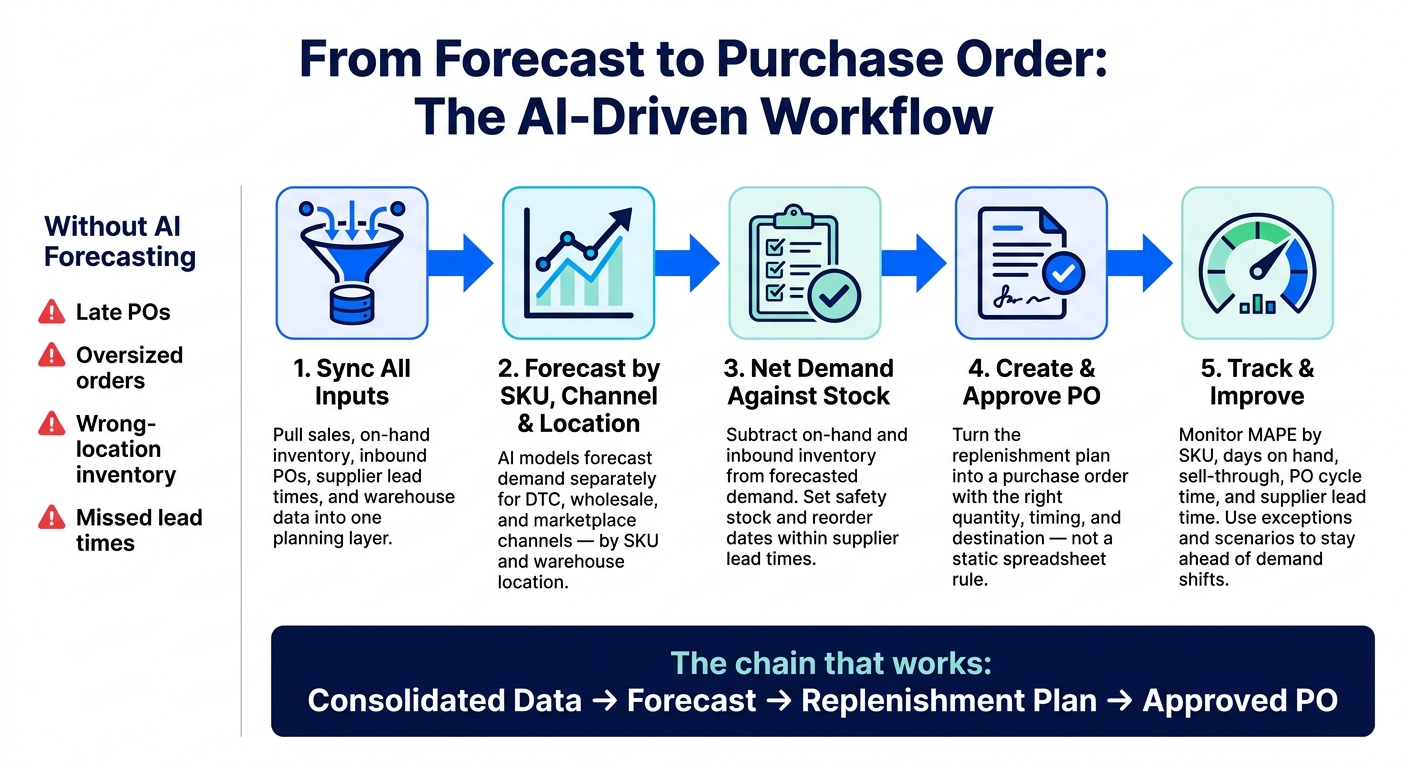
AI Demand Forecasting to Purchase Order: The Connected Workflow
Consolidate Sales, Inventory, Supplier, and Warehouse Data First
A forecast is only as good as the data feeding it. Before you generate a purchase order, your planning system needs a clean view of four things: what’s selling, what’s in stock, what’s already inbound, and how long suppliers need to deliver.
For most brands, that information sits in different tools. Sales may live in one system, inventory in another, inbound POs somewhere else, and warehouse capacity in yet another place. Pulling it all together by hand eats up time and increases PO mistakes. And those mistakes often show up in the worst ways: orders arriving late or landing in the wrong size.
Once those inputs are synced, the next move isn’t PO creation. It’s replenishment planning.
Build Replenishment Plans Before Generating Purchase Orders
If you want to avoid late or oversized POs, don’t jump straight from forecast to order. Start by turning the forecast into a replenishment plan.
That usually means:
- building a demand plan by week or month
- splitting demand by warehouse
- netting out on-hand and inbound stock
- setting safety stock
- generating the PO inside supplier lead times
That flow - forecast → replenishment plan → approved PO - is the point where a forecast turns into day-to-day execution. Skip that step, and the PO is based on the forecast alone, without factoring in inventory that’s already on the way.
Use Forstock to Connect Forecasts, Replenishment, and PO Execution
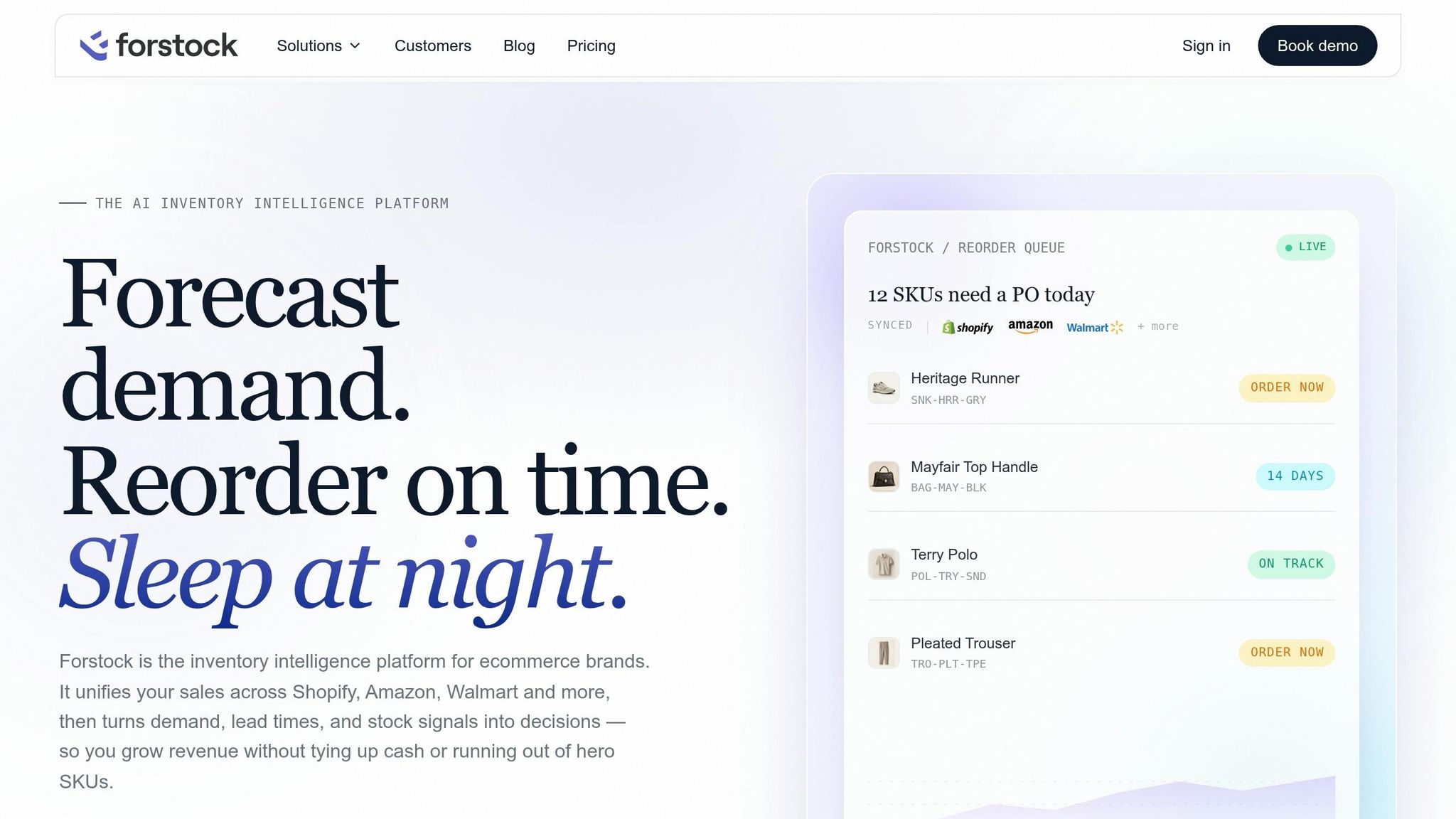
Forstock brings Shopify, wholesale orders, inventory, supplier data, warehouses, fulfillment, accounting, and ERP data into one planning layer. It forecasts demand by SKU and channel, builds replenishment and allocation plans, and generates purchase orders after approval.
For teams that want plain-English answers instead of manual reporting, Forstock’s conversational interface answers questions about forecasts, stockouts, purchasing, and demand shifts.
That same setup also makes forecast and inventory performance easier to measure.
Measure Results and Refine the Purchase Order Process Over Time
Track Forecast, Inventory, and Procurement Metrics Together
Once forecasts feed replenishment plans and POs, the next step is simple: check if the process is doing its job.
That means tracking forecast accuracy, stockouts, inventory coverage, sell-through, PO cycle time, supplier lead time, and inventory value together. Looking at these signals side by side helps teams figure out why a PO missed the mark. Was the forecast off? Did the team assume the wrong lead time? Did the supplier ship late? Those are three separate issues, and each one calls for a different fix.
Forstock tracks MAPE by SKU, channel, and period, along with inventory value and days on hand, so teams can catch repeat misses before they start warping purchase orders. Those signals show whether the team should change timing, quantity, or both.
Use Exceptions and Scenarios to Stay Ahead of Demand Changes
Metrics tell you where the plan failed. Exceptions and scenarios help you decide what to do next.
A promotion, a rush wholesale order, or a supplier delay can throw off a replenishment plan fast. Anomaly detection flags unusual demand patterns as they start to show up. Forstock’s scenario planning models promotions, launches, and supplier delays, and its conversational interface lets planners ask plain-English questions - such as what happens to inventory coverage if a supplier order arrives two weeks late - without building a new spreadsheet model.
That matters because teams don’t have to wait until the damage is done. They can adjust reorder timing or quantity earlier, before a demand shift or lead-time problem turns into a stockout or an overbuy.
Conclusion: Better Forecasts Lead to Better Purchase Orders
When teams track the right signals and act fast, forecasts turn into better purchase orders.
Weak forecasts don’t just create bad numbers on a screen. They lead to late deliveries, oversized orders, tied-up cash, and stockouts that hit revenue. AI forecasting gives teams a clear, SKU-level view of expected demand across each channel and location. From there, that demand flows into order timing and quantities based on what’s likely coming next.
The chain matters: consolidated data, forecast, replenishment plan, approved PO. When those steps stay connected, purchasing stays aligned with demand. Forstock ties each step together in one system, helping teams move from spreadsheet-driven fire drills to faster, more accurate purchase-order execution. Better forecasts lead to better-timed, better-sized purchase orders.
FAQs
How does AI forecasting improve PO timing?
AI forecasting helps teams place purchase orders at the right time by swapping static, manual reorder points for data-driven guidance.
Instead of leaning on fixed lead time estimates, Forstock looks at actual supplier performance, common delays, and seasonal shifts to estimate when each SKU is likely to run out.
Because it keeps sales and inventory data in sync, it can spot the latest point to reorder before stock gets too low. That helps reduce stockouts and cuts down on over-ordering at the same time.
It also automates reorder point and safety stock calculations.
What data do I need for better purchase orders?
For better purchase orders, pull your data into one place instead of leaning on scattered spreadsheets. Clean it up first, then work from at least 24 months of sales history. Leave out returns, cancellations, and any periods when items were out of stock, since those can skew the picture.
You also need your actual supplier lead times, not rough guesses. That means production, transit, customs, and 3PL processing. On top of that, bring in forward-looking inputs like promotions, marketing plans, seasonal patterns, and real-time inventory levels.
When you put all of that together, your purchase orders are based on what’s actually happening across the business, not bits and pieces from different files.
How can I forecast demand by SKU, channel, and warehouse?
Bring sales and inventory data into one place across every channel and warehouse. Then look at 6 to 12 months of history for each SKU-location pair to find demand patterns, seasonality, and sales velocity.
Forstock does this for you. It reviews live sales, supplier lead times, and inventory levels to build SKU-level forecasts and location-specific reorder points. That helps cut down on stockouts and excess inventory at the same time.
Keep reading
Try Forstock free for 14 days.
AI-powered demand forecasting and reorder automation for Shopify brands. No credit card required.