
How to Reduce Dead Stock Without Heavy Discounts
Clear slow-moving inventory without steep markdowns using early detection, strategic bundles, upsells, repackaging, targeted promos and AI forecasting.

How to Reduce Dead Stock Without Heavy Discounts
Dead stock - unsold inventory sitting in storage - can drain profits, clutter warehouses, and tie up capital. While heavy discounts may seem like the easiest solution, they can harm your brand and condition customers to expect sales. Instead, you can manage and clear dead stock effectively with these tactics:
- Identify Dead Stock Early: Use inventory metrics like turnover ratio, sell-through rate, and days of inventory on hand (DOH) to spot slow-moving products before they become a problem.
- Bundle Products: Pair unsold items with popular ones to add value without steep markdowns. Mystery bundles and tiered discounts can also help move inventory.
- Upsell and Cross-Sell: Suggest dead stock alongside bestsellers during checkout or in post-purchase emails to increase sales.
- Targeted Promotions: Offer exclusive member discounts, flash sales, or "last-chance" messaging to create urgency without devaluing your products.
- Reposition Inventory: Refresh packaging, rename products, or market items as "limited edition" to renew interest without significant price cuts.
- Leverage Tools Like Forstock: Use AI-powered forecasting and real-time inventory management to prevent overstocking and streamline purchasing.
Clear Out Dead Stock Without Damaging Your Brand
sbb-itb-f0fc809
Finding Dead Stock with Inventory Analytics
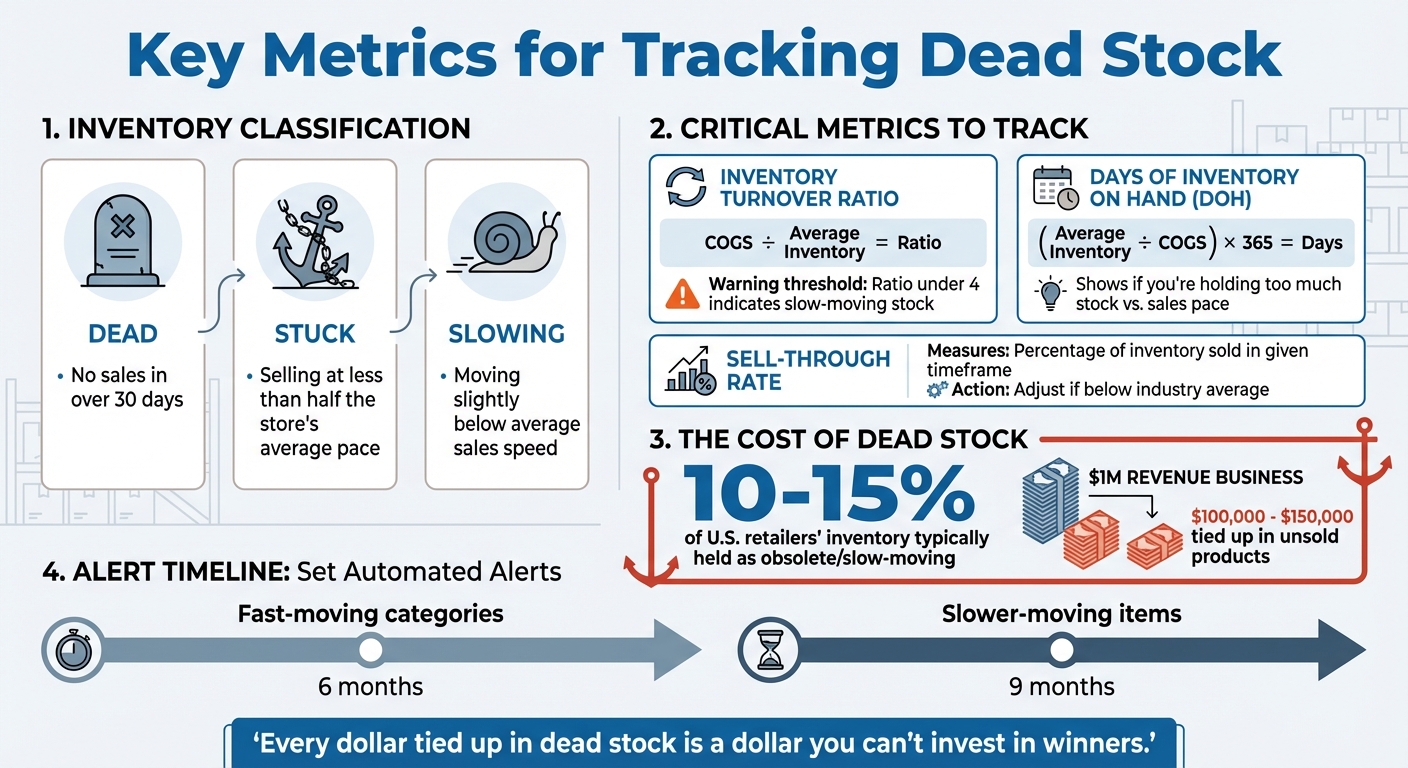
Key Metrics for Tracking and Managing Dead Stock Inventory
What Dead Stock Is and Why It Builds Up
Dead stock refers to inventory that remains unsold for a set period - typically 12 months for general retail. However, in fast-paced e-commerce, items may be labeled as dead stock in as little as 30 days. The timeframe depends on the product type and sales cycle. For instance, a trendy fashion piece might be considered dead stock after three months, while niche equipment may need a longer evaluation period before being written off.
Several factors contribute to dead stock. Ordering mistakes, such as confusing SKU numbers or overordering (e.g., 1,000 units instead of 100), are common culprits. Relying on guesswork rather than data often leads to overstock. Additionally, introducing a new product can sometimes overshadow existing inventory. Other issues like quality defects, poor packaging, or seasonal demand shifts can turn otherwise sellable items into dead stock.
"Dead stock makes it difficult to analyze inventory turnover rates and sales forecasting, which hinders strategic planning." – Shopify Staff
The cost of dead stock extends beyond its purchase price. It takes up warehouse space, requires labor for handling, and ties up capital that could be used to stock better-performing products. These hidden costs make addressing dead stock a priority.
Analyzing sales data early can help identify these problems, allowing for timely corrections.
Using Sales Data to Find Slow-Moving Products
Spotting dead stock starts with comparing actual sales trends to predicted demand and existing inventory levels. Look at sales data from the past 90 to 180 days. For example, if a product's monthly sales drop from 50 units to just 5, it could be heading toward dead stock territory.
To prioritize action, classify inventory into three categories:
- Dead: Items with no sales in over 30 days.
- Stuck: Products selling at less than half the store's average pace.
- Slowing: Inventory moving slightly below average sales speed.
Using EDI reports, like the 852 for sales and 846 for stock levels, can provide real-time insights into trends, helping you address potential issues before products become obsolete.
"Manual tracking fails with large inventories." – Clear Stock
Tracking these patterns with key metrics ensures a more strategic approach to inventory management.
Key Metrics for Tracking Dead Stock
Three metrics are particularly useful for managing dead stock:
- Inventory Turnover Ratio: This is calculated by dividing the cost of goods sold (COGS) by the average inventory. A ratio under 4 indicates slow-moving stock.
- Days of Inventory on Hand (DOH): Divide average inventory by COGS, then multiply by 365. This metric reveals whether you're holding too much stock compared to your sales pace.
- Sell-Through Rate: This measures the percentage of inventory sold during a given timeframe. If your rate is below the industry average, it may be time to adjust. Additionally, tracking your inventory runway - how many days of stock remain based on current sales velocity - helps predict which items are at risk of becoming dead stock.
"Every dollar tied up in dead stock is a dollar you can't invest in winners." – Clear Stock
To prevent dead stock from piling up, set automated alerts for SKUs that have been sitting for six months (for fast-moving categories) or nine months (for slower-moving items). Regularly monitoring sales velocity allows for minor course corrections, reducing the need for drastic markdowns.
Methods to Move Dead Stock Without Heavy Discounts
Once you've pinpointed slow-moving inventory, the challenge is to move it without slashing prices to the point where your brand or profits take a hit. The secret lies in shifting the focus from "clearance" to "value." Instead of deep markdowns, try strategies that make these products more appealing while safeguarding your margins. These approaches can easily align with data-driven inventory management for a smarter overall plan.
Bundling Products to Add Value
Pairing dead stock with popular items is a smart way to make slow sellers more appealing. This tactic, often called strategic bundling, uses a high-demand product to draw attention while the dead stock serves as an added benefit to the deal. For instance, if you have unsold toner sitting in your warehouse, bundle it with a best-selling cleanser and a matching moisturizer. Highlight the original combined value (e.g., $74) and the discounted bundle price (e.g., $59.20) to emphasize the savings.
To avoid looking desperate, keep a mix of about 40% clearance items and 60% best-sellers in your bundles. Bundling can boost average order value (AOV) by 20–35%, as customers often prefer bundles. The sweet spot for bundle discounts is usually 10–25% - enough to entice buyers without making them question the quality of the products.
"By presenting your slow stock as a 'solution' rather than 'clearance,' you elevate the customer experience." – Fulfillment Express
Pre-made bundles also reduce decision fatigue, increasing the likelihood of a purchase. For low-cost items, try mystery bundles or "grab bags", where the surprise factor can help move inventory quickly. Another option is tiered bundling, where discounts grow as customers add more items to their cart (e.g., "Buy 2, save 10%; Buy 3, save 15%").
Using Upsells and Cross-Sells
Suggesting dead stock alongside related products during the shopping process can be an effective way to drive sales without steep discounts. The Hero + Stagnant Combo strategy pairs a popular bestseller with a slow-moving product, making the latter more appealing at checkout.
Post-purchase upselling is another opportunity. After a customer completes a purchase, follow up via email or SMS to recommend related dead stock items. This approach leverages the customer's buying momentum and keeps them engaged. While bundling combines products into a single offer, cross-selling presents related items individually, giving customers more flexibility.
These strategies, combined with targeted promotions, can help clear inventory without eroding your margins.
Running Targeted Promotions with Small Discounts
Introduce tiered discounts like "10% off one, 20% off two, and 30% off three" to encourage bulk purchases while keeping markdowns manageable. Exclusive member sales are another option, offering private discounts to loyal customers or subscribers without impacting your broader pricing strategy. Additionally, time-sensitive markdowns, such as flash sales or countdown timers, can create urgency when promoted through mobile apps or SMS.
"Last-chance" messaging taps into FOMO (fear of missing out) by marketing inventory as "final stock" or "limited quantity left". Instead of lowering prices further, you can also offer perks like free shipping on orders over a certain amount, which adds value while maintaining price integrity.
| Promotion Type | Best For | Impact on Margin |
|---|---|---|
| Tiered Discounts | Moving high volumes of units | Moderate; protected by higher AOV |
| Exclusive Member Sales | Protecting brand equity | Low; targets only a subset of users |
| Flash Sales | Quick cash flow and clearing seasonal stock | Moderate; offset by high volume |
| BOGO (Slow Mover as Gift) | Clearing "dead" stock entirely | High; moves stock that has zero turnover |
Always display the original price alongside the discounted one to highlight the value. Segment your email list to target past buyers with related items, and time promotions around peak shopping seasons like back-to-school or the holidays to maximize visibility.
"Discounting isn't just cutting prices; it's cutting into your profit margins and brand value." – Foxsell
Repurposing and Repositioning Unsold Inventory
Sometimes, all it takes to spark interest in unsold inventory is a fresh perspective. By repurposing products or repositioning how they're presented, you can breathe new life into stagnant stock without resorting to steep discounts. These strategies not only help move inventory but also protect your profit margins and free up cash tied in inventory.
Turning Dead Stock into New Products
Why sell slow-moving items individually when you can create something entirely new? For instance, you could bundle unsold products into themed kits that solve specific problems. Got extra office supplies? Package them into a "Home Office Starter Kit." Leftover camping gear? Turn it into a "Weekend Camping Bundle." This approach creates new SKUs and enhances the perceived value of your products.
Another idea is to collaborate with complementary businesses. Co-branded partnerships allow you to reintroduce your inventory to a fresh audience. Whether it's a joint product or offering your unsold items as a gift with purchase, this strategy can be a win-win. Start small to test customer reactions before scaling up.
For lower-cost items, consider creating surprise boxes. These tap into the excitement of mystery and discovery, making them a fun way to clear out inventory while engaging your customers.
If bundling or partnerships aren’t your style, a simple update in how the product is presented can also work wonders.
Updating Packaging or Branding
Sometimes, a visual or branding refresh is all it takes to make old stock feel new again. Start by renaming products with benefit-driven titles. For example, instead of "3-Piece Skincare Set", try something like "Glow-Boosting Essentials" or "Radiant Skin Duo." These tweaks can instantly increase perceived value.
Updated product photos can also make a big impact. Swap out generic stock images for lifestyle shots that show the product in action. This helps customers visualize how the item fits into their lives.
You can also create urgency by reframing slow movers as "Limited Edition" or "Last Chance" items. Seasonal stock can be cleverly repositioned too - think red products for Valentine's Day or green items for St. Patrick's Day.
Refreshing product descriptions to highlight overlooked features or use cases can make a big difference, especially for repeat customers who might not have noticed those details before. And don’t underestimate the power of repositioning products on your website. Moving items to different sections or creating new landing pages can help overcome "banner blindness" and put your products back in the spotlight.
Finally, small pricing tweaks can also make a difference. Odd pricing (like $49 instead of $50) or offering free shipping instead of a discount can make your inventory feel like a smart, high-value purchase rather than clearance stock.
Using Forstock to Prevent and Handle Dead Stock
While strategies like bundling and targeted promotions can help clear out dead stock, the smarter move is to stop it from building up in the first place. That’s where Forstock steps in. With tools like real-time inventory management and AI-powered forecasting, Forstock helps you avoid excess inventory before it becomes a problem.
How Forstock Enhances Inventory Management
Forstock provides a centralized dashboard that gives you a clear view of your inventory’s health, inventory turnover metrics, and total stock value across your Shopify catalog. Instead of combing through spreadsheets to identify slow-moving items, you can instantly see what’s selling and what’s not - all in real time.
Each SKU is tagged with straightforward labels like "Overstocked", "Running Low", or "Stock Gap", making it easy to spot potential issues before they escalate into dead stock. Emily, an Inventory Manager, shares her experience:
"I open the dashboard in the morning and instantly know what needs reordering, what is overstocked, and what to focus on".
This kind of visibility can drive quick action. For example, Matt, Operations Lead at TechGear, used Forstock’s inventory table to pinpoint over $70,000 in slow-moving stock within the first week of using the platform. With this information, businesses can make better decisions - whether that’s bundling items, running targeted promotions, or adjusting future orders.
AI-Powered Forecasting for Smarter Purchasing Decisions
Dead stock often stems from over-ordering based on guesswork. Forstock eliminates that uncertainty with AI-driven forecasting. By analyzing Shopify data - like seasonal trends, growth patterns, and sales history - the platform predicts demand with precision. For every SKU, it calculates daily sales velocity and depletion dates, so you always know how much to order and when.
Sophie, an E-commerce Manager, explains how this has changed her approach:
"The AI forecast actually makes sense for my business. It feels like having a supply chain manager on my team".
Forstock also generates 12-month demand plans tailored to your business, helping you avoid overstock situations. Jason, Co-founder at HomeGoods, shared an impressive result: his company cut excess inventory by 45% and freed up $150,000 in working capital using Forstock’s insights. By ordering the right amount at the right time, you not only protect your cash flow but also avoid the need for steep discounts later. This precise forecasting also paves the way for automated replenishment.
Automated Purchase Orders and Supplier Management
Forstock takes it a step further by automating purchase order creation. Forecasts are translated into one-click POs, which you can split, track, and send directly to suppliers - all from the dashboard. The system even calculates total landed costs, including shipping and customs.
Alexander, E-commerce Manager at PureOrganics, highlights the convenience:
"The automated PO creation saves us 10+ hours weekly. Setup took only 2 minutes".
Forstock also centralizes supplier communication and tracks performance, ensuring your purchase cycles align with actual sales velocity instead of outdated assumptions. Daniel, a Supply Chain Manager, describes the impact:
"We can create POs in minutes, track supplier performance, and forecast demand without the guesswork. It is the first tool that actually bridges inventory management and purchasing instead of forcing us to hack things together".
Conclusion and Key Takeaways
Dead stock doesn’t have to mean slashing prices and hurting your margins. By using strategies like bundling slow-moving items with bestsellers, you can increase perceived value. Limited-time promotions can also create urgency without resorting to steep discounts. Additionally, repurposing unsold inventory can help boost average order value and attract new customers - all without heavily impacting your core profit margins.
Timing is everything when it comes to slow-moving products. Catching them early allows for smaller adjustments, like a 10% discount or strategic bundling, to prevent them from turning into dead stock. Otherwise, you might face aggressive markdowns of 30–50% to clear inventory. Consider this: U.S. retailers typically hold 10–15% of their inventory as obsolete or slow-moving stock. For a business generating $1 million in revenue, that’s $100,000 to $150,000 tied up in unsold products.
Proactive inventory management is the real game-changer here. Tools like AI-powered forecasting can help you avoid overordering by analyzing sales patterns, seasonality, and lead times. Forstock’s AI tools, for example, ensure you order the right quantities, protecting both your cash flow and your warehouse storage.
By combining these strategies with automated inventory systems, you can turn dead stock from a crisis into a manageable part of your supply chain. This approach not only reduces the constant stress of managing excess inventory but also frees up time to focus on growing your business - all while keeping your margins and brand reputation intact.
"Discounting old stock is a short-term fix. Bundling is a long-term growth strategy." – FoxSell
FAQs
When should I label an item as dead stock?
An item qualifies as dead stock when it sits unsold for an extended period and shows little to no chance of selling. This can happen for several reasons, like seasonal demand, ordering too much inventory, or changes in customer preferences. Conducting regular inventory checks is key to spotting these items - particularly if they’ve gone unsold for an entire season or more, based on your product cycle. Addressing dead stock promptly helps avoid tying up resources in products that no longer bring in revenue.
What bundle discount works without hurting my brand?
When creating a bundle discount, the goal is to drive higher purchase volumes without sacrificing profit margins or the perceived value of your products. For instance, offering a deal like "buy 3 for $20" is often more effective than applying large markdowns. Pairing moderate discounts with value-driven promotions - such as loyalty rewards or free gifts - can also encourage sales while maintaining your brand's image. The key is to align the discount with your product margins and what your customers expect for maximum impact.
How can Forstock help prevent dead stock?
Forstock uses AI-driven demand forecasting to tackle the issue of dead stock. By accurately identifying slow-moving items, it helps businesses make smarter purchasing decisions and adjust inventory levels effectively. The platform flags potential dead stock at the SKU level, allowing companies to take proactive steps before issues arise.
Additionally, Forstock automates purchase orders and redistributes inventory based on real-time sales data. This approach helps optimize stock levels, cutting dead stock rates from 8–12% down to just 2–4%. The result? Better protection of profit margins and improved cash flow management.
Keep reading
Try Forstock free for 14 days.
AI-powered demand forecasting and reorder automation for Shopify brands. No credit card required.