
Demand Forecasting for Seasonal Products: Ultimate Guide
Forecast seasonal product demand using historical sales, external factors, lead-time planning, safety stock, and AI tools to reduce stockouts and overstock.
Demand Forecasting for Seasonal Products: Ultimate Guide
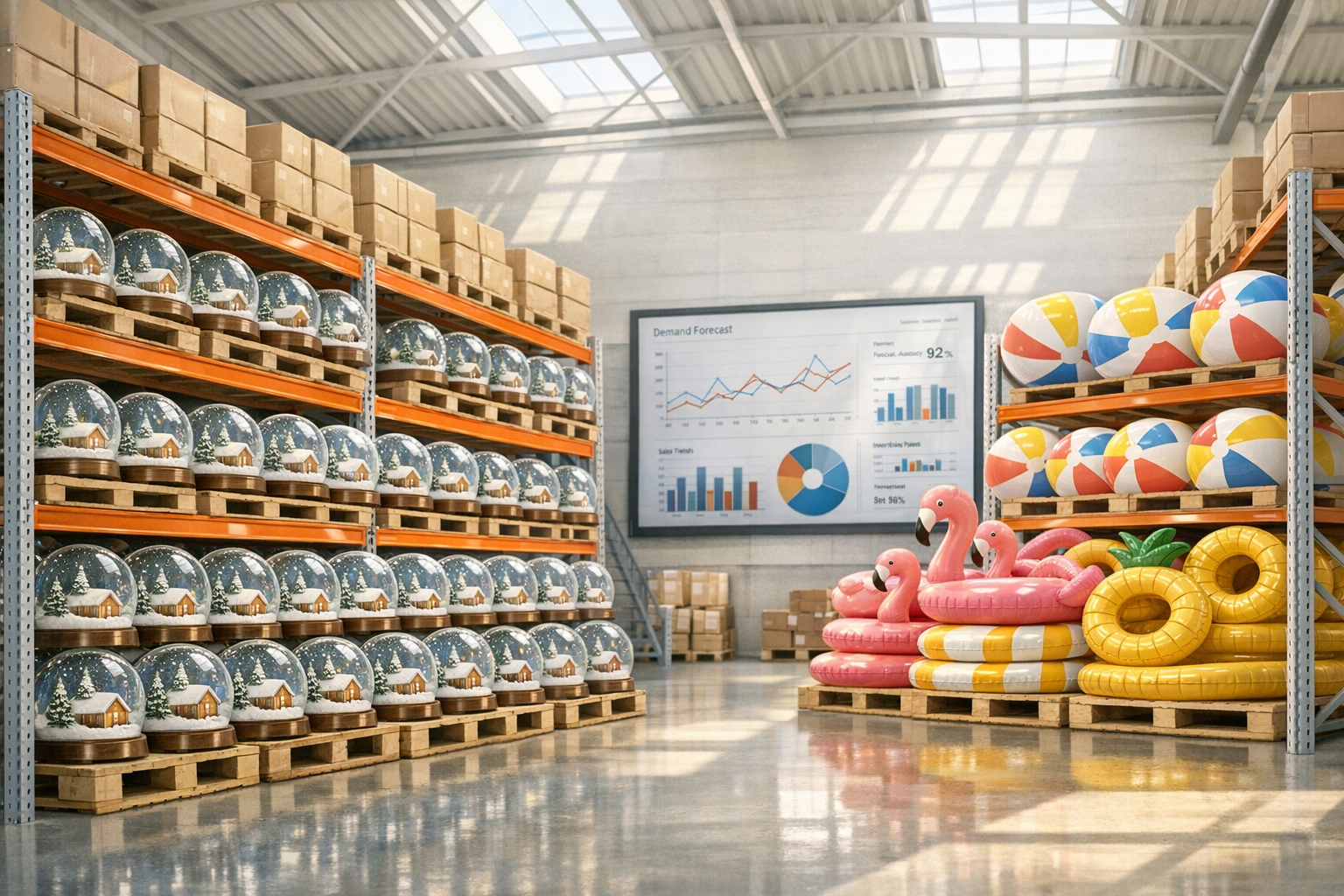
Seasonal demand forecasting is all about predicting the right inventory levels for products that experience demand spikes during specific times of the year. Misjudging demand can lead to costly stockouts or excess inventory. This guide explains how businesses, especially Shopify brands, can use demand forecasting to ensure they’re prepared for peak seasons like Christmas or Black Friday.
Key Takeaways:
- Seasonal products, like winter coats or holiday gifts, require precise planning to avoid stock shortages or overstocking.
- Accurate forecasting helps businesses plan inventory, streamline supply chains, and improve operations.
- Methods like Holt-Winters and AI tools make forecasting more reliable by analyzing historical sales data and external factors like weather or viral trends.
Steps to Build a Seasonal Forecast:
- Set clear goals (e.g., increase sales by a specific percentage).
- Analyze historical data to identify demand patterns.
- Adjust for external factors like weather, economic shifts, or marketing events.
- Plan lead times and safety stock to avoid delays or shortages.
- Use AI-powered tools to refine predictions and automate processes.
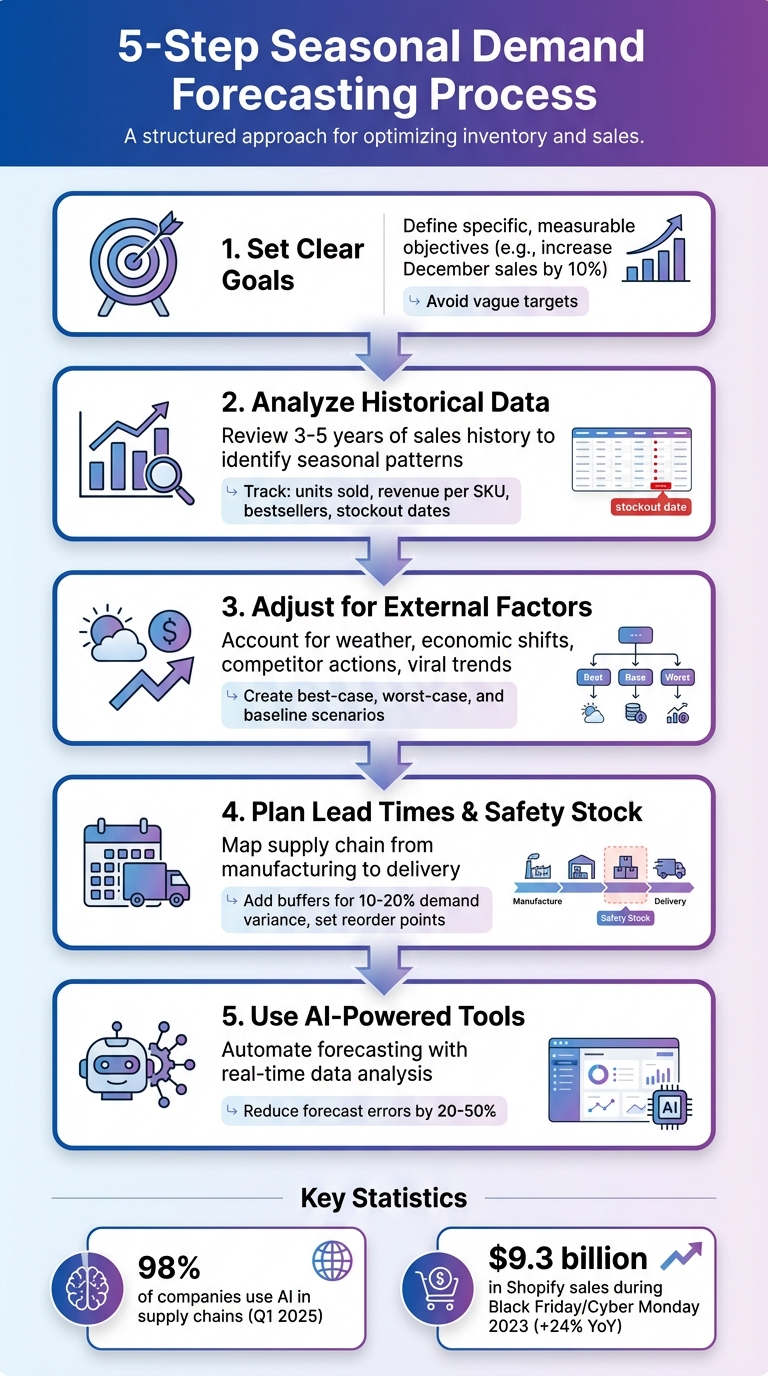
5-Step Seasonal Demand Forecasting Process for E-commerce Businesses
Seasonal Variations in Demand: Step by Step guide how to create a Forecasting Model
Modern retailers often use AI inventory forecasting to automate these models and maintain accuracy across high-volume catalogs.
Understanding Seasonal Demand Patterns
Seasonal demand isn’t a one-size-fits-all concept. While these patterns repeat annually, their timing, intensity, and triggers can vary widely across industries and products.
Understanding these differences can help you sidestep two major issues: ordering inventory too early and tying up cash in stock that doesn’t move, or ordering too late and missing out on sales. The solution lies in identifying the specific drivers of demand in your niche and mapping out those cycles using historical sales data. This groundwork enables more precise forecasting and smarter inventory planning across multiple warehouses.
Identifying Seasonal Products and Cycles
The first step is pinpointing which products in your lineup are seasonal. For example:
- Weather-dependent items: Products like sunscreen or winter coats follow temperature changes.
- Event-related goods: Back-to-school supplies or wedding accessories align with school calendars or social events.
- Holiday-specific products: Items such as Valentine’s Day gifts or Easter eggs see spikes around specific celebrations.
Once you’ve categorized your products, it’s time to map their demand cycles. Using time series analysis, examine past weekly, monthly, or quarterly sales data to uncover recurring trends. For instance, party supplies might see a surge in May (graduation season) and October (Halloween). Knowing this can guide you on when to place wholesale orders and adjust staffing levels.
It’s also essential to document one-time events that cause unusual sales spikes or dips to avoid mistaking these for regular patterns. Take Black Friday and Cyber Monday as an example: in 2023, Shopify merchants hit $9.3 billion in sales during that weekend, marking a 24% increase from the previous year. These predictable events are perfect for proactive planning.
Factors That Influence Seasonal Demand
Identifying cycles is just the beginning - you also need to understand what drives them. Several factors shape seasonal demand, and overlooking these can lead to costly missteps.
- Holidays and major shopping events: Christmas, Black Friday, and similar events create substantial demand surges.
- Weather conditions: Products like umbrellas, ski gear, or air conditioners experience demand shifts based on weather forecasts. For instance, a predicted heatwave in a specific region should prompt inventory adjustments.
- Cultural and life events: Wedding seasons, music festivals, and back-to-school shopping are reliable demand drivers.
- Economic factors: Inflation and interest rates can disrupt traditional patterns, while viral trends on platforms like TikTok may cause sudden, unexpected spikes.
A great example of navigating seasonal demand comes from Qantas Airways. In 2021, they faced fluctuating maintenance needs across 70 global locations. By adopting demand forecasting, they achieved 94% parts availability while freeing up millions of dollars in excess inventory.
| Seasonal Category | Example Products | Primary Influence |
|---|---|---|
| Weather Dependent | Sunscreen, umbrellas, winter coats | Temperature and precipitation |
| Event Related | Back-to-school supplies, wedding accessories | Academic calendars, social seasons |
| Holiday Specific | Christmas decor, Valentine’s gifts, Easter eggs | Cultural and religious celebrations |
| Annual Campaigns | Electronics, home goods (during BFCM) | Scheduled retail discount events |
Demand Forecasting Methods for Seasonal Products
When it comes to forecasting demand for seasonal products, the method you choose depends on how intricate your seasonal patterns are and the quality of your historical data. The ultimate goal is to strike a balance between inventory levels and fluctuating seasonal demand. Quantitative methods rely on historical sales data and analytical models, while qualitative approaches draw from market research and expert opinions. A hybrid approach, blending data-driven insights with market expertise, can help you navigate unexpected changes.
Quantitative Forecasting Techniques
Quantitative methods use historical data - such as sales figures and revenue trends - to predict future demand. These techniques work best when you have at least 24 to 36 months of data that captures two or three complete seasonal cycles.
One of the most practical tools for forecasting seasonal demand is Holt-Winters Exponential Smoothing. This method incorporates three key elements: the current demand level, trends, and seasonality. It’s particularly well-suited for businesses with predictable seasonal patterns. Supply chain expert Gijo Kochuparambil John emphasizes its practicality:
"For highly seasonal supply chains with stable, repeating patterns, Holt-Winters is one of the best practical choices. It's powerful without being overly complex".
For more intricate seasonal trends, SARIMA (Seasonal Autoregressive Integrated Moving Average) offers advanced modeling capabilities. However, it requires a higher level of expertise to implement effectively. Other helpful tools include seasonal indices, which adjust forecasts by applying multipliers for specific time periods (e.g., higher summer sales for ice cream), and regression analysis, which identifies how external factors like weather influence demand (e.g., higher beverage sales during heatwaves).
A real-world example of effective forecasting comes from the Ubique Group. Between 2020 and 2024, they managed over 4,000 products and 100,000 SKUs in their furniture and décor business. By switching from manual Excel-based forecasting to an AI-powered system integrated with Salesforce ERP, they improved their fill rate by 15% and reduced operating inventory by $10 million.
| Method | Handles Seasonality? | Complexity | Best Use Case |
|---|---|---|---|
| Moving Average | Weak | Low | Stable products with mild cycles |
| Holt-Winters | Strong | Medium | Retail or fashion with regular cycles |
| SARIMA | Strong | High | Complex, layered seasonality (e.g., airlines) |
| Causal/AI Models | Very Strong | Very High | Volatile markets driven by trends/weather |
When historical data is scarce or markets are unpredictable, qualitative methods can fill in the gaps.
Qualitative Forecasting Techniques
Qualitative methods are especially useful for situations where historical data is limited or unavailable, such as launching a new product or entering a new market. These approaches bring in real-world insights and flexibility to capture shifts that numbers alone might miss.
Market research and customer surveys offer direct insights into consumer preferences and buying intentions. The Delphi Method, which gathers input from experts through anonymous questionnaires, helps identify emerging trends. Similarly, the sales force composite method collects feedback from sales representatives who have firsthand knowledge of customer behavior. Social media analysis has also become a powerful tool, with more than 50% of consumers reporting that they’ve purchased an item after seeing it promoted by an influencer.
Take Caraway, for example, a direct-to-consumer cookware brand. During 2020, they saw a 51% year-over-year surge in demand for home goods. By automating their forecasting process and replacing manual methods, they developed a backorder model that accurately projected inventory needs. This allowed them to sustain sales even when certain items were temporarily out of stock.
By combining quantitative and qualitative techniques, businesses can build a flexible, data-informed forecasting strategy that adjusts to market dynamics. As Bani Kaur from Prediko puts it:
"The best approach, however, is a combination of both, data analysis backed by market research and expert opinions".
How to Build Seasonal Forecasts: Step-by-Step
Creating a seasonal forecast involves setting clear objectives, collecting the right data, and accounting for real-world variables. Here's how to approach it effectively.
Setting Goals and Gathering Data
Start with specific, measurable goals. For instance, instead of a vague target like "boost holiday sales", aim for something like "increase December holiday sales by 10% compared to last year".
Next, gather the data you need. Analyze 3–5 years of sales history to spot seasonal trends, such as peak shopping periods and year-over-year changes. Pay special attention to inventory metrics, including stockout dates, current stock levels, and which items consistently perform well. Segment your customers to identify who shops most during specific seasons, their spending habits, and their responses to early sales promotions.
Don't overlook supply chain data. Track supplier lead times, shipping durations, and potential bottlenecks in fulfillment. For external insights, monitor competitor sales events, industry growth rates, and wholesale contracts for the coming year. If you're forecasting for a new product without historical data, use tools like customer surveys, expert opinions (via methods like the Delphi method), or input from your sales team.
Here's a quick breakdown of the key data to collect:
| Data Category | Specific Metrics to Collect | Purpose |
|---|---|---|
| Internal Sales | Units sold, revenue per SKU, bestsellers | Spot recurring sales patterns |
| Inventory | Stockout dates, current stock, safety stock | Avoid lost sales and overstocking |
| Customer | Segment spend, purchase frequency | Target high-value seasonal shoppers |
| Supply Chain | Lead times, shipping durations, landed costs | Ensure timely inventory delivery |
| External | Competitor pricing, weather trends | Adjust for external influences |
This comprehensive data collection sets the stage for fine-tuning your forecast as new information becomes available.
Adjusting for External Factors
Seasonal forecasts must account for external influences like weather, economic shifts, competitor actions, and regulatory changes. For example, unseasonably warm winters can lower demand for cold-weather gear, while unexpected rain might drive up umbrella sales. During economic downturns, you might focus on stocking more affordable options, while in periods of growth, premium products could take priority. Competitor promotions or new product launches can also impact demand. Regulatory changes, such as new tariffs, can disrupt supply chains and affect product availability.
Another factor to consider is the impact of viral trends, especially those driven by platforms like TikTok. These can create sudden spikes in demand for specific items, requiring quick adjustments to your forecast.
Make sure your forecast aligns with planned marketing efforts. Promotions and ad campaigns can artificially inflate demand, so factor these into your projections. To prepare for uncertainty, create multiple forecast scenarios - best-case, worst-case, and baseline - to understand how different outcomes could affect cash flow and storage needs.
Finally, ensure your inventory arrives when you need it by planning lead times and safety stock effectively.
Planning for Lead Times and Safety Stock
Even the most accurate forecast won't help if your inventory doesn't arrive on time. As Bani Kaur from Prediko puts it:
"A great forecast is not useful if your inventory doesn't arrive on time. Even if you predict a surge in demand, delays in your supply chain can leave you stuck with empty shelves".
Start by mapping your supply chain from manufacturing to delivery, identifying potential bottlenecks along the way. Regularly update supplier lead times, which may fluctuate during busy seasons. Your total lead time should include order processing, manufacturing, transit, and warehouse receiving.
Add buffers to account for external challenges like bad weather or staffing shortages. Share your forecasts with suppliers early to secure production slots and stock ahead of peak demand. It’s also wise to have backup suppliers or alternative shipping routes as contingency plans.
For safety stock, base your calculations on historical peak demand and expected variances. Use scenario planning to prepare for a 10–20% fluctuation in demand, and set reorder points that reflect your total lead time. During major sales events like Black Friday, adjust safety stock levels in real time to avoid shortages.
Here's a step-by-step guide to managing lead times and safety stock:
| Step | Action for Lead Times | Action for Safety Stock |
|---|---|---|
| Data Collection | Track manufacturing and shipping durations | Analyze historical peak sales |
| Adjustment | Add buffers for delays during peak seasons | Plan for 10–20% demand variances |
| Execution | Set reorder points based on total lead time | Maintain minimum stock levels year-round |
| Monitoring | Update lead times mid-season if delays occur | Adjust buffers during key sales events |
With these steps, you'll be well-prepared to meet seasonal demand while minimizing risks like stockouts or overstocking.
sbb-itb-f0fc809
Using AI-Powered Tools for Accurate Forecasting
AI-powered tools have revolutionized forecasting by processing real-time, multi-dimensional data, offering a level of precision that traditional methods can't match. While older models struggle with the complexities of seasonal demand, AI tools excel by analyzing massive datasets and adapting to sudden changes. By Q1 2025, a staggering 98% of companies had incorporated AI into their supply chains to optimize inventory and forecasting. Businesses leveraging AI for demand forecasting have reported error reductions of 20% to 50%, and 25% credit more than 5% of their Earnings Before Interest and Taxes (EBIT) to AI-driven solutions like demand planning.
The key difference lies in how data is handled. Traditional models depend on historical sales data and seasonal trends, often updating only weekly or monthly. In contrast, AI models continuously learn and adapt using both internal data and live external factors, such as weather conditions, social media trends, and competitor pricing [36,38]. This dynamic capability allows forecasts to shift automatically when unexpected events, like viral trends or unusual weather, disrupt consumer behavior.
Let’s dive into the standout features that make these AI tools indispensable.
Features of AI-Powered Forecasting Tools
Modern AI forecasting tools go far beyond basic sales predictions. They provide precise SKU-level, store-specific, and even daily forecasts, rather than broad category estimates [36,38]. One standout feature is anomaly detection, which can flag unexpected trends - like a sudden storm-driven demand surge or a viral product - before they show up in conventional reports. For instance, Target's Inventory Ledger uses AI to generate billions of weekly predictions about product availability.
Other valuable capabilities include what-if scenario planning and automated replenishment. These features not only create more accurate forecasts but also automate the generation of purchase orders [9,40,41]. Tools that can project demand up to 12 months ahead are especially useful for planning seasonal wholesale orders and production cycles.
Real-world examples highlight the transformative power of these tools. Sync Protein, a plant-based nutrition company, transitioned from manual Excel-based forecasting to AI-driven tools, cutting stockouts by 50% and saving 10 hours per week on inventory management. Similarly, PureHealth, a health and wellness Shopify store, implemented an AI-powered stock control system that reduced stockouts by 30%, decreased excess inventory by 18%, and boosted customer satisfaction by 10%.
These advanced features are central to how Forstock redefines seasonal inventory management.
Forstock: Managing Seasonal Inventory
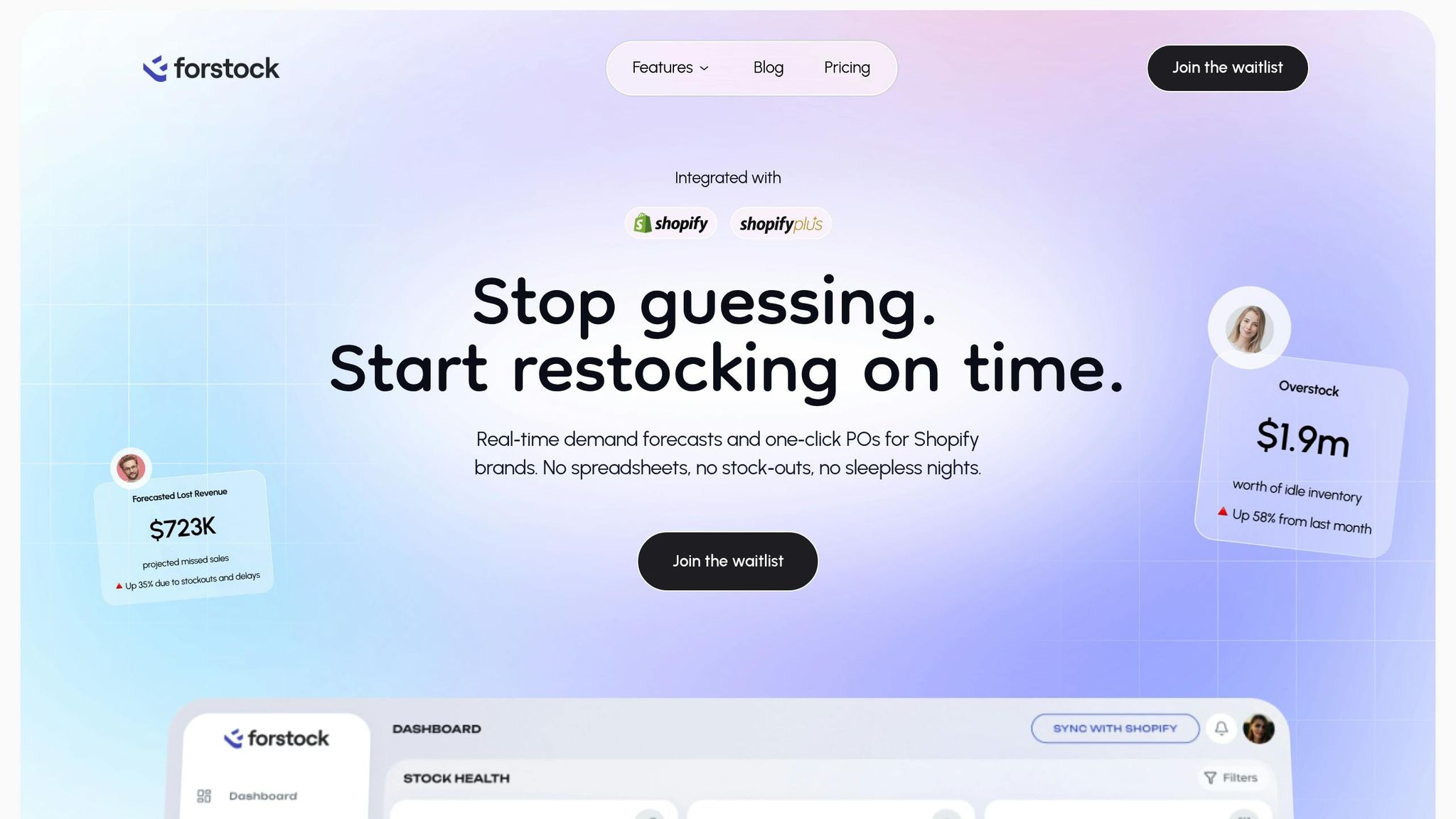
Forstock seamlessly integrates with Shopify, providing a consolidated view of inventory across all locations. By combining real-time demand forecasting with automated purchase order creation, it ensures every purchasing decision is informed by data.
The platform's dashboard tracks essential metrics, including how well your demand plan aligns with actual sales and whether any issues - like faster-than-expected sales or supplier delays - could disrupt your inventory. With 12-month demand planning, Forstock helps you prepare for major seasonal events well in advance. Automated reorder suggestions and safety stock calculations take the guesswork out of replenishment, saving time and reducing errors.
For Shopify brands managing complex product catalogs, Forstock simplifies operations by centralizing supplier communications and automating purchase orders. Whether you're preparing for back-to-school season or holiday shopping, Forstock transforms seasonal forecasting from a tedious guessing game into a streamlined, data-driven strategy.
Best Practices to Reduce Overstock and Stockouts
Managing seasonal inventory is a balancing act, even with accurate forecasts. For many businesses, the difference between turning a profit or taking a loss often hinges on how well they track real-time performance and adapt strategies as conditions evolve. Below are some practical ways to keep inventory levels in check throughout the season.
Segmenting Customers and Tracking Buying Patterns
Understanding when your customers start shopping is key. For instance, while holiday spending typically peaks in December, 59% of back-to-school purchases are completed by July. Similarly, in 2023, most holiday shoppers planned to begin their purchases by October or earlier. If you only focus on peak dates, you risk missing out on earlier demand.
Segment your customers based on their shopping habits. Identify early shoppers who plan ahead versus last-minute buyers who wait until the final days. This segmentation helps fine-tune your inventory strategy, ensuring stock arrives at the right time and in the right quantities. For example, if a significant portion of your customers are early buyers, your inventory should be ready well before the season kicks into high gear.
If you offer subscription-based products, track renewal cycles and align seasonal promotions with these patterns. This approach not only helps stabilize demand but also maximizes revenue while avoiding sudden spikes. Offering early-bird discounts can lock in sales before the peak rush, easing the pressure on fulfillment and logistics during the busiest times.
Monitoring and Adjusting Forecast Accuracy
Comparing forecasts against weekly sales data is crucial for spotting discrepancies quickly. If a product sells faster than expected, you may need to place additional orders. On the flip side, if sales are slower than anticipated, consider markdowns or repositioning the product to avoid excess inventory.
To refine your forecasts, track potential biases by using metrics like Mean Absolute Percent Error (MAPE) or Tracking Signals, which reveal whether your model consistently over- or under-predicts. Standard forecasting tools often overlook the fact that stockouts (lost sales) can cost more than excess inventory. Metrics like the Cost of Forecast Error (CFE) can help prioritize adjustments that have the most financial impact.
Tools like Open to Buy (OTB) planning can compare current inventory and planned sales against actual performance, allowing for automatic adjustments to future orders. A great example is Allbirds, which used Shopify POS to manage inventory across locations in the US, London, and Tokyo. By monitoring real-time demand, they implemented an "endless aisle" strategy, shipping products directly from warehouses to customers when local stock ran out. This approach optimized inventory allocation and boosted conversion rates.
These ongoing adjustments pave the way for incorporating dynamic promotional strategies into your demand planning.
Integrating Promotions and Seasonal Trends
Once your forecasts are fine-tuned, factor in the impact of marketing campaigns and external events. Promotions and trends can significantly shift demand, so it's essential to incorporate input from sales, marketing, and finance teams when planning inventory.
"To obtain the most accurate forecasts you'll want to combine them. Common methods include: blending all available data as inputs of a single forecasting model... or using several models and consider the average of the different results."
– Arthur Pentecoste, Data Scientist and Author of Demand Prediction in Retail
Monitor social sentiment to stay ahead of viral trends that can drive unexpected demand spikes. AI-powered tools are especially useful here, analyzing real-time data from social media, weather forecasts, and competitor pricing to adapt faster than traditional methods. In fact, 88% of retail executives see demand forecasting as a key area for improvement through AI.
Before peak seasons or promotional events, adjust reorder points upward to ensure timely replenishment. Maintain safety stock reserves at around 70% of your maximum busy-season capacity to handle unexpected surges. Use methods like Greasley's formula - multiplying your Z score (e.g., 1.65 for a 95% service level) by the standard deviation in lead time and average demand - to account for supplier variability and demand fluctuations.
For example, the 2024 holiday season had only 27 days between Thanksgiving and Christmas, creating a tighter window for sales and increasing the stakes for accurate forecasting. As Robert Reiter, CEO of DHL Global Forwarding USA, emphasized:
"Peak season came early and will probably last for a couple of months... contingency plans start today"
When external pressures shorten your selling window, integrating promotional timing into your demand planning becomes even more critical.
Conclusion
Seasonal demand forecasting is more than just preparing for holiday rushes - it's a year-round approach that safeguards cash flow, avoids expensive stockouts, and prevents excess inventory from eating into your profits. By accurately predicting demand, you eliminate guesswork, avoid frantic restocking during peak times, and make data-informed decisions that align inventory with actual customer needs.
While the challenges and strategies discussed earlier lay the foundation, advanced forecasting techniques combined with market insights offer a powerful toolkit for managing seasonal products. That said, even the most sophisticated forecasting methods can fall short if you're stuck using manual spreadsheets that lack real-time updates. This is where AI-powered tools become game-changers.
Forstock delivers this level of precision and automation to Shopify brands. It provides real-time demand forecasting, automates purchase orders, and consolidates inventory tracking across multiple locations. By leveraging AI, Forstock adjusts to real-time sales trends, lead times, and seasonal patterns, enabling accurate, automated inventory management. Whether you're handling a small product line or a diverse catalog with multiple variants, Forstock helps you save time, improve cash flow, and meet customer demand - without the costly errors of overstocking or running out of stock.
Industry leaders echo the importance of this approach. Jake Latham from StockIQ emphasizes:
"Seasonal demand forecasting functions as a supplement to regular demand forecasting... when a forecasting model accounts for seasonality, it will adjust its predictions to reflect real-world fluctuations in buying habits".
FAQs
How does AI improve the accuracy of demand forecasting for seasonal products?
AI takes seasonal demand forecasting to a whole new level by diving into real-time and historical sales data, while also factoring in external influences like weather, holidays, and market trends. Through machine learning algorithms, it spots seasonal trends, predicts demand changes, and fine-tunes forecasts automatically.
By removing human bias, AI ensures forecasts stay sharp and adapt as fresh data comes in. This empowers businesses to make smarter, data-backed decisions, minimize stockouts, avoid overstocking, and streamline inventory management - all of which contribute to better profitability.
What’s the difference between quantitative and qualitative forecasting methods?
Quantitative forecasting relies on numbers and statistical models to predict demand. It uses historical sales data, seasonal trends, and measurable variables, applying techniques like time-series analysis, regression, or moving averages. This method is highly objective, consistent, and often automated, making it a perfect fit for tools like Forstock, which uses AI to adjust forecasts in real time.
On the flip side, qualitative forecasting leans on expert opinions and insights instead of hard data. It factors in market trends, seasonal events, and consumer behavior, making it especially valuable when historical data is sparse or when unexpected shifts occur. While this approach offers flexibility, it’s more subjective and less standardized than its quantitative counterpart.
How can businesses adapt their demand forecasts for sudden spikes due to viral trends?
When a product goes viral, demand can skyrocket in ways that go far beyond the usual seasonal trends. To handle these sudden surges, businesses need to treat them as unique situations and rely on real-time forecasting tools to adapt quickly. AI-powered platforms that track live sales, website traffic, and social media buzz can identify demand spikes within hours and automatically update projections.
Here’s how you can stay ahead of the curve:
- Keep an eye out for unusual jumps in site activity or add-to-cart behavior.
- Use short-term demand models to estimate how these trends might play out over the next 2–4 weeks.
- Adjust reorder points while factoring in supplier lead times to ensure your inventory scales appropriately.
Because viral trends can fade as quickly as they appear, it’s a good idea to hold extra inventory at a central warehouse or a fast-moving fulfillment center. For Shopify merchants, tools like Forstock make this process easier by leveraging AI to fine-tune forecasts, automate purchase orders, and help you meet demand without overstocking or tying up unnecessary funds.
Keep reading
Try Forstock free for 14 days.
AI-powered demand forecasting and reorder automation for Shopify brands. No credit card required.