
Custom AI vs. Generic Forecasting for Shopify
Custom AI offers greater accuracy and scalability for growing Shopify stores, while generic forecasting works for small, predictable catalogs.

Custom AI vs. Generic Forecasting for Shopify
Managing inventory is one of the biggest challenges for Shopify merchants. Stock too much, and you lose money on storage and unsold products. Stock too little, and you risk losing customers and sales. While generic forecasting tools like Shopify’s Stocky offer quick and affordable solutions for small businesses, they often fall short as operations scale. Custom AI forecasting models, on the other hand, provide precision by analyzing your store’s unique data, but they require more time and investment upfront.
Here’s the key takeaway:
- Generic tools are great for small stores with fewer than 50 SKUs and predictable demand.
- Custom AI models are ideal for growing stores with complex operations, offering better accuracy and long-term cost savings despite higher initial costs.
Quick Comparison:
| Factor | Generic Tools | Custom AI Models |
|---|---|---|
| Setup Time | Instant or a few days | 3–5 weeks |
| Cost | $29–$1,000/month | High upfront, minimal ongoing costs |
| Accuracy | Basic (historical averages) | Advanced (20–30% fewer errors) |
| Scalability | Limited for large catalogs or channels | High for complex operations |
| Customization | Limited | Tailored to your business |
If you're a small merchant, generic tools can save you time and money. But if your store is scaling or facing challenges like seasonal trends, promotions, or multi-channel sales, investing in custom AI may pay off in the long run.
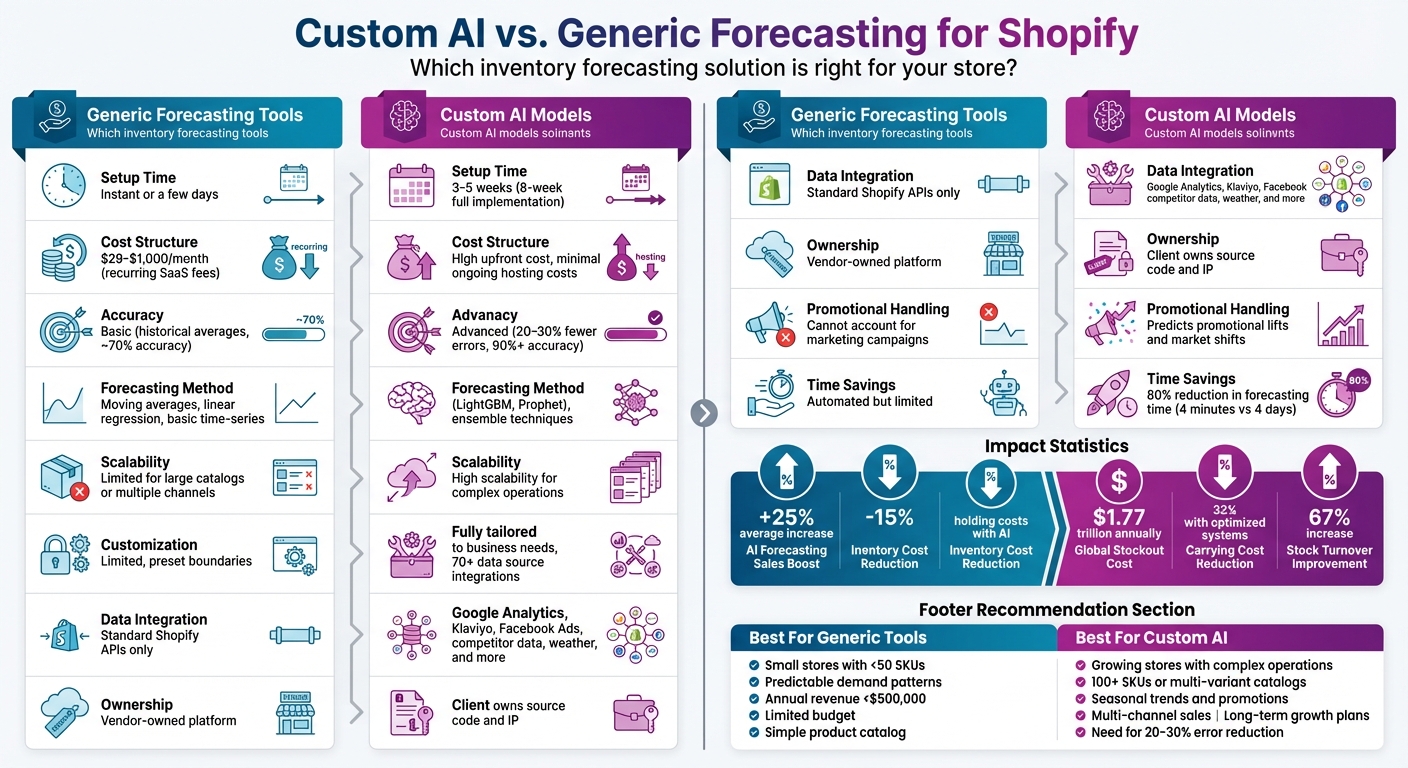
Custom AI vs Generic Forecasting Tools for Shopify: Complete Comparison
5-minute Shopify inventory plan: Julius AI analysis

sbb-itb-f0fc809
Generic Forecasting Solutions for Shopify
Before diving into custom AI forecasting options, let’s take a closer look at the generic forecasting tools that many Shopify merchants use today.
What Generic Forecasting Solutions Are
Generic forecasting solutions are plug-and-play tools designed to help Shopify merchants predict inventory needs without requiring custom coding or development. These include Shopify's built-in tools like Stocky (available with Shopify POS Pro) and third-party apps such as StockIQ. Unlike advanced systems powered by machine learning, these tools rely on traditional statistical methods - like moving averages, linear regression, and basic time-series analysis - to analyze historical sales data.
Here’s how they work: Generic tools calculate sales velocity (how fast items sell over a given period, such as 30, 90, or 365 days) and use that data to estimate future demand. They then apply standard formulas to determine reorder points, typically based on lead time demand plus safety stock.
These tools are ideal for early-stage Shopify stores with straightforward inventory needs, a small number of SKUs, and consistent demand patterns. If your business has a simple product catalog and predictable sales trends, generic forecasting offers a quick and affordable way to automate inventory management.
Let’s explore why these solutions are so appealing to smaller businesses.
Benefits of Generic Forecasting
One of the biggest perks of generic forecasting tools is their speed. They integrate with Shopify in just minutes, offering an easy-to-use dashboard that doesn’t require technical expertise.
Another major benefit is affordability. Shopify Basic, for instance, starts at just $29 per month and includes basic inventory tracking and reporting features. Third-party apps typically range from $50 to $1,000+ per month, which is far cheaper than building and maintaining a custom AI forecasting system. These predictable costs make them an attractive option for small businesses with tight budgets.
Generic tools also improve operational efficiency by automating time-consuming tasks like calculating reorder points, setting low-stock alerts, and flagging potential stockouts. According to research, businesses using optimized inventory systems can reduce carrying costs by 32% and improve stock turnover rates by 67%. For stores with fewer than 500 SKUs or under $500,000 in annual revenue, these tools often provide everything needed to keep inventory levels in check.
However, as businesses grow and inventory needs become more complex, the limitations of generic forecasting tools start to show.
Drawbacks of Generic Forecasting
Generic forecasting tools struggle to keep up as your business scales. They rely on basic mathematical models like moving averages and linear trends, which can’t handle the complexity of seasonal fluctuations, promotional campaigns, or simultaneous shifts in market demand.
"Traditional forecasting tools and spreadsheets fail Shopify brands because they cannot process complex variables, offer real-time updates, or scale across multiple SKUs and stores." - Youri Moskovic, CEO & Co-Founder, Prediko
One major drawback is their inability to account for promotional lifts. These tools often fail to predict the increased demand from marketing campaigns, leading to stockouts during sales events or overstocking right afterward. Additionally, many generic solutions rely on periodic data updates rather than real-time insights, leaving forecasts slightly outdated and forcing businesses to react instead of plan ahead.
As your product catalog expands with more SKUs and variants, these tools require more manual intervention, increasing the chances of errors and decision fatigue. For businesses managing multi-variant products or selling across multiple channels, the limitations of generic forecasting can become costly. It’s worth noting that stockouts alone cost retailers a staggering $1.77 trillion globally each year.
While generic tools are a great starting point, growing businesses may need more sophisticated solutions to stay competitive.
Custom AI Forecasting Models
For Shopify stores on the rise, custom AI forecasting models provide tailored solutions to match unique sales trends and inventory needs. Unlike generic tools, these models focus on precision and adaptability to specific business challenges.
What Custom AI Forecasting Models Are
Custom AI forecasting models rely on machine learning algorithms - like LightGBM or Prophet - trained exclusively on your store’s data. The process starts with a deep dive into your sales history, typically spanning 12–24 months, to identify patterns in seasonality and demand fluctuations. From there, feature engineering incorporates additional variables such as marketing schedules, influencer campaigns, supplier lead times, MOQs, and product bundling rules. Once trained, these models connect to Shopify through APIs, delivering actionable purchase recommendations directly to your dashboard.
What sets these models apart is their ability to evolve. They continuously adapt by integrating real-time data, including shifts in social media sentiment, weather changes, and broader economic trends. By early 2025, 98% of companies had integrated AI into their supply chains to optimize inventory management.
"Your business is forced to fit their model, not the other way around." - Parker Gawne, Founder, Syntora
This adaptability allows custom AI to tackle complex scenarios that generic tools often miss. For example, they can anticipate the sales impact of an influencer campaign or adjust for reduced demand following a big promotion.
Benefits of Custom AI Forecasting
Custom AI models bring a host of advantages, starting with improved accuracy. They reduce forecasting errors by 20–30% compared to manual spreadsheet methods. This leads to fewer stockouts and lower inventory holding costs - key wins for growing businesses.
One standout feature is their ability to predict demand at the SKU level. This is especially valuable for stores with diverse, multi-variant catalogs. They also address the "cold start" issue for new products by using attributes like category, price, and color to generate initial forecasts, which improve as sales data accumulates.
A compelling example comes from Maple & Mortar, an apothecary in Asheville, NC. In early 2026, they implemented a custom SARIMAX model to manage seasonal wellness kits. By factoring in local weather and supplier lead times, they cut their forecast error (MAPE) from 48% to 22%, reduced inventory carrying costs by 19%, and dropped out-of-stock incidents for top SKUs from 8.2 to 1.4 per month.
Time savings are another major benefit. Automated updates can generate a 90-day forecast in just 4 minutes, compared to the 4 days it might take using manual methods - a reduction of 80%. Plus, merchants retain ownership of the source code and intellectual property, avoiding recurring per-seat fees.
While the benefits are clear, custom models do come with their own set of challenges.
Challenges of Custom AI Forecasting
Building a custom AI model isn’t without hurdles. The setup process often takes 3–5 weeks, requiring time for data preparation, feature engineering, model training, and integration - much longer than installing a generic app.
The upfront investment can also be steep. Unlike generic solutions with predictable monthly fees, custom models involve a one-time development cost, which might deter smaller stores with limited budgets. However, the long-term efficiency gains often justify the initial expense.
Another challenge is ongoing maintenance. These models need regular updates to prevent "model drift", where predictions become less accurate as market conditions evolve. Automated alert systems, like PagerDuty or Slack notifications, are crucial for flagging accuracy issues. Additionally, a solid foundation of data is necessary - at least 6–12 months of clean sales data, though 18–24 months is ideal for capturing seasonal trends.
"The model's job is to surface anomalies and quantify uncertainty - not to replace the owner's knowledge of their customers' behavior." - Dr. Arjun Mehta, Director of Applied AI, National Retail Federation
For Shopify merchants ready to invest the time and resources, custom AI forecasting offers the precision and scalability needed to stay ahead in inventory management and customer satisfaction.
Custom AI vs. Generic Forecasting: Direct Comparison
Choosing between custom AI and generic forecasting tools involves weighing several operational factors. For Shopify merchants, the decision often depends on the size of their business, the complexity of operations, and future growth plans. Let’s break down the key differences and trade-offs that can influence cash flow and efficiency.
Setup Time and Cost
The biggest initial contrast lies in how quickly you can start and the upfront investment required. Generic forecasting apps are known for their quick deployment and are often featured among the top cloud inventory tools for Shopify - sometimes within days or even instantly through Shopify integrations. On the other hand, custom AI models require an 8-week setup process, which includes scoping, development, deployment, and monitoring.
Financially, the two options also differ. Generic tools involve low upfront costs but come with recurring subscription fees that often scale based on usage or the number of users. In contrast, custom AI demands a higher one-time build cost, which varies based on data complexity and system integrations. However, ongoing costs are minimal, typically limited to hosting fees on platforms like AWS Lambda.
"A custom algorithm involves a one-time build cost, offering the potential to avoid recurring per-user software fees common with off-the-shelf solutions." - Parker Gawne, Founder, Syntora
Here’s a quick comparison:
| Factor | Generic Forecasting Apps | Custom AI Forecasting Models |
|---|---|---|
| Setup Speed | Fast/Instant (Low to Medium complexity) | 8-week structured implementation |
| Upfront Investment | Low | Higher (One-time build fee) |
| Recurring Costs | Monthly SaaS fees (often per-seat) | Minimal hosting costs only |
| Ownership | Vendor-owned platform/code | Client owns source code and IP |
The choice here boils down to balancing speed and cost with the level of customization your business needs.
Customization Options
Generic solutions operate within preset boundaries, relying on standard Shopify APIs with limited flexibility in processing data. While this simplicity speeds up deployment, it means you’re often working with a "black box" system that offers little visibility into how it functions.
Custom AI models, however, are highly adaptable. They can integrate with over 70 data sources, including Google Analytics, Klaviyo, and even competitor stockout data. This allows them to account for specific factors like seasonal trends or marketing campaigns, which can significantly influence demand.
"Many businesses start with a SaaS tool... But these tools use simple models like exponential smoothing. They cannot incorporate external data, like a planned marketing campaign or a competitor's stockout, which dramatically affects demand." - Parker Gawne, Founder, Syntora
Custom models also offer quick updates. For example, integrating a new source like the Facebook Ads API typically takes just 3–5 days. Generic tools, in contrast, are limited to the integrations their vendor provides. This flexibility makes custom AI models a better fit for businesses that need tailored solutions.
Accuracy and Performance
Accuracy is another area where the two approaches diverge. Generic apps rely on simpler models that often struggle with dynamic shifts in demand. They primarily react to historical data, which can limit their ability to predict future changes influenced by external variables.
Custom AI models employ advanced ensemble techniques, blending time-series methods with gradient boosting to account for complex factors like promotions. This approach can reduce forecasting errors by 20–30% compared to manual spreadsheets.
Custom systems also deliver daily forecasts in about 4 minutes, cutting down on manual effort. They include monitoring for "model drift", which triggers alerts if predictions fall outside acceptable accuracy ranges. For businesses with intricate promotional calendars or multi-warehouse Shopify stores, this level of precision helps avoid stockouts and overstocking.
Scalability
While generic apps can handle large SKU counts - up to 50,000+ products - they often struggle with integrating data from multiple sources like ERPs or marketing platforms. This makes them less suitable for businesses with complex data needs.
"This manual process [spreadsheets] does not scale past 100 SKUs and is completely dependent on one person." - Parker Gawne, Founder, Syntora
Custom AI models excel in scalability. As your business grows, they can incorporate new sales channels, marketing platforms, or operational systems seamlessly. They also adapt to changing inventory complexities by automatically switching between time-series and machine learning models, depending on whether product behavior is steady, seasonal, or trending.
Cost scaling is another key difference. Generic tools often become more expensive as your team or usage grows due to per-seat pricing. Custom models, on the other hand, maintain fixed costs, regardless of the number of users or the complexity of your data. This makes them a more economical choice for businesses with long-term growth plans and multi-channel operations.
For Shopify merchants with at least 12 months of consistent sales data and expanding operations, custom AI provides the flexibility to grow without being constrained by platform limitations or escalating fees.
How to Choose the Right Solution for Your Shopify Store
Picking the best forecasting tool for your Shopify store depends on your current operations and where you’re headed. If your store has fewer than 50 SKUs and limited sales history, basic tools can be a good starting point. They’re affordable, easy to use, and don’t require a technical background to get up and running.
As your store grows and inventory management becomes more complex, you’ll need a more advanced solution. For stores managing hundreds or even thousands of SKUs or juggling sales across multiple channels, generic forecasting tools often include features like automated purchase orders and seasonal adjustments. But if you frequently run promotions or deal with external factors that impact demand, a custom AI model might be a better fit. These models can adapt to more intricate patterns and offer the flexibility you’ll need.
Your budget and growth plans are equally important. Basic tools typically come with low monthly fees, while custom AI models require a larger upfront investment. However, the latter can lead to more predictable long-term costs since they don’t charge ongoing per-user fees. For smaller teams without data scientists, some basic AI tools provide straightforward insights, while high-growth brands with more complex needs often benefit from the tailored features of custom solutions.
Before committing to a tool, take a close look at your data. Ensure your SKU numbers are consistent, product variants are well-organized, and supplier lead times are clearly documented. This preparation is essential for testing how well a tool works. Run a pilot for 4–8 weeks and compare its forecasts to actual demand. Tracking metrics like Mean Absolute Percentage Error (MAPE) can help, with a target of under 15% being a good benchmark for accuracy.
Lastly, think about how much time you could save. AI-driven solutions have helped businesses cut forecasting time by as much as 80%. Whether you’re currently stuck in manual spreadsheet work or managing complex sales calendars, the right forecasting tool can simplify your operations and support your growth. For instance, Forstock offers a 14-day trial featuring real-time demand forecasting and automated purchase order creation, giving you a chance to explore its benefits firsthand.
Conclusion
Deciding between custom AI and generic forecasting tools isn’t about picking the “best” option - it’s about finding what fits your Shopify store’s current needs and growth plans. Generic tools are a solid choice for startups with fewer than 50 SKUs and straightforward operations. They’re easy to set up, budget-friendly, and get the job done for simpler catalogs. But as your store grows - whether through expanding product lines, multichannel sales, or handling seasonal trends - these tools can start to feel limiting.
That’s where custom AI forecasting steps in. When precision becomes critical, custom AI can deliver. AI-driven forecasting boasts accuracy rates exceeding 90%, while traditional methods often struggle to hit 70%. And the impact is real: businesses using AI forecasting report an average 25% boost in sales and a 15% cut in inventory holding costs.
However, precision alone isn’t enough. The ability to understand and trust the system is just as important. As Parker Gawne, Founder at Syntora, wisely notes:
"The team could not trust a recommendation they could not explain".
If the system’s recommendations feel opaque or confusing, merchants often fall back on manual spreadsheets, which defeats the purpose of automation.
For those looking for a middle ground, Forstock offers a practical solution. It combines AI-powered forecasting with ease of use, adapting to sales trends, lead times, and seasonality - all without the complexity of a custom system. At a $79/month, regardless of revenue, it includes features like automated purchase orders and real-time demand forecasting. Plus, the 14-day trial lets you see how its forecasts align with actual demand before making a commitment.
Ultimately, the right choice depends on where your business is today and where you want it to go. Whether you start small and scale up or dive into advanced AI right away, the goal remains the same: smarter inventory decisions that prevent stockouts and reduce overstock, and drive sustainable growth.
FAQs
When should I switch from generic forecasting to custom AI?
Switch to custom AI when your business demands more precise insights, the ability to scale, or predictions tailored to complex operations. While generic tools can handle straightforward tasks, they often fall short when dealing with diverse datasets or unique variables. Custom AI becomes essential if manual processes or basic tools can't prevent issues like stockouts or overstocking - or fail to adjust to factors like seasonality, promotions, or external trends effectively.
What data do I need before using custom AI forecasting?
To integrate custom AI forecasting into your Shopify store, start by collecting essential data. This includes historical sales records, seasonal trends, promotional schedules, and customer behavior patterns. Additionally, factor in supplier lead times, current inventory levels, and external market influences to refine accuracy.
Real-time sales data plays a critical role in adjusting forecasts on the fly, allowing you to respond to shifts quickly and effectively. By focusing on these key elements, you can create demand forecasts that are not only precise but also actionable, aligning perfectly with your store's unique needs.
How do I measure if my forecasting is actually improving?
To measure how well your forecasting efforts are working, keep an eye on key performance indicators (KPIs) like Mean Absolute Percentage Error (MAPE). This metric helps you compare your predicted demand to actual sales. Beyond that, look at operational results - are you seeing fewer stockouts, less overstock, and reduced dead stock? For instance, if stockouts or surplus inventory are dropping over time, that’s a clear sign of improvement. Regularly reviewing these metrics is crucial to ensure your forecasts are driving smarter inventory decisions and better overall management.
Keep reading
Try Forstock free for 14 days.
AI-powered demand forecasting and reorder automation for Shopify brands. No credit card required.