
Checklist for Blockchain Supply Chain Integration
Practical 5-step checklist to assess, pilot, and integrate blockchain into your supply chain for faster traceability and fewer errors.
Checklist for Blockchain Supply Chain Integration
Blockchain technology can solve many supply chain problems by offering transparency, accuracy, and automation. It creates a shared, tamper-proof record of transactions accessible to all authorized parties, ensuring trust and efficiency. Companies like Walmart and De Beers have already seen faster traceability and reduced costs using blockchain solutions. Here’s how you can start integrating blockchain into your supply chain:
- Identify Pain Points: Map your workflow to uncover bottlenecks like data silos, manual errors, and poor visibility.
- Set Goals: Define clear objectives, such as faster trace times or reduced costs.
- Choose a Platform: Select a blockchain platform like Hyperledger Fabric for privacy or Ethereum for public transparency.
- Run a Pilot: Test blockchain with a small-scale project before scaling up.
- Integrate Tools: Connect blockchain with cloud inventory tools like Forstock for real-time updates and smarter operations.
Key Stats:
- Blockchain can cut administrative costs by 30%.
- Walmart reduced food trace times from 7 days to 2.2 seconds.
- Inventory errors cause 90% of supply chain disruptions.
Whether you’re managing food safety, luxury goods, or e-commerce returns, blockchain offers a reliable way to improve traceability, reduce fraud, and streamline operations.
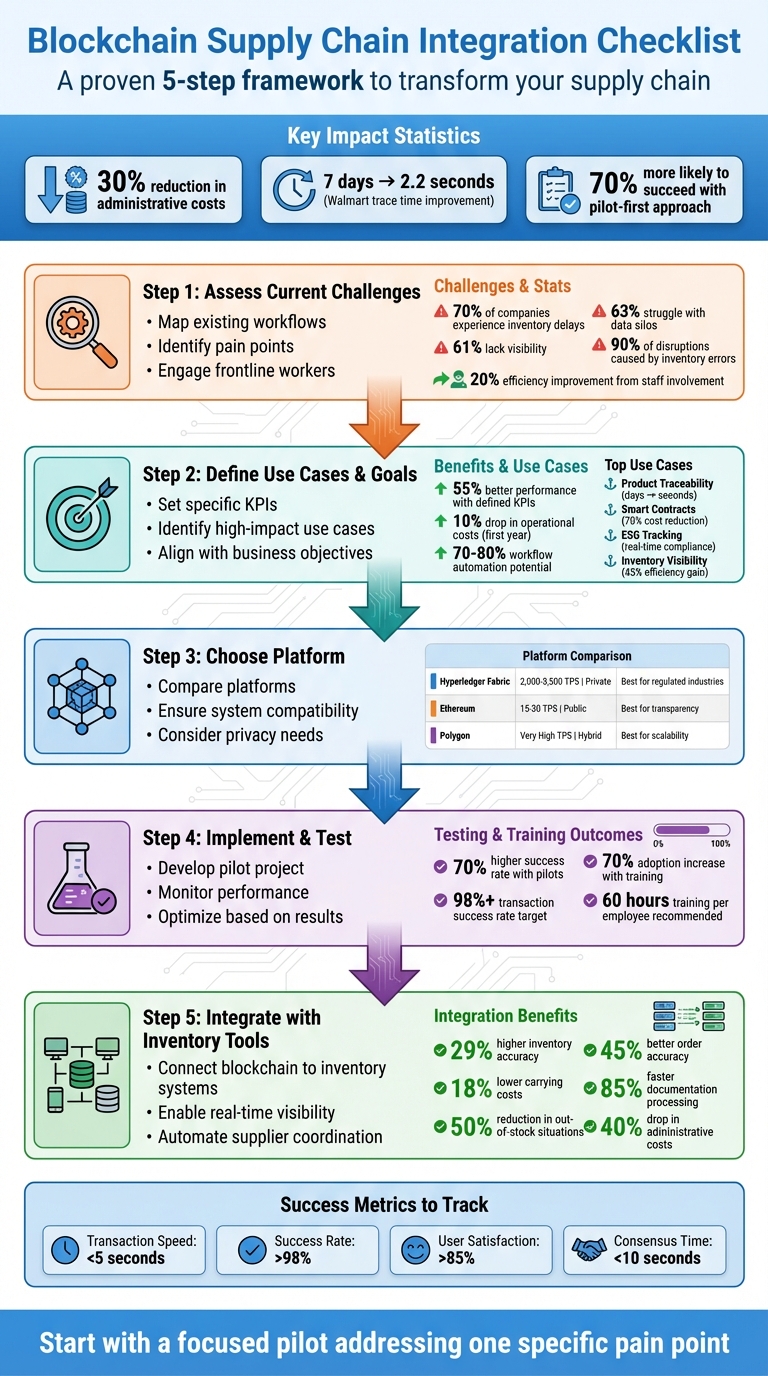
5-Step Blockchain Supply Chain Integration Checklist with Key Statistics
Step 1: Assess Current Supply Chain Challenges
Map Existing Workflow and Pain Points
Start by mapping your workflow, tracking every step from raw material intake to the shipment of finished products. Studies show that 70% of companies experience delays in inventory management.
Some of the most common pain points include:
- Lack of visibility: This affects 61% of businesses and limits their ability to monitor supply chain activities effectively.
- Data silos: About 63% of companies struggle with isolated systems that hinder smooth data sharing.
- Manual reconciliation: This creates administrative bottlenecks and slows down operations.
Engage frontline workers - such as warehouse managers, logistics coordinators, and procurement teams - to identify operational friction points. These team members often see inefficiencies that management might overlook. For example, manual tasks or frequent errors could be slowing you down. Interestingly, involving frontline staff can improve operational efficiency by up to 20%. Pinpointing these challenges is a critical step toward integrating blockchain technology effectively.
| Stakeholder | Primary Pain Point | Blockchain Benefit |
|---|---|---|
| Suppliers | Data transparency and trust | Joint mapping of data flows and immutable records |
| Manufacturers | Process efficiency and traceability | Real-time tracking and automated quality verification |
| Distributors | Real-time inventory tracking | Fewer stockouts and overstock due to better visibility |
| Retailers | Product authenticity and safety | Easier recalls and proven product origins for consumers |
Evaluate Data and Process Gaps
Once your workflow is mapped, assess where your data and processes fall short. Many financial ledgers and ERP systems lack the ability to provide full visibility into inventory, funds, and other critical information. These blind spots can limit the benefits of blockchain if the data feeding into the system isn’t reliable.
For example, inventory inaccuracies cause 90% of supply chain disruptions. Issues like phantom inventory or errors from manual data entry are common culprits. Conduct a feasibility study to identify technology gaps - 39% of companies report challenges with blockchain integration due to outdated systems. Determine if your existing hardware and software can connect to a blockchain platform or if middleware solutions are necessary.
Another major hurdle is miscommunication. Around 54% of organizations cite miscommunication as a key cause of inefficiencies. Processes that rely heavily on phone calls, emails, or paper documents are especially prone to errors. These areas are ideal candidates for blockchain automation, such as using smart contracts to streamline operations. Addressing these gaps can help recover up to 15% of wasted operational budgets. Use these findings to shape your blockchain use cases in the next step.
sbb-itb-f0fc809
Step 2: Define Blockchain Use Cases and Goals
Set Specific Goals for Blockchain Integration
Turn your challenges into clear, measurable objectives. For instance, instead of saying, "improve transparency", aim for something concrete like reducing trace times from 7 days to under 10 seconds, lowering reconciliation costs by 70%, or speeding up supplier payment cycles by 2.2x.
Organizations that set precise KPIs for blockchain integration see 55% better performance compared to those that don't. Your goals should directly address the inefficiencies identified in Step 1. If manual reconciliation is a bottleneck, target automating 70–80% of workflows, such as purchase approvals and invoice processing, using smart contracts. If inventory errors are a recurring issue, aim for 99% data accuracy across your network.
Financial goals are equally important. Many companies experience a 10% drop in operational costs within the first year of blockchain adoption. In industries with heavy compliance requirements, blockchain-based auditing can cut compliance expenses by 15–20%, streamlining processes like carbon tracking, fair labor verification, and regulatory checks. Keep your budget and timeline in mind - pilot projects often start at $15,000, while global implementations can cost upwards of $120,000.
Once you've defined these KPIs, focus on use cases that deliver the most impact and align with your objectives.
Identify High-Impact Use Cases
Zero in on use cases that promise the highest returns. Product traceability is a standout application, particularly for food safety and luxury goods. For example, De Beers uses blockchain to register over 1 million diamonds weekly, ensuring conflict-free sourcing. This kind of speed is crucial during product recalls, where blockchain can improve response times by 20%.
Smart contracts are another game-changer, streamlining processes through automation. In 2025, fintech platform Mesha introduced a blockchain module for supplier finance. Within just 60 days, they achieved a 2.2x faster supplier payment cycle, a 48% cut in reconciliation time, and 100% audit coverage for transactions. Smart contracts can reduce administrative costs by 30% and cut transaction times by 40%.
Blockchain also fights counterfeiting with tamper-proof records, which can reduce fraud by 25%. For companies prioritizing ESG (Environmental, Social, and Governance) compliance, blockchain enables real-time tracking of ethical labor practices and carbon emissions. This capability is expected to become mandatory for some EU industries by 2026. A practical example: the Australian Trade and Investment Commission used blockchain to improve cattle export tracking by 38% for shipments to China.
| Use Case | Primary Benefit | Impact Metric |
|---|---|---|
| Product Traceability | Food safety & anti-counterfeiting | Trace time reduced from days to seconds |
| Smart Contracts | Payment & audit automation | Up to 70% reduction in reconciliation costs |
| ESG Tracking | Regulatory compliance | Real-time carbon and ethical labor auditing |
| Inventory Visibility | Reduced stockouts/overstock | 45% improvement in digital efficiency |
Focus on use cases that involve multiple stakeholders - manufacturers, suppliers, and distributors - where blockchain can act as a "distributed trust layer". Start small with a pilot project aimed at solving a specific pain point, then expand based on the results. This step-by-step approach helps minimize risks while demonstrating the value of blockchain before scaling up.
Step 3: Choose and Configure a Blockchain Platform
Compare Blockchain Platforms
Picking the right blockchain platform is a critical decision - it affects everything from scalability and security to developer support and overall costs.
Hyperledger Fabric is a top choice for enterprise supply chains, and it’s easy to see why. This private, permissioned network can process more than 3,500 transactions per second (TPS) in optimized setups, with most enterprises achieving 2,000+ TPS. Its modular design allows for tailored consensus mechanisms and private channels, which help protect sensitive data like supplier contracts. With no gas fees and full control over access, it’s built for businesses. A standout example is IBM Food Trust, which uses Hyperledger Fabric to improve food traceability for companies like Walmart and Nestlé. This reduced the time to trace food origins from seven days to just 2.2 seconds. By early 2026, over 300 organizations had joined the network using IBM Cloud infrastructure.
Ethereum, on the other hand, offers public transparency but comes with trade-offs. Transaction costs vary depending on network demand, and all data is public by default - making it less ideal for handling sensitive information like pricing or contracts. Still, Ethereum’s extensive developer ecosystem and support for Solidity make it a good option for projects like tokenized loyalty programs or publicly verified sustainability claims.
Polygon offers a middle ground between public and private needs. It uses zero-knowledge (ZK) proofs to verify transactions without exposing sensitive data. With high scalability and minimal fees, it’s a smart choice for businesses needing both privacy for B2B operations and transparency for B2C interactions. Plus, it’s compatible with Ethereum tools, so teams experienced with Solidity can hit the ground running.
| Platform | Type | Throughput (TPS) | Privacy Level | Cost Structure | Best For |
|---|---|---|---|---|---|
| Hyperledger Fabric | Private, Permissioned | 2,000–3,500+ | Very High (Private channels) | No gas fees; infrastructure costs | Regulated industries, supply chain |
| Ethereum | Public, Decentralized | 15–30 native; ~90 with Layer 2 | Low (Public by default) | Variable gas fees | Tokenization, public apps |
| Polygon | Hybrid (Layer 2) | Very High (zkEVM/PoS) | Medium-High (ZK proofs) | Very low fees | Scalable B2B/B2C applications |
| Hyperledger Besu | Private with EVM | High | Very High | No gas fees | Ethereum compatibility + privacy |
"The selection of the platform is now a strategic move and not a technical one." - NanoByte Technologies
Your choice should align with your specific needs. For high privacy and regulated data, go with Hyperledger Fabric. For public transparency, Ethereum or Polygon might be better. Hyperledger Besu is a solid option if you need Ethereum compatibility with added privacy. If you need to sync private operations while keeping data confidential, the Baseline Protocol can help.
Once your platform is selected, the next step is ensuring it integrates smoothly with your existing systems.
Ensure System Compatibility
After deciding on a blockchain platform, it’s essential to confirm that it works seamlessly with your current tech setup. Integration is key, and modular platforms like Hyperledger Fabric make this easier by letting you add features like consensus mechanisms or privacy modules without a complete system overhaul.
API and SDK integration is critical for connecting blockchain to your existing tools. For instance, Hyperledger Fabric’s Node.js SDK allows for transaction submissions and ledger queries via standard APIs. If you’re already using Ethereum-compatible tools, platforms like Binance Smart Chain or Hyperledger Besu offer EVM compatibility, making migrations smoother.
Blockchain-as-a-Service (BaaS) solutions from providers like AWS, Azure, or SAP come with built-in tools for integrating IoT, AI analytics, and ERP systems. This approach reduces the complexity of managing blockchain infrastructure. In supply chain operations, middleware or API layers can help synchronize blockchain data with ERP and Warehouse Management Systems (WMS), enabling real-time updates for inventory and delivery tracking.
For example, Forstock pairs effortlessly with blockchain platforms to improve inventory management. Blockchain ensures tamper-proof records of shipments and supplier transactions, while Forstock’s AI-powered forecasting uses this verified data to enhance demand predictions and automate purchase orders. Together, they provide real-time, reliable insights for better decision-making across the supply chain.
Before scaling, it’s smart to run a pilot project to test performance and compatibility. Tools like Docker containers and CI/CD platforms (e.g., Jenkins) can help deploy and test smart contracts (chaincodes) in your existing IT environment. Standardizing data formats with XML or JSON and adopting industry standards like GS1 for product identifiers ensures smooth interoperability. For added security, check if your platform supports Hardware Security Modules (HSM) for managing digital keys.
"While speed is an important consideration, it should never be at the expense of security standards." - Blockchain Development Solutions
A popular approach combines the strengths of private and public blockchains. For instance, you can use Hyperledger Fabric for daily supply chain management while storing encrypted proofs on a public blockchain like Ethereum for external verification. This setup balances privacy with transparency, giving you control over sensitive data while still offering verifiable records for stakeholders when needed.
Step 4: Implement and Test Blockchain in Phases
Develop a Pilot Project
Starting small with a focused pilot project can make all the difference. Companies that begin with a limited-scope pilot are 70% more likely to succeed when scaling up compared to those jumping straight into company-wide rollouts. A good starting point might be tackling a specific challenge, like reconciling invoices with a single supplier or tracking one category of goods.
Before launching, establish clear KPIs to measure success. Use the KPIs defined in Step 2 as your benchmarks. For example, aim for transaction speeds under 5 seconds, data accuracy at 99%, and lead time reductions of 20% to 50%. Research shows that organizations with well-defined KPIs perform 55% better in blockchain initiatives than those without.
For the prototype, consider using accessible platforms like Ethereum or Corda to test functionality and performance. Employ CI/CD tools to automate testing and deployment, catching bugs early to keep development on track.
Getting stakeholders involved early is also key. Their input not only ensures the system meets operational needs but also encourages adoption. Providing robust training can increase user adoption rates by 70%. Devote at least 20% of training to hands-on simulations, aiming for around 60 hours per employee to reduce resistance and build confidence.
When it comes to smart contracts, thorough code reviews are non-negotiable. Look out for common vulnerabilities like reentrancy, variable shadowing, and overflows. Remember, once deployed, smart contracts are difficult to modify. After launching the pilot, focus on monitoring and fine-tuning to ensure everything runs smoothly.
Monitor and Optimize Performance
Once your pilot is live, ongoing monitoring is essential to ensure success. Use analytics tools to track key metrics like network health, transaction success rates, and latency. A transaction success rate above 98% is ideal; if it dips below this threshold, conduct a root cause analysis to pinpoint issues like network congestion or errors in smart contract logic.
Feedback loops are just as important as performance metrics. Hold user feedback sessions with stakeholders at least twice a year to uncover usability issues or bottlenecks that metrics might not reveal. Deloitte found that 40% of companies reported better collaboration with vendors after implementing blockchain systems.
To stay ahead of demand spikes, leverage predictive analytics. By analyzing historical data, you can anticipate system loads and allocate resources like additional nodes or processing power before performance suffers. Real-time monitoring tools can improve operational efficiency by 25%, and regular system audits have been shown to drive performance improvements 70% of the time.
Keep a detailed log of all changes, including why they were made and the outcomes. If your pilot hits its performance benchmarks - like faster transactions or reduced lead times - you’ve validated the concept and can move forward with broader implementation. These phased evaluations help confirm blockchain’s value and set the stage for integrating it with tools like inventory management systems, which will be discussed next.
| Metric | Target/Benchmark | Action if Not Met |
|---|---|---|
| Transaction Speed | < 5 seconds | Scale network resources or optimize smart contracts |
| Transaction Success Rate | > 98% | Conduct root cause analysis for congestion or logic errors |
| Consensus Time | < 10 seconds | Benchmark against industry standards and optimize |
| User Satisfaction | > 85% | Adjust interface usability or streamline processes |
Step 5: Integrate Blockchain with Inventory Management Tools
Improve Inventory Visibility with Forstock
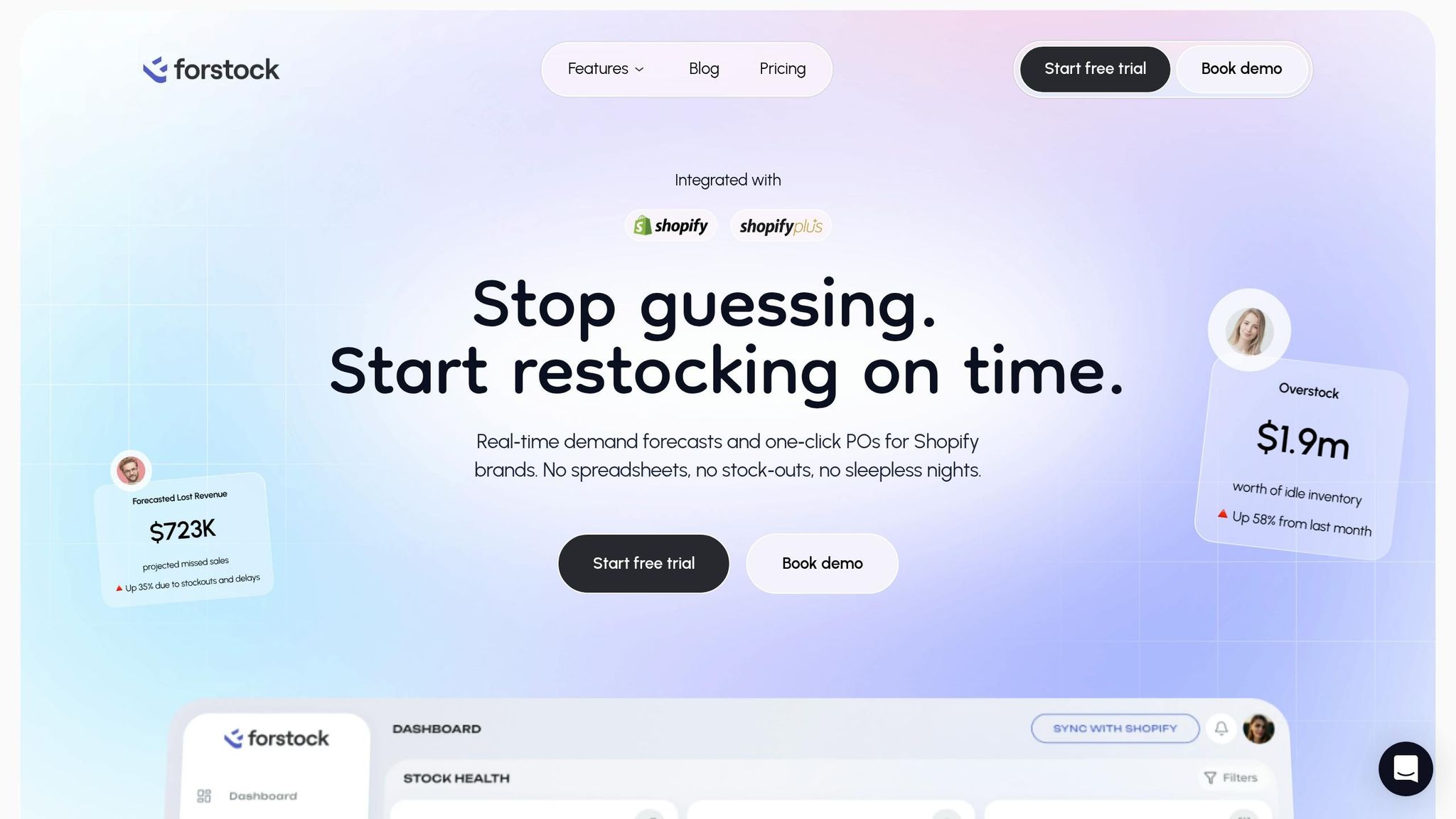
For Shopify brands, combining blockchain technology with Forstock creates a seamless flow of real-time inventory data across all operations. By syncing Forstock's dashboards with blockchain, suppliers, manufacturers, and retailers can access the same up-to-date information simultaneously. This eliminates errors caused by manual data entry or disconnected systems.
The results speak for themselves. Companies leveraging real-time inventory visibility report 29% higher inventory accuracy, 18% lower carrying costs, 15% better order fulfillment rates, and a 12% drop in excess inventory levels. Additionally, real-time updates slash out-of-stock situations by 50% and improve order accuracy by 45%.
"The decentralized nature of blockchain technology ensures that all parties in the supply chain have access to the same real-time information, eliminating the need for manual data entry and reducing the risk of discrepancies." – MoldStud Research Team
Middleware tools or oracles, like Chainlink, connect off-chain data from Forstock to on-chain smart contracts. Meanwhile, IoT sensors and RFID tags feed precise location and condition data directly into the blockchain. Forstock then displays this information on a unified dashboard, offering complete traceability and quickly highlighting potential bottlenecks or delays.
For Shopify brands, this integration also sharpens demand forecasting. AI models benefit from blockchain's clean, tamper-proof data instead of relying on scattered inputs. Starting with a permissioned blockchain like Hyperledger Fabric ensures sensitive information, such as pricing and supplier details, remains secure while still providing transparency for authorized partners. This streamlined data flow lays the foundation for better supplier coordination.
Streamline Supplier Coordination
Enhanced inventory visibility paves the way for smoother supplier interactions. With blockchain, Forstock's smart contracts can automatically trigger purchase orders when stock falls below a set threshold. This removes the need for manual intervention, reducing human error and cutting operational costs by nearly 20%.
Blockchain also speeds up documentation processing - up to 85% faster than traditional methods. Smart contracts further drive efficiency, reducing overall operational costs by 50% through automated, real-time transactions. Companies using shared data ledgers report a 40% drop in administrative costs tied to dispute resolution.
A great example of this in action is Walmart's collaboration with IBM Food Trust. Using the Hyperledger Fabric platform, Walmart cut the time needed to trace the origin of food items like sliced mangoes from 7 days to just 2.2 seconds. This not only improved supplier accountability but also enabled precise recalls when necessary.
Smart contracts can also streamline payments, releasing funds as soon as goods are received - eliminating unnecessary delays. Forstock's supplier management tools centralize communication, while blockchain automates verification and payment processes. To get started, consider launching a pilot program with one product line or supplier before scaling it across your entire operation.
| Feature | Blockchain Contribution | Forstock Contribution | Integrated Outcome |
|---|---|---|---|
| Data Integrity | Immutable record | Detects data discrepancies | Trusted Data Foundation |
| Traceability | End-to-end audit trail | Pattern recognition | Proactive Fraud Prevention |
| Automation | Smart contracts | Predictive triggers | Autonomous Supply Chain |
Conclusion and Next Steps
Recap of the Blockchain Integration Checklist
Taking a structured approach to blockchain integration is key. Start by mapping out your current workflows to identify gaps in visibility - research highlights that 61% of organizations face challenges with operational transparency. Define measurable KPIs to track improvements, such as cutting transaction processing times or lowering administrative costs, as outlined in earlier steps. To test feasibility, pilot the integration with a single product line or supplier. Companies that begin with a limited scope are 70% more likely to succeed in full-scale deployment.
Selecting the right blockchain platform is equally important. For private enterprise needs, Hyperledger Fabric is a strong choice, while Ethereum works well for public-facing operations requiring transparency. Pairing blockchain with inventory management tools like Forstock can streamline data flow, improve accuracy, and reduce manual tasks. This recap provides a clear roadmap for moving forward.
How to Get Started
To put the checklist into action, begin with a focused pilot addressing a specific issue, such as invoice reconciliation or tracking a single product line. Start small by forming a basic ecosystem involving one company, one key supplier, and one logistics partner to test the blockchain network before scaling.
If your team lacks blockchain expertise, consider consulting specialists or leveraging cloud-based Blockchain as a Service (BaaS) platforms from providers like AWS, IBM, or Microsoft. Dedicate at least 60 hours of training per employee, using hands-on simulations to improve retention by 30%.
Organizations that set clear, measurable goals see 55% better performance compared to those without defined metrics. Focus on tracking metrics like transaction success rates (targeting at least 98%), inventory accuracy improvements, and reductions in administrative costs. For Shopify brands, combining blockchain’s tamper-proof data with Forstock’s AI inventory forecasting creates a robust system for smarter purchasing and better supplier coordination. Using Forstock’s real-time inventory insights ensures that your blockchain integration drives smarter, data-backed decisions for Shopify businesses.
How Do You Integrate Blockchain Into Supply Chain ERP? - Smart Logistics Network
FAQs
What data should go on-chain vs off-chain?
The decision to use on-chain or off-chain storage boils down to priorities like transparency, immutability, and performance.
On-chain data is ideal for storing essential, unchangeable information such as transaction histories, product origins, and ownership records. This ensures transparency and permanence.
Meanwhile, off-chain data is better suited for handling large, flexible, or sensitive details. Examples include inventory levels, demand forecasts, and supplier information. These can still be tied to the blockchain through hashes or pointers, ensuring they can be validated when needed.
How do I choose between a permissioned and public blockchain?
Choosing the right blockchain depends on your supply chain's specific needs for transparency, privacy, and control. Public blockchains, like Ethereum, are open to everyone, decentralized, and highly transparent. They work well in trustless settings but come with reduced privacy. On the other hand, permissioned blockchains limit access, providing more privacy, control, and efficiency - making them a better fit for supply chains that handle sensitive or regulated information. When deciding, think about factors such as scalability, governance, and how much control over data privacy you need to meet your objectives.
How can I connect blockchain to Shopify inventory using Forstock?
To link your Shopify inventory to blockchain using Forstock, begin by verifying that your Shopify store's product and supplier details are up-to-date. Next, install Forstock to streamline tasks like inventory tracking, purchase orders, and supplier management. Afterward, connect a blockchain platform through APIs or custom configurations. This integration allows Forstock's real-time data to sync with the blockchain, creating transparent and tamper-resistant records while improving supply chain traceability.
Keep reading
Try Forstock free for 14 days.
AI-powered demand forecasting and reorder automation for Shopify brands. No credit card required.