
TL;DR
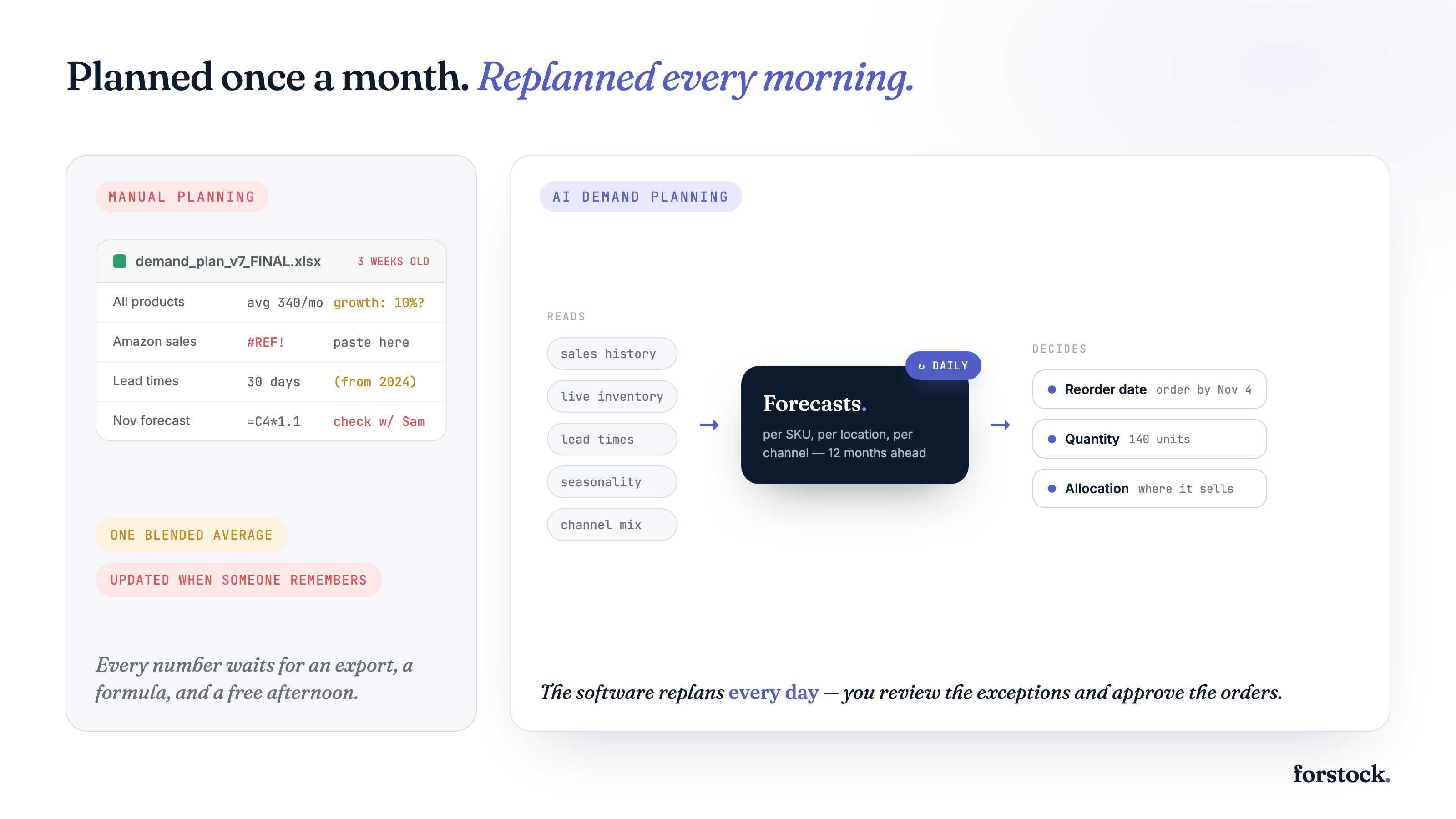
- AI demand planning uses sales, inventory, lead-time, and other data to forecast demand by SKU, location, and channel, then updates those forecasts to guide replenishment decisions.
- Demand forecasting predicts future sales. Demand planning turns those predictions into reorder dates, order quantities, and inventory allocations.
- Unlike spreadsheets, AI demand planning software recalculates forecasts as new data arrives instead of relying on manual data pulls and periodic updates.
- Shopify brands use AI demand planning to reduce stockouts, avoid excess inventory, and coordinate stock across channels such as Shopify, Amazon, and Walmart.
- You may need it when SKU growth, multiple sales channels, supplier lead times, or several inventory locations make spreadsheets difficult to maintain.
What is AI demand planning
AI demand planning uses machine learning to forecast product demand at the SKU, location, and sales channel level. It combines signals such as sales history, seasonality, promotions, current inventory, and supplier lead times, then updates predictions as new data arrives. Those predictions guide reorder timing, purchase quantities, and inventory allocation.
Demand forecasting predicts what customers will buy. Demand planning uses that prediction to decide what inventory to order, when to order it, and where to place it.
Continuous recalculation helps the plan respond when actual sales differ from earlier expectations. For example, a promotion that increases Shopify sales can change the expected stockout date and trigger a revised reorder recommendation. The operator still controls purchasing decisions, while the software handles the recurring analysis needed to keep those decisions current.
How AI demand planning differs from traditional forecasting
Traditional forecasting usually starts with sales history copied into a spreadsheet. You might average recent sales, apply a growth rate, and adjust the result for known seasonal periods. Each forecast depends on someone collecting current data, maintaining formulas, and deciding when unusual events require manual corrections.
Spreadsheet forecasting becomes harder to maintain as inventory complexity grows. A monthly total can hide different demand patterns across individual SKUs, sales channels, and fulfillment locations. Adding those dimensions creates more rows, formulas, and data imports. Forecasts also age between updates, so a recent promotion or channel-level sales increase may not affect purchasing decisions until the next planning cycle.
AI demand planning software recalculates forecasts as new sales and inventory data arrive. A model can evaluate multiple signals at once, identify patterns for each SKU and channel, and revise its estimates when those patterns change. Automation removes much of the manual work involved in copying data and rebuilding formulas, which makes frequent updates practical.
AI models can also treat temporary events differently from recurring demand. For example, a one-week discount may cause a sales spike without establishing a new baseline. A spreadsheet formula may carry that spike into its moving average, while an AI model can consider the promotion alongside sales history before updating future demand.
AI demand planning still depends on accurate inputs and informed operating decisions. Incorrect inventory counts, missing channel data, or unrealistic supplier lead times can produce poor recommendations. The software handles more data and recalculates faster, but you still need to review exceptions and account for events the model cannot know in advance.
The core mechanics of an AI demand planning system
An AI demand planning system calculates demand at the level where you make inventory decisions. Instead of producing one companywide sales estimate, the system can model each SKU separately by location and sales channel. A product may sell at different rates on Shopify and Amazon, while two warehouses may need different replenishment schedules.
The forecasting model combines sales history with current operational data. Relevant inputs can include available inventory, incoming purchase orders, supplier lead times, catalog changes, and recent channel performance. Forstock provides a concrete example with more than 40 signals per SKU. Its model uses a brand’s own data rather than applying one fixed growth rate across the catalog.
Automated updates keep the forecast connected to current conditions. Forstock projects demand up to 12 months ahead and recalculates its forecasts daily. Each update incorporates new sales and inventory records, so a recent increase in demand can affect projected stockout dates and recommended order quantities. In this context, continuous forecasting means the software refreshes predictions on a recurring schedule without requiring a new spreadsheet export.
The planning layer turns each forecast into an inventory decision. The software compares expected demand with stock on hand and incoming units, then accounts for how long a supplier usually takes to deliver an order. Those calculations support reorder timing and stockout prevention. Channel-level forecasts also give you a basis for deciding where available inventory should sit when Shopify, Amazon, and Walmart draw from shared supply.
Common use cases in a Shopify inventory workflow
Reorder timing
AI demand planning tells you when to place a purchase order and how much stock to request. The software combines expected SKU demand with current inventory, open purchase orders, supplier lead times, and safety stock targets. As sales patterns or delivery times change, daily forecast updates move the recommended order date and quantity. You can place orders based on the expected stockout date rather than a fixed monthly schedule.
Stockout prevention
Stockout prevention starts with identifying which SKUs may run out before replenishment arrives. A demand planning system compares projected sales against available and incoming units at each location. When a promotion accelerates sales or a supplier takes longer than expected, the projected stockout date moves closer. You can then expedite an order, transfer inventory, or adjust the promotion before the SKU becomes unavailable.
Multi-channel inventory allocation
Channel-level forecasts help you decide where limited inventory should sit. A product may sell steadily through Shopify while demand rises faster on Amazon or Walmart. Separate channel forecasts reveal those differences, while location-level data shows which warehouse or 3PL holds the available units. You can allocate an incoming shipment according to expected channel demand instead of dividing stock evenly or relying on total sales alone.
Signs your brand has outgrown spreadsheets
Spreadsheets become unreliable when inventory complexity grows faster than you can update formulas and source data. Check for these symptoms in your current demand planning process.
- You still experience stockouts despite maintaining a forecast. Infrequent updates prevent the spreadsheet from reflecting recent sales changes, promotions, or supplier delays.
- You make reorder decisions partly on gut feel. Missing or outdated inputs force you to estimate order quantities and timing outside the model.
- Your workbook requires frequent manual data pulls. You spend hours exporting Shopify sales, inventory levels, and purchase order data before you can make a decision.
- SKU, channel, or location growth keeps breaking formulas. Adding Amazon, Walmart, a warehouse, or a 3PL creates more combinations than one workbook can track safely.
- Different people work from different inventory numbers. Copied files and disconnected tabs create conflicting forecasts, reorder dates, and purchase order records.
- Supplier lead times remain fixed in the spreadsheet. Static assumptions produce late orders when actual delivery times change.
- You cannot explain why the forecast changed. Hidden formulas, manual overrides, and inconsistent inputs make inventory decisions difficult to review.
- You relied on Shopify Stocky. Stocky’s August 2026 sunset requires affected merchants to replace its inventory planning functions and preserve access to purchase order history, reorder settings, and operating data.
AI demand planning vs. manual forecasting
The comparison below shows how each approach handles recurring inventory planning work.
| Dimension | Manual/spreadsheet forecasting | AI demand planning |
|---|---|---|
| Update frequency | Updated when someone imports data and revises formulas | Recalculates automatically as new data arrives |
| Forecast granularity | Often groups products or uses a blended sales average | Forecasts by SKU, location, and sales channel |
| Signals used | Usually relies on sales history and planner assumptions | Combines sales history with inventory, seasonality, lead times, and other signals |
| Reorder decisions | Requires separate calculations for timing and quantities | Connects forecasts with stockout dates, lead times, and recommended quantities |
| Multi-channel planning | Requires manual data consolidation across Shopify, marketplaces, and locations | Unifies channel and location data within one planning model |
| Time cost | Requires recurring exports, formula maintenance, and manual checks | Automates data updates and routine recalculation |
| Responsiveness | May miss changes between scheduled planning cycles | Adjusts forecasts when demand or inventory conditions change |
Who needs AI demand planning by Shopify growth stage
Early single-SKU brand
A young brand with one product and one sales channel can usually plan inventory without specialized software. Shopify sales history, a basic spreadsheet, and known supplier lead times may provide enough information. AI demand planning becomes useful when promotions, seasonality, or rapid growth make recent sales averages unreliable.
Growing multi-SKU brand
A broader catalog makes manual planning harder because each SKU sells at a different rate. Slow sellers can trap cash in excess stock while popular variants sell out before the next order arrives. You may need AI demand planning when spreadsheet updates consume several hours, forecasts fall behind current sales, or reorder quantities still depend on judgment.
Scaling multi-channel brand
Selling through Shopify, Amazon, Walmart, or wholesale creates separate demand patterns for the same products. A spreadsheet often requires manual exports and cannot reliably show where inventory will run out first. AI demand planning can calculate forecasts by SKU and channel, then update replenishment decisions as each channel changes.
Multi-location or 3PL brand
Multiple warehouses and 3PL partners add location-level inventory and transfer decisions. Total stock may look sufficient even when the warehouse serving your fastest-growing market faces a shortage. You likely need a dedicated platform when you regularly expedite shipments, transfer inventory between locations, or discover stockouts after placing purchase orders.
Operationally complex brand
Supplier delays, long production cycles, and frequent purchase orders make forecast accuracy only one part of planning. You also need to connect expected demand with lead times, stockout dates, order quantities, and open purchase orders. At this stage, disconnected forecasting and purchasing tools can create conflicting records and delayed decisions.
Choosing a demand planning platform
Spreadsheets become difficult to maintain as a brand adds SKUs, sales channels, suppliers, and inventory locations. AI demand planning replaces manual updates with a planning platform that can support growing operational complexity.
For Shopify-first, multi-channel brands, Forstock unifies forecasting, reorder decisions, and purchase order management in one platform. Operators can start a free 14-day trial without a credit card or book a demo to evaluate the platform with their inventory data and workflows.
Frequently asked questions
What is the difference between demand planning and demand forecasting?
Demand forecasting predicts how much customers may buy, while demand planning turns that prediction into reorder, allocation, and purchasing decisions. Forstock connects forecasts with reorder recommendations and purchase order management. You can use one forecast to decide what to buy, when to order, and where to place inventory.
What software is used for demand planning?
Demand planning software combines sales history, current inventory, supplier lead times, and other demand signals to produce forecasts and replenishment recommendations. Options for Shopify brands include Cin7, Inventory Planner, Fabrikatör, Prediko, Cogsy, and Forstock. The right choice depends on your sales channels, inventory complexity, and need for purchase order management.
How often should demand forecasts update?
Demand forecasts should update whenever new sales, inventory, or supplier data could change a purchasing decision. Forstock recalculates its forecasts daily, while spreadsheets often depend on manual weekly or monthly updates. Frequent updates help you respond sooner to changing sales patterns, stock levels, and supplier lead times.