
How Automation Reduces Inventory Mistakes
Use real-time tracking, AI forecasting and centralized data to eliminate manual inventory errors, reduce stockouts and lower carrying costs.

How Automation Reduces Inventory Mistakes
Manual inventory management is costly and error-prone. Businesses lose millions annually due to stockouts, overstocking, and human errors. Automation can fix this. By replacing manual processes with tools like real-time tracking, AI forecasting, and centralized data systems, companies can reduce inventory errors by up to 47%, improve accuracy to 99%, and save time and money.
Key Takeaways:
- Human Error Costs: Manual inventory errors cost businesses billions, with error rates as high as 50%.
- Automation Benefits: Real-time tracking, automated reordering, and AI forecasting prevent stockouts, overstocking, and data mismatches.
- Financial Impact: Automation improves cash flow, reduces inventory costs by up to 35%, and ensures accurate accounting.
Switching to automation ensures better inventory management, fewer errors, and improved profitability.
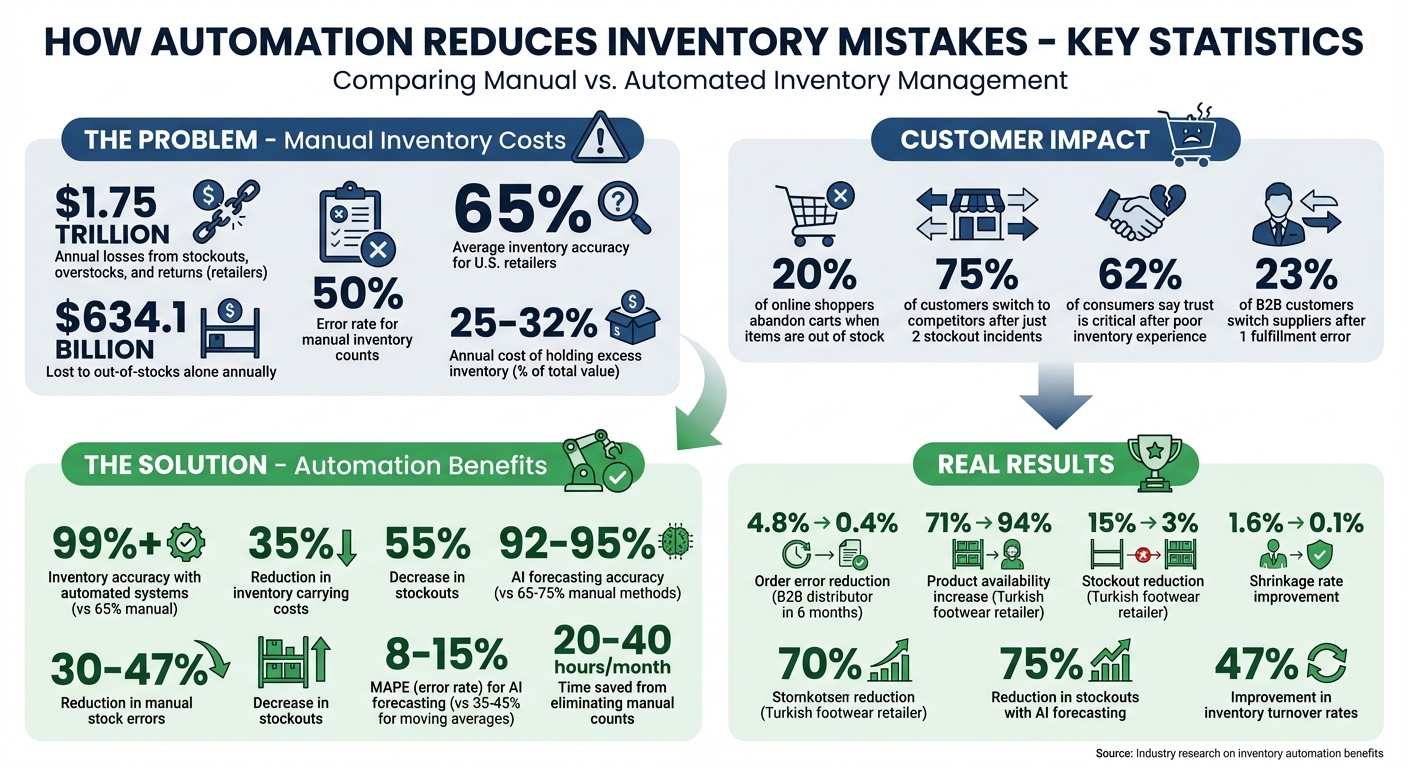
The Financial Impact of Manual vs Automated Inventory Management
Cut Inventory Errors by 67% & Hit 99.5% Accuracy - Here’s How
sbb-itb-f0fc809
Common Manual Inventory Errors and Their Impact
Relying on manual inventory management often leads to recurring mistakes that hurt profits and frustrate customers. One common issue is phantom inventory - when records show stock that doesn’t actually exist. This can happen due to misplacement, theft, or poor documentation. On the flip side, there’s the problem of ghost items, where products are physically in the warehouse but never logged into the system. This often occurs when deliveries or returns are overlooked during data entry.
Another headache is the location labyrinth, where an item’s recorded storage location doesn’t match its actual position. Employees then waste 5–8 minutes searching for misplaced items. Quantity mismatches occur when physical counts don’t align with system records, often caused by data entry errors. SKU duplication adds further confusion, with identical products listed under different identifiers in purchasing and sales systems. And let’s not forget mispicks and misships, where staff either grab the wrong item or send it to the wrong address - leading to unnecessary returns and unhappy customers.
These errors disrupt operations and can drain significant financial resources.
Financial and Operational Costs of Inventory Errors
Inventory mistakes don’t just complicate operations - they’re expensive. Retailers lose $1.75 trillion annually due to stockouts, overstocks, and preventable returns. Out-of-stocks alone account for $634.1 billion of those losses each year. When phantom inventory results in unfulfilled orders, cancellations not only cost sales but may also lead to penalties from marketplaces. On top of that, 20% of online shoppers abandon their carts if an item is out of stock, and 75% of customers will turn to competitors after just two stockout incidents.
Overstocking is no better. Holding excess inventory costs businesses 25% to 32% of its total value annually due to storage fees, insurance, and tied-up capital. Many companies try to compensate for bad data by keeping 30% more inventory than necessary, tying up cash flow without improving customer service. The average U.S. retailer operates with just 65% inventory accuracy.
Customer trust also takes a hit. 62% of consumers say trust is critical after a poor inventory experience, while 23% of B2B customers will switch suppliers after just one fulfillment error.
Why Manual Processes Lead to Mistakes
Human error is a major weakness of manual systems. Error rates for manual inventory counts can reach 50%, meaning there’s almost a coin flip’s chance of getting it wrong. Simple mistakes - like transposing "150" to "510" or failing to save updates - can snowball into major stockouts or overstocking issues.
Manual updates often lag behind real-time warehouse activity, creating discrepancies between physical inventory and system records. When businesses rely on disconnected spreadsheets to manage multiple sales channels, overselling becomes a common problem. Additionally, accuracy tends to decline with repetitive tasks - by the time employees are on their hundredth count of the day, mistakes are far more likely. Instead of addressing root causes like theft or receiving errors, manual adjustments often just "patch the numbers", leaving underlying issues unresolved.
"In 2026, where platforms like Amazon penalize cancellations instantly... operating at 65% accuracy is a problem that manages you, not one you manage." – Linnworks
Without automation to catch and correct these errors, businesses remain stuck in a cycle of inefficiency and financial risk. Automated systems offer a clear solution to these challenges.
How Automation Eliminates Inventory Errors
Automation tackles the most error-prone, human-dependent tasks, slashing error rates significantly - by as much as 30%–47% - and boosting accuracy to an impressive 99.9% in some cases. It also speeds up decision-making, cutting timelines from weeks to mere hours. Take the example of a B2B distributor: after implementing an AI-powered order validation system, they reduced order errors from 4.8% to just 0.4% in only six months. These advancements pave the way for real-time tracking, automated reordering, and centralized data management.
Real-Time Inventory Tracking
Automated systems use tools like IoT devices, RFID tags, and smart sensors to keep tabs on inventory movement in real time. Every transaction updates the inventory system instantly, ensuring that the recorded stock matches what's physically available. AI adds another layer by identifying anomalies, such as unexpected spikes or shrinkage, reducing shrinkage rates to below 0.1%, compared to the industry standard of 1.6%. For Shopify sellers, platforms like Forstock offer a unified dashboard that syncs stock levels across all channels, eliminating overselling caused by disconnected systems.
Automated Reordering and Restocking
Automation simplifies restocking by setting predefined reorder points based on factors like sales trends, lead times, and safety stock levels. When inventory hits these thresholds, purchase orders are automatically generated. This eliminates guesswork, ensuring the right balance between stockouts and overstocking. For instance, Zara uses this strategy to restock high-demand items twice a week. Similarly, a Turkish footwear retailer saw product availability jump from 71% to 94% and reduced stockouts from 15% to 3% after adopting AI-driven inventory management.
Centralized Data Management
By replacing manual entries with automated systems, centralized data management brings order to inventory control. Instead of scattered spreadsheets that lead to SKU duplication and mismatches, these systems consolidate all inventory data into a single, unified source. This ensures real-time synchronization across multiple sales channels and warehouse locations, cutting down on data entry errors. For businesses with complex operations, Forstock’s Shopify integration offers a clear view of stock levels while simplifying supplier communication and purchase order tracking - tying together all the error-reduction benefits.
Better Demand Forecasting with Automation
Automation isn't just about cutting errors - it’s also a game-changer for smarter inventory management. At its core, accurate demand forecasting ensures inventory decisions are made with precision. While tools like real-time tracking and automated reordering tackle execution issues, AI-powered forecasting focuses on planning accuracy, addressing potential problems before they even surface. By integrating multiple data points, automated systems can predict future demand with remarkable precision.
Data-Driven Predictions
AI forecasting pipelines use advanced models such as XGBoost, Prophet, and neural networks to deliver highly accurate predictions. These systems analyze two key data streams: internal factors (like sales history, promotion schedules, and return rates) and external signals (such as weather patterns, economic trends, social media activity, and competitor moves). The result? A Mean Absolute Percentage Error (MAPE) of just 8–15%, compared to the 35–45% range typical of older moving average methods.
One standout feature is the ability to calculate stockout-adjusted demand. This accounts for lost sales caused by out-of-stock items, ensuring future forecasts aren’t skewed by past inventory gaps. Forecasts are broken down to granular levels - by SKU, location, and even day - and include confidence intervals and anomaly detection to flag unusual trends for review.
As AgileSoftLabs highlights:
"AI delivers 92–95% accuracy vs. 65–75% for manual methods. Processes 50+ variables real-time... while spreadsheets handle only 3–5 basic factors".
This level of precision leads to significant results, with businesses reporting a 75% drop in stockouts and a 47% improvement in inventory turnover rates.
| Method | MAPE (Lower is Better) | Best For |
|---|---|---|
| Moving average | 35–45% | Stable demand only |
| Exponential smoothing | 25–35% | Trending products |
| ARIMA | 20–30% | Seasonal patterns |
| ML ensemble | 10–18% | Complex demand |
| ML + external signals | 8–15% | All demand scenarios |
(Source:)
Adjusting to Sales Trends and Seasonality
AI-driven systems don’t just forecast demand - they adapt to it in real time. Instead of relying on static, monthly updates, these tools continuously re-forecast, ensuring procurement decisions stay in sync with changing conditions [23, 24]. AI can even detect demand spikes or seasonal trends up to six weeks earlier than traditional methods.
For seasonal businesses, this adaptability is a game-changer. Automated tools identify multi-year patterns and proactively adjust reorder points and safety stock levels by 25–40% ahead of peak seasons. Take Velocity Vehicle Care as an example: managing over 400 SKUs with peak demand from October to December, they integrated AI forecasting with their ERP system. The result? A 98% fill rate, a 10% improvement in order fulfillment, and no more cash flow issues from overstocking.
Dynamic safety stock calculations further enhance efficiency, adjusting daily based on demand fluctuations and forecast confidence. This reduces excess inventory by 18–28%. For Shopify brands, tools like Forstock use these AI models to adapt automatically to sales trends, lead times, and seasonality. This provides 12-month demand visibility, fewer forecasting errors, and better cash flow management. By aligning inventory with actual customer demand, automation proves itself as an essential part of modern inventory planning.
Automation for Multi-Channel and Multi-Location Operations
Managing a business that spans multiple sales channels and physical locations generates a mountain of inventory data. Relying on manual updates often leads to overselling, stockouts, and unhappy customers. In fact, retailers lose close to $1 trillion annually due to these issues. Automation steps in to reduce manual errors and streamline operations, ensuring inventory accuracy across all channels and locations. Let’s dive into how this works.
Unified Inventory Tracking
Automated systems solve the problem of disconnected data by integrating inventory from all sales channels into a single, centralized dashboard. Unlike manual or single-channel updates, these systems synchronize inventory in real time. For example, when a customer places an order, the system immediately adjusts stock levels across all platforms, preventing overselling.
What’s more, advanced systems go beyond just updating totals. They track inventory by individual location - whether a warehouse or store - and categorize stock into "available", "reserved", "incoming", and "committed" statuses. This ensures that items already reserved for pending orders don’t accidentally get sold elsewhere. As Bhoomi Singh from Sumtracker explains:
"Real-time inventory isn't just about fast updates. It's about accuracy at the moment a decision is made."
For Shopify brands, this unified inventory view simplifies fulfillment. Orders can be fulfilled from any location, cutting down on manual allocation and saving an average of 10 hours per month on inventory management. Alexandra McNab, COO of Bared Footwear, highlights this advantage:
"These fulfillment options wouldn't be possible if our store inventory, orders, and checkout wasn't linked to our online store checkout like it is with Shopify."
Beyond streamlining sales channels, automation also improves how businesses interact with their suppliers.
Simplified Supplier Coordination
Automation makes supplier management much easier. Systems can automatically generate purchase orders and send low-stock alerts as soon as inventory dips below a certain threshold.
For example, brands using Forstock benefit from centralized supplier communication. This platform stores all vendor details, lead times, and order histories in one place. It even calculates reorder points by factoring in supplier lead times and seasonal demand, removing the guesswork. IZIMINI, a children’s brand, once struggled with manual Excel tracking, which often led to stockouts. After adopting automated inventory management with real-time analytics, the brand saw 70% year-over-year growth by consolidating inventory across all channels.
Automation doesn’t just save time; it also frees up capital. AI-powered systems can reduce inventory levels by 20% to 30%. In more advanced setups, some retailers even use Vendor Managed Inventory (VMI) systems, sharing real-time data with suppliers. This allows suppliers to take over stock optimization and replenishment, further streamlining operations.
Improved Financial Accuracy Through Automation
Integrating inventory systems with accounting software keeps financial records precise. Real-time synchronization ensures that every sale, return, or stock adjustment is instantly reflected in financial records, eliminating the delays and errors tied to manual updates across disconnected platforms. This seamless data flow guarantees that financial reports align perfectly with inventory events.
A key advantage of automation is three-way matching. This process compares purchase orders, goods received notes, and vendor invoices before payments are processed. By catching discrepancies early, businesses prevent unnecessary payouts and ensure their financial records match the goods received. For Shopify brands using Forstock, this integration means that Cost of Goods Sold (COGS) and inventory valuations update automatically, keeping profit and loss statements aligned with real-time asset values.
Automation also simplifies reconciliation. Instead of waiting for monthly audits, automated systems flag inconsistencies as they happen. For example, in December 2025, Broonson International transitioned from manual spreadsheet reconciliation to an automated system, saving over eight hours per week while reducing errors and duplicate entries. Similarly, fashion retailer Rebecca Minkoff adopted RFID technology to track inventory, achieving 99% accuracy and nearly eliminating phantom inventory issues.
Oak + Fort provides another compelling example. By implementing a unified retail operating system in 2025, they freed up 50 hours of labor per week and cut operating costs by 47%. Guillaume Jaillet, their Chief Omnichannel Officer, highlighted how the system improved the accuracy of store stock levels for online customers. Adam Besheer, Co-founder of Greenery Unlimited, emphasized the importance of clean data, saying:
"Clean inventory numbers help us not only replenish our existing stock as needed but allow us to make more accurate predictions on how and when to replenish our inventory".
Tax compliance also becomes more straightforward with integrated systems. These platforms automatically apply the correct tax rates, record credit and debit notes, and prefill tax reports, reducing the likelihood of errors in filings. With inventory accuracy averaging 91% for top performers but dropping to just 67% in manual setups, automation provides finance teams with a reliable, unified source of truth for accurate reporting and compliance.
Conclusion
Manual inventory management has some major downsides. It eats up time, ties up working capital, and racks up unnecessary costs. Automation steps in to solve these issues with real-time tracking, AI-powered forecasting, and centralized data management, boosting accuracy to an impressive 99% or more - far above the 65% average for manual systems. Retailers lose a staggering $1.75 trillion annually due to stockouts, overstocks, and returns, with individual manual errors costing as much as $100.
Switching to automation provides real, measurable benefits. Businesses using AI-based systems report a 30% to 47% reduction in manual stock errors, cut carrying costs by up to 35%, and experience stockouts dropping by 55%. Real-time dashboards eliminate the need for tedious manual stock counts and spreadsheet updates, saving 20 to 40 hours per month - time that can be redirected to strategic planning. Automated reordering ensures accurate purchase orders as soon as stock hits predefined levels, avoiding delays and costly mistakes.
For Shopify brands, Forstock offers a powerful solution. This platform provides AI-driven forecasting tailored to sales trends, lead times, and seasonal changes, delivering 12-month demand plans to help businesses grow without cash flow issues. Starting at just $79 per month with a 14-day free trial, Forstock brings advanced inventory management tools to businesses of all sizes.
To fully benefit from automation, start with clean, accurate data. Audit and standardize product and supplier details before making the switch. Set up reorder rules, configure supplier profiles with lead times, and enable low-stock alerts to avoid surprises. By automating repetitive tasks and gaining real-time visibility, businesses can move away from error-prone manual processes and toward a system that supports scaling, better cash flow, and meeting customer demand without costly setbacks.
FAQs
What’s the fastest way to spot phantom inventory and ghost items?
The fastest way to spot phantom inventory and ghost items is by using AI-powered tools. These tools compare system records with actual physical stock, flagging any discrepancies. By identifying mismatches quickly, retailers can correct errors, boost inventory accuracy, and minimize mistakes.
How do I set reorder points that avoid both stockouts and overstock?
To keep shelves stocked without overloading inventory, use this formula to calculate reorder points: Reorder Point = (Average Daily Sales × Lead Time) + Safety Stock. Accurate data is key - track your daily sales, lead times, and safety stock levels to determine the right reorder points for each product.
Tools like Forstock can simplify this process. These AI-powered solutions automatically adjust reorder points by analyzing real-time trends, seasonal patterns, and supplier performance, helping you maintain better accuracy and streamline operations.
What data should I clean before automating inventory in Shopify with Forstock?
Before diving into automating inventory on Shopify with Forstock, it's crucial to start with clean and accurate data. Take the time to standardize your historical sales records, supplier lead times, stock levels, and event-related data. Be sure to eliminate any errors, duplicates, or inconsistencies, and ensure uniformity in formats - things like units, dates, and supplier details should align. This groundwork helps ensure that AI-driven forecasting and automation operate smoothly, minimizing errors and boosting inventory precision.
Keep reading
Try Forstock free for 14 days.
AI-powered demand forecasting and reorder automation for Shopify brands. No credit card required.