
How AI Enhances Cloud Inventory Systems
AI improves cloud inventory with SKU-level forecasts, automated replenishment, lower carrying costs, and fast ROI.
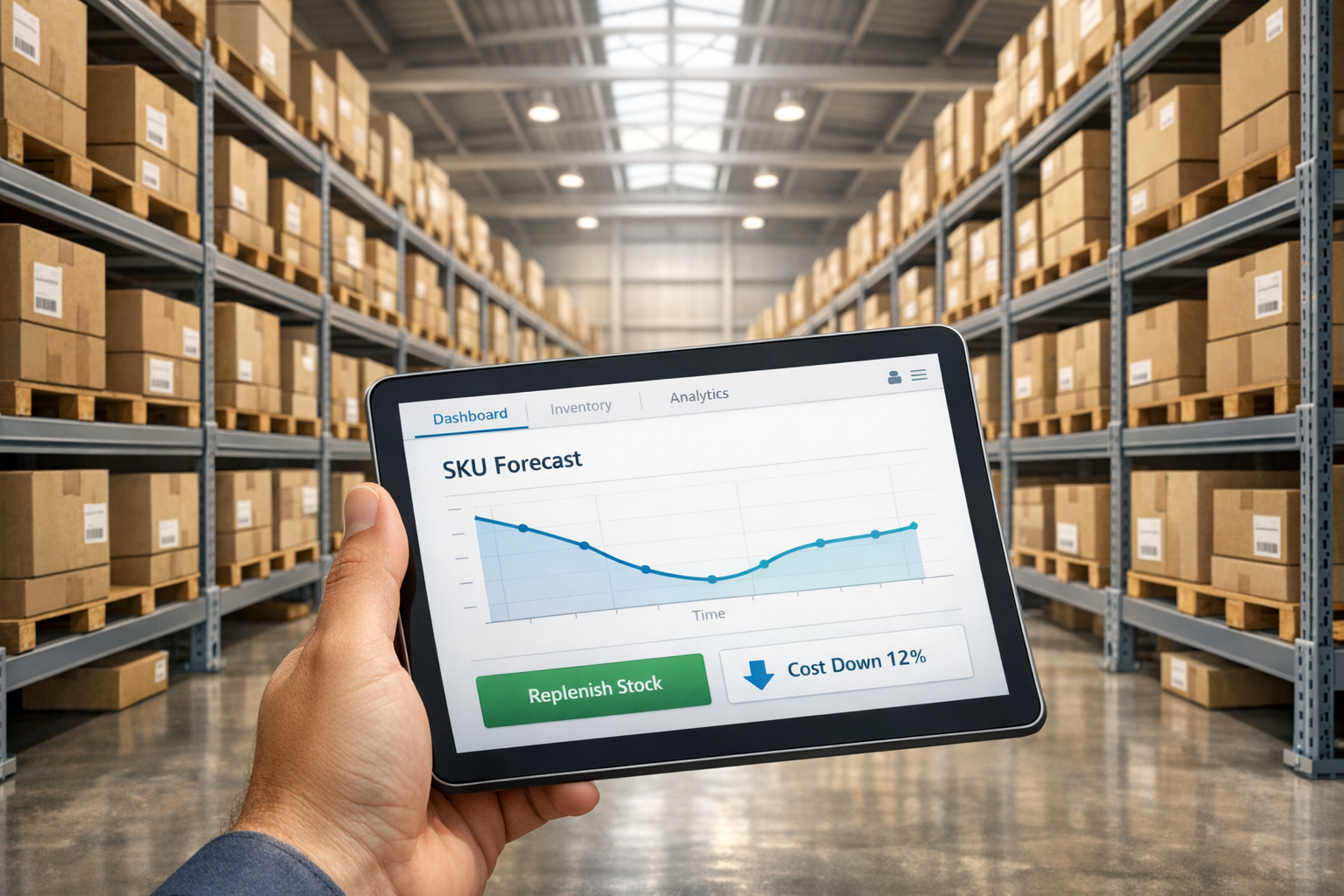
How AI Enhances Cloud Inventory Systems
AI-driven inventory systems are transforming how businesses manage stock. Here's why they matter:
- Better Forecasting: AI analyzes real-time data like sales trends, weather, and social media to predict demand with 85–92% accuracy, compared to 55–65% for manual methods.
- Reduced Costs: Companies report 15–25% lower carrying costs and 30–50% fewer stockouts.
- Time Savings: Automating tasks like reorder calculations and purchase orders saves up to 80% of forecasting time.
- Scalability: AI handles complex inventory needs across multiple warehouses and thousands of SKUs effortlessly.
Businesses using AI see faster inventory turnover, fewer stockouts, and improved cash flow. Implementing these systems typically takes 10–14 weeks and delivers ROI within 3–6 months for companies managing over $5M in inventory. The shift to AI is no longer optional - it's essential for staying competitive in 2026.
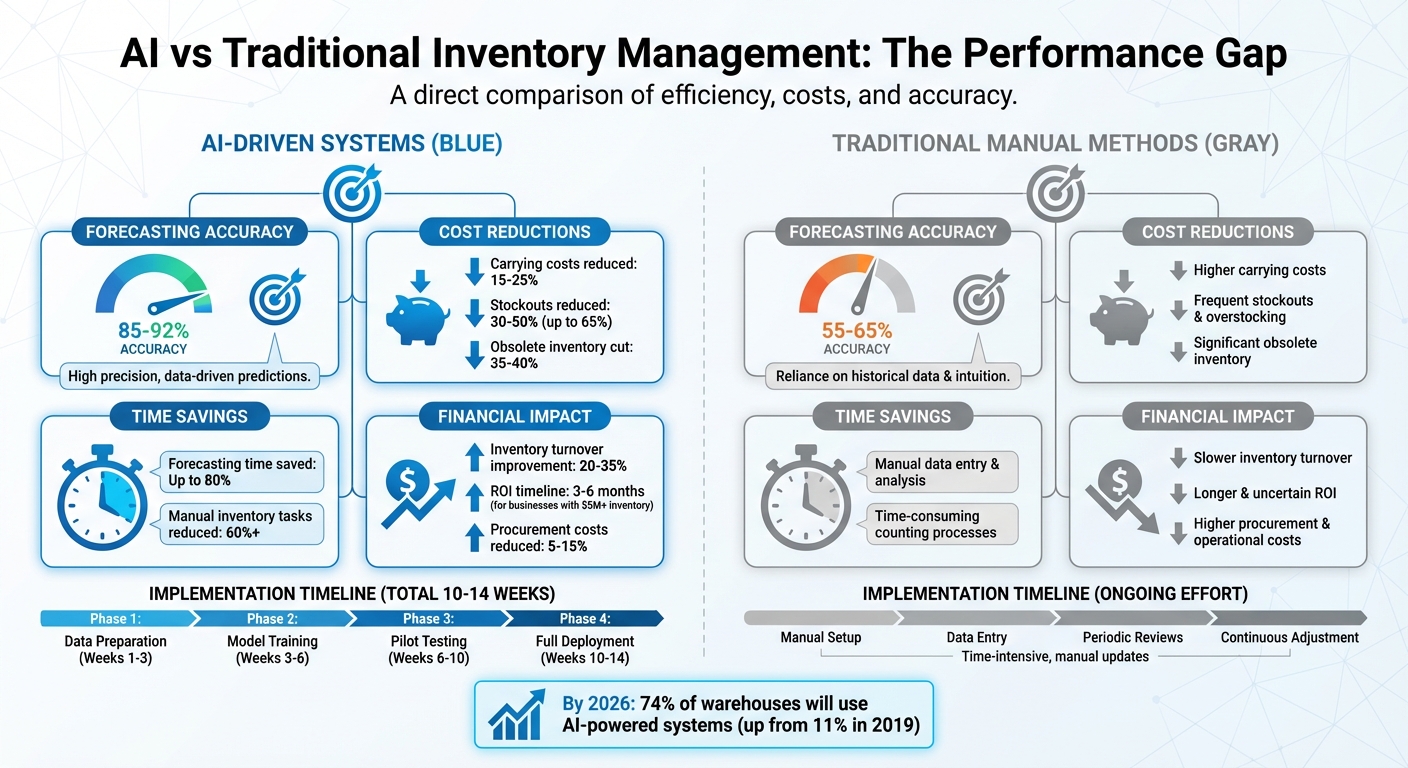
AI vs Traditional Inventory Management: Key Performance Metrics Comparison
AI in Action: How AI Transforms Inventory Management
This video demonstrates how AI powers real-time inventory monitoring to eliminate manual tracking errors.
sbb-itb-f0fc809
AI Features That Improve Demand Forecasting
AI-powered forecasting models analyze a variety of factors that traditional methods simply can't handle. These advanced algorithms uncover patterns in historical sales data that might escape human observation, linking variables like weather conditions, competitor pricing, and social media activity. The result? Forecasts that are far more precise than those produced by older techniques.
How AI Forecasting Models Work
Modern AI models take forecasting to the next level by predicting demand at the SKU level. This means they don't just estimate overall product demand - they break it down to specific product variations, like the exact number of units needed for a particular size or color. This level of precision eliminates the guesswork of general estimates.
These algorithms account for a range of factors simultaneously, including seasonality (weekly, monthly, yearly), price sensitivity, marketing campaigns, and even broader economic trends. What’s more, they continuously improve their predictions through ongoing learning.
For new products, AI relies on data from similar items and pre-order trends to make informed estimates. When it comes to promotions, these models can predict both the initial sales spike and the subsequent drop, adjusting forecasts for related products accordingly. The key to their effectiveness lies in their ability to integrate real-time data for constant refinement.
Why Real-Time Data Matters
Static forecasts quickly fall behind in today’s fast-moving markets. AI models thrive on real-time data, enabling them to adapt instantly to sudden shifts - be it a viral social media post, unexpected competitor moves, or supply chain hiccups. This adaptability is especially vital in 2026, as demand becomes increasingly volatile due to external factors, making traditional inventory methods outdated.
The benefits are clear. Businesses using AI forecasting have reported 20–30% reductions in inventory holding costs and 15–25% fewer stockouts. AI also helps cut obsolete inventory by 35–40%, thanks to its ability to predict product lifecycles more accurately. These gains come from the system's capacity to process real-time inputs and continuously optimize stock levels.
This real-time responsiveness forms the backbone of effective predictive analytics.
Making Better Decisions With Predictive Analytics
By building on accurate, up-to-the-minute forecasts, predictive analytics takes inventory management to the next level. It calculates dynamic safety stock levels tailored to each product’s demand variability and supplier reliability, moving away from outdated, one-size-fits-all percentages. For products with irregular or unpredictable demand - where traditional methods often fail - AI ensures service levels are maintained while using 20–30% less inventory overall.
The automation doesn’t stop there. AI systems also streamline purchase order generation by calculating the exact stock needed based on forecasted demand and safety stock, minus current and in-transit inventory. Orders are created automatically, eliminating the errors and delays common in manual processes.
The results? Companies typically see a 20–35% boost in inventory turnover after implementing these systems. For businesses managing over $5 million in inventory, the return on investment often comes within just 3–6 months. That’s efficiency and cost savings rolled into one powerful solution.
How to Implement AI-Driven Stock Management
Switching to an AI-powered inventory system typically unfolds over 10–14 weeks, divided into four phases: data preparation (weeks 1–3), model training (weeks 3–6), pilot testing (weeks 6–10), and full deployment (weeks 10–14). Start by gathering at least 24 months of normalized sales data, making adjustments for irregularities like pandemic-related spikes or unusual bulk orders.
It’s also crucial to flag instances of lost sales - cases where zero sales occurred due to stockouts rather than lack of demand. This ensures the AI system can accurately estimate demand. During the pilot phase, run AI-generated recommendations alongside your current manual methods. This parallel testing helps confirm improvements in stock availability and cost management. These steps are essential for transitioning to automated replenishment while minimizing manual oversight.
Setting Up Automated Stock Replenishment
AI simplifies stock calculations by using this formula: (Forecasted Demand + Safety Stock) - (Current Stock + In-Transit Stock). This process runs automatically for every SKU, factoring in supplier lead times and your review period. Unlike static formulas like Economic Order Quantity, which assume steady demand, AI dynamically adjusts based on real-time data.
The system also incorporates supplier-specific constraints such as minimum order quantities, bulk pricing tiers, and varying lead times to generate orders that meet these requirements. Integration with platforms like ERP or Shopify streamlines restocking, eliminating manual processes. Once replenishment becomes automated, centralizing supplier data becomes a priority for efficient management.
Managing Suppliers From One Platform
Bringing together internal data - like sales and inventory - with supplier reports and logistics into a single cloud-based system creates a single source of truth. This unified platform allows you to monitor supplier performance, track lead times, and oversee transportation logistics in real time. Instead of reacting to delays, you can identify potential disruptions early and adjust your procurement plans accordingly.
Some advanced platforms connect thousands of businesses - some networks include over 90,000 organizations - providing unmatched visibility across the supply chain. This integration supports "planning collaboration", enabling you to understand not only what changed but also why it changed, with insights into supplier decisions. Companies leveraging AI forecasting through centralized systems have reported cutting procurement costs by 5% to 15% and reducing lost sales due to stockouts by up to 65%.
Tracking and Adjusting Your Inventory Strategy
AI-driven forecasting provides precise data, but regular reviews are key. Weekly, assess AI recommendations to identify trends and act on them. AI doesn’t just issue generic "low stock" alerts - it provides detailed insights, such as days of inventory left and projected stockout dates. This shift from reactive to proactive planning is a game changer.
Every month, track critical metrics like stockout rates, inventory turnover, carrying costs, and forecast accuracy. Allow the AI system 2 to 3 months to refine its predictions before evaluating its long-term effectiveness, as its accuracy improves with more data. For a business holding $500,000 in inventory, improving forecast accuracy by 20% can translate into significant savings in both carrying costs and lost sales.
Modern AI tools also let you ask straightforward questions like, "What products haven’t sold in the last 30 days?" to get instant, actionable insights without manual reporting. These insights help identify slow-moving inventory early, enabling strategies like price adjustments or bundling. AI can also support inventory balancing across multiple warehouses or sales channels, ensuring stock is where it’s needed most - especially during marketing campaigns that drive regional demand.
Forstock's AI Features for Shopify Stores
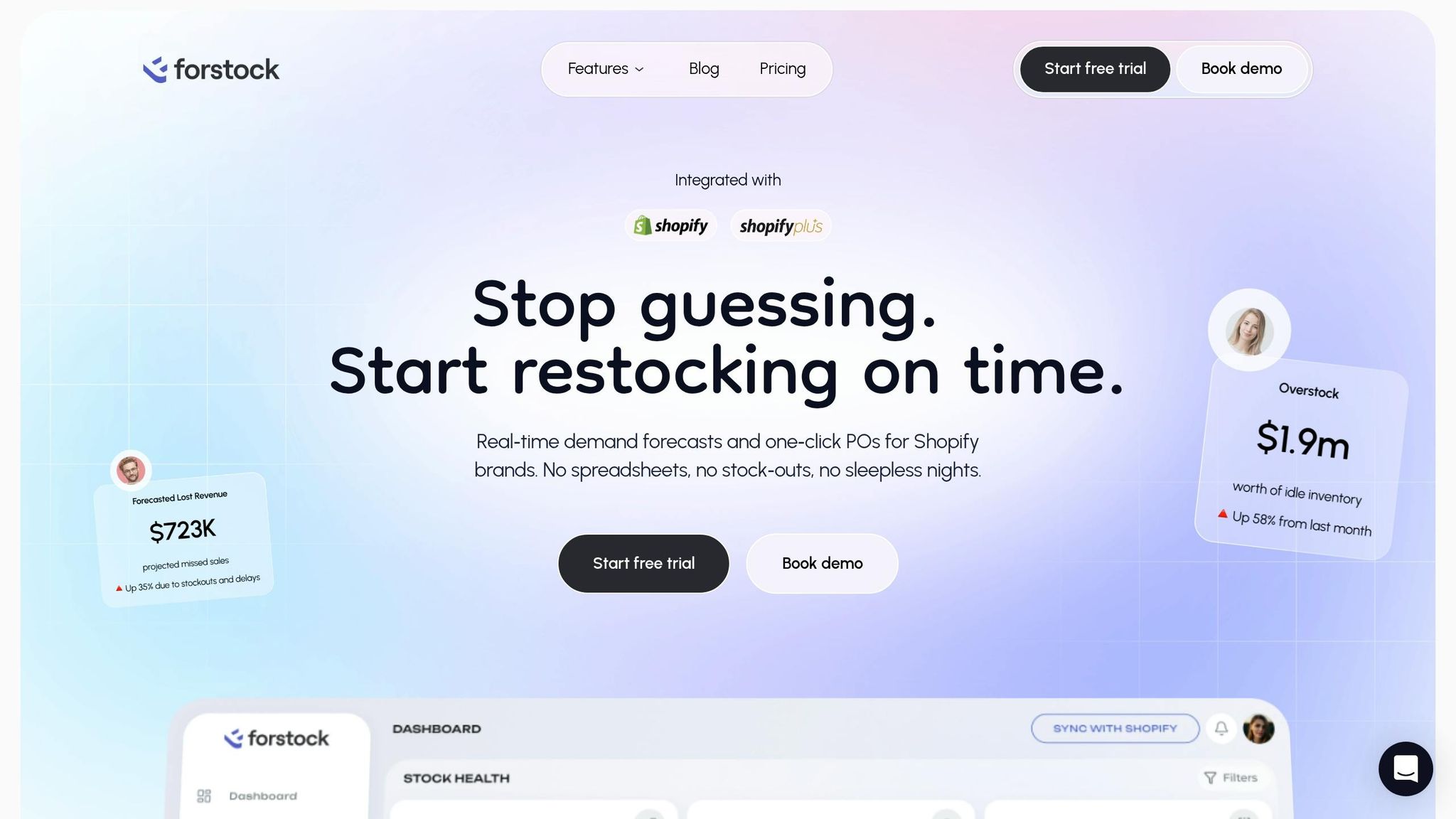
Forstock integrates AI-driven inventory management directly into Shopify, syncing seamlessly with your store's data for immediate use. By analyzing historical sales trends, seasonal shifts, and growth patterns, the platform delivers accurate and dynamic demand forecasts. This ensures Shopify brands can make inventory decisions that keep pace with ever-changing market conditions.
AI-Powered Demand Forecasting
Forstock's AI system calculates real-time sales velocity and lead times, pinpointing exactly when and how much stock to reorder. Its Reorder Table highlights products at the highest risk of running out or those with the shortest days of stock remaining. Additionally, Stock Health indicators like "Stock Gap" and "Running Low" provide instant alerts for SKUs that need immediate attention.
"The AI predictions are incredibly accurate... preventing stockouts that were costing us $50,000 monthly."
- Jason, Co-founder at HomeGoods
Thanks to Forstock, Jason's team reduced excess inventory by 45% and unlocked reduced excess inventory by 45% and unlocked $150,000 in working capital50,000 in working capital.
Automatic Purchase Order Generation
Forstock simplifies the purchasing process by automatically generating purchase orders, factoring in shipping, customs, and other costs to offer a complete view of total spending. This automation eliminates delays, ensuring stock replenishment happens without manual bottlenecks. The platform also syncs directly with Shopify, streamlining the entire process from order creation to delivery.
"The automated PO creation saves us 10+ hours weekly. Setup was seamless - just 2 minutes!"
- Alexander, E-commerce Manager at PureOrganics
"We can create POs in minutes, track supplier performance, and forecast demand without the guesswork."
- Daniel, Supply Chain Manager
On average, brands have reduced manual inventory tasks by over 60% using Forstock.
Centralized Inventory Dashboard
The platform's unified dashboard consolidates Shopify listings, orders, and inventory data into a single real-time interface. This dashboard provides a clear view of inventory health, stock value, and supplier performance, while managing the entire lifecycle of purchase orders in one place. It offers brands a streamlined way to monitor and act on inventory needs.
"I open the dashboard in the morning and instantly know what needs reordering, what is overstocked, and what to focus on."
- Emily, Inventory Manager
With integrated 12-month demand forecasts, businesses can plan for long-term growth and seasonal trends, rather than relying solely on historical data. For example, Matt, Operations Lead at TechGear, used the inventory table to identify over $70,000 in slow-moving stock within just one week of using Forstock.
Measuring AI's Effect on Inventory Performance
To truly understand how AI impacts inventory management, it's crucial to track specific metrics. These numbers reveal whether AI is making smarter purchasing decisions and improving overall efficiency. Key metrics to monitor include inventory turnover, stockout frequency, and carrying costs. Together, these indicators show how effectively your AI system is working.
Important Inventory Metrics to Track
When measuring success, it's important to focus on metrics that directly reflect inventory performance:
- Forecasting accuracy: Use MAPE (Mean Absolute Percentage Error) to measure this. For best-selling products, aim for a MAPE below 20%. Also, check forecast bias, which should be as close to 0% as possible to avoid over- or under-ordering.
- Service level achievement: This shows how often stock is available when customers need it. Strive for service levels above 95% for high-margin products and over 90% for mid-tier items.
- Obsolescence write-offs: AI should help reduce excess stock, especially for slow-moving items, minimizing write-offs due to outdated inventory.
By keeping these metrics in check, you can ensure that AI is delivering measurable improvements.
Examples of AI Success in Inventory Management
Real-world cases highlight the financial benefits of AI in inventory management. For instance, a mid-sized e-commerce business saw annual revenue jump by $1.2M through fewer stockouts and a $700K reduction in average inventory. Their stockout rate dropped by 62%, carrying costs decreased by $175K annually, and obsolescence write-offs were cut by $90K each year.
Different AI models deliver varying results based on complexity:
- Ensemble models: These offer the highest accuracy, improving forecasting by 30–45% compared to traditional methods.
- LSTM (Long Short-Term Memory) models: Ideal for complex patterns, they show 25–40% better accuracy for large SKU catalogs.
- ARIMA (Autoregressive Integrated Moving Average): Simpler but effective for stable, seasonal demand, with a 10–15% accuracy boost.
These examples demonstrate how AI can transform inventory management, leading to both immediate and long-term financial gains.
Long-Term Advantages of Using AI
For businesses with over $5M in inventory value, AI systems often pay for themselves within 3–6 months. Over time, companies typically see a 20–35% improvement in inventory turnover and a 15–25% reduction in carrying costs. This means less capital tied up in stock and more cash available for growth.
Another major advantage is scalability. AI systems reduce the need for additional staff as your business grows. Many merchants report up to 80% time savings on forecasting and planning tasks. This freed-up time allows teams to focus on strategic decisions instead of tedious spreadsheet updates. Plus, as your product catalog expands, AI continues to optimize each SKU based on its unique demand trends and profitability.
The long-term benefits of AI go far beyond cost savings - they include improved efficiency, better resource allocation, and a stronger foundation for future growth.
Conclusion
AI-powered inventory systems are transforming the way businesses manage stock, shifting from reactive approaches to predictive strategies. These systems adapt in real time, taking into account factors like weather patterns and social media trends. The results speak for themselves: forecasting accuracy climbs to 85–95%, compared to just 60–70% with older methods, and stockouts drop by as much as 65%.
The financial benefits are equally striking. Companies often achieve a 300–400% return on investment within 2–3 years. For businesses holding over $5 million in inventory, the break-even point can be as quick as 3–6 months. Beyond cost savings, AI reduces overstock by up to 35%, freeing up significant working capital that can be reinvested in growth opportunities.
Momentum in the industry is building fast. By 2026, 97% of retailers plan to boost their AI investments, and the market for AI inventory management is expected to hit $33 billion by 2030. Gartner highlights this shift, noting that "74% of warehouses will use AI-powered systems by 2026, up from just 11% in 2019". This isn’t a distant possibility - it’s already underway. As AI continues to evolve, it’s set to redefine operational autonomy across industries.
What's Next for AI in E-Commerce Inventory
The next wave of AI integration promises even more advanced automation and precision. Future systems will handle supplier negotiations, mitigate supply chain disruptions, and seamlessly balance inventory across multiple sales channels. These tools will connect with broader business intelligence platforms, linking real-time inventory data with CRM systems, marketing tools, and financial planning software.
For Shopify merchants, this advancement means tools that can optimize inventory based on local preferences, predict supplier issues before they arise, and integrate dynamic pricing to balance stock levels and pricing strategies. As AI systems learn and refine through feedback loops, businesses could see accuracy improve by another 5–10% within the first year. The question isn’t whether to adopt AI - it’s how quickly you can implement it to maintain a competitive edge.
FAQs
What data do I need to start AI forecasting?
To kick off AI forecasting for inventory management, the first step is collecting relevant data. This includes historical sales records, supplier lead times, and seasonal trends. These elements form the foundation for accurate predictions.
Key data inputs to focus on:
- Past sales patterns: Look at how products have sold over time to identify trends.
- Supplier performance metrics: Evaluate supplier reliability, delivery times, and consistency.
- External factors: Consider the impact of promotions, market trends, or other external influences.
- Real-time updates: Incorporate live sales data and current inventory levels for more dynamic and responsive forecasting.
By feeding this information into AI models, businesses can fine-tune their forecasts, automate decision-making, and reduce the risk of stockouts or excess inventory.
How does AI set safety stock for each SKU?
AI calculates safety stock for each SKU by examining demand patterns, supplier performance, and external factors. It continuously updates reorder points and stock levels in real time, helping to reduce the chances of running out of stock or overstocking. This approach keeps inventory levels well-balanced and efficient.
How do I measure ROI after switching to AI?
To gauge ROI after implementing AI, zero in on metrics that reflect tangible benefits, like productivity boosts, cost savings, and fewer stockouts or overstock situations. Stick to 2–3 key KPIs that align with your objectives - whether that's trimming expenses or driving revenue growth. For inventory management, AI tools like Forstock can help measure advancements in demand forecasting and stock control, which directly influence both revenue and operational efficiency. Keep a close eye on these metrics regularly to evaluate the impact AI is making.
Keep reading
Try Forstock free for 14 days.
AI-powered demand forecasting and reorder automation for Shopify brands. No credit card required.